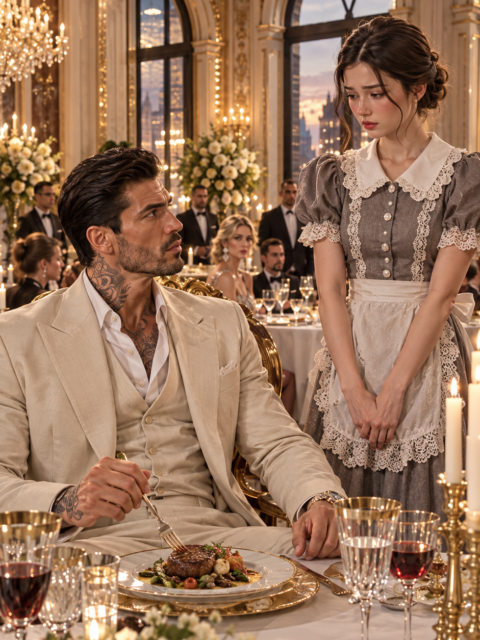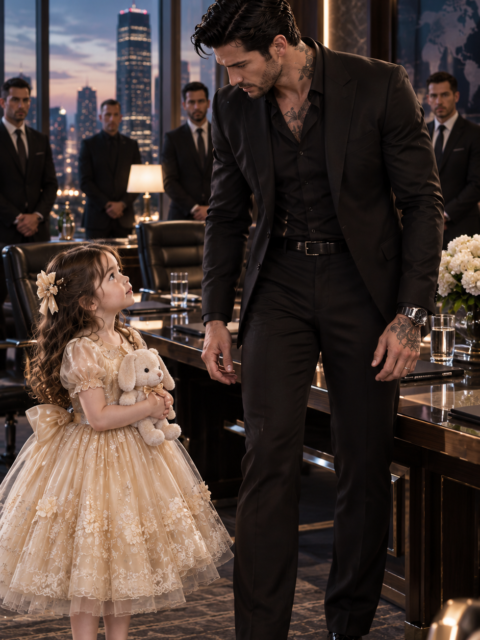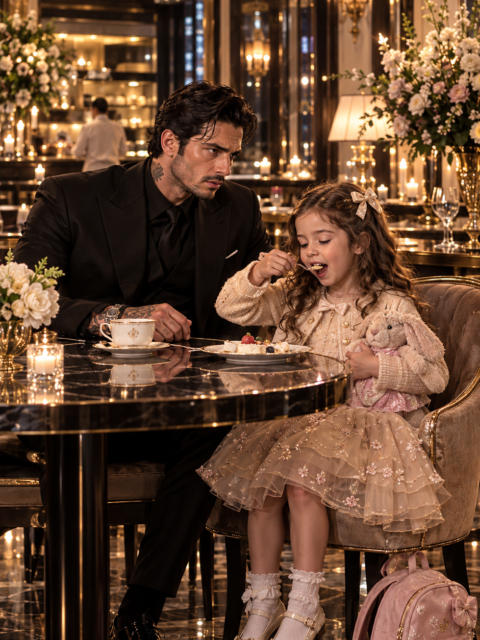
“Are You the Grumpy Giant?” A Mafia Heir Found a Little Girl Under His Staircase on Christmas Eve — Then She Held Up a Photograph of the Woman Who Vanished Four Years Ago
I’m Dominic Moretti, thirty-eight, and I had enough enemies that grown men knew better than to stare at me. At 10:17 on Christmas Eve, in the middle of my own engagement party, a three-year-old in a ruby-red dress offered me half a cookie to fix my face. Then she turned a photograph around. It was the only woman I had ever loved, and my mother went white as paper. Read every chapter to find out what Victoria Moretti did four years ago, and why her granddaughter had been told never to say where she lived.
The Grumpy Giant
“Tell me the truth, Mother. Is that little girl mine?”
For the first time in my life, Victoria Moretti looked afraid. Her eyes dropped to the photograph in my hand, then slid toward the tiny girl standing in the study doorway. Three years old. Chestnut curls. Huge brown-hazel eyes. Sophia’s eyes. My chest tightened until I could barely breathe around it.
“What did you do to her?”
But twenty minutes earlier, I had not known the child existed.
It was 10:17 on Christmas Eve, and two hundred guests were celebrating my engagement inside my Long Island estate. I was supposed to be happy. A string quartet played beside the fireplace, champagne flowed beneath six thousand white lights, and across the ballroom stood my fiancée, Isabella Vitale, elegant in champagne silk at my mother’s side. It was the perfect life everyone expected me to want. Instead, I had slipped out of my own party to stand alone in the front hall, and that was where I found a little girl hiding beneath my staircase.
“Are you the grumpy giant?”
I looked down. She wore a cream cardigan over a ruby-red princess dress, and one tiny shoe swung above the floor. Her thick chestnut curls were pinned aside with a satin bow. She regarded me with grave interest, the way a person might regard a suspicious Christmas ornament, and then she offered me half a cookie.
“You can have this. Maybe it’ll fix your face.”
I almost smiled. Almost.
My name is Dominic Moretti. I am thirty-eight years old, six-foot-four, with broad shoulders and tattooed hands, and I have enough enemies that grown men learn not to stare. This child stared at me with an expression of scientific curiosity, and swung her foot.
“What’s your name?” I asked.
“Lily.”
“Why are you under my staircase, Lily?”
“Waiting. For my mommy.”
I should have called for security. Instead I lowered myself onto the bottom stair, and the music from the ballroom drifted out into the hall. Four years earlier, I had wanted someone else. Sophia Carter, a pastry chef at my restaurant on Mulberry Street, the only woman I had ever loved, and the woman who vanished one morning without saying goodbye. I had searched for six months. Hospitals, apartments, employment records, airports, people I had no business questioning. Nothing. Eventually I accepted the obvious: that Sophia had looked at what loving Dominic Moretti meant, and run.
“Mr. Giant?” Lily tugged my sleeve. “You stopped listening.”
“I was thinking.”
“You looked sad.”
“I don’t look sad.”
She studied me solemnly. “Okay. Angry-sad.”
That was when I noticed the photograph clutched against her chest.
“What’s that?” “Mine.” “I’m not going to take it.” Her eyes narrowed. “Promise?” “Promise.” Slowly, with great ceremony, she turned it around.
The room disappeared. It was Sophia, chestnut hair over one shoulder, wearing that familiar smile I had spent four years trying to forget, and the three-year-old beside me said calmly, “That’s Mommy.”
Back to top ↑
Our House
My gaze snapped to her face. Those eyes. Those curls. The shape of her nose, which I had once traced with my thumb at three in the morning in an apartment above a bakery. “How old are you, Lily?”
She raised four fingers proudly, frowned, and pushed one down. “Three. But almost more.”
Footsteps approached across the marble. My mother stopped beside me. Victoria Moretti has faced arrests, betrayals, and deaths without blinking, and I have never once seen her lose her composure. But when her eyes landed on the photograph, every drop of color left her face. “Dominic,” she said, in a voice that was not hers.
I stood. “You know this picture.”
Her silence answered me.
Twenty minutes later I was in my late father’s study with Enzo, my oldest lieutenant, while the party carried on downstairs. I had sent Lily to the kitchen with a maid and a plate of cookies, and I had told my mother to stay in the ballroom and smile. She had obeyed me, which she had never done in her life. Enzo stood by the door with his hands folded and said nothing, because he is a man who knows when to say nothing.
I opened the family safe. Behind the deeds and trusts and financial records sat a thin manila folder that I had never seen. Across the tab, in my mother’s hand, a name: SOPHIA CARTER.
Inside were bank transfers dated exactly four years earlier. A lease for an apartment in Queens. A confidentiality agreement, eleven pages long, and at the bottom, beside Sophia’s signature, my mother’s. My hands went cold, and I read it twice. The undersigned agrees to cease all contact with Dominic Moretti and any member of the Moretti family, and to disclose nothing about her prior association with the family, in perpetuity.
“What the hell did she do?” I said, to no one.
The study door creaked open.
Lily stood on the threshold with a cookie in one hand and her photograph in the other. She had escaped the maid, as she had presumably escaped every adult who ever tried to supervise her. “I wasn’t snooping,” she announced. “I was exploring.”
I opened my mouth to send her back downstairs, but she had spotted the address on the lease. Her face lit up. “That’s our house!”
I froze. She trotted across the Persian rug in her ruby-red dress and tapped the paper with one small finger. “Mommy keeps your picture there too.”
My pulse stopped. “What picture?”
“The one beside her bed.”
Behind me, Enzo slowly turned his head.
Lily smiled innocently up at me and said, with absolute confidence, “Mommy says I’m not supposed to tell Grandma Victoria where we live.”
Back to top ↑
What My Mother Signed
I found my mother in the conservatory, standing by the potted poinsettias with her back to the party and a champagne flute she had not touched. She did not turn around when I came in. She said, in the clear, level voice that had run my family for twenty years, “I wondered how long it would take.”
I had meant to shout. I had imagined it all the way down the corridor, every word I would use. What came out was quiet, and I think it frightened her more. “Tell me the truth, Mother.”
“You were going to destroy this family.” She finally turned. Her eyes were dry. “Your father died owing Anthony Vitale five million dollars, Dominic. Did you know that? You were twenty-eight and grieving, and you were building a restaurant, and you never looked at the books. I looked at them. For three months I looked at nothing else. I found a way to keep this house, and your name, and the lives of every man who works for us. It was a marriage.”
“And Sophia?”
“Sophia Carter made pastry.” She said it the way another woman might have said Sophia Carter stole silver. “She was a lovely girl, and she had no family, and no name, and no idea what she was standing in front of. If you had married her, the Vitales would have taken everything. I offered her two hundred thousand dollars and an apartment, and I told her what it would cost you if she stayed.”
“What did you tell her?”
My mother lifted her chin. “That you had already agreed.”
The conservatory was silent but for the quartet, muffled beyond two sets of glass doors. A string of white lights flickered on the poinsettias. I thought of Sophia in the doorway of my restaurant, flour on her forearm. I thought of every night for four years that I had lain awake and invented reasons that she had left.
“You told her I chose Vitale.”
“I showed her a letter, in your handwriting.” She did not look away. “Mr. Greaves is an excellent forger.”
I do not remember crossing the conservatory. I remember that a pot broke, and that my mother stepped back, and that for the first time in thirty-eight years I saw something in her face that I had never seen there. It was shame. “And the child?” I said, barely above a whisper. “Did you know?”
“No.” It came out too fast, and too raw, and I believed it. “I swear on your father’s grave, Dominic. If I had known, I would never have…” She stopped. Her hand rose to her mouth. “I thought she had taken the money and left.”
From the folder in my hand, a small white envelope slid out and landed on the tile between us. Sophia’s handwriting. It was addressed to me. It had been opened and resealed.
I picked it up. It was dated the day she disappeared. In the corner, in my mother’s hand, was a single line: Do not deliver.
Back to top ↑
The Kitchen
The letter was short. Four years had not faded the ink, and I read it standing in the middle of the conservatory with my mother watching me and two hundred guests laughing beyond the glass.
Dominic. Your mother told me you’d decided. I don’t believe it, and I don’t want to find out I’m wrong. So I’m leaving before you can tell me yourself. I have never loved anyone the way I loved you, and I don’t think I will again. Please be happy. Please be braver than your family. Sophia.
I folded it and put it in the inside pocket of my tuxedo, over my heart, and walked past my mother without a word. I do not think she tried to stop me. I went through the ballroom with my face arranged in a way that I had learned over thirty years, past my fiancée’s curious glance and the string quartet and a hundred people I would have to explain this to, and pushed through the swinging door into the kitchen.
The caterers were in the middle of the dessert service. A dozen white-coated figures moved around steel counters in the bright, clattering heat, and in the middle of it all, standing in front of a tray of tiny frosted cakes with a piping bag in her hand, was a woman in a black apron with chestnut hair tied back from her face. She had her back to me. She did not turn. She was saying, a little desperately, to the girl in the next apron, “I’ll be one more minute. Lily is exploring again. She’ll come back when she’s hungry, she always does—”
“Sophia,” I said.
The piping bag fell to the floor. She turned very slowly, and I saw her face for the first time in four years. She was thinner than I remembered. There was a thin scar across her left thumb that I did not know. Her eyes, the huge brown-hazel eyes that her daughter had inherited, went wide, and then they filled with tears she tried to blink away, and then she looked at the door, as though calculating how fast she could reach it.
“Don’t,” I said. “Please don’t run.”
“I didn’t know it was your house.” The words came out in a rush. “The agency sent us from a different company, they changed the venue this afternoon, and I only saw the address on the van, and by then it was too late to quit. I was going to stay in the kitchen. I was going to leave the minute the cakes were done.” She pressed the back of her wrist against her mouth. “I never wanted you to find out like this.”
“Find out what, Sophia?”
Her shoulders shook. Behind her, the kitchen had gone completely silent, a dozen waiters frozen with plates in their hands. I did not care. I took one step toward her and held out my hands, palms up, the way you hold them out to something that might bolt.
“I got your letter,” I said, very quietly. “Four years late.”
She stared at me. Her lips parted, and what she said next was not an accusation, and it was not a plea. It was a whisper. “Then you know she’s yours.”
Back to top ↑
The Picture by Her Bed
We talked in the pantry, because it was the only room in the house with a door that locked from the inside. It smelled of cinnamon and cold flour, and Sophia sat on an overturned crate with her hands knotted in her lap, and told me everything without once looking up.
Your mother came to me on a Tuesday, she said. Mr. Greaves was with her. They had a letter in your handwriting, or something very close, and a contract, and a check. She told me you had a duty to your family and that I was a distraction. She said that if I stayed, she would make sure my brother Danny, who was nineteen and on probation for a stupid mistake, would be back in prison by the end of the month. “She had a lawyer who could do it,” Sophia said. “I knew she could. I signed.”
“And the baby?”
“I found out six weeks later.” A laugh, small and broken. “I was standing in the bathroom of that apartment in Queens, holding a stick, and I thought, I can’t tell him. I had signed a paper. I had taken the money. I thought you had chosen, and I would only be a scandal that your family would have to clean up.” She pressed her hands against her eyes. “And then I thought about your mother finding out. I didn’t know what she would do. I decided I would rather raise my daughter without a name than risk her.”
“You stayed in the apartment.”
“Nobody ever came. Mr. Greaves sent a check on the first of every month for a year, then the checks stopped, and I thought it was over.” She looked up at last. “I kept your picture. I couldn’t help it. I put it beside the bed, and every night when I put Lily down, she asked who the big man was. I told her the truth. I said he was a giant, and that he was very busy, and that he had a face that looked grumpy but wasn’t.” Her voice caught. “I taught her to say it. I wanted her to know there was a good man, even if she couldn’t meet him.”
I had crouched down in front of the crate without noticing, and I had both her hands in mine, scarred thumb and all. I was a man who had buried people and never wept. I wept in a pantry on Christmas Eve, in my father’s tuxedo, over a woman who had spent four years teaching our daughter to forgive me.
“She’s three years and eleven months,” Sophia whispered. “Her middle name is Rose. She loves cookies, and she hates the dark, and she thinks all giants are secretly kind.” She tried to smile. “She has your temper, Dominic. God help us.”
From the other side of the pantry door came a small, determined knock. It was followed by a voice in the particular tone of a three-year-old who has lost patience with the adult world.
“Mommy? Mr. Giant? I know you’re in there. There’s a lady outside in a fancy dress, and she says she’s going to marry him.”
Back to top ↑
Isabella
I opened the pantry door, and Isabella Vitale was standing in the kitchen in her champagne silk with a glass of Prosecco she had clearly forgotten she was holding. Behind her, at a respectful distance, hovered Enzo, and the caterers, and half of the string quartet, and my mother, who had come in from the ballroom and had the look of a woman watching her own house burn. And at Isabella’s knee, with one hand wrapped around the hem of her dress, was Lily.
“She found me,” Lily explained, in the tone of someone filing a report. “I told her Mr. Giant was in the pantry. She said she wanted to meet my mommy.”
Isabella was twenty-six, with dark hair and a sharp, intelligent face that I had always thought of as pleasant and had never thought of as anything else. She looked at me, and then at Sophia, who had stepped out of the pantry behind me with her hands pressed to her apron, and then at the child holding her skirt. I watched her do the arithmetic. The shape of Lily’s eyes. The curve of her mouth. The tiny, stubborn jaw.
“Well,” she said, very quietly. “That explains a great deal.”
“Isabella, I—”
“No.” She lifted her hand. “Let me.” She set the glass down on the steel counter and folded her hands in front of her, the way she did at dinners and funerals and charity galas. “I have known for eight months that you didn’t want to marry me, Dominic. You are a terrible actor. You looked at me across a dinner table as though I were an unpaid bill.” A small, rueful smile. “I didn’t want to marry you either. My father arranged it. I was twenty-five and had never once refused him anything.”
I stared at her. “You knew?”
“That your mother was blackmailing a pastry chef? No.” Her eyes slid to my mother, and they were very cold. “I learned that tonight. But I knew there was someone. You only ever looked that tired when you were thinking about a person who wasn’t in the room.”
Behind me, I heard Sophia draw a breath. Isabella turned and looked at her for a long moment, and something in the sharp, intelligent face softened. “You must be the one,” she said. “He has a way of saying nothing at all about someone. I think I’ve been jealous of you for eight months.” Her mouth twitched. “I’m not, anymore.”
My mother stepped forward. “Isabella, my dear, this is a misunderstanding—”
“It’s not, Victoria.” Isabella’s voice did not rise. “It’s a crime. You forged a letter. You threatened a nineteen-year-old with prison. You hid a child from her father for three years.” She turned to me. “I won’t marry a man whose mother does that, and I won’t let my father pretend he doesn’t know what to do about it. I’ll tell him myself.”
She picked up her glass again, turned to the swinging door, and lifted her chin. “Dominic,” she said, “I think you owe two hundred guests an announcement.”
Back to top ↑
Two Hundred Guests
I walked into the ballroom at 11:42 with a three-year-old on my hip.
The string quartet faltered and stopped. Conversation cut off in the middle of two hundred sentences. Beneath six thousand white lights, in the center of the polished floor, I stood in my father’s tuxedo with a small girl in a ruby-red dress, who had one arm around my neck and a half-eaten cookie in her free hand, and who was looking out at the most powerful families in the Northeast with the frank curiosity of a person who has not yet learned to be afraid of them.
Anthony Vitale sat at the head table, a heavy man of sixty with a silver mustache and a signet ring on each hand. His eyes moved from me to the child to his daughter, who had entered behind me and stood with her hands clasped and her back straight, and to my mother, who had stopped just inside the door. He understood faster than anyone. It was how he had stayed alive.
“Ladies and gentlemen,” I said. My voice carried the length of the ballroom without effort. “I apologize for the interruption. Isabella Vitale has done me a great honor tonight, and I am afraid I have to repay it with a disappointment. The engagement is over.”
The silence had a texture. I could have cut it.
“This is Lily Rose Carter,” I said. “She is three years old. She is my daughter.” I looked directly at Vitale. “I did not know she existed until ten-seventeen tonight. My mother did not know either, until she saw a photograph. But she knew that she had forced the child’s mother out of my life, with a forged letter and a threat against her brother, four years ago. I am telling you this because I will not have it said, in any room in New York, that I married your daughter under false pretenses.”
Anthony Vitale rose slowly to his feet. His hand moved toward his jacket. In the corner of my eye I saw Enzo move, and four of my men step forward from the walls, and I saw Isabella, small and straight in her champagne silk, step into the space between us.
“Papa,” she said clearly. “Sit down.”
“Isabella—”
“I ended it. Not Dominic. I did.” She lifted her chin. “I will not be your collateral. If you want to be angry with someone, be angry with Victoria Moretti, who forged a letter and held a boy over a child’s head to buy your five million dollars.” Her voice cracked once, and recovered. “And if you want to be angry with me, you may. But I will not marry a man for a debt. I would rather be a spinster in Connecticut.”
It was the longest silence I have ever stood inside. Then, impossibly, Anthony Vitale began to laugh, a harsh, startled sound that cracked across the ballroom. “My God,” he said. “She has your mother’s spine, you know.” He lowered himself into his chair. “Five million dollars. I will take it in installments, Moretti. And I will take it with an apology, in writing, from your mother.”
I looked at my mother, standing alone at the ballroom door with her hand at her throat, and I did not feel triumph. “She will give it to you,” I said, “and she will give it to Sophia first.”
Back to top ↑
Half a Cookie
My mother wrote the apology that night, by hand, in the study where the safe still hung open. It was three pages long. She sent one copy to Anthony Vitale and one to Sophia, and she delivered the second herself, at eight o’clock on Christmas morning, to the small apartment in Queens where her granddaughter had spent three years learning to say grumpy giant.
Sophia did not let her in. She stood in the doorway with her arms folded, in a gray sweatshirt, and listened to my mother apologize through the screen door in a voice I had never heard her use. It lasted eleven minutes. When it was over, Sophia said, “I don’t forgive you.” And then, after a pause, “But I’m not going to keep her from you forever. She’s going to ask.” She closed the door gently. I don’t know whether my mother cried in the car. I did not ask.
I had driven Sophia and Lily home from the estate at three in the morning. I had carried Lily up the stairs to her bedroom, a small room with a nightlight in the shape of a star, and set her down in a bed covered with cartoon rabbits. On the nightstand sat a framed photograph. It was me, four years younger, in a suit at the opening of the restaurant, with flour on my sleeve, laughing at something outside the frame. Beneath it was a small drawing in crayon. A very tall figure, scribbled in black, with a fierce frown and a speech bubble that said, in a three-year-old’s trembling letters, I’M NOT REALY GRUMPY.
Sophia had stood beside me in the doorway, not touching me. “I can’t pretend it’s simple,” she said softly. “I’m still angry, Dominic. Four years is a long time to be angry. I’m going to need you to earn it.”
“I know.”
“It won’t be quick.”
“I have time.” I looked at the child asleep under the rabbits. “I intend to spend all of it.”
It was almost noon on Christmas Day when I came back. I had not slept. I carried a bag with three gifts that I had bought that morning, in a panic, from the only open shop in Queens, and I knocked at the door like a boy on his first date. Lily opened it. She was wearing a red velvet dress and mismatched socks, and she looked up at me, all six-foot-four of me, with absolute composure, and held out a plate.
On it, carefully broken in half, was a single Christmas cookie.
“Mommy made them,” she said. “They’re the good ones. This half is for you.” She considered my face with narrow-eyed, scholarly attention. “Maybe it’ll fix your face.”
Behind her, in the kitchen doorway, Sophia was laughing into her wrist, trying and failing to stifle it.
I took the cookie. It tasted of cinnamon, and butter, and something I had not tasted in four years that I think was home. “It’s working,” I said, and my voice was not quite steady.
Lily’s whole face lit up, a three-year-old’s triumph, entire and unselfconscious. “Mommy,” she called over her shoulder. “Mommy, it fixed him!”
I looked at the two of them, the chestnut curls and the huge hazel eyes, in a small apartment in Queens with a crooked paper chain on the ceiling and a single crayon drawing taped to the refrigerator door. For four years I had believed that I had everything. I had been wrong in the way that only a very powerful man can be wrong.
I was going to spend the rest of my life earning the right to be right.
More Trending Stories You Can’t Put Down