“Please, Nico, Stop Crying!” The Ruthless Mafia Boss Begged His Screaming Baby… Until a Grieving Stranger in the Rain Held Out Her Arms and the Baby Called Her “Mama”
I’m Matteo Varric. Grown men cross the street to avoid my shadow, and I could not make my seven-month-old son stop crying. Then a soaked young woman with an old suitcase rang my bell at midnight, twenty-two days after burying a baby of her own, and my boy said a word he had never said to anyone. Read every chapter to learn who was making Nico sick, and why a stranger’s grief was the only thing that could save him.
The Gate
“Please, Nico. Stop crying. Daddy’s here. Just tell me what you need!”
I heard my own voice crack on the last word and hated it. I had threatened senators in that voice. I had ended a war with it. And at midnight, in a wrinkled white shirt, with the rain hammering the windows of my own mansion, I was begging a baby to breathe.
My name is Matteo Varric. I run Valecroft, and I do it with fear, because fear is cheaper than loyalty. For three days my son had screamed from dusk to dawn. He had refused every bottle, every nurse, every specialist I had flown in from Boston and Zurich. His cries had grown weaker, and a baby that stops crying because he is too tired to cry is a baby I knew how to be afraid for. My wife Elena had been dead for eight months. Nico was all I had left of her, and I could feel him slipping away through my fingers.
“Sir,” one of my guards said at the front door. “There’s a woman at the gate.”
I should have ignored it. I didn’t. I carried Nico out into the cold with him twisting against my chest, tiny fists locked, and under the security lights I saw her.
She was small and soaked, in a thin gray coat and a faded dress that clung to her legs. An old suitcase sat beside her feet. She couldn’t have been older than twenty-three. And she was not looking at me. She was looking at my son, with a face I couldn’t read at first, because it looked like someone looking at an open wound.
“I heard there’s a baby inside,” she told the guards. “I’m looking for work.”
“You heard wrong,” the guard said. “Leave.”
Everyone in Valecroft knows the rules about my gate. She had to know them too. Yet she stepped toward us anyway, her hand pressed flat against her chest like she was holding something in.
“Let me hold him,” she whispered. “Please. I think I can help.”
The guards drew. I took a step toward her, and the whole night held its breath.
Then Nico stopped crying.
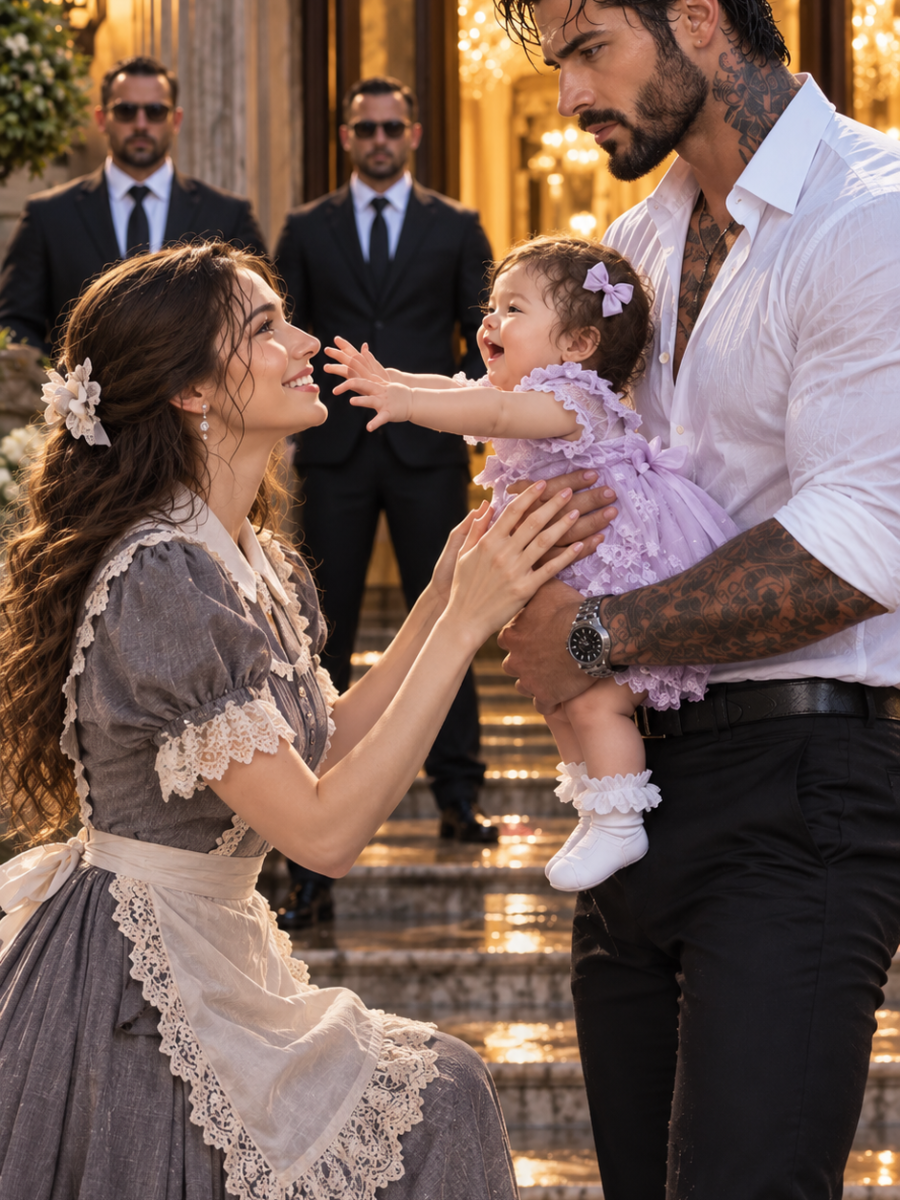
His head turned toward her. His wet, red face tilted like a flower finding light. His arms came out, both of them, stretching past my chest toward a stranger he had never seen. And in a small, cracked, perfectly clear voice, he said the word I had spent seven months praying for him to say to someone, anyone.
“Mama.”
The rain kept falling. Nobody moved. I felt every drop run down my neck as the word hit me.
Nico had never called anyone Mama. Not the nurses, not my sisters, not the portrait of Elena that hung over his crib. I caught the stranger’s wrist before I knew I’d moved, and I felt her pulse hammering under my fingers like a trapped bird.
“Who are you?”
She raised her eyes to mine, and what she said next had nothing to do with a job. “My name is Liana Graves. And I buried my son twenty-two days ago.”
Back to top ↑
Twenty-Two Days
I let go of her wrist. It was the first time in my adult life I had released a stranger without an order behind it.
My men wanted her searched, her suitcase opened, her name run through six databases before she crossed the threshold. I let them do all of it in the foyer while Nico clung to her coat with both hands and refused to be set down. She stood dripping on my marble floor and let them check her, her face blank with a fatigue so deep I could feel it from across the room.
“He’s hungry,” she said when they finished. Her cheeks colored. “Not for formula. I mean he’s been hungry for something that isn’t coming out of a can. Babies know. I’m sorry, Mr. Varric, this is going to sound strange. I lost my son at three days old. My body hasn’t been told yet. I’m still…” She stopped, and her voice dropped to nothing. “I still have milk.”
I should have thrown her out. A grown man in my position, with enemies who would pay a fortune to put a stranger in my nursery, should never have said yes. But Nico was gasping against her collar, his small body shuddering with hunger and relief, and the nurse beside me, a woman who hadn’t smiled in three weeks, put a hand over her mouth and nodded.
So I led her upstairs, past the guards, past Elena’s portrait. In the nursery, Liana sat in the rocking chair with her back to me and gave my son what he had been starving for. The silence that followed was the first real silence in my house in three days.
He drank for twenty minutes. Then he slept. I stood in the doorway and watched my boy sleep, one hand curled in her dress, his breathing slow and steady, and I felt something give way behind my ribs, an old wall I hadn’t known I’d built.
“Where did you bury him?” I asked, quietly, because I wanted to know what kind of woman I’d let in.
“St. Anselm’s, at the edge of the municipal ground.” She was looking at Nico’s face. “They gave me a wooden marker. I couldn’t afford to have the name cut. I keep meaning to go back with a chisel.”
“What was his name?”
“Theo.”
It was one word, and she said it as if the whole night depended on it.
The nursery door opened behind me. My cousin Dante Varric, who had been my second for ten years and my brother for twenty, stood in the hall in his dressing gown, his face composed into polite alarm. “Matteo. A stranger? At this hour? Dr. Halloran said Nico can’t be fed anything but the prescription formula. Anything else is a risk.”
“He’s asleep, Dante.”
“He’s asleep, but who is she?” Dante’s eyes moved over Liana’s bent head in a way I didn’t like. I remember thinking it was only worry. “I’ll send her to a hotel. We’ll sort out references in the morning.”
“She stays,” I said. “Tonight.”
Dante’s smile held perfectly still. But I saw his hand tighten around the doorframe, and later I would remember that grip every time I tried to forgive myself.
Back to top ↑
The Song
I found her at four in the morning, awake and humming.
The nursery was dim, Nico warm in her arms, and the tune she hummed was one I had not heard in eight months. It was an old Italian lullaby, half in dialect, about a swallow carrying a child home across the sea. Elena used to sing it in the kitchen when she thought no one was listening. She told me once she learned it from the nuns at the orphanage where she grew up, because the older girls sang it to the babies who cried at night.
I stood in the doorway very still. “Where did you learn that?”
Liana startled, then relaxed when she saw my face wasn’t angry. “St. Brigid’s. The girls’ home on Harrow Street. I grew up there until I was eighteen. A girl named Elena taught it to me, the year I turned six. She was twelve. She used to sit on my bed and hum it until I fell asleep.”
I had to sit down. The floor was cold under my hand.
“Elena Voss,” I said. “She was my wife.”
Liana’s face drained. She looked down at Nico, and I watched her put it together: the portrait over the crib, the dark curls, the eyes. “She told me once that she’d found a family, someone who loved her enough to stay. I wrote to her for years. She stopped answering about two years ago, and I thought she’d forgotten me.” She was crying now without noise. “I didn’t know she died. I didn’t know. I came here for a job, and I never…”
“How did you find my house?”
“Someone at the church said the Varrics were looking for a nurse. I only wanted work.” She shook her head. “But I think she sent me. I think she sent me to him.”
I do not believe in signs. I run an empire on arithmetic. But a baby who had refused every woman in Valecroft had reached for a stranger who sang his mother’s song, and the arithmetic of that was something I couldn’t solve.
I offered her the job at dawn. She would feed Nico and sleep in the room beside the nursery. She would take no orders from anyone but me. In the same breath I told her what the job was, and the danger of it, because a man who lies to the people he protects is only a thief with better manners.
“There are men who would like to harm this family,” I said. “They will notice you.”
“I buried my son in a wooden box, Mr. Varric,” Liana said, rocking my boy. “I’m not afraid of much anymore.”
That was the moment I realized she was braver than my entire security staff, and that I had never thanked anyone for being brave in my life.
She stayed. And on the fourth night, while she changed Nico’s blanket, she found something taped to the underside of the old music box on his shelf, something my dead wife had put there.
Back to top ↑
What Was in the Bottle
By the fourth day, Nico had gained eleven ounces. The color had returned to his cheeks. The dark circles under my own eyes were fading too, and I found myself coming home early to stand in the nursery doorway like an idiot.
But Liana noticed things. She noticed that on the mornings when the nurse brought up a warm bottle of Dr. Halloran’s prescription formula, to “supplement,” Nico’s breathing grew shallow within the hour. His skin flushed. His cries had the same rasping edge I had heard in the weeks before she arrived.
“It’s the bottle,” she told me on the fifth night, in the sitting room outside the nursery, holding a can in both hands. “I know I’m not a doctor. But I smelled it. It’s faint, but there’s something under the vanilla. Bitter. Like almonds. And look.” She pointed at the seal. “The foil’s been lifted and pressed back down.”
I wanted to dismiss it. Halloran had been Elena’s physician. He had delivered Nico. Dante had recommended him himself, and Dante had held my hand at Elena’s funeral.
But I had also spent my whole career learning to read what people don’t want me to see, and I couldn’t unsee the foil.
I sent the can to a lab I owned through three shell companies, and then I did something I had never done, which was to ask Liana to wait with me. She sat on the couch, her feet tucked beneath her, and held the music box she’d found, the one with the bit of tape hanging from its underside.
“There’s a card inside it,” she said. “Elena’s handwriting. I didn’t open it. It felt like it was yours.”
I opened it with hands that had never been steady around my wife’s memory. It was a memory stick wrapped in a note. The note said only: Matteo, if I’m not around to say this myself, listen before you trust anyone with our son.
I played it on the nursery laptop at two in the morning. Elena’s voice filled the room, soft, tired, and frightened. She was five months pregnant when she recorded it. She said Dante had been asking questions about the trust that would pass to her child if I died. She said she had overheard him on the phone with Halloran. She said she had no proof, and that she knew I would never believe it of him without proof, and that she was sorry. She said she would try to find some.
Eight months ago, a brake line failed on her car on the way home from a prenatal appointment. I had been told it was an accident. She had barely survived long enough to deliver our son.
The recording ended with a pause, and then her voice again, much softer, as if she’d turned away from the microphone. “Whoever finds this, if it isn’t Matteo, please. Please look after my baby.”
I looked up. Liana was weeping silently again, and her hand lay over the music box as if she’d been protecting it for months.
The lab called at dawn. The formula was laced with a sedative and an allergen, the kind of dose that would never kill a baby outright, only make him sicker and sicker until a doctor wrote “failure to thrive” on a death certificate.
Back to top ↑
The Night the Doctor Didn’t Come
I didn’t kill anyone that morning. I want that on the record. I sat in my study with the lab report in front of me and my hands flat on the desk, and I made myself do what Elena had asked. I found proof.
My people pulled the Halloran file in six hours. It was thick. He had been on Dante’s payroll for four years, long before Elena died. And in the middle of it, buried in a log of his private movements, was a night I didn’t expect and Liana had never known to ask about.
I asked her to come to the study that evening, and I closed the door myself.
“Liana. Theo was born at Mercy Free Clinic?”
“Yes.” She watched my face. “Why?”
“Who was the doctor on call the night he got sick?”
“Nobody came.” Her voice flattened into the tone of a woman reciting something she’d said to herself a hundred times. “The nurse said Dr. Halloran had been called away. She said she’d phoned twice. He had a fever of a hundred and four by dawn. By the time they transferred us across town…” She pressed her fist to her mouth. “It was too late. An infection. They said sometimes it just happens.”
I slid a page across the desk. It was a phone log, and a car service receipt, and a signed entry in Halloran’s own handwriting. On the night Theo Graves died of an untreated infection, Dr. Halloran had been inside my mansion, at three in the morning, running his first test of the sedative on Nico’s formula. Dante had paid him to be there. The doctor who should have been in a free clinic saving a three-day-old boy had been in my nursery, making a baby sicker.
She read it twice. She did not make a sound. She just folded forward in the chair, slowly, as if the weight of it had finally found her, and put both arms around herself.
“He wasn’t coming,” she whispered. “He wasn’t ever coming.”
I knelt in front of her. I have never knelt in front of anyone. “I did not know,” I said. “But it was my house they used. My family. If I had seen it sooner…”
“Don’t.” She lifted her wet face. “Don’t take this on, Mr. Varric. Not for Theo. He’d have hated it.” Her fingers closed gently over my sleeve. “I want them to answer for it. Not you, with a gun. I want them to answer where everyone can see.”
That was the moment I decided to keep my promise to a woman I’d known eleven days. I would take Dante apart in daylight.
But at midnight, as I was drafting the plan, the nursery alarm went off, and by the time I reached the door the rocking chair was empty, the window was open, and the thunder had begun.
Back to top ↑
Thunder
I remember the sound Liana made. It was not a scream. It was lower than that, the sound of a woman discovering the same loss twice.
Two of my guards lay stunned in the hall. One was bleeding from a gash at the temple. Dante had known my schedule to the minute. He had waited until the meeting with the lab, until half the staff were out of the house, until the perfect night. He had a team of six and a car on the east road, and he had my son.
My phone rang as I ran down the stairs. “Matteo,” said my cousin, his voice warm, almost kind, over the sound of an engine. “You’ve spent so long worrying about the boy that you forgot to worry about the man who raised you. I’ll keep him safe. But the trust passes tonight, and I’d like your signature. The old chapel. Midnight. You and the nurse.”
“Dante.”
“Bring the girl, Matteo. The boy won’t settle without her. I’d hate for anything to happen to him.”
Liana was standing next to me in her wet coat. She had heard every word. She didn’t ask whether it was safe. She just said, “I’m coming,” and pulled her suitcase out from under the bed, the old one, and dug out a small, dented tin. “Theo’s blanket,” she said when I looked at it. “He only had it three days. But it smells like him. If Nico gets scared, I want him to have something that’s loved.”
The old Varric chapel sits at the edge of the family estate, where my grandfather used to hide his enemies’ relatives. I drove through the storm with my hands steady and my heart in pieces. I thought about everything I’d have done, in the old days, to the man who touched my child. I thought about Liana beside me, who had asked me to let the law do it.
Dante stood at the altar in a black suit, with my son in the crook of his arm, and a pistol at his hip. Five men flanked him. Halloran sat on a pew, gray and terrified, a bag at his feet.
“There you are,” Dante said, as if I were late to dinner. “Sign, and I’ll hand over the boy, and Halloran and I will quietly leave the city. You keep your little nurse. Everyone’s happy.”
Nico was crying again, thin and exhausted. I would never forget that sound for as long as I lived.
Liana stepped out from behind me. Before anyone could stop her she walked the length of that aisle in a thin coat, with her hands open and the little blanket held out in front of her.
“Nico,” she said, in the voice of a mother. “Come here, baby. It’s all right.”
He turned. He reached. And Dante, who had spent twenty years perfecting the art of knowing what people would do, did not know what a ruthless man could never learn: that a baby can tell the difference between being held and being kept.
Nico lunged toward her, so hard that Dante’s grip slipped for one instant. And the instant was all I needed.
Back to top ↑
What the Law Is For
I don’t remember crossing the altar. I remember Liana catching my son against her chest, turning her whole body around him like a wall, and the first gunshot cracking against the stone where she had been a half second before.
My men came through the chapel doors from three sides. I had known Dante would use the chapel. I had also known, because Liana had asked me to, that the only way to answer him in daylight was to give him one more crime to commit on tape. My guards had been inside the walls since noon, and the little camera in the stained glass above the altar had recorded every word.
It was over in under two minutes. Dante’s five men went down or dropped their weapons. Halloran tried to run and fell over the pew, sobbing. And Dante and I stood face to face at the altar, with a pistol in his hand and rage in mine, and between us the quiet of a small country church.
“Elena found out,” he said, with something like pride. “She had a mind of her own, your wife. She said she’d tell you. I only meant to scare her. It was supposed to be a flat tire, Matteo, and it went wrong.” He laughed, a dry, terrible sound. “It was the only thing that ever went wrong.”
My hand closed around the gun at my back. Every part of me wanted to answer him the way our family had always answered such things.
“Mr. Varric.”
Liana’s voice was calm. She stood a few feet away, Nico asleep against her shoulder, the blanket that had once belonged to her dead son tucked around him.
“Please. For Theo. For Elena. Not like this.”
I looked at her, this woman I had known two weeks, who had every right to demand blood and instead asked me to be better than my father. The gun left my hand and clattered onto the stone.
Dante stared. He had expected the old Matteo. That was his last mistake.
The police were waiting outside, state troopers led by Captain Rhea Okonkwo, who had spent three years trying to build a case against my family and had never once had a witness she could trust. Tonight I handed her a camera, a recording, a doctor, and my own testimony. I told her what Dante had done to my wife, and what he had planned for my son, and what Halloran had done to a free clinic in the dark. I also told her things about my own business that I hope never to repeat. Liana had asked me for a day in the light. I gave her my own.
Halloran confessed in the car on the way to the station, in a rush, as if the words had been waiting in his throat for years. Dante never spoke again. He was sentenced to life, and Halloran to thirty years. A civil court later awarded Liana a settlement for Theo’s death, which she signed over, in full, to the Mercy Free Clinic.
I thought it was over. Then Liana asked me for one more thing, and it was not a favor I could have ever refused.
Back to top ↑
Mama
“Will you come with me?” she asked.
We drove to St. Anselm’s on a bright, cold morning in early spring. Nico rode in her arms, wearing a little blue coat, kicking at the seatbelt. At the edge of the municipal ground, where the grass ran out against a wire fence, a crooked wooden marker leaned in the wind. A faint, unreadable pencil mark was all that remained of the name.
Behind us the stonemason I had hired, an old man with gentle hands, unrolled his tools on a blanket. Liana pressed her hand over her mouth. She had told me she couldn’t afford to have the name cut. It hadn’t occurred to her that it could be a gift.
The stone was small, white, plain, and carved by hand. It said THEO GRAVES, and under it, in letters she had chosen herself, Loved for three days. Remembered for all the rest.
She knelt there a long time, her shoulders shaking. I stood behind her with Nico on my hip, and my son, who had learned more about grief in eight months than anyone should, put one small hand on her hair and kept it there.
She never became an employee after that. She just stayed. She fed Nico in the beginning, then taught him to hold a spoon, then to walk, then to sing. She planted roses beneath the nursery window in the spring and put Elena’s picture on the shelf beside Theo’s blanket, so my son would always know that he had two mothers who had loved him before he knew what love was. Her grief didn’t leave. It grew quieter and found a place to live, the way grief does when it is finally allowed to be shared.
The Varric empire changed. I closed the part of it I was ashamed of, and I used the rest to build what Liana asked for first: a maternity ward at the Mercy Free Clinic, with a doctor on call every night of the week, named for a baby who had lived three days.
On Nico’s second birthday, in a yard full of balloons and clumsy relatives, my son climbed into her lap with a handful of frosting. He looked up at her with Elena’s dark eyes, and then across the lawn at me.
“Mama,” he said, clearly. “Papa. Mine.”
Liana laughed through tears, and I realized I had not heard that sound at my gate the night she came, in the rain, when everything in my house had been broken. I took her hand. It was warm. It had been warm every day since.
“Yours,” I said, and I meant every word of it. “All of it. For as long as you’ll have us.”
Read Next