Clara Bennett had spent two years surviving widowhood, poverty, and the quiet humiliation of cleaning homes for people who believed money made them untouchable. When Vivian Romano struck her in front of twelve assembled crime families over a spilled glass of juice, Clara’s three-year-old daughter stepped between them without hesitation. Alessandro Moretti knelt to check on the child — and found a small black symbol stitched into her teddy bear’s ear that connected directly to a betrayal nobody had ever solved, two years after it got a man killed. Read every chapter to find out who murdered Daniel Bennett, and why his daughter’s toy held the answer the whole time.
Mr. Teddy Says You Look Sad
The fiancée of Milan’s most feared mafia boss slapped me in front of twelve powerful crime families, sneering that I was “only a housekeeper.” But when my three-year-old daughter stepped between us clutching her cream-colored teddy bear, the mafia king himself discovered that her toy carried a mark connected to a traitor inside his empire.
The slap cracked through Villa Moretti’s marble corridor like a gunshot. My cheek burned, but I swallowed my anger. I had spent two years surviving widowhood, poverty, and the humiliation of cleaning homes for people who believed money made them untouchable. Vivian Romano was one of them.
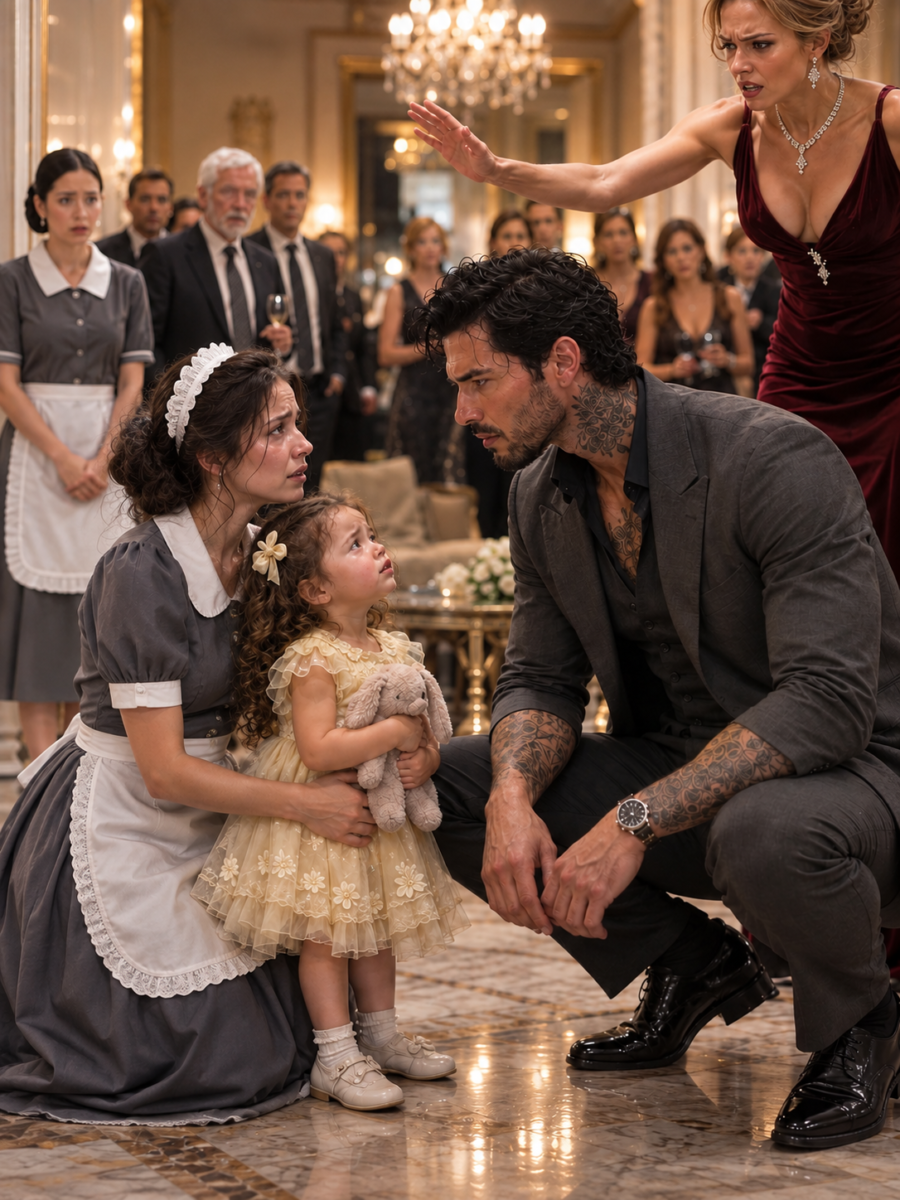
She stood before me in a red designer gown, diamonds flashing at her throat, her hand still raised as though striking me once had not been enough. “You spilled juice on a Persian rug,” she hissed. “Do you have any idea what that costs?” “It was an accident,” I said quietly. “People like you always say that.”
Before I could answer, a tiny barefoot figure rushed from the service corridor. “Don’t you dare order my mommy around!” Emma planted herself between us, hugging her cream-colored teddy bear tightly against her chest. She was only three, but she stared up at Vivian with more courage than every armed man in that mansion.
My heart stopped. “Emma, come here,” I whispered. She refused to move. “My mommy works harder than anyone in this house,” she said. “And you only know how to make people cry.”
The grand hall went silent. Beyond the archway, twelve mafia families sat beneath crystal chandeliers — men who controlled ports, unions, casinos, judges, and entire neighborhoods. Their wives watched from behind jeweled hands while armed guards stood motionless against the walls.
Vivian’s face tightened. “You should teach your child to know her place.” Then she lifted her hand again.
“Vivian.” One voice froze the entire villa. Alessandro Moretti stood at the far end of the corridor, dressed in black, his expression colder than death. He was not merely wealthy or influential. He was the man other mafia bosses feared.
He placed his wineglass on the console table. The soft click sounded like a death sentence. “Apologize to Mrs. Bennett,” he ordered. Vivian forced a laugh. “Alessandro, darling, she is only a maid.” His eyes darkened. “She is under my protection. You struck her inside my house.”
No one moved. Even Don Ricci, the oldest boss in the room, lowered his glass. “Moretti is right. You insulted his household before twelve families.” Vivian turned pale. “I apologize,” she muttered.
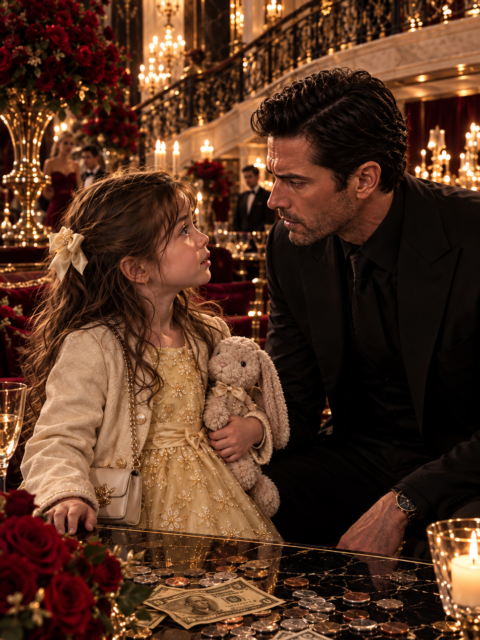
Then Alessandro did something no one expected. The mafia boss walked past his fiancée and knelt before my daughter. “Are you all right, sweetheart?” he asked.
Emma studied him carefully. “Are you all right?” she whispered. “Mr. Teddy says you look sad.” For one brief second, the most dangerous man in Milan looked almost human.
Then he touched the cream-colored teddy bear’s folded ear. His entire face changed. Beneath the cream-colored fabric was a small black symbol stitched into it.
Alessandro slowly looked toward the twelve families.
“Where did she get this cream-colored teddy bear?” he demanded. His voice was quiet.
Daniel’s Workshop
The question landed with a weight I didn’t understand, though the way every guard in the room had gone rigid told me it mattered considerably more than a simple curiosity about a child’s toy.
“My husband made it,” I said carefully, my hand finding Emma’s shoulder. “Before he died. He was a tailor, Mr. Moretti — he did custom stitching and repair work for several families in Milan, including, I believe, some connected to your own household.”
“Your husband’s name?”
“Daniel Bennett.”
Something shifted behind Alessandro’s eyes — recognition, quickly masked, though not quickly enough to escape my notice. “I want to speak with you privately,” he said. “Now, Mrs. Bennett. Bring Emma.”
He led us away from the stunned assembly of twelve families, Vivian’s furious, confused protests fading behind us as we moved into a private study lined with dark wood shelving and considerably more silence than the grand hall had offered.
“Tell me about your husband,” Alessandro said, once the study door had closed behind us. “Everything. When did he die, and how?”
“Two years ago,” I said, old grief resurfacing with a rawness I hadn’t expected given how carefully I’d learned to manage it in public. “A fire in his workshop. The investigators ruled it accidental — faulty wiring in an old building, they said. He worked long hours in that space, surrounded by fabric and thread, exactly the kind of conditions where an electrical fire could spread quickly.”
“Did you believe that explanation at the time?”
The question startled me, old doubts I’d never voiced aloud to anyone suddenly given permission to surface. “I wanted to,” I admitted. “It was easier than the alternative. But Daniel was meticulous, Mr. Moretti — obsessively careful about fire hazards, given how much of his livelihood depended on flammable materials. He rewired that workshop himself, twice, specifically because he didn’t trust the original electrical work. I never fully believed a simple accident took him, but grief made it easier to accept the official explanation than to keep asking questions nobody seemed interested in actually answering.”
Alessandro studied the teddy bear’s stitched symbol for a long moment before finally looking up at me directly. “Mrs. Bennett,” he said slowly, “this mark is not decorative. It’s a signal — a method used, as far as my own organization has ever been able to determine, exclusively by a small, dangerous network of informants operating within the families of Milan, identifying items and communications meant for a specific, unknown contact. Two years ago, around the same time your husband died, I lost a considerable amount of sensitive information to exactly this kind of informant network, and I was never able to identify who was responsible. If your husband stitched this mark into your daughter’s toy, either deliberately or by some connection to his other work, I need to understand immediately whether Daniel Bennett was involved in that betrayal, or whether he discovered it and paid for that discovery with his life.”
The Symbol
The accusation, however carefully qualified, struck me with a fresh, defensive fury. “Daniel would never have betrayed anyone,” I said. “He was a simple tailor, Mr. Moretti. He wanted nothing to do with the more dangerous business of the families he worked for. He took commissions because they paid well and treated him with respect, not because he had any interest in whatever conflicts existed between you.”
“I don’t doubt your certainty,” Alessandro said, his tone carrying a careful neutrality that suggested he was genuinely trying not to presume guilt before understanding the full picture. “But this symbol appearing in an item your husband made, around the exact time both the betrayal and his death occurred, is not a coincidence I’m willing to dismiss without proper investigation. I want to understand exactly what work Daniel did in his final months, for which families, and whether anything unusual happened that he might have mentioned to you.”
I sat with the question, memory reaching back through two years of grief to details I hadn’t examined closely in a long time. “He’d taken on considerably more commission work in his final few months,” I said slowly. “More hours, more secrecy than usual — he’d always shared details about his clients freely before, workshop gossip mostly, but that last stretch, he grew unusually quiet about a particular project. I remember him coming home agitated one evening, saying he’d found something in a garment’s lining that he needed to think carefully about before deciding what to do with it.”
“Did he say what he found?”
“No,” I said. “He told me it was better if I didn’t know, for my own safety. I assumed at the time he meant some minor business dispute, a client unhappy with pricing, something mundane. I never imagined it might be connected to whatever you’re describing.”
Alessandro’s expression hardened with a focused intensity I found simultaneously frightening and, given the circumstances, strangely reassuring. “Which families did he work for most frequently, in those final months?”
I considered carefully, old memories of Daniel’s workshop schedule, hastily scrawled in a notebook I still kept in a drawer at home, resurfacing with painful clarity. “Yours, occasionally, though not as his primary client. The Ricci family, some smaller commissions. And—” I hesitated, something in Alessandro’s earlier tension with Vivian Romano suddenly registering with fresh significance. “The Romano family. Vivian’s father, Don Romano, commissioned several formal garments in the months before Daniel died. I remember because the payment was considerably higher than his usual rate, and Daniel mentioned being surprised by how particular Don Romano was about certain specific details in the tailoring.”
Alessandro’s face went carefully, deliberately still — the particular controlled stillness, I was beginning to understand, that meant something considerably more dangerous than his outward calm suggested. “Mrs. Bennett,” he said slowly, “I need you to think very carefully. Did Daniel ever mention Don Romano’s name specifically, in connection with whatever he found that troubled him so deeply in his final weeks?”
The Fire
I searched my memory as thoroughly as grief and two years of distance allowed, and one detail finally surfaced with a clarity that made my stomach turn. “He mentioned a name once,” I said slowly. “Not Don Romano directly. Someone called ‘the old man’s contact.’ He said it in passing, the same night he came home agitated about something he’d found, and I never thought to ask him to clarify what he meant.”
“The old man,” Alessandro repeated. “That’s how several people in this business refer to Don Romano privately, given his considerable age relative to most current family leaders.”
The pieces began arranging themselves into a shape I didn’t want to fully accept. “You think Daniel discovered evidence that Don Romano was working with this informant network, hiding it inside garments he commissioned specifically for that purpose.”
“I think it’s a possibility serious enough to investigate immediately,” Alessandro said. “Mrs. Bennett, I want to review the original fire investigation into your husband’s death, properly, with resources considerably more thorough than whatever local authorities applied two years ago. If Daniel Bennett discovered Don Romano’s involvement in a betrayal that cost my organization considerable damage, and if that fire wasn’t the accident it was ruled to be, I intend to understand exactly what happened to him, and exactly who is responsible.”
The investigation, launched that same evening through resources Alessandro’s organization commanded considerably beyond what any grieving widow could have accessed alone, moved with a speed that left me simultaneously grateful and unsettled by how quickly two years of unquestioned grief could be reopened into active, dangerous inquiry.
Within three days, a forensic fire investigator retained by Alessandro’s team, reviewing the original case file alongside physical evidence still available from the scene, identified irregularities the original investigation had apparently either missed or deliberately overlooked — accelerant residue inconsistent with an electrical fire’s typical burn pattern, and evidence that the workshop’s rewired electrical panel, which I had told Alessandro Daniel maintained meticulously, showed signs of recent, deliberate tampering rather than the gradual wear an accidental failure would typically produce.
“This wasn’t an accident,” the investigator confirmed, presenting his findings to Alessandro and me together. “Someone deliberately sabotaged that electrical panel and used an accelerant to ensure the fire spread quickly enough to destroy evidence and prevent any possibility of rescue. Mrs. Bennett, I’m sorry to confirm what you apparently suspected all along — your husband was murdered, and whoever did it went to considerable trouble to make it look like an accident convincing enough that no one would ever think to look closer.”
The Romano Commission
The confirmation of murder transformed two years of quiet, private grief into something considerably more urgent and complicated, my need for justice suddenly entangled with Alessandro’s own investigation into a betrayal that had apparently cost his organization dearly.
“I want to understand the connection to Don Romano definitively,” Alessandro said, “before I act on suspicion alone against a man who sits on the council of twelve families and is, at least until this evening’s events, still set to become my father-in-law.”
His investigators traced Daniel’s final commissions through careful review of workshop records I provided, cross-referenced against Don Romano’s own household purchasing history, and confirmed that Daniel had, in his final six weeks, completed three separate garments for Don Romano personally — each one, according to Daniel’s own meticulous notes, requiring an unusual amount of interior lining work that Don Romano had specifically requested, citing concerns about durability that struck the investigator, reviewing the pattern now with fresh suspicion, as an unusually convenient excuse for exactly the kind of concealed pocket construction the coded symbol suggested.
“The symbol itself,” Alessandro’s own intelligence contact explained, presenting additional research the following day, “matches a communication method our organization first identified nearly three years ago, used by an informant feeding sensitive information to a rival syndicate operating out of Naples. We were never able to identify the informant definitively, though the timing of several serious operational losses always suggested someone with access to considerably sensitive planning discussions.”
“Don Romano sits on every major planning discussion this council holds,” Alessandro said grimly. “If he’s been quietly feeding information to a rival syndicate for three years, using coded garments commissioned from an unsuspecting tailor as his communication method, the damage could extend considerably further than the operational losses we’ve already identified.”
“And Daniel discovered this,” I said slowly, “while completing routine tailoring work, entirely by accident.”
“It appears that way,” Alessandro confirmed. “A man simply doing his job well enough, and carefully enough, to notice something unusual in the construction details Don Romano requested — details that, to anyone else, might have seemed like nothing more than an eccentric client’s particular preferences.”
“What happens now?” I asked, old grief and fresh, urgent fear tangling together as the full danger of what we’d uncovered settled over me. “If Don Romano killed my husband to protect this secret, and he learns we’re investigating, what’s to stop him from deciding Emma and I represent exactly the same kind of loose end Daniel apparently became?” Alessandro’s expression hardened into something resolute and considerably more protective than I’d expected from a man I’d known, until that very afternoon, only as a distant, feared employer. “Nothing is going to happen to either of you,” he said firmly. “You’re both under my protection now, Mrs. Bennett, and I intend to make sure Don Romano understands exactly how seriously I take that responsibility before this investigation concludes.”
Vivian’s Question
Vivian Romano appeared at Villa Moretti the following morning, considerably more subdued than the woman who had struck me in front of twelve families less than a day earlier, her expression carrying a genuine, unguarded uncertainty I hadn’t expected to see from her.
“Alessandro told me you’re investigating something involving my father,” she said, finding me in the villa’s kitchen where I’d been permitted, at Alessandro’s insistence, to remain rather than return to my usual modest apartment while the danger remained unresolved. “I need to understand what’s actually happening, Mrs. Bennett. Please.”
I studied her carefully, uncertain how much to share given her family connection to the very man now suspected of orchestrating Daniel’s murder. “I think that conversation should happen with Alessandro present,” I said carefully.
“I understand your caution,” Vivian said, something in her composed, wealthy exterior cracking into a more genuine vulnerability. “I know how I treated you yesterday, and I have no right to expect your trust after that. But Mrs. Bennett — if my father is genuinely responsible for whatever you’re investigating, I need to know. Regardless of what it costs our family, or my own engagement to Alessandro.”
Alessandro, summoned once his security detail noted Vivian’s arrival, arrived in time to hear her final statement, his expression carrying a careful, evaluating consideration of whether her apparent sincerity could be trusted given everything currently at stake.
“Your father is suspected of feeding sensitive information to a rival syndicate for at least three years,” Alessandro said directly, apparently deciding the direct approach served better than careful evasion. “And of murdering Mrs. Bennett’s husband two years ago to prevent that betrayal from being discovered.”
Vivian’s composure, already fragile, finally broke entirely, tears falling with a genuine grief that suggested, at minimum, she had no prior knowledge of her father’s alleged crimes. “That’s not possible,” she said, though her voice carried less conviction than the words themselves suggested she wanted to feel. “My father has served this council for thirty years. He’s difficult, certainly, proud and demanding, but a traitor? A murderer?”
“I understand this is difficult to accept,” Alessandro said, his tone considerably gentler than I’d yet heard him use with his fiancée. “But the evidence is substantial, Vivian, and growing more concerning with each additional detail we uncover.”
Vivian was quiet for a long moment, some difficult internal calculation visibly working through her features before she finally spoke again. “There’s something you should know,” she said slowly. “Six months ago, I found an unfamiliar phone hidden in my father’s study, one he became unusually agitated about when he realized I’d seen it. He told me it was for a business matter he couldn’t discuss, and I accepted that explanation at the time because questioning my father’s business has never been something our family encourages. But if what you’re telling me is true, Alessandro, I think that phone might be exactly the evidence you’re looking for — and I know precisely where he keeps it hidden.
What Daniel Found
Vivian’s cooperation, offered with a genuine, visible courage given the personal cost of betraying her own father, provided access considerably more valuable than any external investigation could have achieved on its own.
The phone, retrieved carefully through Vivian’s own knowledge of her father’s household routines rather than a confrontation that might have alerted Don Romano prematurely, contained a communication history spanning nearly three years — encrypted messages to a contact identified only by a coded designation matching the same symbol stitched into Emma’s teddy bear, discussing information exchanges timed precisely with the operational losses Alessandro’s organization had suffered.
“This is enough to confirm everything,” Alessandro said, reviewing the extracted data with his own security team’s forensic specialist. “Don Romano has been feeding operational intelligence to a Naples syndicate for nearly three years, receiving substantial payment in return, communications timed to avoid any pattern that might have triggered earlier suspicion.”
Further examination revealed a message, dated exactly the week before Daniel’s death, discussing what Romano referred to only as “the tailor problem” — a coded reference that, combined with everything else uncovered, left little doubt about what had actually happened to my husband.
“He found the symbol while completing the lining work,” I said quietly, reading the message myself with a grief that had transformed, over the preceding days, from quiet private mourning into something considerably more resolved. “He recognized it as something unusual, mentioned his concern to someone, and word reached Don Romano before Daniel ever had the chance to understand exactly what he’d stumbled onto.”
“The message confirms exactly that sequence,” Alessandro’s specialist noted grimly. “Don Romano learned that his tailor had noticed something suspicious in the lining construction, and arranged the fire within days to ensure the discovery went no further.”
Vivian, present throughout the investigation despite the mounting evidence against her own father, absorbed each revelation with a controlled grief that reminded me, uncomfortably, of my own composure in the aftermath of Daniel’s death. “What happens now?” she asked quietly.
“Now,” Alessandro said, his voice carrying the particular controlled finality that had, until recently, only ever frightened me, “your father answers to the same council he’s spent three years betraying. I want this evidence presented formally, Vivian, to all twelve families together, exactly as tradition requires for a matter this serious — and I want you to understand clearly that regardless of what happens to your father, this evidence changes nothing about my respect for your own courage in bringing it forward.”
The Council of Twelve
The council reconvened three days later, the same grand hall where Vivian had once struck me now filled again with the same twelve families, though the atmosphere carried none of the earlier evening’s careless social ease.
Alessandro presented the evidence methodically — the phone’s communication history, the forensic fire investigation confirming Daniel’s murder, and the pattern of operational losses now clearly explained by three years of Don Romano’s calculated betrayal.
Don Romano, seated among his fellow bosses with a composure that finally, visibly cracked as the evidence mounted against him, made no attempt at denial once the phone’s contents were displayed for the assembled council to review directly.
“You don’t understand the pressure I was under,” he said, his voice carrying none of the imperious confidence I remembered from brief, distant encounters at prior gatherings. “The Naples syndicate approached me with threats against my family considerably more direct than any of you have ever faced. I made an impossible choice under impossible circumstances.”
“You murdered an innocent tailor,” Alessandro said, his voice cold with a fury he’d carefully controlled throughout the entire investigation, finally permitted its full expression now that formal proceedings allowed it. “A man with no connection to this council’s politics, killed simply because he did his job too well and noticed something you needed hidden. Whatever pressure you faced doesn’t excuse that, Don Romano, and it certainly doesn’t excuse three years of betraying every family in this room.”
Don Ricci, the council’s eldest member, rose slowly, his expression carrying the particular grave authority decades of leadership had earned him. “This council has judged betrayals like this before,” he said. “The penalty has never once, in my considerable memory, been anything less than absolute.”
The council’s judgment, delivered that same evening after careful deliberation among all twelve families, removed Don Romano permanently from any position of authority or protection within their combined territories — a sentence that, within the particular, brutal logic governing this world, effectively ended both his power and his safety in a single decisive stroke, the details of his ultimate fate left to consequences Alessandro never fully explained to me, and which I found myself, in the end, no longer needing to know.
Vivian, present throughout the council’s deliberation despite the devastating personal cost, approached me once the formal proceedings concluded, her expression carrying a complicated mixture of grief and hard-won relief. “I’m sorry,” she said quietly. “For the slap, for everything I said about your place in this world, and for whatever role my own family’s crimes played in taking your husband from you and Emma. I don’t expect forgiveness, Mrs. Bennett. I simply needed you to hear it directly from me, rather than assume my silence meant I didn’t understand exactly how much my father’s choices cost you.”
Mended
The weeks following the council’s judgment brought considerable change to Villa Moretti, Alessandro’s engagement to Vivian formally, mutually dissolved in the aftermath of her father’s exposure — not out of any lingering resentment toward Vivian herself, whose courage in exposing her own family’s crimes had earned genuine respect from the assembled council, but simply because an arrangement built on political alliance between two families no longer made sense once one of those families had been so thoroughly disgraced.
Vivian herself, choosing to distance herself entirely from whatever remained of her father’s damaged organization, relocated to Florence within the month, and I received, some weeks later, a brief but genuinely warm letter thanking me for what she described as “an unexpected kind of honesty that finally showed me exactly what my family had actually become.”
Emma’s teddy bear, once forensic examination of the stitched symbol had concluded, was carefully repaired by Alessandro’s own household seamstress, the coded thread removed and replaced with an ordinary, unremarkable stitch that left the toy looking exactly as it always should have — simply a beloved, well-worn companion rather than an accidental piece of criminal evidence.
“Mr. Teddy looks happy now,” Emma announced, examining the repaired ear with the same serious attention she’d once brought to comforting a mafia boss she’d correctly identified, on pure instinct, as someone carrying considerable hidden sorrow.
Alessandro, present for this small, domestic moment in a household routine that had gradually, naturally expanded to include considerably more of his time than either of us had initially planned, knelt beside Emma with a warmth that had grown steadily since that first chaotic evening in the marble corridor.
“I owe your family a debt I don’t know how to properly repay,” he told me quietly, once Emma had returned to her considerably more pressing business of introducing Mr. Teddy to the villa’s newest addition, a patient, elderly cat who tolerated the introduction with considerable dignity. “Daniel’s death led directly to uncovering a betrayal that could have cost this organization considerably more than it already had, and Emma’s simple courage in that corridor started an investigation I might never have pursued otherwise.”
“You don’t owe us anything,” I said. “You gave us justice, Alessandro. That’s considerably more than two years of grief and unanswered questions ever offered.”
“Perhaps,” he said. “But I find myself, more each week, hoping we might build something considerably more than simple gratitude between us — if you’re willing to consider it, in whatever time and pace actually feels right to you.”
I looked at him for a long moment, two years of careful, guarded survival finally allowing room for something I hadn’t expected to feel again so completely. “I think,” I said slowly, “Emma already decided that answer the moment she stepped between us in that corridor. I find I’m simply catching up to her considerable courage a little more slowly than she managed it herself.”