A Homeless Little Girl Promised to Make a Mafia Billionaire Walk Again… Then He Saw the Watch That Belonged to His Missing Sister
I’m Charles Whitmore. For four years I sat in a wheelchair while Manhattan’s elite whispered that the Whitmore empire was dying with me. Then a barefoot eight-year-old said she could make me walk, and I stood. But the gold watch that fell from her pocket was the real miracle, and the man who hid my sister for twenty years was already in the room. Read every chapter to learn who broke my legs, and who has been lying to me my whole life.
Six Words
“Sir, I can make you walk.”
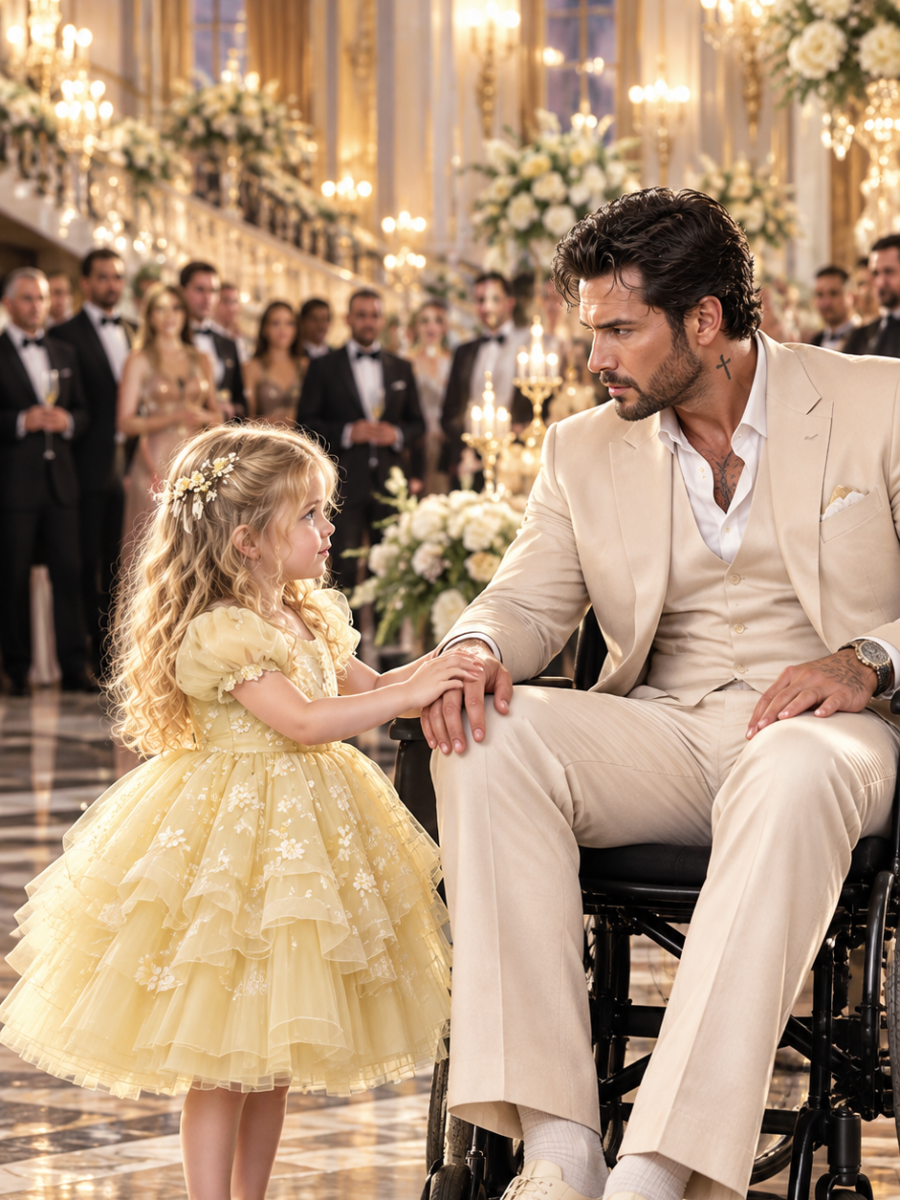
The little girl said it in the middle of the Whitmore Foundation gala, in front of four hundred of the richest people in New York, and the room laughed so hard that a waiter dropped a tray. She was barefoot. Her sweatshirt hung to her knees, her hands were bruised, and she smelled like cold subway air. Someone had let her in through the kitchen. I never found out who, and I never needed to.
My name is Charles Whitmore. Four years earlier, a black sedan with failed brakes had thrown me off the Henry Hudson Parkway, and I woke up in a hospital that told me the bottom half of my body no longer belonged to me. I owned shipping lines, three casinos and the loyalty of men who didn’t file taxes. None of it could buy back a single step. By the night of the gala I had stopped asking doctors for hope. I only asked them to stop pretending.
So I should have waved her away. My guard captain, Marcus Reed, was already moving. But something in her face held me. She wasn’t selling anything. She looked at me the way people look at a house they plan to save.
“A million dollars,” I said, and the laughter came again, louder. “Make me walk and it’s yours.”
“I don’t want your money.” She didn’t blink. “I just want you to believe me.”
“What’s your name?”
“Lyla. Lyla Everly.”
Before Marcus could grab her, she crossed the marble and laid both small hands on my knees. I felt nothing, as I had felt nothing for four years. Then warmth spread under her palms, slow at first, then fast, like blood returning to a frozen limb. My right foot moved. A woman near the front gasped and the laughter simply stopped.
I gripped the arms of the chair. Pain tore up my spine, so sharp I tasted metal, but I pushed through it. My knees shook. The chandeliers swam overhead. And I stood. Four hundred people held their breath while I stood on my own legs in a black tuxedo, swaying like a man on the deck of a ship.
I barely heard them. Something small and bright had slid out of Lyla’s sweatshirt pocket and rung against the floor.
It was an antique gold pocket watch, and it was engraved with the Whitmore crest.
My father had two of them made in 1961, one for his son and one for his daughter. Mine sat in a safe upstairs. The other had last been seen on my sister Evelyn’s wrist the night she vanished twenty years ago. The police called her a runaway. My family called her dead. I had spent two decades half believing both.
“Where did you get that?” My voice came out like gravel.
“My mother gave it to me.”
“What is your mother’s name?”
Lyla’s lips moved. She whispered it, and the entire ballroom tilted around me.
It was my sister’s name.
Evelyn Whitmore was alive. And the only thing that kept my knees from folding was the sudden, terrible look on her daughter’s face, as if she’d just remembered how little time we had.
Back to top ↑
The Man Who Smiled
“Take me to your mother,” I said.
Lyla shook her head. “You can’t. They already found her.”
Every guard in the ballroom reached for a weapon. I closed my fist around the watch and felt the old gold bite into my palm. Twenty years of grief rearranged itself inside me in a single heartbeat, from mourning into something much colder. Someone had hidden my sister for two decades. Someone had just found her again.
I crouched, which my legs had no business letting me do, and put myself at eye level with the child. “Lyla. Who found your mother?”
She leaned close enough that her breath touched my ear.
“The man who made you disabled.”
Six words. I’d spent four years telling myself that crash had been an accident, the kind of bad luck that finds rich men on wet roads. The investigators had agreed. A mechanic had been fired. A file had been closed. Now a barefoot girl was telling me otherwise in a ballroom full of my enemies, and I believed her, because I had never in my life seen a child lie with that kind of terror.
Marcus reached my side. “Sir, you’re standing,” he said, very quietly. “Everyone is watching.”
“Exactly.” I looked past him across the room, because the instinct that kept me alive in my business was waking up along with my legs. People were whispering. Phones were rising. But one man wasn’t looking at me at all. He stood at the champagne fountain with a glass in his hand, silver hair combed back, a face I had known since I was six years old.
Gideon Crane. My father’s oldest friend. My godfather. The man who had held my hand at my father’s funeral and run the family’s accounts through every crisis since. He was the only person I still trusted completely.
He was smiling. It wasn’t the smile of a man watching a miracle. It was the smile of a man doing arithmetic.
Lyla’s small fingers closed around my sleeve. “That’s him,” she breathed. “That’s the man in Mommy’s pictures.”
Something went very still inside me. I did the hardest thing I have ever done in public. I lowered myself back into the wheelchair, gripped the armrests, and let my face go slack, as though the effort had drained me. “Marcus,” I murmured, “tell the room I’m exhausted. Tell them the girl is a hoax I’ll sort out privately. Then clear the ballroom.”
“Sir?”
“Gideon doesn’t know I can feel my legs. He hasn’t known for four years, and I’m not going to teach him tonight.”
From across the room Gideon raised his glass to me, a small, affectionate salute. I raised mine back.
I carried Lyla out through the kitchen in my own lap, a wheelchair-bound man hiding the most dangerous thing in New York. And when she opened her fist in the elevator, there was a name inked on her palm in a woman’s handwriting: “Trust Charles.”
Back to top ↑
What Lyla Carried
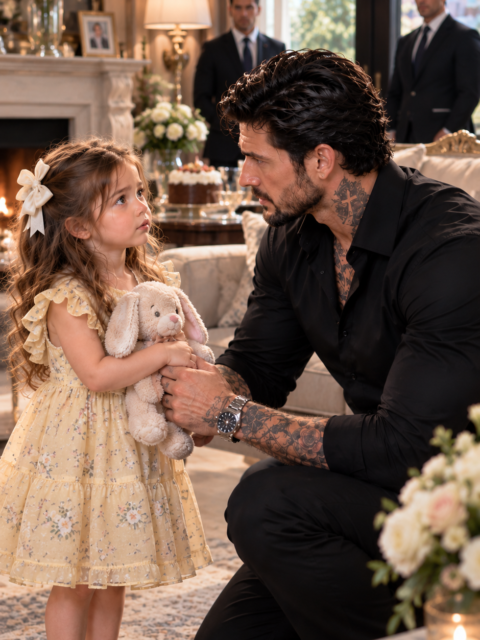
Marcus put a blanket over her shoulders in my penthouse and turned the heat up to eighty. Lyla ate three grilled cheese sandwiches without speaking. I watched her and tried to find my sister in her face. It took me a minute. Then she tilted her head to listen to the elevator, and there was Evelyn at sixteen, listening for our father’s footsteps.
“Mommy writes on my hand when she’s scared,” Lyla said at last, looking at the faded ink. “She says if anything happens, I find the man in the wheelchair.”
“How did she know where to find me?”
“She worked for you.” Lyla pulled one sneaker from her bag. She’d shoved them in there when she took them off to run, and she dug out the insole with the practiced patience of a child who had hidden things before. “Six months ago. She said her name was Ellie Grant.”
Marcus and I looked at each other. The Whitmore Foundation’s home-care program had sent a night aide to my penthouse in the spring, a quiet woman with a nurse’s training and a habit of keeping her hair over her face. I had barely looked at her. She changed my linens and logged my medications and was gone by dawn, and I remembered thinking she was the only staff member who never asked me for anything.
Lyla unfolded a sheet of paper from the insole. It was a page torn from a ledger, with columns of dates and dosages and one initial next to each entry: G.
“Mommy said your pills were wrong,” Lyla said. “She said somebody was adding something to them. A medicine that keeps people from feeling their legs. She started switching them at night, and she said it would take months, but your body would remember.”
The room didn’t move, but I felt it spin anyway. For four years I had swallowed what my own physician, Dr. Hollis, handed me every morning, and Hollis had been recommended to me by only one person.
“Did your mother say who?”
“She said a man who pretends to love you.” Lyla looked up. “She had a plan. She was going to tell you on Sunday. But he found her this morning. Two men in gray coats took her from the shelter. I was in the bathroom. I heard her say my name, loud, like a warning, and so I ran.”
She said it without crying. I wanted to be angry at someone for the calm in her voice, and the only person I could be angry at was myself.
“The watch,” I said, my voice rough. “Why did you bring it?”
“Because Mommy said you’d never believe a stranger. But you’d believe a Whitmore.” Lyla’s eyes shone, finally, with tears she refused to let fall. “And the hands, Mr. Whitmore, that part’s true too. Mommy taught me how to rub the cold out. I did it every night when she came home sore from cleaning offices. I didn’t know if it would work on you. I just promised, because someone had to.”
The truth of it was gentler than a miracle and far more dangerous. Evelyn’s nightly switch of my pills had been waking my nerves for half a year. The little girl had only found the last stubborn knot.
I held the ledger page under the lamp and read the final line twice. It was dated three days ago, in Gideon Crane’s neat hand: “Evelyn confirmed. Deal with her before the Foundation gala.”
Back to top ↑
Twenty Years Ago
I did not sleep that night. I sat by the window with my sister’s watch in my hand and went back through my own life like a detective, one room at a time.
My father, Arthur Whitmore, died of a heart attack in his study when I was twenty-four. Evelyn was seventeen and the one who found him. Three weeks later she was gone, with a suitcase missing and a note saying she couldn’t breathe in that house. I begged the police to keep looking. Gideon sat beside me at the kitchen table and told me gently that some people don’t want to be found. “Let her go, son,” he said. “She’s grieving. She’ll come home when she’s ready.”
I let her go. I had a company to hold together, and I told myself that was a reason. That was the first lie I swallowed, and I was the one who cooked it.
Marcus came in around four a.m. with a folder and a face the color of old paper. He had spent the night doing what I’d refused to do for four years: pulling the sealed file on my accident.
“The mechanic they fired was named Dale Pruitt. He died in a hit-and-run eight months later,” Marcus said. “The driver was never found. And Dr. Hollis’s office just shredded a box of medication records yesterday afternoon. Our man at the building caught the truck.”
“Gideon moved fast.”
“He didn’t have to. He had a plan for the moment you said her name. He just didn’t expect the girl to show up first.”
I looked at Lyla, asleep on my couch beneath a blanket far too big for her. The ledger page in her insole, the one Evelyn must have stolen from Gideon’s private study, listed a second set of entries below the dosages. They went back twenty years. They recorded payments to a lawyer, a coroner and a private detective, and the first one was dated three days after my father’s death.
I read it, and for the first time in my life I understood what my father had really died of. Evelyn hadn’t run away from grief. She had seen something in that study. She had run from the man standing over our father’s body, and she had spent twenty years keeping a child and a secret alive in the shadows of the same city I ruled.
“Why now?” I asked. “Why come out of hiding after twenty years?”
Marcus put a printed page on the desk, a trust document I had signed years ago without reading it. “Because of this. The Whitmore Trust passes to Gideon if both Arthur’s children are legally dead or incapacitated. You were declared incapacitated four years ago. Evelyn’s death certificate is due in two weeks, and then it’s all his. When Evelyn found out she was running out of time, she tried to save you the only way she could.”
I gripped the arms of my chair, and for once I felt my fingers shake in rage instead of in weakness.
“Marcus. Find me where he keeps her.”
“Sir, Gideon is coming for breakfast. It’s on your calendar.”
He was coming for breakfast. In nine hours my godfather would sit at my table, and I would have to look the man who murdered my father in the eyes and pour him coffee.
Back to top ↑
A Visit From My Godfather
Gideon arrived at nine with a box of pastries and a look of fatherly concern. I had hidden Lyla in the library with Marcus’s wife, a retired nurse who sat beside her with a book. I slouched in my wheelchair, a blanket across my lap, and let my godfather kiss the top of my head.
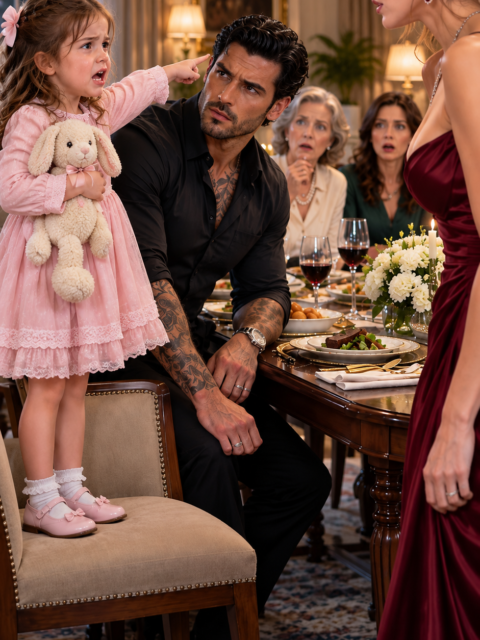
“That business last night,” he said, settling across from me. “A scandalous stunt, Charles. Hoaxers. I’ve already had the girl’s description given to the authorities, in case someone put her up to it.”
“Someone did,” I said. “I think she was telling the truth, Gideon. About the watch.”
He poured his own coffee, and his hand was perfectly steady. “That watch could be a copy. Arthur had a dozen jewelers.”
“It had Evelyn’s initials on the back.”
The cup paused for half a second at his lips. It was the smallest hitch, the kind only a man who has spent his life reading liars could catch. Then he put the cup down. “Charles. Your sister is gone. I know it hurts, and I know you want to hope. But I’ve spent twenty years learning what hope costs. I’d rather watch you grieve than watch you be robbed by strangers.”
“I’d like to see her.”
“Who?”
“Evelyn.” I let my voice crack the way a broken man’s would. “If there’s even one chance.”
Gideon studied me for a long moment, then pulled out his phone. “You’re not well. You’ve been under strain.” He tapped the screen and turned it toward me. “I wanted to spare you this.”
It was a video, twelve seconds long. A woman sat in a bare room, a gag around her mouth, her wrists strapped to a metal chair. She was thirty-seven, thin and exhausted, with our mother’s black eyes. She looked into the lens and her eyes found me through the screen, and they filled with the same fear I had seen in her daughter’s face.
It was my sister. I knew it the way I knew my own heartbeat. Rage rose in me so fast that my right foot jerked against the footrest, and under the blanket I pressed it flat with my left hand to stop the movement from showing.
“I’m so sorry,” Gideon said gently, all warmth and regret. “She turned up three months ago, begging for money, wanting to claim her share. I’ve been taking care of her, privately, so the family wouldn’t be disgraced. But she’s unstable, Charles. She’s been telling people terrible things about me. About your father.”
“What do you want?”
“Only what’s best for the family.” He slid a document across the table, ten pages thick, with a yellow tab on the last. “Sign over your voting shares. Let me manage the Whitmore Trust while you recover. Do it by midnight tonight, and I’ll bring Evelyn to you myself, safe and sound, at the old boathouse on Hunter’s Point. Come alone, and we can end this like a family.”
I looked at the signature line. I picked up the pen. My hand didn’t shake.
“I’ll be there,” I said.
He smiled, and for one second his mask slipped, and I saw it all at once: the patience, the hunger, the twenty years of waiting for me to be small enough to swallow. He kissed my forehead again. He left the pastries.
The moment the elevator doors closed, I dropped the pen, stood up out of my wheelchair, and said to the empty room, “He’s going to kill us both at that boathouse.”
Back to top ↑
Midnight at the Boathouse
Marcus wanted an army. I told him an army was exactly what Gideon expected, and what Gideon expected wouldn’t work. A man who has been underestimated for four years owns one weapon his enemies can’t count on, and I intended to use it.
That evening, in a private clinic where I trusted every doctor because I had hired none of them, a neurologist named Dr. Imani Brooks told me what my body already knew. The paralysis had been chemical, a sedative stacked on a sedative, and the damage left by the crash itself was far smaller than anyone had admitted. “Six months of clean doses, and your nerves are screaming back to life,” she said. “You can stand for minutes. Maybe ten. But the pain will be severe.”
“Ten minutes is a long time,” I said.
The boathouse at Hunter’s Point sat at the end of a rotting pier, a black shape on black water, with one lamp burning in a window. I rolled down the dock in my wheelchair at five minutes to midnight, the signed papers in my lap and a recorder the size of a button stitched into the cuff of my jacket. Lyla had made me promise to keep her mother’s watch in my pocket. She’d said it would remind me what to be brave for.
Gideon was waiting inside with six men and a woman strapped in a chair.
“Evelyn,” I said.
My sister looked up. Twenty years collapsed into a single look. She couldn’t speak around the gag, but she saw my face, and then she saw my eyes drop to the watch chain at my waist, and her whole body convulsed in a sob. She hadn’t thought I would come.
“Charles.” Gideon spread his hands. “Always so dramatic. Hand me the papers, and we’ll untie her, and you’ll both be home in time for breakfast.”
“Why did you kill Dad?” I asked softly.
The warehouse went silent. His smile did not move, but his eyes slid to one of his men. “Is that what she told you?”
“It’s what your ledger says.”
That was the moment he stopped pretending. He was almost relieved. He walked slowly around my wheelchair, the way a man circles a car he is about to sell for parts. “Arthur was going to cut me out. After thirty years of cleaning up his messes, he was going to hand the empire to his children. I couldn’t allow that. I only wanted a few more years of the life I’d built.” He glanced at Evelyn. “She walked in on it. That was her bad luck. I had her chased through three states, and still she kept slipping away. I should have drowned her myself.”
“And me?”
“You were always going to be easier.” He sighed. “The brakes were a clean solution. Dale Pruitt did not love it, and I regret that. I wanted you in a chair, not in a grave. A broken Whitmore can be managed. A dead one gets investigated.”
Every word went into the recorder at my wrist. I let the last one finish, and then I set both hands on the arms of my wheelchair.
“You forgot something, Gideon,” I said, and stood.
Six armed men raised their guns at once. And the pain that tore through me as I rose was nothing compared to the sound of my godfather, for the first time in my life, saying a word without a plan behind it: “Impossible.”
Back to top ↑
The Ledger
I have been shot at before. I have been in rooms where a single word meant a funeral. I had never been so afraid as I was standing on those legs, trembling, in front of six guns and my sister’s eyes.
“Kill him,” Gideon said, and his voice was almost a whisper.
Nobody moved. For a long, awful second, six hired men did the math. They had been told they were guarding a cripple. They were looking at a Whitmore on his feet, and behind him on the pier lights were coming on, one after another, a line of headlamps cutting through the fog.
“Marcus,” I said without turning.
The doors burst inward. My people came in low and fast, thirty of them, and behind them a different kind of boots, FBI windbreakers, an agent named Dana Okoye holding a warrant I had signed my pride away to get that afternoon. The recorder at my wrist had been feeding every word to a van parked a quarter mile down the road. Gideon’s confession had already left the building.
There was gunfire anyway. Two of his men fired wild, one bullet shattering the window above Evelyn’s head. I threw myself across the floor and took the chair with her in it down with me, my body over hers, my legs screaming. The pain nearly blacked me out. When it cleared, I was lying on the boards with my sister’s face a foot from mine.
“You came,” she said into the cloth Marcus cut loose from her mouth. “I didn’t think you would. I thought you’d think I abandoned you.”
“I thought you were dead,” I said. “Which is worse.”
It ended quickly after that. Four of Gideon’s men were on the ground in a minute, two more with their hands up. Gideon himself ran for the side door, a sixty-eight-year-old man in an Italian coat. He made it as far as the end of the pier, where Lyla stood, because Marcus’s wife had lost her in the confusion and she had come looking for her mother on small cold feet.
He stopped. She stopped. Fifty feet of wet wood lay between them.
“Don’t move, Mr. Crane,” she said, in the same voice she’d used on me. “My mommy’s got more pictures.”
Gideon laughed, a cracked, ugly sound, and then Agent Okoye was behind him with the cuffs, and he stopped laughing. I walked over to him on my own two legs. It took everything I had. I stood in front of the man who had taught me to ride a bike and bury a father, and I held up the watch.
“Twenty years,” I said. “And you were beaten by an eight-year-old who walked here barefoot.”
“You’d still be in that chair if she hadn’t—”
“I know,” I said. “That’s why I’m going to be here for every day of your trial.”
They led him past my sister without a word. And that was when Evelyn, still shaking, took the watch from my hand, pressed it into her daughter’s palm, and finally whispered what she had come back from the dead to say.
Back to top ↑
Believe Me
“Thank you for believing her,” Evelyn said.
She didn’t mean the watch, or the ledger, or the boathouse. She meant the first minute in the ballroom, when I could have let four hundred people laugh a little girl out of the room and instead asked her what she wanted. Everything else had followed from that one small decision, and it had cost me nothing at all.
The trial lasted eleven weeks. Gideon Crane was convicted of two murders, one attempted murder, conspiracy and fraud, and sentenced to life without parole. Dr. Hollis testified against him in exchange for a plea. The ledger, the recording and my sister’s own written account sealed every door. When the judge read the verdict, I sat in the front row on a cane, and Evelyn held my arm, and between us Lyla swung her legs from the bench and drew a picture of a courtroom with a tiny gavel.
My recovery was slower than the miracle in the ballroom had promised. There was a month of agony, then another month of falling and being picked up, and a physical therapist named Rosa who treated my complaints with open contempt. But I got better every week. On a gray morning in January, I walked from my bed to my balcony without a cane, and a little girl clapped from the doorway as if I had just hit a home run.
My sister moved into the penthouse with her daughter that spring. We didn’t talk about the twenty years right away. We sat across from each other in my father’s old study, the one we had both avoided for two decades, and slowly, over weeks, we filled the silence with small things. Her favorite songs. The names of the cities she’d hidden in. The shoebox of drawings Lyla had made of an uncle she’d never met, a man in a wheelchair she’d been promised was good.
I changed things at the company. The three casinos came to the foundation and became shelters, and the Whitmore Foundation, which had been a tax dodge under Gideon, started doing real work. We opened a clinic on the Lower East Side for children who had no insurance and no home. Lyla cut the ribbon herself. She wore shoes for the occasion, under protest.
On her ninth birthday, I gave her the watch. Not the one from my safe, the other one, the one that had crossed two decades and an entire city in her sneaker. Evelyn had cleaned it and replaced the strap. Lyla held it to her ear to hear it tick.
“Uncle Charlie?”
“Yes?”
“Do you believe me now?”
I looked at the girl who had walked into the loudest, richest room in New York and promised me the impossible, and I looked at my sister smiling beside her, and I stood up straight on my own two legs.
“Every word,” I said. “For the rest of my life.”
Read Next