Where Did You Get That Ring?
New Mexico Territory, autumn of 1889. Aboard the wood-paneled first-class dining car of the Santa Fe Express, railroad titan Nathaniel Crowe sat among governors and bankers, having carved an empire of steel across the American frontier. But when an eight-year-old orphan in a dusty calico dress unfolded a linen handkerchief to reveal an antique blue sapphire ring, the iron resolve of the West’s most feared financier shattered. Inside that ring lay a secret inscription—and the realization that the woman he had buried nine years earlier had never died at all.
Chapter One
The Sapphire in the Pullman Car
“Where did you get that ring?”
Nathaniel Crowe’s voice cut through the mahogany-paneled first-class dining car like a winter squall, and every clatter of silver against china died instantly with it.
New Mexico Territory, autumn of 1889. The Santa Fe Express was thundering westward through the darkening desert mesas, its steam whistle echoing against distant red-rock canyons. Inside the car, brass chandeliers swayed gently with the rhythm of the rails, casting a warm golden gleam across damask tablecloths, crystal decanters of Kentucky bourbon, and the tailored broadcloth coats of cattle barons and territorial judges.
At forty-two, Nathaniel Crowe was an intimidating figure across the frontier: tall, broad-shouldered, his dark wool coat impeccably cut, his steely gray eyes weathered by years of commanding surveyor battalions and breaking through granite mountains. To Washington politicians, he was the master financier of the Southern Pacific and Santa Fe rail lines. To the men who laid the ties, his word was as unyielding as forged iron.
Moments earlier, he had barely glanced up from his ledger as the train’s conductor escorted a dusty young deputy and a small child through the aisle. But then the eight-year-old girl had stopped beside his table.
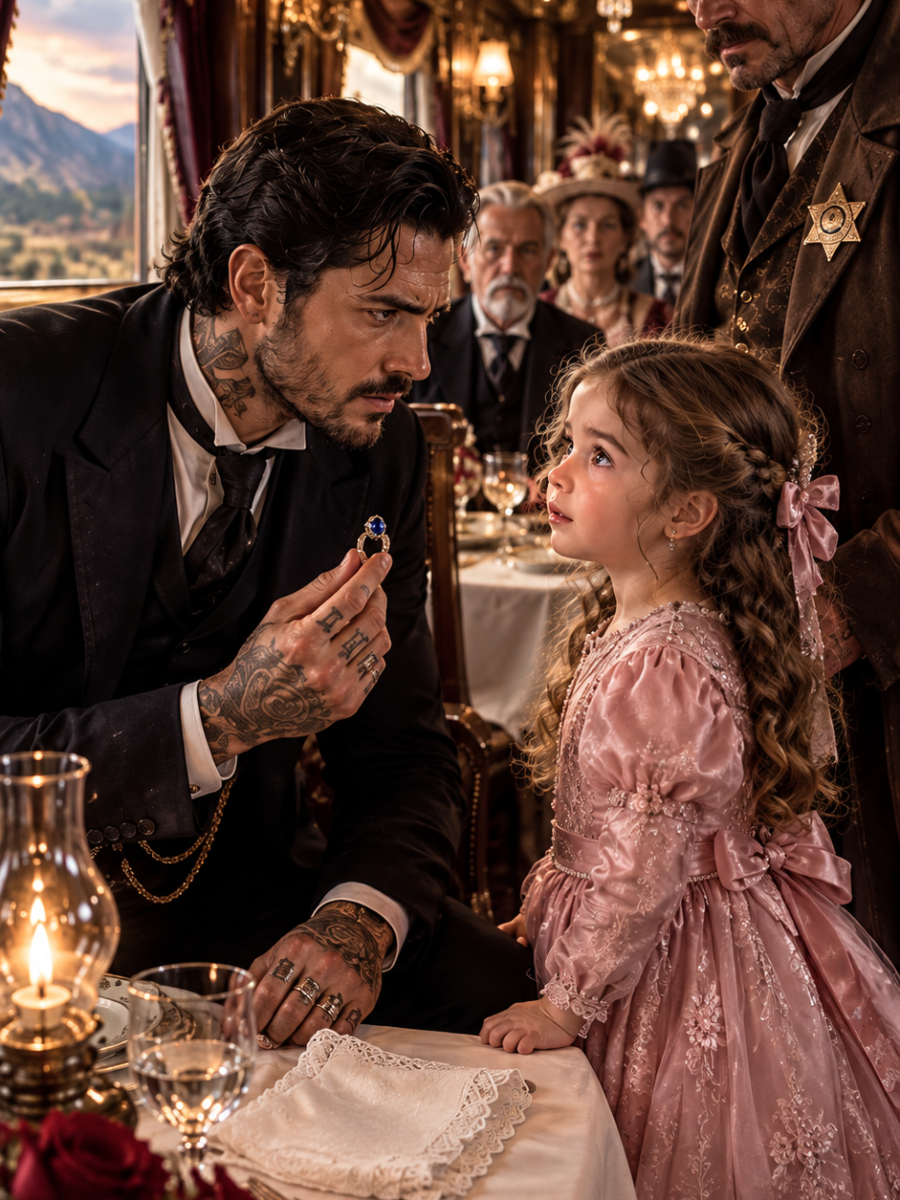
Ruthie Bell stood frozen, her small, dirt-streaked fingers gripping Deputy Thomas Briggs’s sleeve. She wore a faded blue calico dress, a patched wool shawl wrapped around her narrow shoulders, and worn leather boots that had walked miles of red dust. Her dark curls were tangled, but her eyes—wide, golden-hazel, and framed by thick dark lashes—stared up at Nathaniel with a desperate, heartbreaking intensity.
With trembling hands, Ruthie placed a folded white linen handkerchief onto the damask cloth beside Nathaniel’s coffee cup.
Nathaniel frowned, his brow furrowing as he reached out and peeled back the corners of the linen.
Nestled inside was a ring.
It was an antique oval blue sapphire, deep as midnight ocean water, flanked by two seed diamonds and mounted in a hand-carved sterling silver filigree band. Beneath the flickering gaslight, the sapphire flared with an electric blue radiance.
The color drained completely from Nathaniel Crowe’s face. His breath hitched in his throat, and his right hand began to tremble with a violent, uncontrollable tremor.
No. It was impossible.
He knew every millimeter of that silver setting. He knew the tiny, half-moon scratch carved on the left bezel where a jeweler’s chisel had slipped in St. Louis ten years ago. He had spent three months’ salary as a young surveyor to buy that ring. He had placed it on the finger of the only woman he had ever loved—and he had wept over an empty bronze casket when the Overland stagecoach had been crushed beneath a mudslide in the Raton Pass in the spring of 1880.
He had believed that ring was buried fifty feet beneath mountain shale forever.
Nathaniel slowly raised his gaze to the little girl. “Where did you get this?”
Ruthie swallowed hard, tears brimming in her hazel eyes. “It belonged to my mother, sir.”
The word hit Nathaniel harder than a bullet from a Colt .45. He stood up, his heavy oak chair scraping violently against the floorboards.
“Child,” Nathaniel whispered, his voice cracking with a decade of buried agony. “Who is your mother?”
Chapter Two
The Ghost of Raton Pass
Ruthie’s little lip quivered, but her hazel eyes held his without flinching.
“Her name is Evangeline,” the girl whispered. “Evangeline Bell. But she told me… she told me that a long time ago, before the mountains fell, her name was Evangeline Vance.”
A collective murmur rippled through the dining car, but to Nathaniel, all sound ceased. The world narrowed to the tiny ring between his fingers and the child standing before him.
With shaking fingers, he picked up the ring, turning it over under the lamplight to inspect the inner shank. There, worn smooth by years of skin against metal, was the faded cursive engraving he had ordered in St. Louis in the summer of 1879:
“Always, N.C. 1879.”
Nathaniel sank back down onto his chair, his broad chest heaving as if he had just climbed a peak in the Rockies. Evangeline. The brilliant, spirited daughter of surveyor Henry Vance. Nine years ago, when the Overland stagecoach was swept off the precipice at Raton Pass during a flash flood, four bodies were recovered, mangled beyond recognition. A shallow grave had been dug in Cimarron. Nathaniel had stood over the fresh earth in the freezing rain, broken, hollow, swearing he would never open his heart again.
He had poured his grief into dynamite and steel, laying hundreds of miles of track across barren wasteland, building an empire because he had nothing left to live for.
And now, standing in the aisle of his own train, was an eight-year-old child with Evangeline’s hazel eyes, Evangeline’s arched dark brows, and the sapphire ring she had sworn never to take off.
Nathaniel reached out, his calloused palm cupping Ruthie’s trembling cheek with an awe so profound it terrified the surrounding passengers.
“Where is she, Ruthie?” Nathaniel asked, his voice raw, hoarse with emotion. “Where is your mother right now?”
Ruthie’s face crumpled into tears as she buried her head against his wool sleeve: “She’s in the dark stone cellar in Las Vegas town, sir… and the bad men said they’re going to hang her at sunrise.”
Chapter Three
The Deputy’s Secret
Deputy Thomas Briggs stepped forward, removing his sweat-stained Stetson and clutching it nervously against his belt.
“Mr. Crowe,” Briggs began in a low, cautious voice, keeping his eyes on the dining car floor. “I’m the town deputy from San Miguel County. I was given twenty dollars by Judge Silas Thorne and told to put the little girl on this train bound for the Sisters of Mercy orphanage in Santa Fe. I was ordered to throw that handkerchief into the river.”
Nathaniel’s eyes sharpened into two daggers of ice. “Silas Thorne.”
The name tasted like poison. Silas Thorne was the territorial judge and land syndicate boss who ruled the eastern counties with a network of crooked marshals and paid cattlemen. For five years, Thorne had been fighting Nathaniel’s railroad company over the right-of-way through the Silver Creek basin—a mineral-rich valley containing millions in undeveloped silver and timber.
“Why did you keep the ring, Deputy?” Nathaniel asked, rising slowly to his feet until his towering frame cast a heavy shadow over the young lawman.
“Because I’m not a murderer, Mr. Crowe,” Briggs whispered, his voice shaking with righteous defiance. “The girl hid the ring inside the heel of her boot before Thorne’s deputies tore her cabin apart. On the platform in Las Vegas, she showed it to me. She told me her mama said if the iron rails ever reached the territory, to find the man who owned the Crowe Line. She told me your name was on the timetables posted on every depot wall in the county.”
Briggs swallowed hard. “Her mama didn’t murder anybody, sir. Silas Thorne’s men shot the county surveyor three nights ago because the surveyor found the original 1879 Spanish land grant for Silver Creek. Then Thorne pinned the killing on Evangeline, held a kangaroo court at midnight, and signed a hanging warrant for tomorrow morning at 6:00 A.M.”
Nathaniel’s jaw tightened until the bone threatened to crack. He pulled his gold pocket watch from his waistcoat. The hands read 8:42 P.M.
The train was forty miles past Las Vegas, steaming westward toward Albuquerque. To reach Las Vegas by sunrise on horseback was impossible; it was eighty miles of mountain switchbacks across the Sangre de Cristo foothills.
Nathaniel shoved the watch into his pocket, grabbed the conductor’s brass bell cord, and pulled it down with the fury of a thunderclap.
Chapter Four
Reversing the Iron Horse
The screech of iron brake shoes against steel rails screamed through the night.
Plates shattered, wine spilled across linen, and wealthy passengers tumbled against their mahogany seats as the fifty-ton train shuddered to a violent halt in the middle of the dark New Mexico prairie. Outside, steam hissed violently into the cold night wind.
The chief conductor, a silver-haired veteran named Higgins, came sprinting down the aisle, lantern swinging wildly. “Mr. Crowe! Good heavens, sir! What is the meaning of this emergency stop? We have a federal mail schedule to maintain—!”
“Damn the mail, Higgins,” Nathaniel barked, his voice carrying the thunder of a commander on a battlefield. “Where is the nearest rail siding?”
“At the Glorieta spur, sir. Three miles back.”
“We are reversing this train,” Nathaniel commanded without hesitation. “Decouple every passenger coach and sleeper car at the spur. I want only the locomotive, the tender, and my private security coach. Clear the main line back to Las Vegas.”
A wealthy livestock broker stood up, red-faced with outrage. “Crowe, you can’t abandon two hundred passengers on a siding in the wilderness! I have a bank closing in San Francisco on Friday!”
Nathaniel turned on his heel. His gaze was so cold, so terrifying in its lethal stillness, that the broker swallowed his words and backed away against the wood paneling.
“This entire railroad belongs to me, sir,” Nathaniel said in a deadly, even tone. “Every spike, every tie, every engine, and every foot of land beneath your boots. If you speak another word, I will have my men put you off onto the sagebrush on foot.”
He turned to Deputy Briggs. “Take Ruthie into my private salon car. Feed her roasted chicken and warm bread. Briggs, you stay by her side with your revolver unholstered. If anyone approaches her, shoot them.”
Within twenty minutes, the passenger cars were shunted onto the dark Glorieta siding under the care of the station master. The massive 4-4-0 Baldwin steam locomotive, stripped of all extra weight, roared to life.
With black coal smoke billowing into the star-studded desert sky, the locomotive reversed its drive wheels and surged eastward into the night at sixty miles an hour—a metal beast tearing across the desert to save a ghost.
Chapter Five
The Web of Judge Thorne
Inside the velvet-appointed private parlor car, the stove crackled with dry cedar, filling the warm air with the scent of woodsmoke and coffee.
Ruthie sat nestled in a deep leather armchair, her little boots pulled up onto the cushion, hungrily eating a plate of roasted chicken and biscuits. In her lap lay the folded linen handkerchief, the blue sapphire ring safely tucked inside Nathaniel’s breast pocket over his racing heart.
Nathaniel sat across from her, his broad shoulders leaning forward, watching her with an intensity that bordered on reverence.
“Ruthie,” Nathaniel asked softly. “How did your mother survive the stagecoach in the Raton Pass? Tell me everything.”
Ruthie wiped her mouth with the back of her sleeve, her hazel eyes glistening under the brass lamps. “Mama said her father smelled the burning axle grease before the pass. He knew someone had tampered with the stagecoach wheels. When the coach slowed near the river bend, he threw Mama out into the wild plum bushes just before the bridge gave way.”
Nathaniel’s breath caught. Henry Vance had sacrificed his life to throw his daughter clear of the sabotage.
“Mama was hurt,” Ruthie continued in a hushed whisper. “A Mexican sheepherder family found her in the canyon and nursed her for months. But when she finally woke up, Silas Thorne had already claimed her father’s silver mines, showing forged deeds. Thorne told the territory that the Vance family was dead. Mama knew if she went to the law, Thorne would finish what he started. So she took her mother’s maiden name—Bell. She lived in a sod cabin near the creek, taking in laundry and teaching ranch children to read.”
Ruthie reached beneath her woolen shawl, her small fingers feeling along the stitched lining of her calico dress. “Mama gave me this two nights ago, right before Thorne’s marshals kicked down our door.”
With careful, deliberate precision, Ruthie pulled loose a folded sheet of heavy oilcloth from a slit in the fabric.
Nathaniel unfolded the document on the mahogany desk. It was the original 1879 patent grant for the Silver Creek basin, bearing the sovereign seal of the United States Department of the Interior—and beneath it were the co-signatures of Henry Vance and surveyor Nathaniel Crowe.
All of it had been planned nine years ago. Silas Thorne had murdered Evangeline’s father to steal an empire of silver, believing the girl was buried in the mudslide.
Nathaniel’s fingers traced the faded ink, his jaw hardening into obsidian: “Nine years she lived in hiding while Thorne grew fat on her father’s silver. Tonight, Silas Thorne pays his debt in full.”
Chapter Six
Midnight at the Old Plaza
At 4:15 A.M., the roaring Baldwin locomotive screeched into the rail depot of Las Vegas, New Mexico.
The whistle wailed like an enraged beast, shattering the silence of the sleeping town. Coal smoke rolled across the tracks in heavy black fog as Nathaniel Crowe stepped down from the iron cowcatcher, flanked by Deputy Briggs and eight veteran private railroad guards armed with repeating Winchester rifles and double-barreled shotguns.
The town plaza was dark, illuminated only by swaying kerosene lanterns hanging outside the stone county courthouse. A makeshift gallows of raw pine lumber stood in the center of the dirt square, its fresh hemp rope dangling ominously in the freezing morning breeze.
Six armed men—Thorne’s hired ruffians wearing tin marshal stars—stood outside the heavy oak doors of the county jailhouse, passing a whiskey jug between them. When the heavy boots of Nathaniel’s squad crunched across the frozen gravel, the ruffians froze, reaching for their holsters.
“Hold it right there!” one of the gunmen shouted, thumbing the hammer of his Colt. “This is a closed county execution by order of Judge Silas Thorne!”
Nathaniel did not slow his stride. He walked straight into the yellow circle of lantern light, his heavy wool coat open, his silver pocket watch chain glinting against his dark vest. In his right hand, he carried a 12-gauge Remington shotgun, leveled squarely from his hip.
“Drop the iron, boys,” Nathaniel said, his voice flat, low, and echoing off the adobe walls like rolling artillery. “Or your mothers will be collecting your boots before the sun hits the plaza.”
From the courthouse steps, a portly man in a beaver-felt coat and silk cravat stepped into view, clutching a leather dossier. Silas Thorne.
“Crowe!” Thorne sneered, his florid face contorting with panic. “What in God’s name are you doing in my county? You have no jurisdiction here! The woman inside was tried and convicted by a legal territorial jury!”
Nathaniel raised his left hand, opening his palm under the lantern light to reveal the blue sapphire ring: “You built your fortune on a murdered surveyor, Silas. But you forgot that the dead have a way of remembering.”
Chapter Seven
The Reckoning in Stone
Thorne’s hired gunmen looked at the ring, then looked at the nine Winchester rifles aimed with clinical precision at their chests. One by one, their hands left their gun belts. The first pistol hit the dirt with a hollow thud; five more followed in rapid succession.
“Cowards!” Thorne screamed, backing toward the courthouse steps. “I am the territorial law! The Governor appointed me—!”
Deputy Briggs stepped forward, snapping heavy steel cuffs over Thorne’s wrists with a sharp, concussive click. “The Governor didn’t sign off on murder, Silas. And federal marshals are boarding the train at Lamy right now.”
Nathaniel didn’t waste another second on Thorne. He grabbed a heavy iron sledgehammer from the tool crate beside the gallows, strode to the reinforced oak door of the stone jailhouse, and brought the sledge down against the iron lock with bone-jarring force.
The lock shattered. The heavy door groaned inward.
Nathaniel walked down the damp stone corridor, the smell of lime and cold earth thick in the air. At the far end of the cell block, behind rusted iron bars, a woman was kneeling on the straw floor in prayer, her slender frame wrapped in a tattered gray blanket.
Her dark hair fell across her shoulders, streaked with dust. Her wrists were bruised from iron shackles.
Nathaniel’s boots stopped outside the bars. The sledgehammer slipped from his fingers, clattering against the flagstones.
The woman turned. Her hazel-gold eyes, tired and sunken with sleepless terror, met his across the lantern light.
For nine years, Nathaniel had seen those eyes in every dream, in every mountain fog, in every sunset over the plains.
“Nathaniel…” she whispered, her voice barely a breath against the cold stone.
“Evangeline,” Nathaniel choked out, falling to his knees before the iron grate. He reached through the bars, his trembling fingers cupping her cold, tear-streaked face. “I’m here. My God, Evangeline… I’m here.”
Evangeline pressed her cheek into his palm, weeping with the raw, soul-shattering relief of someone who had survived nine years in purgatory. “Ruthie… where is my baby? Did she find you?”
From the doorway of the corridor, small footsteps ran across the stone. “Mama!” Ruthie cried, throwing her little arms through the bars.
Chapter Eight
The Morning Train to Santa Fe
By 6:30 A.M., the eastern horizon was ablaze with violet, rose, and molten gold.
The gallows in the plaza had been dismantled by the townsfolk. Silas Thorne and his deputies were locked inside the very cells they had kept for their victims, awaiting the federal territorial transport wagon. The forged deeds were revoked; the Silver Creek basin was restored by territorial decree to the rightful heir of Henry Vance.
Inside Nathaniel Crowe’s private Pullman parlor car, the Santa Fe Express steamed gently westward toward Santa Fe under a clear, azure autumn sky.
Evangeline sat on the plush velvet sofa by the window, dressed in a clean, soft wool traveling gown that Nathaniel’s staff had prepared for her. Her hair was brushed, shining like polished chestnut in the morning sun. On her left ring finger, the antique blue sapphire ring rested once more, catching the desert light like a brilliant blue flame.
Beside her sat eight-year-old Ruthie, happily spooning warm peaches and cream from a silver bowl, her little calico dress smoothed down, her dark curls gleaming.
Nathaniel walked into the parlor, setting down two porcelain cups of steaming coffee on the mahogany table. He sat on the cushion beside Evangeline, his large, scarred hand gently closing over hers.
Evangeline looked at him, tears of quiet wonder glistening in her eyes. “I wanted to send for you a hundred times, Nathaniel. But every newspaper said you were in Chicago, in New York, building empires. I was so afraid Thorne’s men would track you… that they would hurt you because of what my father discovered.”
“I spent nine years building tracks through mountains, Evangeline,” Nathaniel murmured, his voice thick with unashamed emotion. “And all this time, I was only trying to find my way back to you.”
Ruthie looked up from her peaches, wiping a milk mustache with the back of her hand. She looked at Nathaniel, her hazel eyes identical to the woman beside him.
“Mr. Nathaniel?” she asked timidly.
Nathaniel looked down at the eight-year-old child who had crossed sixty miles of hostile territory to save her mother. He calculated the months in his mind—the Raton Pass collapse in May of 1880, Ruthie’s birth eight months later in January of 1881. The golden hazel eyes, the stubborn chin, the quiet courage.
A slow, breathtaking smile broke across Nathaniel’s weathered face—the first genuine smile anyone in the territory had seen on the railroad baron in a decade.
“You don’t have to call me Mr. Nathaniel anymore, princess,” he whispered, lifting the little girl gently into his lap and wrapping his arms around both mother and daughter.
Ruthie’s eyes widened with wonder. “What do I call you?”
“You call me Papa,” Nathaniel promised softly, kissing her forehead as the train whistled through the mountain pass toward home. “Always.”