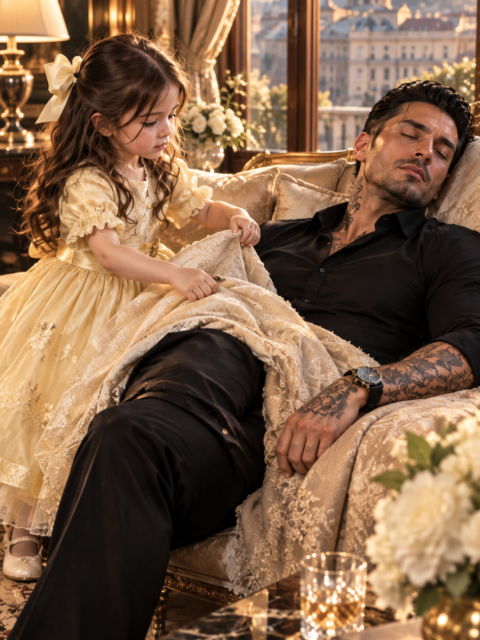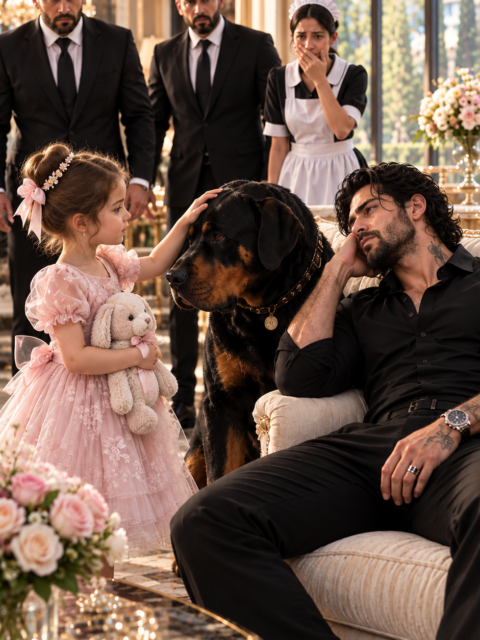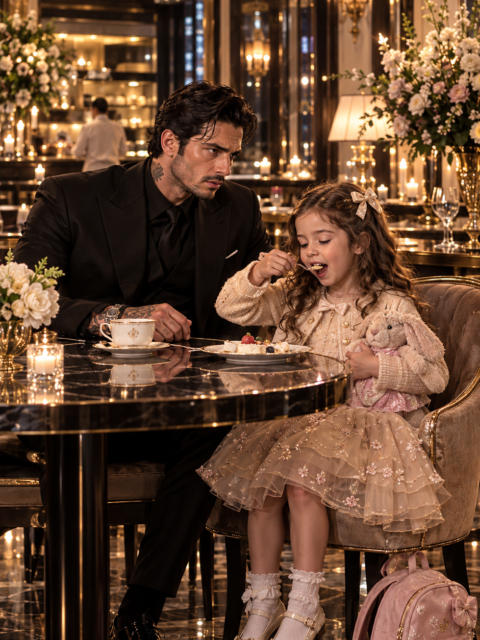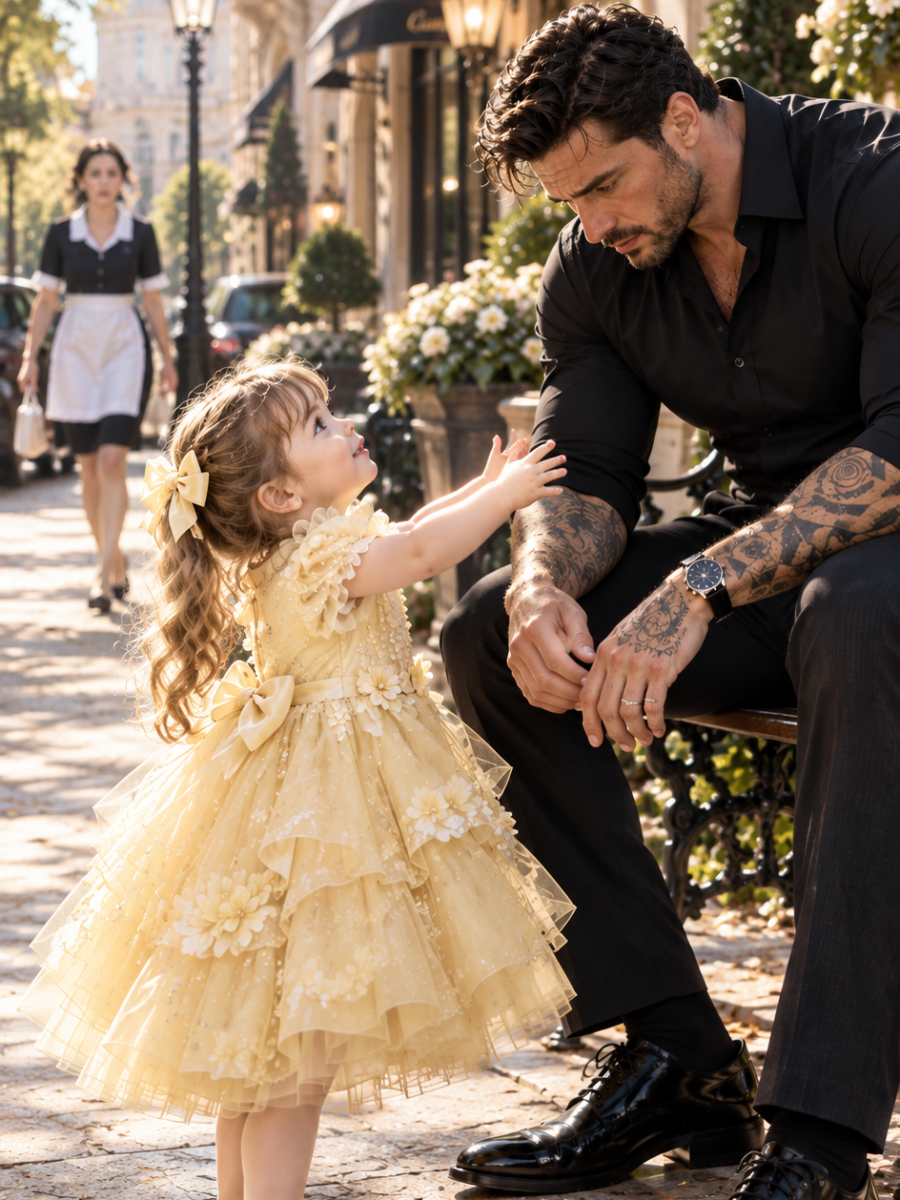
“Did You Feel That?” The Paralyzed Mafia King Hadn’t Moved His Legs in Eight Years — Until a Little Girl Wearing His Dead Wife’s Necklace Walked Into His Forbidden Garden
I’m Caleb Marino. Some people call me the Harbor King. For eight years my legs were dead and ninety-nine doctors said there was no hope. Then a muddy-sneakered little girl danced in my winter garden, my right foot moved one inch, and I saw my dead wife’s necklace around her neck. Read every chapter to find out who lied to me about my child, and what they were willing to do to keep it buried.
The Forbidden Garden
“Did you feel that?” the little girl whispered.
I couldn’t answer. For eight years, my legs had been dead. Ninety-nine doctors had told me there was nothing left to save. No treatment. No miracle. No reason to hope. Yet my right foot had just moved. One inch. And the child standing in front of me was wearing my dead wife’s necklace.
My name is Caleb Marino. Some people call me the Harbor King. Others are too afraid to call me anything at all.
I built my life around control. Every room in my mansion was designed to expose danger. No dark corners. No hidden exits. No place where an enemy could breathe without my security team knowing. The winter garden was no exception. A glass ceiling opened to the sky. Marble fountains echoed between rows of imported trees. Everything was beautiful, expensive, and controlled, just like my life had once been.
Then came the accident. I woke in a hospital bed unable to move my legs. Doctors spoke carefully about spinal damage and permanent paralysis, and their voices blurred together, because somewhere else in that same hospital, my wife Audrey was dying. She had been giving birth. Men in suits eventually came to my room and told me she was gone. Then they told me our baby hadn’t survived either.
I never saw the child. Maybe I should have demanded to. Maybe the man I had been before the accident would have torn that hospital apart until someone showed me the truth. But grief hollowed me out. For eight years, I accepted what I had been told. My wheelchair became another kind of prison, teaching me that even powerful men could lose everything overnight.
Then, at exactly 3:47 on a Tuesday afternoon, a little girl walked into my forbidden garden.
She was tiny, fearless, and completely unimpressed by the armed guards surrounding me. Mud covered her sneakers as she stepped across marble worth more than most homes. An older boy followed her, his face pale with terror. The girl looked directly at me and frowned.
“Mister,” she said, “your face looks like a statue somebody forgot to finish.”
One of my guards reached for his radio. I raised one finger. He stopped. “What’s your name?”
“Lily.”
Before anyone could react, Lily pulled a speaker from her hoodie. Music burst through the garden. Then she started dancing. Badly. She spun between the fountains, slid across the marble, and pretended she was selling hot dogs at an imaginary baseball game. My guards stood frozen. The older boy looked like he might faint.
And somehow, against everything inside me, I laughed. The sound tore out of my chest like something escaping a locked room. I hadn’t laughed since Audrey died.
Then I felt something. My smile disappeared. I looked down, and my right foot moved. Only an inch. But after eight years of absolute silence from my legs, that inch felt like the earth had shifted beneath me.
Nobody spoke. Every guard stared at my shoe. I stared at Lily. She had stopped dancing. Her hazel eyes locked onto mine, and there was something in her expression that struck me harder than any bullet ever had. Recognition.
“Did you feel that?” she whispered.
Then sunlight caught something around her neck. A thin silver chain. A small pendant. I knew every scratch on it, because I had fastened that necklace around Audrey’s neck myself, the night before the accident.
“Lily,” I whispered, struggling to breathe. “Where did you get that necklace?”
Her hand closed around the pendant. Behind her, the older boy went completely still. One of my guards slowly reached inside his jacket.
In that moment, I understood something that made eight years of grief collapse beneath me. Lily had not wandered into my garden by accident. Someone had lied to me about my child.
Back to top ↑
The Guard’s Hand
“Tom,” I said quietly. “Take your hand out of your jacket.”
The guard did not move. His name was Tom Baxter. He was thirty-five, square-jawed and silent, the third man in my security detail, and he had stood behind my chair for four years. I had trusted him with my life. I had never, until that moment, looked at his hands.
He was sweating. A single bead ran down the side of his face, and the winter garden was cool.
“Mr. Marino,” he said carefully. “The child is a security breach. I need to remove her.”
“She’s eight years old.”
“Sir, with respect—”
“Reggie.”
The second guard, a huge, soft-spoken man named Reginald Pike who had once carried me up a flight of stairs after a car broke down, stepped smoothly behind Tom. I did not see him move. I only saw the barrel of a pistol come out of Tom’s jacket an inch and a half, and Reggie’s enormous hand close around the wrist.
“Drop it,” said Reggie, mildly, in my ear. It was not a request.
The gun hit the marble. The older boy made a small, strangled sound. Lily had not flinched. She stood with one hand on the pendant and the other balled into a fist, glaring up at Tom with a ferocity that made me think of a very small, very angry cat.
“He’s the one,” she announced. “The man in the black car. He was at Grandma’s funeral.”
Tom lunged. It was clumsy and desperate, and it did not get him two steps. Reggie caught his collar and slammed him against a fountain, and the water erupted over both of them. By the time the other guards had their weapons out, Tom Baxter was on his knees on the wet marble with his arms behind his back and his face bleeding from one cheek.
“Take him to the cellar,” I said. “Nobody talks to him until I do.”
They dragged him out. The garden settled slowly into silence, broken only by the trickle of the fountains. I realized that my hands were shaking. I realized that my right foot was still resting an inch to the left of where I had left it.
I turned the chair slowly toward the children. “Come here.”
Lily came. The older boy followed, his hand on her shoulder. He was perhaps twelve, thin and dark-haired, in a too-large coat. He had the pinched, watchful face of a child who has been looking after someone smaller for a very long time.
“What’s your name?” I asked him.
“Noah, sir.” His voice cracked. “Noah Doyle. I’m sorry. I told her we shouldn’t come. She wouldn’t listen.”
“I had to,” said Lily. “Grandma said.”
“Who is Grandma?”
“Margaret.” Lily’s chin quivered, the first sign of anything but bravado. “She died. Three weeks ago. And she said if anything happened to her, I had to give the man in the chair a letter.”
She reached into her hoodie pocket and drew out a small, wrinkled envelope, soft with handling. She held it out to me with both hands, as though it were something that might spill.
I took it. My name was written across the front, in an elegant, shaking hand I had never seen. Mr. Caleb Marino. The Harbor King. To be given to him alone.
Back to top ↑
Margaret’s Letter
I read it in my study, alone, with the door locked and the children eating grilled cheese sandwiches in the kitchen under the watchful eye of Reggie Pike.
Dear Mr. Marino. My name is Margaret Doyle. Eight years ago, I was a night nurse at St. Anne’s Hospital in Brooklyn. I am writing this because I am sick, and I do not have long. I have carried a terrible secret for eight years, and I would like to put it down before I die.
On the night of March ninth, a woman named Audrey Marino was brought to our maternity ward in labor. She had been in an automobile accident. She was bleeding, and frightened, and she kept asking for her husband. I was the nurse on duty. I held her hand.
Your daughter was born at 11:52 p.m. She was small and perfect and she cried at once. Your wife held her for four minutes. In that time, she took off the silver necklace she was wearing, the one with the little anchor, and put it in the baby’s blanket. She said, “Tell Caleb I loved him. Tell him her name is Lily.”
Then she began to bleed again.
I stopped reading. I put my hand flat against the desk. The room had gone very still, and in the quiet I could hear the tick of the clock and the thudding of my own heart.
I do not know what I would have done if I had been left alone. But I was not. At midnight, a doctor came in. A tall man named Dr. Wallace Prewitt. He was not our regular obstetrician. He told the other nurses to leave. He said he would take over.
I stayed. I do not know why. Something in his face frightened me. I stood in the corner of the room, behind a curtain, and I watched him. He did not treat her. He stood at the foot of the bed with his arms folded, and he waited. Your wife looked at him and said, “Please.” And he said, “I’m sorry, Mrs. Marino. I have my instructions.”
My eyes were burning. I could not see the page.
She died at 12:40. Another man came in then, in a dark suit, and said that the baby must be taken to a private facility. He said it was for the baby’s protection. I could not stop him. But I followed. I saw him walk to the loading dock. I saw him put the child in a gray van and give a name to the driver, and the name was not yours.
I did what I should have done. I took the baby back. It was not difficult. The driver was a boy, and he was afraid, and I had a scalpel in my pocket and a face that looked, to him, like his own mother’s. I took her home. I called her Lily. I raised her with my grandson, Noah, as though she were my own.
I do not know who gave the order. I know only what the man in the suit said, as he left the room. “Rafael will want to know it’s done.”
My brother’s name. I read it once, then twice, and the word did not change. Rafael Marino. My younger brother. The man who had run my business for eight years while I sat in a chair. The man who had stood beside me at Audrey’s funeral and wept.
Back to top ↑
Eight Years of Silence
I sat for a long time in the dark, with the letter in my lap and my right foot resting on the footplate, an inch to the left of where it belonged.
I tried to remember the accident. I had spent eight years trying not to. A wet night on the harbor road, rain slanting through the headlights, Audrey beside me with one hand pressed to her swollen belly and a laugh on her lips. She had been eight months pregnant and wanted pickles, and I had turned off the highway to find a late-night grocer. I remember the brakes. I remember the pedal going soft under my foot, like a sponge. I remember the guardrail, and a long, slow tumble, and then nothing at all.
The police had called it a mechanical failure. The mechanic who had serviced the car, a man named Dino, had died of a heart attack two weeks later.
I had never thought to ask why.
I pressed the intercom. “Dominic. Come to my study.”
Dominic Vega had been my father’s consigliere, and then mine. He was seventy, silver-haired, thin as a heron, with the quiet, courteous manner of a man who has outlived most of his enemies. He came in with a cane and sat down across from me, and I handed him the letter without a word.
He read it very slowly. When he finished, he folded it along its creases and laid it on the desk. His hands were trembling. I had never seen that before.
“Caleb,” he said. “I did not know.”
“Did you sign the papers?”
“Which papers?”
“At the hospital. The death certificate. The one that said the baby died.”
He closed his eyes. “Rafael brought them. He said you were in no condition to read them. He said the doctors had advised him to take care of everything. I was grieving too, my boy. I did not look.” His voice broke. “I buried an empty box.”
I had stood at that grave. I had thrown a handful of earth on a casket the size of a bread box. I had said goodbye to a child who was, at that moment, three miles away in a Brooklyn kitchen, eating cereal.
The rage, when it came, was not what I had expected. It was not hot. It was cold, slow, and clear, like a cell door finally unlocking.
“Rafael has been running the harbor for eight years,” I said. “He has every account. Every route. Every man.”
“Yes.”
“If I’d had a daughter, a living heir, he would never have held it.”
“No.” Dominic looked at his hands. “Caleb. What do you intend to do?”
I looked at the clock. It was nearly six. In forty minutes, as he did every Tuesday night for eight years, my brother would walk through the front door, kiss my cheek, and sit down at my table.
“I’m going to have dinner,” I said.
It was then that a small knock came at the door. It opened a crack. Lily’s face appeared, rimmed with a cloud of dark curls, with a smear of cheese on her chin.
“Mister Caleb? Noah says you’re not allowed to be sad on an empty stomach.”
I held out my arms. I did not know I was going to. She crossed the study in four steps and climbed into my lap, and I put my face into her hair, and she smelled of grilled cheese and rain and my wife’s shampoo. And beneath me, in the dark, my right foot twitched again.
Back to top ↑
Dinner With My Brother
Rafael arrived at 6:40, as he always did, in a charcoal suit and a silk tie, with a bottle of Barolo under his arm. He was thirty-nine, five years younger than me, handsome in a dark, easy, boyish way, with our mother’s smile and none of our father’s temper. He kissed my cheek in the hall. He asked about my health. He smelled of cologne and cigar smoke and the sea.
I had loved him all my life.
We sat down at the long table in the dining room. Dominic took his place at my left. Two guards stood by the door. And at the far end, in a chair so large that her feet did not touch the floor, sat a small girl in a clean yellow sweater, with her curls pulled back in a ribbon and a napkin tucked under her chin.
Rafael stopped with the wine bottle halfway to the table.
“Who’s this?”
“A guest,” I said. “Margaret Doyle’s granddaughter. Her grandmother was a friend of Audrey’s. She died last month. The child had nowhere to go.”
It was a lie, and I told it well. I have told a great many in my life.
My brother smiled. It was a warm, charming, perfectly natural smile. But I was watching his hand. The hand that held the wine bottle was shaking, just slightly, so that the Barolo slopped against the glass.
“How kind of you,” said Rafael. “How is she?”
“Why don’t you ask her?”
Lily had put down her fork. She was staring at Rafael with a look I knew. I had seen it on Audrey’s face a hundred times, in the instant before she said something devastatingly true.
“You sent the flowers,” she said.
Rafael blinked. “I’m sorry?”
“To Grandma’s funeral. They were white lilies, and they had a black card. Nobody knew who it was from.” Her voice was clear and high and entirely without fear. “And then a man in a black car sat outside our house for three days.”
The room went silent. Rafael laughed. It was a very small laugh. “Children have such imaginations.”
“I’m not imagining.” Lily put both hands on the table. “My grandma said a man called Rafael wanted me gone. She said he’s the reason I don’t have a mommy.”
Rafael’s smile had frozen on his face. In the corner of my eye, I saw Dominic reach slowly into his pocket and press a button on his cane.
“Caleb,” said my brother. His voice had changed. “What is this?”
I did not answer. I looked at the necklace around Lily’s throat, the little silver anchor, glinting in the candlelight. Rafael looked at it too. I watched his eyes find it. And I watched every drop of color leave his face.
“It’s Audrey’s,” he whispered.
“Yes.”
“Where did she—”
“Where do you think?”
For one long second, we looked at each other across the table, two brothers, thirty-nine and forty-four, who had grown up sharing a bedroom and a bicycle and a single, terrible father. I saw him understand. And I saw him decide.
“I have to take a call,” said Rafael, softly, and set down the wine. He rose. He walked out of my dining room without looking back. And ten minutes later, the lights of the mansion went out.
Back to top ↑
The Night Visitors
I had designed that house to be impossible to surprise. No dark corners. No hidden exits. Every hallway lit, every door wired, every room built so that an enemy had nowhere to stand without being seen. It had never occurred to me that the weakness might be the man who held the master switch.
The power failed at 7:52. The emergency generators did not engage. It was the first thing I noticed. In the blackness, I heard a sound I had not heard in years. A long, slow metallic click, repeated in a dozen places, as armed men moved into position.
“Reggie.”
“Here, boss.” His huge voice was in my ear. “Eight of Rafael’s boys. They came through the service entrance. Tom let them in before we caught him. They’re in the east wing.”
“Where are the children?”
“Noah took the girl upstairs. I told him to lock the door of the nursery.”
The nursery. I had kept it closed for eight years. I had never opened it. It was at the end of the second-floor corridor, painted pale yellow, with a crib I had bought three days before the accident. I had not let anyone near it. And my ten-year-old Noah, in his too-big coat, had taken my daughter there to hide.
I turned my chair and wheeled toward the door.
The elevator was dead. The stairs were thirty-four steps. I had not climbed them in eight years. I stopped at the bottom, with my hands on the wheels and my pulse thudding in my ears, and listened. From above came the creak of boards, a whisper, a door opening.
“Dominic,” I said. “Hold the hall.”
“Caleb, you cannot—”
“Hold it.”
I took hold of the banister. I did not decide to do it. My arms simply did what they had trained for eight years to do, and pulled. I hauled myself out of the chair with both hands, and for one long moment I hung there, with my weight on the rail and my useless legs dangling beneath me.
Then I put my feet on the floor.
I felt them. I swear to God, I felt them. The cold of the marble. The ache of ankles that had forgotten they existed. The sharp, bright, impossible sting of blood returning to a place long dead. My knees shook. My right thigh spasmed. But they held.
I stood.
It lasted perhaps four seconds. It was enough. I took one step, and then another, dragging my left leg like a chain, with my knuckles white on the banister. A man appeared at the top of the stairs. A dark shape, a pistol, a flash of teeth. He was looking at the empty wheelchair behind me, and he did not understand what he was seeing.
“Put it down,” I said.
He fired.
I did not feel the bullet. It struck the post beside my hand and showered me with splinters. And then Reggie Pike, who had been moving through the dark for thirty seconds on enormous silent feet, came up the stairs behind him and took him out like a sack of potatoes.
The fight did not last long. Rafael’s men had expected a crippled man and four guards. They had not expected two hundred feet of well-lit corridors, a consigliere with a cane that fired, and a boy of twelve with a baseball bat. Noah stood in the nursery doorway, white-faced and shaking, with his arms wrapped around Lily and the bat clutched in one fist like a lance.
“I didn’t hit anyone,” he said, in a small voice. “I wanted to.”
By eight-fifteen, the mansion was quiet. Seven of Rafael’s men were bound in the front hall. The eighth had fled by water. And at the edge of the harbor, in a gray van with its engine running, my brother was waiting for a report that would never come.
Back to top ↑
What a Brother Owes
I found him on the pier at the old Marino warehouse, in the cold, with the wind coming off the water and the lights of the harbor smearing across the black. He stood by the edge in his charcoal suit, with his hands in his pockets. He did not turn when he heard my cane.
I had been walking for three hours. They had given me a cane, and Dr. Okafor, a surgeon I had called at nine that night, had arrived at the mansion with a portable scanner and a face I will remember for the rest of my life. She had run it over my spine for twenty minutes. At the end, she had put it down, and said, “Mr. Marino, I don’t know how to explain this. The nerve pathways were never severed. There’s a lesion, but it’s functional. Not structural. I think your spine has been waiting.”
“For what?”
“For you to give it a reason.”
I stood now behind my brother with a cane in my right hand and my left leg trembling, and I said his name.
“Rafael.”
He laughed, softly, without turning. “You’re standing up.”
“Yes.”
“I should have known. You always did know how to make an entrance.” He shook his head. “Eight years, Caleb. I kept waiting for it to happen. Every year, I thought, this is the year he walks.”
“Why?”
It was the only thing I wanted to know. Not the how. Not the who. Only the why. He turned then. In the glare of the dock lights, his face was haggard, older than I remembered, and there was something in it that I had never seen before. Not triumph. Not guilt. Something closer to relief.
“Because you were going to leave me nothing,” said my brother. “That’s the truth. You never said it, but I knew. Dad left it all to you. You were the firstborn, the golden one, the king. And I was the spare. I did the dirty work, and I smiled, and I waited.” He drew a breath. “And then Audrey got pregnant. And I thought, there goes the last chance. A son. A daughter. Whatever it was, it would have taken everything.”
“So you killed her.”
“I didn’t. God, Caleb. I swear on Mama’s grave. I never wanted Audrey dead.” His voice broke. “The brakes were supposed to give you a scare. A broken leg. A few weeks in the hospital. A reason for me to step in. I told Prewitt to keep the baby away from you until you’d recovered. That was all.” He looked at his hands. “I didn’t know the crash would be that bad. I didn’t know about the bleeding. By the time I understood, it was too late, and I’d already signed.”
The wind off the water was bitter. Somewhere behind us, a police siren began to rise.
“You could have told me.”
“And watch you look at me the way you’re looking at me now?” His smile was terrible. “I’d rather have died.”
I took one step forward, and then another. My left leg shook. My brother watched me come. And when I was close enough to touch, I held out my hand. Not in forgiveness. I did not have it in me. But something older than forgiveness, something that had been born in a shared bedroom thirty-five years ago.
“Come with me,” I said. “Turn yourself in. Tell them everything. Prewitt, the brakes, the van. If you do, you’ll live.”
He stared at my hand. For a long time, he did not move.
The sirens were on the pier now, blue light washing across the water. “You always were better than me,” said Rafael, quietly. And he took my hand.
Back to top ↑
Unfinished
The DNA results came back on a Thursday. Ninety-nine point nine nine percent. I did not need them. I had known since the moment I saw the necklace. But I framed the printout anyway, and hung it in my study, next to the photograph of a woman with a laugh on her lips and a baby’s blanket in her arms.
Rafael pleaded guilty to conspiracy, kidnapping, and obstruction. Dr. Wallace Prewitt, who had been practicing in a small Florida town under a new name, was arrested in his kitchen in his bathrobe. Between them, they gave the district attorney nine other names, three cold cases, and the location of a warehouse full of falsified hospital records. My brother was sentenced to eighteen years. He asked me, at the end, to look after the cufflinks Mama had given him. I do.
I did not sell the harbor. I could have. But I have learned, in the past two years, that there is a difference between holding power and being held by it. I closed the casinos. I opened a maritime school. I am told that it is the only mafia boss in American history to leave his organization to a nonprofit board, and I am told it was in the New York Times, though I did not read the article.
Margaret Doyle is buried in the little churchyard in Brooklyn. I visit her on Sundays, with Lily, who carries a pot of marigolds and lectures the headstone in great detail about school. I have never been able to thank her. I do what I can. There is a scholarship at St. Anne’s Hospital for night nurses, in her name. There is a bench in the garden.
The rehabilitation took two years. It was long, and humbling, and I will not describe it. There were days when I could not lift my leg. There were days when I wept in front of a physical therapist half my age, a patient, sardonic woman named Priya, who handed me a tissue and told me to do it again. There were parallel bars. There was a walker. There was a cane, and then a second cane, and then one.
I walk with a limp. I always will. But I walk.
Noah lives with us now. His mother died years ago, and his grandmother’s savings had run out. He is thirteen, and tall, and quiet, and he is the finest older brother a girl could ask for. I have adopted him. He did not say much about it. He only stood in the study with his hands in his pockets, and said, “Okay.” Then he went to his room and did not come out until dinner. I have since learned that this is how Noah says thank you.
On the second anniversary of the day in the garden, I took them both to see Audrey.
It was a clear day in March, with a thin cold sun and the first green on the trees. I walked from the car to the grave with my cane in my hand, and Lily’s hand in the other. She was wearing the silver anchor. She had worn it every day. I had offered to have it cleaned. She had refused, firmly, on the grounds that Mommy liked it dirty.
We stood in front of the stone. It was a plain gray marble. Audrey Marino. Beloved wife and mother. I had added the last two words a year ago.
“Hi, Mommy,” said Lily. She was not sad. She was talking the way one talks to an old friend. “I’m eight and three-quarters. I can do a cartwheel. Daddy can walk. He’s very slow, but he does it. He cries sometimes.”
“I do not,” I said.
“You do.” She glanced up at me, her hazel eyes bright. “It’s okay. Mommy says that’s allowed.”
I knelt, carefully, with one hand on the stone. My knee ached. I laid a single white rose at the foot of the grave, and for a long moment, I could not speak.
When I stood, Lily was studying me with her head tilted. She had the same look she had worn that first day in the garden. Grave, thoughtful, entirely unafraid.
“Daddy,” she said. “Remember what I said? When we met?”
“You said my face looked like a statue somebody forgot to finish.”
“Yes.” She nodded, satisfied. She stepped forward, put both small arms around my waist, and pressed her cheek against my chest. “You’re finished now.”
I do not know how long we stood there. A breeze moved through the cemetery. Somewhere, a bird began to sing. And in the spring sunlight, with a child in my arms and a dead woman’s blessing on my shoulders, the Harbor King, the man whose name people were afraid to say, stood on his own two feet, and wept.
More Trending Stories You Can’t Put Down