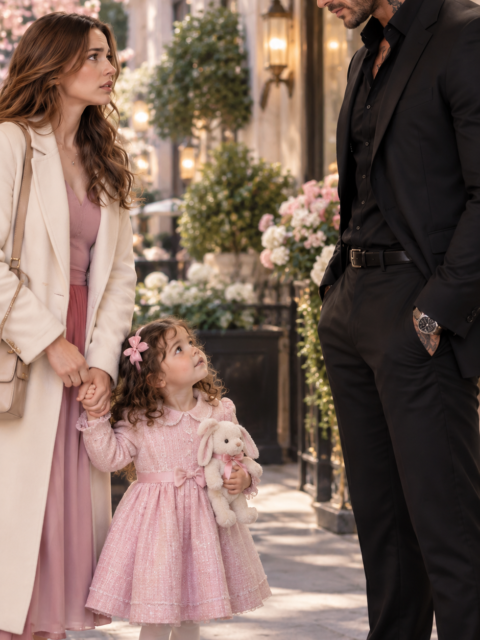
My 3-Year-Old Wandered Into the Forbidden Study and Mocked the Most Feared Man in New York to His Face
Claire broke both unspoken rules of the Castalano estate in a single desperate morning: never enter Vincent’s study, and never bring a child to work. Then her daughter Mia copied his terrifying scowl perfectly, eyebrow twitch and all, and the most feared man Claire had ever worked for knelt down to answer her instead of firing her mother on the spot. Read every chapter to find out what Vincent said, and what grew from that impossible morning.
You Look Mad
My three-year-old daughter wandered into the forbidden study of Vincent Castalano, the most feared man I had ever worked for, looked straight at his terrifying expression, and mocked it perfectly to his face. I was certain I was about to lose my job, until Vincent did something so unexpected that every hardened man in that room struggled not to laugh.
The coffee cup was trembling in my hand when Mia’s tiny voice floated through the open study door. “You look mad.” My blood went cold.
There were two rules every employee in the Castalano estate understood without needing them repeated: never enter Mr. Castalano’s study unless summoned, and never bring a child to work. That morning, I had broken both.
My babysitter had called at 5:54 a.m., sick with a stomach virus. My sister was working a nursing shift, emergency daycare wanted seventy dollars I didn’t have, and missing work meant risking rent money.
So I dressed Mia in her yellow sundress, packed crayons and crackers, and prayed Vincent would spend the day in Manhattan.
He came home at 8:40. By nine, Mia had disappeared from the laundry room. Now she was standing in front of him.
Vincent towered behind his massive oak desk in a charcoal suit, while Renzo Moretti and two security guards watched in absolute silence. His eyebrows lowered, his mouth tightened, and his head tilted slightly.
I knew that look. Men twice my size feared that look.
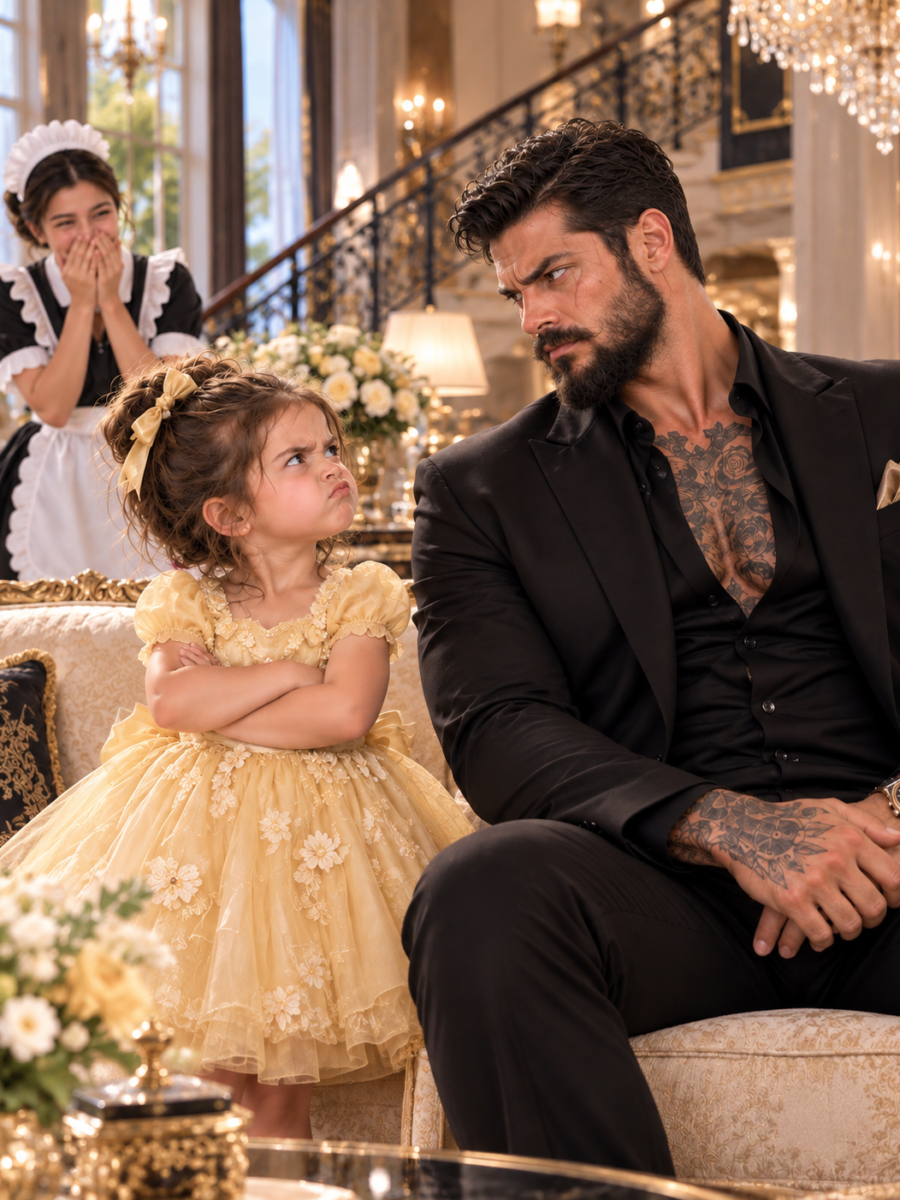
Mia studied him carefully. Then she lowered her eyebrows. Flattened her lips. Folded her tiny arms. And tilted her chin exactly like Vincent.
My heart nearly stopped. Renzo’s eyes widened. One guard stared at the ceiling like he wanted no part in whatever disaster was coming.
Vincent stared at Mia. Mia stared right back. Five unbearable seconds passed.
Then Vincent raised one eyebrow. Mia raised hers. The corner of his mouth twitched. Hers twitched too. Renzo suddenly made a choking sound. Vincent snapped his eyes toward him. Renzo immediately buried his face in his tablet.
“You do that face a lot,” Mia announced. “Mia!” Everyone turned toward me. She beamed. “Hi, Mommy.”
Heat rushed into my face. “Mr. Castalano, I’m so sorry. My sitter canceled, and I had nobody else. She was supposed to stay in the laundry room. I only looked away for a minute and…”
Vincent raised one finger. I instantly stopped talking. My anger at myself burned beneath the fear, but I swallowed every word. I needed this job.
Vincent slowly walked around his desk. Then the most intimidating man I had ever met crouched in front of my daughter until they were eye to eye. Nobody moved. Nobody breathed.
Mia stared innocently into his face. Vincent stared back.
And then he quietly opened his mouth to speak.
What Vincent Said
“You’re right,” he said. “I do.”
The entire room seemed to exhale at once. Renzo’s shoulders dropped from somewhere near his ears. One of the guards let out a breath he’d clearly been holding for the better part of a minute.
Mia, entirely unbothered by the fact that she’d just addressed a man who made grown criminals reconsider their life choices, tilted her head with the same serious curiosity she brought to most of her observations. “Does it hurt your face?”
Vincent’s mouth twitched again, considerably closer to an actual smile this time. “Sometimes.”
“You should smile more,” Mia informed him solemnly. “Smiling doesn’t hurt.”
“Doesn’t it?” Vincent asked, genuine curiosity entering his voice in a way I’d genuinely never heard from him in the eight months I’d worked within his household.
“Nope,” Mia said confidently, demonstrating with an enormous, gap-toothed grin that transformed her entire face.
Vincent studied her small, delighted expression for a long moment, something shifting behind his usually unreadable eyes. Then, slowly, deliberately, the corner of his mouth lifted into something that might genuinely have qualified as a smile.
Renzo made another strangled sound, quickly disguised as a cough.
“There,” Vincent said, still crouched at Mia’s eye level. “Better?”
Mia nodded with the satisfied confidence of someone who had accomplished exactly what she’d set out to do. “Much better.”
Vincent finally rose, turning to face me with an expression I couldn’t quite read, my earlier terror still very much present despite the surprisingly gentle exchange I’d just witnessed. “Ms. Whitmore,” he said, using my actual name rather than the formal address I’d grown accustomed to, “I believe we need to discuss your current childcare arrangements, given that today’s crisis seems considerably more systemic than a single sick babysitter.”
The Laundry Room
“I’m not fired?” I asked, disbelief evident in my voice despite my best efforts to maintain professional composure.
Vincent’s expression carried something almost like amusement at the question. “Should you be?”
“I broke two explicit rules,” I said. “Bringing a child to work, and allowing her to wander into your private study unsupervised.”
“You broke two rules while managing an impossible situation with no good alternatives available,” Vincent corrected. “There’s a meaningful difference, Ms. Whitmore, between carelessness and desperation.”
Renzo, apparently having recovered his composure, stepped forward with visible curiosity. “Boss, I don’t think I’ve ever seen you actually smile. Genuinely smile, I mean, not the kind you use to unsettle business partners.”
Vincent’s expression shuttered slightly at this observation, old guardedness resurfacing. “That’s not relevant to the current conversation.”
“It’s a little relevant,” Mia said, still watching him with her characteristic direct honesty. “You looked happy when you smiled. You should do it more.”
Something in Vincent’s expression softened again at this simple, unfiltered observation. “Perhaps,” he said, before turning his attention back to me. “Ms. Whitmore, I’d like to understand your full childcare situation. Not simply today’s emergency, but your ongoing circumstances.”
I hesitated, old pride warring against exhausted honesty. “It’s complicated,” I admitted. “My regular sitter helps when she can, but she’s a college student with an unpredictable schedule. Emergency backup options are expensive enough that I usually just… manage, however that’s possible in the moment. Today simply happened to be a day when managing required considerably more creativity than usual.” Vincent nodded slowly, his expression carrying focused, thoughtful consideration rather than his earlier intimidating authority. “I think,” he said, “we should discuss a more permanent solution, one that doesn’t require you risking either your employment or your daughter’s safety every time an ordinary childcare emergency arises.”
Seventy Dollars
Over the following days, Vincent’s household staff, apparently acting on his own careful, deliberate instruction, established a formal arrangement I genuinely hadn’t expected — a dedicated, properly vetted childcare position within the estate itself, ensuring Mia could accompany me to work on days when my regular arrangements fell through, without requiring the desperate, secretive management I’d previously relied upon.
“This seems considerably more generous than a single embarrassing morning warrants,” I told Vincent directly, once the arrangement had been formally established.
“I don’t consider it generous,” he said. “Simply practical. You’re a valuable member of my household staff, Ms. Whitmore. Losing you over circumstances entirely outside your control would be considerably more costly to my own operations than establishing proper childcare support.”
I studied him carefully, uncertain whether his careful, practical framing fully explained the genuine warmth I’d witnessed during his surprising exchange with Mia. “Is that the only reason?” I asked, unable to entirely suppress my curiosity.
Vincent’s expression carried something considerably more complicated than his earlier practical explanation. “Your daughter,” he said slowly, “reminded me of something I’d genuinely forgotten I valued. Honesty. Directness. The particular fearlessness children sometimes carry before the world teaches them caution.”
“She’s certainly fearless,” I agreed, thinking of her casual confrontation with a man who commanded genuine terror throughout considerable portions of New York’s underworld.
“I have no children of my own,” Vincent said, something old and complicated entering his usually controlled expression. “No family, genuinely, beyond the considerable responsibility my organization requires. I hadn’t fully realized how much I’d missed simple, unguarded human connection until your daughter walked into my study and informed me I look mad.”
A Standing Arrangement
The following months brought a gradual, genuine warmth to my previously formal, professional relationship with Vincent — Mia’s occasional presence at the estate evolving from rare necessity into something considerably more regular, her easy, delighted friendship with Vincent growing steadily despite his continued reputation as one of New York’s most feared men.
“She asked if you’d come to her preschool graduation,” I told him one afternoon, watching his expression shift through surprise into something genuinely touched. “I told her that probably wasn’t appropriate to ask, given how busy you are.”
“I’d like to attend,” Vincent said, surprising me with his immediate, genuine response. “If you’re comfortable with that, Claire.”
The use of my first name, considerably more familiar than his usual formal address, landed with a warmth I hadn’t quite expected to feel this completely. “I think she’d be thrilled,” I said honestly.
Vincent’s attendance at Mia’s small preschool graduation, arriving in considerably more casual attire than his usual formal business suits, drew curious glances from other parents who clearly recognized his considerable reputation despite his careful, unassuming presence at such an ordinary childhood milestone.
“You came,” Mia announced proudly, running toward him the moment the ceremony concluded, her small diploma clutched triumphantly in one hand.
“I wouldn’t have missed it,” Vincent told her, kneeling to properly admire her diploma with the same genuine attention he’d shown since that first, extraordinary morning in his study. Watching this exchange, I felt something shift in my own understanding of the careful, professional distance I’d maintained since beginning my employment — recognizing, with growing clarity, that whatever was developing between Vincent, Mia, and myself had evolved considerably beyond simple employer generosity into something I hadn’t fully allowed myself to properly name yet.
Mia’s Father
The growing warmth between our small family and Vincent faced its first genuine complication when Mia’s biological father, largely absent since her infancy beyond sporadic, unreliable contact, suddenly reappeared, apparently having learned through mutual acquaintances about my improved circumstances within Vincent’s household.
“He wants visitation,” I told Vincent, unable to fully hide my anxiety during one of our now-regular evening conversations. “After three years of almost no contact, no support, nothing beyond the occasional guilty phone call around her birthday.”
“What does Mia want?” Vincent asked, his protective instinct visible beneath his careful, measured tone.
“She barely remembers him,” I admitted. “I don’t know how to properly navigate this, Vincent. I don’t want to deny her a relationship with her father if that’s genuinely healthy for her, but I also don’t trust his sudden reappearance isn’t connected somehow to my own improved financial circumstances.”
Vincent’s own investigation, conducted quietly through his considerable resources once I’d cautiously accepted his offer to help understand the situation properly, confirmed my worst suspicions — Mia’s father had indeed learned about my new employment and Vincent’s involvement in our lives, and his sudden interest in visitation appeared motivated considerably more by potential financial opportunity than genuine paternal reconnection.
“He’s accumulated considerable debt,” Vincent reported, “and based on communications my investigator uncovered, he apparently believes establishing renewed contact with Mia might provide leverage toward accessing whatever resources he assumes I’ve extended to your household.”
“I won’t let him use her that way,” I said, fresh fury building at the confirmation of exactly what I’d feared. “But I also don’t know how to legally prevent contact without proper documentation of his actual intentions.” Vincent’s expression carried focused, protective resolve. “I have legal resources considerably more comprehensive than most single parents can typically access,” he said. “I’d like to help you navigate this properly, Claire, ensuring Mia’s safety and stability without requiring you to face this alone, the way you’ve apparently faced considerably too much alone already.”
What Vincent Offered
Vincent’s legal team, engaged properly to address the situation through legitimate channels rather than his organization’s more typical methods, helped establish formal documentation of Mia’s father’s actual pattern of absence and apparent financial motivation, providing considerable legal protection against his sudden, opportunistic reappearance.
The formal custody evaluation, conducted with careful attention to Mia’s actual wellbeing and stability, ultimately confirmed limited, supervised visitation at most — a resolution that protected Mia from potential exploitation while still preserving whatever minimal, healthy connection might eventually develop should her father demonstrate genuine, sustained commitment rather than opportunistic interest.
“Thank you,” I told Vincent, once the legal proceedings had concluded favorably. “I don’t know how I would have properly navigated this without your help.”
“You would have found a way,” Vincent said. “You’ve demonstrated considerable resourcefulness throughout everything I’ve witnessed these past months. I simply provided resources you deserved access to regardless of whether I happened to be involved in your life.”
“I think it’s more than that,” I said honestly, old caution finally giving way to genuine vulnerability. “Vincent, I need to understand what’s actually developing between us, beyond simply employer generosity or protective concern for Mia’s wellbeing.”
Vincent’s expression carried careful, genuine consideration before he finally, honestly answered. “I’ve fallen in love with both of you,” he said simply. “Your daughter’s fearless honesty reminded me what genuine connection actually feels like. And you, Claire — your strength, your dedication, your remarkable ability to navigate impossible circumstances with grace I genuinely admire — I find myself wanting considerably more than simply employer and employee between us.”
I studied him carefully, old caution about his dangerous world warring against genuine, growing feelings I could no longer deny. “I need to understand what loving you actually means,” I said, “given everything your world involves.” Vincent’s expression carried genuine, careful honesty. “It means considerable protection, and considerable resources,” he said. “It also means honesty about the complications that world sometimes brings. I won’t pretend those complications don’t exist, Claire. I simply want the chance to build something genuine with both you and Mia, navigating whatever challenges arise together, rather than continuing to keep you both at careful, professional distance.”
The Face She Makes
The year following that extraordinary, honest conversation brought a genuine, complete transformation to our small family’s circumstances — Vincent’s careful, consistent presence in both Mia’s life and my own evolving from cautious possibility into something genuinely, completely precious.
Mia’s easy friendship with Vincent continued flourishing, her fearless honesty apparently having permanently softened whatever careful, guarded composure had once defined his public reputation, at least within the privacy of our now-blended household.
“He still makes the mad face sometimes,” Mia told me once, nearly a year after that extraordinary first morning, watching Vincent handle a business call with his usual controlled authority. “But he smiles way more now.”
“I think you get the credit for that,” I told her, watching Vincent’s genuine, easy laughter following whatever business matter had just concluded satisfactorily.
Vincent’s proposal, delivered on the anniversary of that extraordinary morning when Mia’s fearless imitation first transformed our entire family’s trajectory, carried genuine, complete devotion built through an entire year of careful, deliberate partnership.
“Say yes, Mommy,” Mia instructed solemnly, watching the moment unfold with the same serious concentration she’d once brought to mimicking Vincent’s terrifying scowl.
“Yes,” I said, laughing through genuine, overwhelming happiness, old caution finally, completely replaced by certainty I hadn’t expected to feel this fully when a desperate, chaotic morning first brought impossible complications crashing into Vincent’s carefully guarded world.
Vincent’s genuine, unguarded smile — the same one Mia had first coaxed from him in his forbidden study, eyebrow twitch and all — carried a warmth that had become simply ordinary rather than remarkable throughout our extraordinary year together. “I believe,” he said, “your daughter was entirely correct that first morning. Smiling really doesn’t hurt at all.”