The Billionaire Caught His Exhausted Housekeeper Before She Hit the Floor… Then a Silver Key Fell From Her Hand, and It Was the Key From the Night Someone Shot Him
I’m Dominic Kane. Money can’t buy me back my legs, and for two years I’ve believed I knew exactly who took them. Then the overnight housekeeper who refused to steal seven minutes of rest collapsed in my arms, and a silver key landed on my thigh. Read every chapter to learn whose key it was, why she carried it, and who in my house has been lying to me since the night it rained.
The Silver Key
“Emma, where did you get this key?”
I heard my own voice go cold. I hadn’t intended it to. It was the voice of the man I’d been before the rain, before the sedan, before the bullet, the man who didn’t ask a question twice. The woman in my arms opened her hazel-green eyes and saw what I was holding, and her face changed.
I should go back. A few hours earlier, nothing in my house had seemed unusual.
My name is Dominic Kane. Two years ago, on a rain-soaked night on the Harbor Expressway, someone put a bullet through the back of my armored sedan and my spine, and I have lived in a black wheelchair ever since. I own half the piers in the port and a security team that costs more than most hospitals. Neither of them has found out who did it.
Emma Harper arrived at the estate that night for a thirty-two-dollar-an-hour overnight cleaning shift. To me that money was insignificant. I learned later what it meant to her. A week of her mother’s care at Willow Glen Memory Care, where Linda Harper had been drifting for three years through the fog of vascular dementia after a stroke. Emma worked breakfast at Mae’s Corner Diner, cleaned offices downtown, and then came to me. She had been awake twenty-one hours.
I noticed her limping at midnight. “Sit down.”
“I’m paid to clean.”
“You’re also paid by the hour.”
“That doesn’t mean I should steal one.”
I stared at her. People had stolen my money, my information, my loyalty. This exhausted woman in a gray uniform was refusing to steal seven minutes of rest. When her stomach growled, I asked when she’d last eaten.
“Yesterday.”
I ordered food. She tried to refuse. “If you collapse, you’ll damage something expensive,” I said.
“Like what?”
And for the first time in two years, I almost smiled.
Then Ethan Ward, my security chief, came in without knocking. He had been with me eleven years. He told me a container had vanished from Pier Nine, and that the authorization code had come from inside the estate. I asked where. “The east wing,” he said. That wing held my father’s records, the private offices, the security core. “Someone used that terminal tonight. Eleven minutes after the new maid arrived.”
My eyes went to Emma. She reached for a cleaning cloth, and her hand missed it. “I’m fine,” she said, and her knees folded.
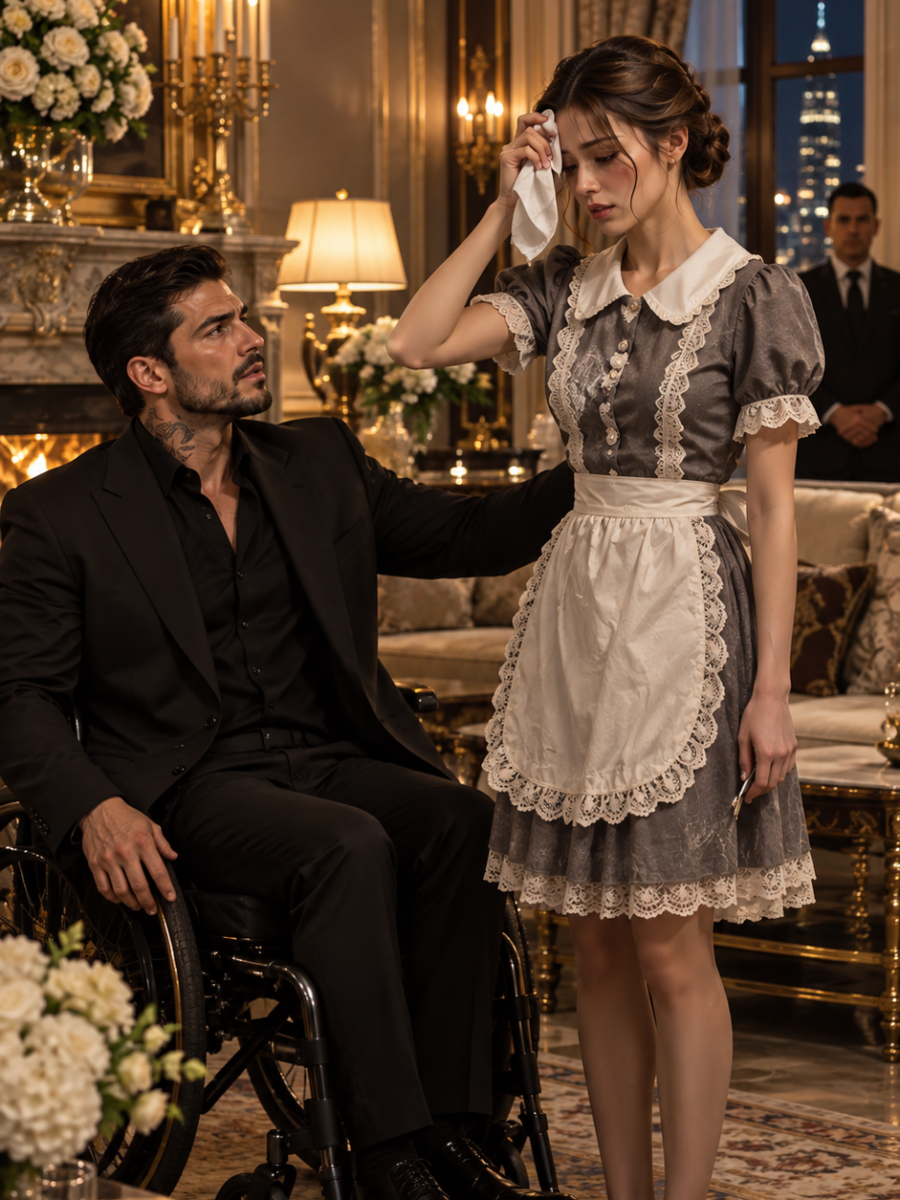
I caught her. I don’t know how, in a chair, with legs that can’t brace. I pulled her against my chest and felt how little she weighed, and brushed a chestnut curl from her cheek. I saw Ethan stare at me.
Then something slid from her cloth, and landed on my thigh with a small, bright click.
It was a silver key, no longer than my thumb, with a notched bow and a faint scratch across the head. I knew it. I had seen its twin on a rainy night, hanging from a belt in the headlights beside my wrecked car, seconds before the bullet.
She woke. She looked at my hand, and at the key, and every color left her face. “Emma,” I said, very quietly. “Where did you get this?”
Back to top ↑
Ryan Mercer’s Sister
She did not lie. That was the first thing I noticed.
I sent Ethan out, told him to stay on the line, and closed the study door. Emma sat on the edge of a chair with a blanket around her shoulders, holding a glass of water in both hands, and told me with her chin lifted that she had been waiting for this moment for three months and was glad it had come.
“It was my brother’s,” she said. “Ryan.”
“Ryan who?”
“Ryan Mercer. We have different fathers. He was ten years older.” She watched my face. “You’d remember him. He was your driver.”
I felt the room tilt. Ryan Mercer had been my driver for four years. He drove the armored sedan the night I was shot. His body had been found two days later, a few miles from the expressway, in a car that had gone into the river. Ethan Ward had come to my hospital bed and told me what the evidence suggested. Someone had disabled the sedan’s rear door lock to let the sniper do his work. A key had been found in Ryan’s apartment that matched. He had been paid. Ryan, it seemed, had sold me out and then been silenced by the people who bought him.
I had believed it for two years. I had hated a dead man every night of them.
“Your brother,” I said slowly, “betrayed me.”
“No.” Emma’s voice cracked, and then steadied. “My brother never took a dollar in his life. He worked for you because you paid for our mother’s first year of care. He told me you were the only boss who’d ever asked about her.” She reached into the pocket of her uniform and drew out a small folded paper. “I found this key in my mother’s jewelry box, three months ago. It was wrapped in a note in Ryan’s handwriting. It says, Give this to Dominic Kane. Not to anyone else.”
I read the note. It was Ryan’s hand. I had signed a hundred forms in that handwriting. It was short, three lines, and the last one said Don’t trust the people closest to you.
“Why didn’t you come to me?”
“Because the whole world said he was a traitor,” she said, “and you’re the man who told them so. I didn’t know if I’d be walking into your house or into a trap.” She pressed her lips together. “So I took a job cleaning it. I wanted to see who you were first.”
I looked at her, this woman I had thought of as part of the furniture. She had been working three jobs, and in the spare minutes she had been quietly learning who I was, and she had not once used her access for anything but scrubbing the floors.
“The terminal,” I said. “Someone used the east wing terminal tonight. Eleven minutes after you arrived.”
“I never went there,” Emma said. “I was told to start in the kitchen.”
“By whom?”
She hesitated. “Mr. Ward.”
I said nothing. But at the other end of the house a man I had trusted with my life was waiting by the phone, and for the first time in eleven years I wondered what exactly he was waiting to hear.
Back to top ↑
Willow Glen
I did not confront Ethan. A man who has survived as long as I have learns patience in the worst way.
The next morning I told him I’d confirmed Emma’s story: a poor woman with a sick mother, no connection to anything. I told him to drop it. His relief was almost invisible. It showed in the way his shoulders came down half an inch, the way a man exhales after a close call.
That was the second thing that told me.
At ten that morning, Emma and I drove, in my private van, to Willow Glen. I had never visited a place like it. It was clean, cheerful, understaffed, and it smelled of boiled vegetables and lemon. Her mother sat by a window in a quilted robe with a crossword in her lap, and she looked up as we came in, a small gray-haired woman with Emma’s eyes.
“Mom,” Emma said, kneeling. “I brought somebody to meet you.”
“Is it Ryan?” Linda asked. Her face lit up. “Is Ryan home?”
Emma swallowed. “Not yet, Mom.”
I rolled forward. I wasn’t sure what to say. I took her hand, which was thin and cool and trembling. “Mrs. Harper. I’m Dominic Kane.”
Her eyes sharpened. It was an astonishing thing to watch, the fog thinning, a mind surfacing from a deep well. “Mr. Kane,” she said. “My son drove you.”
“He did.”
“He said you were a good man. He said, if anything happened, you’d want to know.” She frowned, reaching for a thought that kept sliding away. “He called me that night. He said, Mom, don’t let anyone take the key from the box. He said Mr. Ward had made a mistake.” Her eyes filled. “He said Mr. Ward was going to say it was him.”
The room was silent. Emma’s hand came to her mouth.
Then the fog closed again, and Linda looked at me and asked politely whether I was the new doctor.
I held her hand for a minute more. I thought about a mother who had spent two years carrying that sentence alone in her head, repeating it to nurses and crossword puzzles and the empty air. I thought of a son who had called home from the last night of his life to say that someone else was going to take the blame.
“Thank you, Mrs. Harper,” I said.
In the van afterwards, Emma wept for the first time. Quietly, her face turned to the window, with her hands pressed flat against her knees. I didn’t touch her. I didn’t know how. But I took out my phone and, with a steady hand, I made a call to a lawyer who owed me a favor, and told him to find out everything about Pier Nine.
By evening, he had it. The vanished container was Number 9-14. And the key in Emma’s pocket had a number etched inside the notched bow, in letters so small we’d both missed them: 9-14.
Back to top ↑
Container Nine-Fourteen
The key did not fit a container. It fit a locker.
It took us two nights to work out where. My attorney’s contact at the harbor authority found the answer in an old maintenance ledger. Pier Nine’s container yard had a row of small steel storage lockers, built into the back of the old harbor master’s office. They were used by dockworkers for tools, and they were numbered to match the containers they served. Locker 9-14 had been rented two years and one month ago, in cash, by a man named R. Mercer.
That man had been dead for two years. And someone had spent the last two weeks emptying out the container it was linked to.
We went at three in the morning. I took Emma, Benny, my old driver, and one security man I’d trusted before Ethan came, a quiet man named Teague. I told no one else. I wheeled across the wet concrete of Pier Nine in the dark with the smell of diesel and salt in my face, the same smell I’d had in my nose two years before, and I didn’t let myself feel it.
The harbor master’s office was boarded up. Teague forced the rear door. In the back room, behind a rack of rusting tools, a row of gray lockers lined the wall. Emma put the silver key into number 14, and it turned, smooth and quiet, like a key that had been waiting.
Inside was a flat metal box. Inside the box was a notebook with a cracked black cover, a flash drive in a plastic bag, and a photograph.
The photograph showed two men standing in the headlights of an armored sedan. One was Ryan Mercer, in a driver’s uniform, smiling at the camera. The other had his back half turned, a tall man in a dark overcoat, and on his belt, in the glare of the lights, hung a ring of keys.
It was a duplicate of the key in Emma’s hand. I had seen it that night. I had always believed it hung from Ryan’s belt. In the photograph it hung from a different man’s. The tall man’s hand rested on the sedan’s rear door. And around his wrist, just visible beneath his cuff, was a heavy steel watch I knew as well as I knew my own.
I had given it to him, eleven years ago, the day he joined my family.
I turned the photograph over. On the back, in Ryan’s careful handwriting: Ethan Ward, the night before. Mr. Kane, I’m sorry. I only found out too late.
Back to top ↑
The Notebook
I read Ryan’s notebook that night in my study, with the door locked and Emma on the sofa across from me. She had refused to leave. She had said, in her quiet, level voice, that she had waited two years to hear it, and she wasn’t going to hear it through a wall.
It was a short book. It began three weeks before my shooting, with the careful entries of a man who didn’t know what he was documenting. A container at Pier Nine that wasn’t on any manifest. An overnight meeting between Ethan and two men I didn’t know. A line in my driver’s neat hand: E.W. asked me to leave the rear lock unlatched on Thursday. Said Mr. Kane wanted to test the system. Seems odd.
Then a page that stopped my heart. Thursday. Wouldn’t do it. Told him I’d ask Mr. Kane myself. He smiled and said of course.
The next entry was dated the night of the shooting, written in a shaking hand. I’m in the car. I saw them wait at the bend. Ethan is the one who set it up, and I know why. He’s been selling Kane’s shipping manifests for three years. Mr. Kane found a discrepancy in the books. I’ll call him from the next exit. I only hope the rain doesn’t cut the line.
That was the last line. The rest of the page was blank.
I put the notebook down. The study was very still. Emma sat with her knees drawn up and tears running down her face, not making a sound.
“He tried to call me,” I said. My own voice sounded far away. “Ryan tried to call me that night. I remember the phone buzzing in my jacket, and I thought it was a mistake, and I didn’t answer.”
“You couldn’t have known.”
“He died alone because I didn’t answer a phone.”
“He died because of Ethan Ward.” Emma’s voice was fierce, and I looked at her, surprised. “Not you, Dominic. Don’t you dare. I’ve spent two years hating a man I’d never met, and I came into your house ready to hate you more. I don’t. I can’t. You’ve been blamed for something you didn’t do, and so has he.”
I looked at her. It was the first time she’d said my name. We sat in the quiet, two people who had been carrying someone else’s grief for two years without knowing it was the same grief.
On the flash drive was every record Ryan had been able to copy: shipping logs, bank transfers, three audio files. In the last one, a voice I knew said, “Make it look like the driver. Nobody will dig for a dead man.”
I reached for the phone. And at that exact moment, every light in the study went out. In the black I heard the soft electronic chirp of the house’s security system switching from my control to someone else’s.
Back to top ↑
Lockdown
Ethan Ward knew my house better than I did.
He’d designed the security system. He’d chosen the cameras, written the protocols, installed the east-wing terminal. In the dark he had everything: the doors, the lights, the monitors. In twenty seconds he sealed every exit in the estate, killed the landline and jammed the cell signal. When the emergency lamps flickered on, red and dim, I was sitting in my wheelchair in a locked room with a drive in my fist and a woman beside me who had gone perfectly still.
“Dominic.” His voice came from the intercom, calm and regretful. “I’m sorry it came to this. You’ve always been so stubborn about loose ends.”
“Ethan.” I kept my voice even. “Eleven years.”
“Eleven years of cleaning up after you,” he said. “You were going to go to the authorities. I had no choice. Give me the drive, and the maid walks free.”
“And if I don’t?”
“Then I’ll make a call.” There was a pause, and in the background I heard a faint, familiar sound, the chime of a hallway clock. “It’s one a.m. at Willow Glen, Dominic. The night nurse has a very quiet shift. It would be so easy for an old woman with dementia to wander out in the cold.”
Emma’s whole body flinched. I caught her hand, and it was ice.
I looked at her face. I saw a woman who had stayed awake twenty-one hours so her mother could have a clean room. I saw a woman who had kept a silver key in her uniform for three months without once using it for herself. And I knew, with the clarity of a man who has run out of time to be afraid, that I was not going to let her lose anyone else.
“Ethan,” I said. “Do you remember what my father taught us about this house?”
The intercom was silent.
“He never trusted a single system,” I said. “He built a second.” I reached under my desk and pressed a panel Ethan had never seen. A hidden door in the bookcase slid open, and behind it, in a narrow stone corridor, hung a coil of old copper wire and a rotary phone that hadn’t been used in forty years.
I picked it up. It connected to a single line, and a single number. It rang once.
“Kane,” said a gruff voice. “It’s been a while.”
I had never been so glad to hear a federal agent.
“Agent Brandt,” I said. “I need you at Willow Glen Memory Care in fifteen minutes. And I need you to bring everything you’ve got.”
Back to top ↑
The Man Beside the Car
They reached Willow Glen with eleven minutes to spare.
I was not there. I was in a locked estate, on a rotary phone, with Teague breaking the east-wing door with a fire axe. But I listened to every second of it through a borrowed radio, with Emma’s hand in mine, as Agent Marcus Brandt and eight federal officers entered the building, found the night nurse bound in a supply closet, and came upon a man named Ward’s associate standing in Linda Harper’s room, quietly closing the window.
Linda was asleep. She never woke. She never knew.
It was over in under an hour. Ethan’s men, stripped of their orders and their access, surrendered one by one. When Teague finally broke through into the study, Ethan was standing at my desk with a gun in his hand and a face I’d never seen on him, tired and old and furious. He had spent eleven years pretending to be the man he wasn’t. Now there was no more pretending.
“You should have retired,” he said. “You had everything.”
“I had a driver who tried to call me,” I said. “I have the drive. I have the notebook. And I have a woman who walked into my house for three months and never once did the wrong thing.”
His eyes went to Emma, and he laughed. It was a thin, bitter sound. “A maid.”
“A witness,” said Agent Brandt from the doorway.
Ethan looked at the badge. He looked at the men behind it. I watched him calculate, and arrive at the only answer he had left. He raised the pistol, not toward me, but toward himself, and Emma moved before I could.
She crossed the room in three steps and knocked his arm sideways. The shot went into the ceiling. Teague took him down from behind. It was the bravest thing I have ever seen anyone do, and she did it in a gray cleaning uniform with a silver key still hanging from her neck on a chain.
“Don’t,” she said, shaking, as the agents hauled him up. “He doesn’t get to decide how this ends. He has to answer for it.”
Ethan Ward stood trial for conspiracy, embezzlement, attempted murder and the murder of Ryan Mercer. The prosecution played every one of the audio files. He was sentenced to life without parole.
When the verdict was read, Emma took my hand in the front row, the first time she’d done it in daylight. “It’s over,” she whispered. But I knew there was one thing left that I owed her.
Back to top ↑
One Hour, Stolen
Ryan Mercer’s name was cleared in every record in the state.
I made sure of it. I put his photograph in the front hall of the Kane Harbor Authority, under a brass plaque that said Ryan Mercer, 1987–2024. He tried to call. I paid for a proper funeral, two years too late, with a flag, and a granite stone, and a pecan tree planted beside it, because Emma told me it had been his favorite. Linda Harper sat in the front row in her best coat. At the end of the service she turned to me and asked, politely, whether the nice young man in the box was somebody’s son.
“He was, Mrs. Harper,” I said. “He was yours.”
She smiled and patted my hand. And then, softly, for one clear second: “Thank you for coming, Mr. Kane.”
I moved Linda to the best care facility in the state, near my estate, with a garden and a full-time team, and I paid for it through an endowment with her son’s name on the door. Emma protested for about a week. I told her it wasn’t charity. It was the wages Ryan had never collected.
She quit two of her three jobs that spring. She kept the diner, because she liked the regulars, and because she said a woman should never be anyone’s whole life. She came to the estate on Saturday mornings and sat in my kitchen eating toast. It took me six months to convince her that she could sit down.
One Saturday, in the autumn, I found her dozing in the sunlit window seat with a cleaning cloth still in her hand. I wheeled over, very quietly, and took it from her fingers. She woke slowly, and looked at me, and smiled.
“I’m paid to clean,” she murmured.
“You’re not on the clock.”
“Then I’m stealing an hour.”
“Steal two,” I said. “I’ll make a note of it in the books.”
She laughed. It was a tired, bright, lovely sound, and I realized I hadn’t heard it often enough. She reached for my hand, and her fingers closed around mine, around the scarred, tattooed knuckles she had once seen tremble over a silver key.
“Dominic,” she said. “Where did you get this?” She touched the small silver key I now wore on a chain at my collar, the one she had given back to me, the one that had opened every door.
“From a woman who stayed awake for twenty-one hours,” I said. “And trusted me anyway.”
Read Next