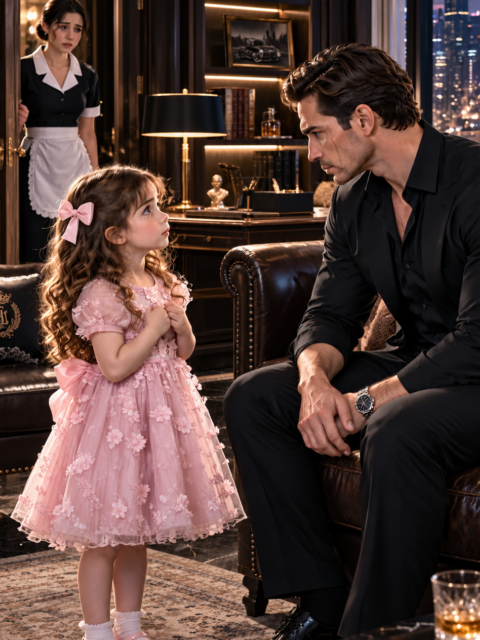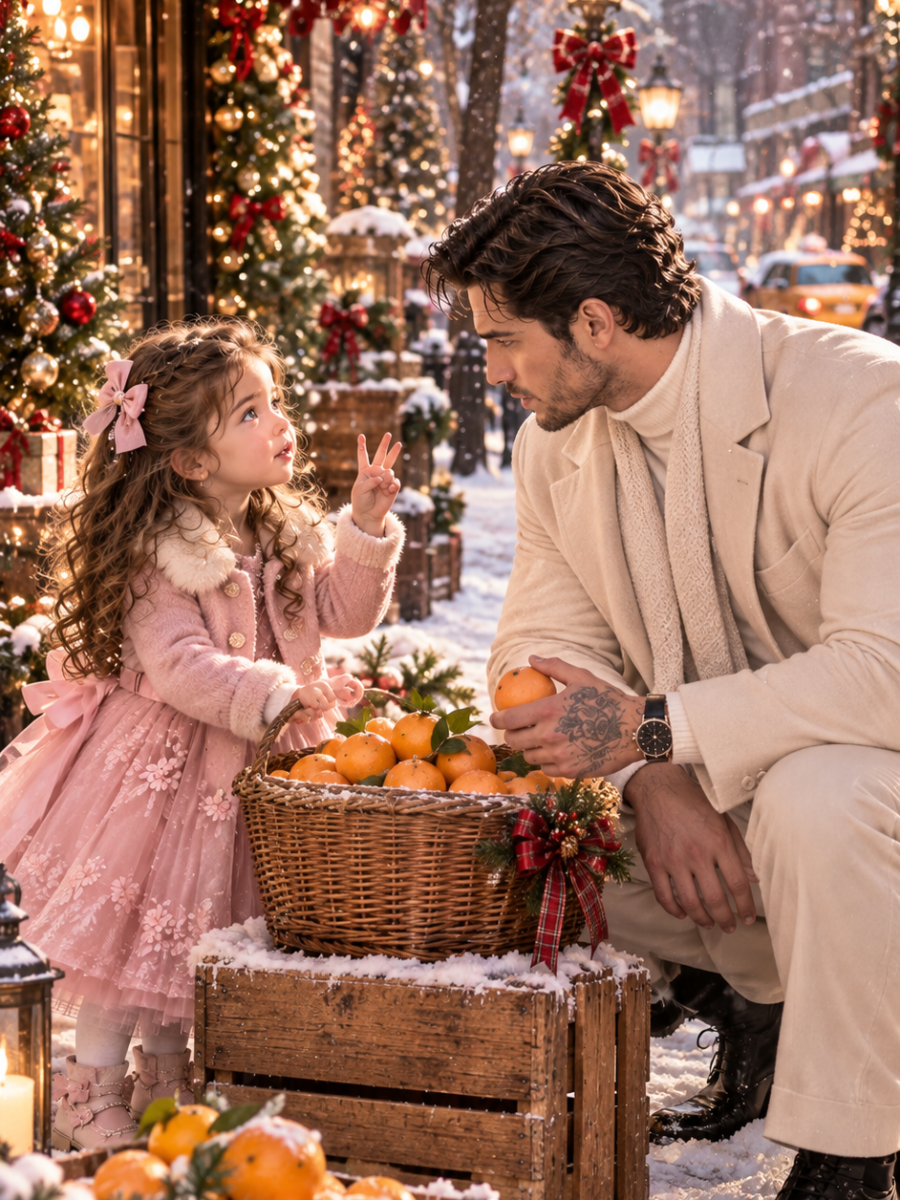
“Wait. Where Did You Get This Picture?” A Billionaire Bought All 34 of a Little Girl’s Oranges — Then Recognized Her Mother’s Face
Isa was selling oranges on the Lower East Side to pay for her mother’s surgery. Blake Hamilton bought all thirty-four and left them behind. Then she showed him a worn photograph of the woman she loved most, and Blake’s world stopped. It was Clare, the woman who had vanished from his life seven years ago without a word. Read every chapter to find out why she left, and what he does once he finds her.
Thirty-Four Oranges
“Wait. Where did you get this picture?” Blake Hamilton’s hands began to shake. The six-year-old girl stared at him. “That’s my mommy.”
Blake couldn’t look away from the worn photograph. Wavy brown hair. Bright green eyes. That unmistakable smile. Clare Bennett. The woman he’d loved. The woman who had vanished from his life nearly seven years ago.
Blake looked from the photograph to the little girl’s face. Same green eyes. Same smile. Even the same nervous habit of biting her lower lip. “How old are you?” he asked quietly. “Six and a half.” Blake’s heart slammed against his ribs. The timing was impossible to ignore. Because the last time he’d seen Clare was almost exactly seven years ago. And now her daughter was standing on a Lower East Side sidewalk, selling oranges to pay for her mother’s surgery.
That morning had begun like dozens before it. At thirty-eight, Blake possessed a multibillion-dollar fortune, luxury properties, private jets, and influence most men could only imagine. Yet once a month, he dismissed his driver and walked alone through New York’s poorer neighborhoods. His advisers called it eccentric. Blake called it perspective. “Maybe it’s guilt,” he murmured that morning.
Then he noticed a flash of orange across the street. A makeshift fruit stand had been built from wooden crates. Behind it stood a tiny girl carefully arranging oranges. Beside her was a handwritten sign: HELP MY MOM, PLEASE. SHE NEEDS SURGERY.
Blake crossed the street. “Hi, mister,” she said brightly. “Want some oranges? They’re really sweet.” Something about her voice felt strangely familiar. “Why aren’t you in school?” The girl bit her lower lip. “Mommy’s sick. Really sick. She couldn’t get out of bed today.” Blake’s chest tightened. “So I’m selling oranges,” she continued. “I need to save money.” “How much?” “Three for five dollars.” Blake opened his wallet. “I’ll take all of them.” Her eyes widened. “All thirty-four?” “All thirty-four.”
She concentrated fiercely, trying to calculate the price. “Let’s say sixty dollars,” Blake offered. “Wow.” He handed her the money. Then he left the oranges where they were. She frowned. “You paid, but you don’t want them?” “Sell them again.” “Why?” “Because your mother needs the money more than I need thirty-four oranges.”
The girl’s entire face brightened. “Thank you! I’m Isa. What’s your name?” “Blake.” Then her smile faded. “My mommy needs an operation. She says she’ll get better.” Isa lowered her voice. “But I know that’s not true.”
Blake crouched beside her. “Do you have a picture of her?” Isa reached into her worn coat. “She was really pretty before she got sick.” She unfolded a creased photograph. And Blake’s world stopped. Clare. His Clare. “This is your mother?” Isa nodded proudly. “She looks different now. She’s skinnier, and some of her hair fell out.”
Blake struggled to breathe normally. “Where do you live?” “Orchard Street. The red building with the broken door.” He handed the photograph back. “How old did you say you were?” “Six and a half. My birthday was last month.”
Six and a half. Blake’s mind returned instantly to the final night he’d spent with Clare. Then she had disappeared. No explanation. No goodbye. Now there was Isa. Blake looked into those familiar green eyes and felt a question forming that he wasn’t ready to ask.
“Can I walk you home?” Isa hesitated. “Mommy says never go anywhere with strangers.” “She’s right.” The girl studied him carefully. Then she looked at the money in her hand. “But you bought all my oranges.” Blake almost smiled. “That doesn’t mean you should trust me.” Isa thought about that. Finally, she began packing the oranges. “You can walk beside me. But not too close.” “Deal.”
She picked up the wooden crate. Blake gently took it from her. Together they started toward Orchard Street. Toward the red building with the broken door.
Toward the woman Blake had spent nearly seven years believing he’d lost forever. And possibly toward the answer to why a six-and-a-half-year-old girl had his former love’s eyes.
The Red Building
The stairwell smelled of old paint and radiator heat. Isa climbed ahead of him, counting the steps under her breath the way children do when a place has become entirely their own. On the third floor, she pushed open a door that didn’t lock properly and called out, “Mommy, I’m home, and I brought a friend.”
Clare Bennett was sitting up in a narrow bed near the window, a blanket pulled to her waist, a scarf wrapped loosely over hair that had thinned considerably since Blake had last seen her. She looked up, expecting perhaps a neighbor, and went utterly still.
“Blake.”
His name in her voice undid something he had spent seven years carefully reinforcing. “Clare,” he managed. “I didn’t know. I swear to you, I didn’t know any of this.”
“Isa,” Clare said, her voice carefully controlled, “go wash your hands, sweetheart. I need to speak with Mr. Hamilton alone for a moment.”
Isa, sensing the sudden weight in the room, looked between the two adults with the same grave attention she’d given her arithmetic on the sidewalk. “Are you going to be okay, Mommy?” “I’m going to be fine,” Clare said. “Go on.”
Once the bathroom door clicked shut, Clare turned to Blake, exhaustion and old fear tangled together in her face. “How did you find us?”
“I didn’t find you,” Blake said quietly. “Your daughter found me. She was selling oranges on a street corner to pay for your surgery, Clare, and she showed me a photograph of you that I would recognize in complete darkness.” He crossed the small room and knelt beside the bed. “Is she mine?”
What the Doctors Said
Clare closed her eyes. “Yes,” she said finally. “She’s yours. I found out three weeks after the last night we spent together. By then, I had already made a decision I believed was final.”
Blake absorbed this with a stillness that cost him considerable effort. “We’ll discuss that,” he said. “I need you to. But right now, I need to understand what’s happening to you. Isa said surgery. She said you’re not getting better, whatever you’ve told her.”
Clare’s composure wavered for the first time. “Stage two,” she said quietly. “Caught later than it should have been, because I don’t have insurance, and I kept telling myself I couldn’t afford to be sick. By the time I finally saw a doctor at a community clinic, it had progressed considerably. They’ve recommended surgery, followed by treatment. I’ve been trying to save enough to cover even the surgeon’s portion the clinic can’t absorb.”
“How much?”
“Blake, I’m not asking you for money.”
“I’m not asking whether you’re asking,” he said. “I’m asking how much, because that number stops mattering to me the moment I heard it, and I’d like to move forward from there as quickly as possible.”
Clare studied him for a long moment, old pride and genuine, desperate relief visibly warring in her expression. “I don’t want you to feel obligated,” she said. “Not because of Isa, not because of guilt over whatever you’re about to learn about why I left.” Blake took her hand, carefully, the way one holds something both familiar and entirely changed. “Tell me why you left,” he said. “All of it. I think we’re both finally ready to hear it.”
Why Clare Left
“Your mother came to see me,” Clare said. “Three weeks after I found out I was pregnant. I never told you, because I never had the chance. She arrived at my apartment on a Tuesday afternoon, and she was very clear about why she’d come.”
Blake’s jaw tightened. “What did she say?”
“That I wasn’t suitable for a Hamilton. That you were being groomed for a merger marriage with the Ashworth family, and that a pregnancy from someone like me would destroy everything your father had spent decades building. She offered me money to disappear, Blake. A great deal of money. And she made it very clear that if I refused, she would ensure I never worked in this city again, and that any child I had would spend their life known as the woman who tried to trap a Hamilton for money.”
“You believed her.”
“I was twenty-four, pregnant, and alone,” Clare said, old hurt entering her voice for the first time. “I had no family with resources to fight your mother’s lawyers. I believed, genuinely, that staying would destroy your future and mine both, and that leaving quietly was the only way to protect the child I was carrying from becoming a weapon in a fight I couldn’t win.”
Blake sat with this for a long moment, seven years of assumed abandonment reorganizing itself around a betrayal he hadn’t previously suspected. “There was no merger marriage,” he said quietly. “I never once discussed marriage with anyone from the Ashworth family. My mother invented that entirely.” Clare’s face went pale. “Then everything I built my decision on,” she said slowly, “was a lie she told me to make me leave.”
Eleanor Hamilton
Blake did not wait until morning. He called his mother from the stairwell of the red building, his voice carrying a controlled fury she had rarely heard from him in thirty-eight years.
“I’m standing in Clare Bennett’s apartment,” he said, without preamble. “I’ve just learned I have a six-year-old daughter, and that you paid Clare to disappear seven years ago using a lie about a merger marriage that never existed.”
The silence on the line lasted long enough that Blake wondered if she’d hung up. “Blake,” Eleanor said finally, “I did what I believed was necessary to protect this family.”
“You destroyed a woman’s life,” Blake said. “You let me believe, for seven years, that someone I loved had simply abandoned me without explanation. You let your granddaughter grow up selling oranges on a street corner to pay for medical care, Mother, while I had more money than I could reasonably spend in ten lifetimes.”
“I didn’t know about the child’s illness,” Eleanor said, and for the first time, genuine unease entered her voice.
“You didn’t ask,” Blake said. “That’s the part I find hardest to forgive. You made a decision that affected three lives, and then you simply walked away from the consequences for seven years, never once wondering what actually happened to the woman you threatened.” He closed his eyes. “I need you to understand something clearly, Mother. Whatever relationship we have going forward depends entirely on how you respond to what I’m about to ask of you.”
The Envelope
Eleanor arrived at the red building two days later, considerably diminished from the commanding woman Clare remembered from seven years earlier. She stood in the small doorway, taking in the narrow room, the thin blanket, the child’s drawings taped carefully to the wall, and something in her carefully maintained composure finally cracked.
“I owe you an apology,” she told Clare, “though I understand it arrives seven years too late to undo what it caused.”
Clare studied her carefully. “You told me lies that shaped the rest of my life,” she said. “I don’t know that an apology changes that.”
“It doesn’t,” Eleanor admitted. “But I’d like to do something that might actually help, rather than simply offering words.” She produced an envelope, considerably different in purpose from the one she’d offered seven years earlier. “This covers your surgery and treatment in full, at whichever hospital your doctors recommend, regardless of cost. I’d also like to establish a trust for Isa, separate from anything Blake decides, so that her future never again depends on decisions made by people trying to control her parents’ lives.”
Isa, who had been listening from the doorway with her usual grave attention, stepped forward. “Are you my grandma?”
Eleanor’s composure finally, completely broke. “I would like to be,” she said, “if you’re willing to give someone who made a terrible mistake a chance to do better.”
Isa considered this with the seriousness she brought to all important questions, then looked at her mother for guidance. Clare, watching this extraordinary exchange with careful, cautious hope, nodded slowly. “We can try,” Isa announced finally, with the particular authority of a child granting a genuinely significant favor. “But you have to visit. Not just send money.”
What Clare Never Knew
With the surgery scheduled at one of the city’s finest hospitals, Blake spent the following days navigating both the practical urgency of Clare’s care and the slower, more delicate work of properly getting to know his daughter.
“You missed a lot of birthdays,” Isa told him bluntly, over the ice cream he’d brought to the hospital waiting room during Clare’s pre-surgical testing. “Six of them.”
“I did,” Blake agreed. “I didn’t know you existed, or I promise you, I would have been there for every single one.”
“Grandma Eleanor made a bad choice,” Isa said, working through this with the same careful logic she’d once applied to orange pricing. “But you didn’t know. So it’s not really your fault.”
“I appreciate you saying that,” Blake said. “Though I intend to spend considerable time making up for those missed years regardless, fault aside.”
A DNA test, conducted quietly and respectfully at Blake’s request, confirmed formally what the photograph, the green eyes, and the nervous habit of biting her lower lip had already made abundantly clear. Isa was his daughter, in every sense the law and biology could confirm.
“I’d like to establish proper legal paternity,” Blake told Clare, once the results had arrived, “not to complicate your life further, but so that Isa has every protection and opportunity available to her going forward, regardless of whatever happens between the two of us romantically.” Clare’s expression carried old, careful hope. “And what do you want to happen between us?” she asked quietly. Blake considered the question with the same seriousness Isa brought to everything. “I want the chance to find out,” he said, “properly, without my mother’s lies standing between us this time.”
The Surgery
Clare’s surgery, performed by one of the city’s leading specialists at Blake’s insistence and expense, went considerably better than the community clinic’s more limited resources had initially projected. The surgeon described the results as genuinely encouraging, with a clear treatment path forward that offered real, substantial hope.
Blake stayed at the hospital throughout the entire procedure, Isa curled against his side in the waiting room, occasionally offering him a segment of orange from a bag she’d insisted on bringing, “for luck,” though Blake suspected the luck was intended equally for both of them.
“She’s going to be okay,” Isa said, more statement than question, somewhere around the third hour.
“I believe she is,” Blake said, and found, to his own genuine surprise, that he meant it completely.
The recovery that followed brought its own considerable challenges, treatment schedules and careful monitoring and the particular exhaustion that illness brings even amid genuine improvement. But Clare’s prognosis, confirmed by subsequent scans, showed steady, encouraging progress, each appointment bringing news considerably better than the fear she’d carried alone for months before Blake’s unexpected arrival.
“I don’t know how to properly thank you for all of this,” Clare told Blake, several weeks into her recovery, watching Isa show Eleanor her latest drawing with the easy confidence of a child who had decided, on her own careful terms, to extend trust to someone who had genuinely earned a second chance. “You don’t need to thank me,” Blake said. “You need to let me stay. That’s the only thing I actually want from any of this.”
Sweet Oranges
The year following that extraordinary sidewalk encounter brought genuine, complete transformation to every life it had touched — Clare’s health steadily, genuinely improving with each passing month, Eleanor’s careful, consistent effort to properly earn back trust she’d forfeited seven years earlier, and Isa’s fearless curiosity earning her a family considerably larger and more complete than the one she’d known selling oranges on Orchard Street.
“Do you remember what you told me?” Blake asked Isa, nearly a year after that transformative morning, watching her arrange a fresh crate of oranges on the same sidewalk, now simply for the pleasure of it rather than desperate necessity. “About selling oranges again?”
“I remember,” Isa said. “You said sell them again because Mommy needed the money more than you needed oranges.”
“I’ve been thinking,” Blake said, “that we might set up a proper stand here, permanently, if you’d like. Not because you need the money anymore, but because I think you genuinely enjoy it.”
Isa considered this with characteristic seriousness, then nodded decisively. “But you have to actually buy some this time,” she said. “Not just leave them again.”
“Deal,” Blake said, laughing, watching Clare approach along the sidewalk, considerably stronger now, her hair growing back in soft new waves, her smile the same one that had first stopped his heart nearly eight years earlier. She reached them and took an orange from the crate, examining it with the same careful attention her daughter brought to everything.
“Sweet ones today?” she asked Isa.
“The sweetest,” Isa confirmed, and handed one to each of her parents, watching with evident satisfaction as they both, finally, completely, belonged exactly where they were standing.