“When I Grow Up, I’m Going to Marry You.”
Alessandro Romano ruled the city with iron discipline and impenetrable silence. In seven years, not a single soul inside the Romano estate had seen him smile, let alone laugh. But during an emergency council of grim lieutenants, a three-year-old girl named Sophie wandered into the formal dining hall clutching a ragged stuffed rabbit, looked the feared king dead in the eye, and made an innocent declaration that brought the entire empire to a standstill. What followed was a journey of buried grief, a mother’s desperate escape, and a tiny gray pebble that melted seven years of winter.
Chapter One
The Unforgivable Disruption
There was one cardinal commandment within the limestone walls of the Romano estate: when Alessandro Romano was in session, the world did not breathe.
At thirty-two, Alessandro carried a reputation that made district prosecutors reconsider their careers and rival syndicate heads lower their eyes. His six-foot-two frame was draped in a bespoke charcoal Italian suit, his chiseled jaw set in perpetual tension, his steel-gray eyes cold as alpine ice. Ever since the tragic car bombing seven years ago that had taken his newlywed bride and unborn child, Alessandro had ceased living as a man and existed solely as an institution. He felt nothing. He forgave nothing. And he had not smiled once in nearly two thousand six hundred days.
On this damp Thursday evening, the grand dining hall was occupied by seven senior capos, their leather folders spread across a twenty-foot mahogany table. Tensions were running dangerously high over disputed cargo shipments at the northern railyards.
Suddenly, the heavy double doors creaked open an inch.
Through the gap squeezed a small, round-cheeked girl in soft pink pajamas patterned with yellow ducks. In her left arm she clutched a battered, gray plush rabbit with one missing button eye. Her socks slipped slightly on the polished marble as she padded innocently toward the head of the table.
Behind the service pantry doors, Clara Bennett—the estate’s recently hired assistant archivist—froze in sheer, paralyzing horror. She had turned her back for barely thirty seconds to organize historic shipping ledgers, and her three-year-old daughter Sophie had slipped out.
Clara’s lungs seized. Everyone knew the legends of Alessandro Romano. Men who coughed out of turn were exiled; men who interrupted his council were removed before the sun set. She stepped forward to grab her daughter, but her legs felt like lead.
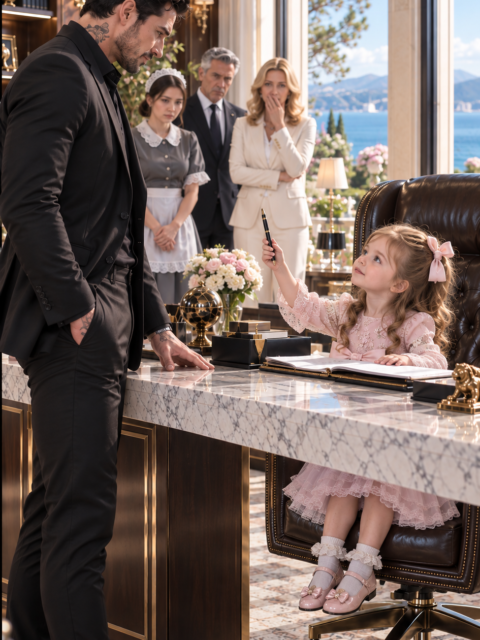
Sophie didn’t look at the armed guards standing against the wall. She didn’t glance at the burly, tattooed capos whose mouths hung open in disbelief. She walked straight to the high-backed velvet chair at the head of the table.
Alessandro paused mid-sentence, his silver pen hovering over a contract. He lowered his gaze to find a three-year-old standing at his elbow, gazing up at him with unblinking hazel eyes.
Sophie placed her chubby little hand on Alessandro’s tailored knee, tilted her head with complete conviction, and announced clearly to the entire room:
“When I grow up, I’m going to marry you.”
Chapter Two
The Sound in the Silence
The air in the dining hall vanished, replaced by an agonizing vacuum that stretched for ten eternal seconds.
Capo Valenti, seated to Alessandro’s right, began to reach discreetly for his lapel before thinking better of it. The security guards stiffened, their expressions tight with dread. Clara felt the room spin; tears pricked her eyes as she prepared to throw herself between her child and whatever terrifying wrath was about to descend upon them.
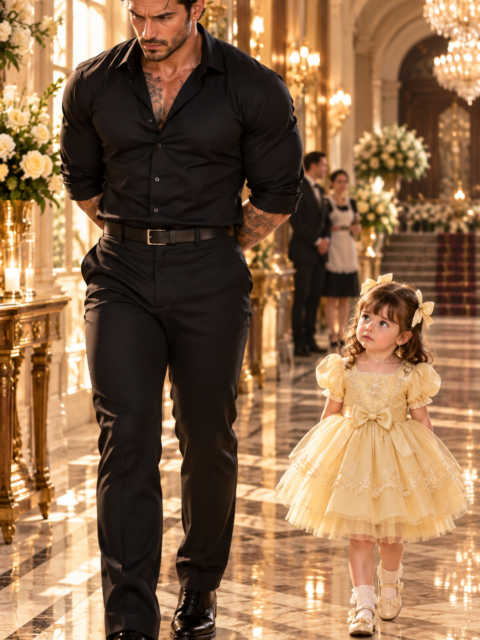
Alessandro did not speak. He stared down at the toddler whose small palm was still planted firmly on his pristine trousers. He looked at her duck pajamas, at the floppy-eared rabbit tucked against her chest, and then into her large, serious eyes. There was no mockery in her expression. No calculation. Only the pure, fearless honesty of a child who saw a man where everyone else saw a monster.
Then, a muscle in Alessandro’s jaw twitched.
His broad chest hitched once. A sound broke from his throat—low at first, rough and rusty, like an antique iron gate being forced open after decades of winter. Then it swelled into a clear, resonant chuckle.
Alessandro Romano was laughing.
It was not a cold, cruel smirk. It was genuine, startled, bewildered amusement. The sound bounced off the coffered ceiling and antique crystal chandeliers, echoing through the cavernous hall like a shockwave. Men who had traded gunfire without flinching looked at one another as if the walls had turned to glass.
“You’re going to marry me?” Alessandro asked, his voice gravelly, unused to warmth, but surprisingly gentle. He set his gold pen down on the mahogany surface.
Sophie nodded vigorously, lifting her stuffed animal. “Yes. And Barnaby can be the flower boy because he has a bow tie.”
The corner of Alessandro’s mouth twitched upward again. In that fleeting second, the terrifying ghost of Providence was replaced by the ghost of the young, hopeful man he had buried seven years ago.
Clara took that moment to stumble forward, dropping to her knees beside the chair, her voice trembling violently. “Mr. Romano, I am so sorry—please forgive her! She slipped away from the library—I will take her immediately, she will never come near this hall again—”
Alessandro’s laughter subsided, but the harsh frost had not returned to his gaze. He looked at the trembling mother, then back at Sophie, who waved cheerfully at him as Clara scooped her up in a panic.
“Take her upstairs, Clara,” Alessandro said quietly, his voice neutral once more, but his gray eyes lingered on the little girl until the pantry door clicked shut.
Chapter Three
Flight at Midnight
Back in their modest second-floor quarters above the east wing conservatory, Clara’s hands could not stop shaking.
She had taken this job two months ago out of sheer desperation. After her late husband—an honest bookkeeper who had refused to alter ledgers for an aggressive loan syndicate—had suffered a fatal hit-and-run, Clara had fled across state lines with Sophie. The Romano estate offered private lodging, discreet wages, and impenetrable security. But Clara had never intended for her daughter to cross paths with the patriarch himself.
He had laughed, yes. But Clara had lived long enough around dangerous circles to know that unpredictable men were the deadliest. Capos had watched. Guards had seen. A boss whose legendary icy focus appeared compromised by a maid’s toddler was a recipe for instability.
“We can’t stay,” Clara whispered to herself, frantically stuffing their small duffel bag with warm clothes, Sophie’s birth certificate, and what little cash she had saved.
“Mommy, why are we packing Barnaby?” Sophie asked from the bed, rubbing her sleepy eyes. “I didn’t finish showing Mr. Eyes my drawing.”
“We’re going on an adventure, sweetie,” Clara lied softly, pulling a thick coat over Sophie’s pajamas and fastening her little boots. “We have to be very quiet, like little mice.”
At 1:30 A.M., Clara slipped out through the service stairwell. The estate grounds were shrouded in heavy fog, damp leaves muffling their footsteps as they moved along the gravel driveway toward the secondary iron gate. The night air was biting, smelling of wet earth and pine.
Fifty yards from the perimeter wall, Clara’s heart plummeted into her stomach.
Standing in the center of the driveway, illuminated only by the faint amber glow of the gate lamps, stood a lone, tall silhouette. He wore a long black cashmere overcoat against the cold, his hands buried deep in his pockets. There were no armed guards beside him. No convoy of black sedans.
Alessandro Romano was waiting for them alone.
Chapter Four
A Gift Worth More Than Gold
Clara came to a shuddering halt, instinctively pulling Sophie behind her skirts. Her breath formed pale plumes in the freezing mist.
“Mr. Romano,” Clara gasped, fighting to keep her chin up despite the terror clawing at her throat. “Please. She’s only three. She doesn’t understand your world. Take whatever you want from my wages, let me take the blame, but let us leave the city.”
Alessandro didn’t move. He stood ten feet away, the collar of his coat turned up against the wind. His eyes were shadowed, unreadable beneath the brim of the night sky.
“Do you think this estate is a prison, Clara?” he asked, his voice calm and even, cutting through the rustle of autumn leaves. “If you wished to resign, you needed only to submit your paperwork to the front desk at dawn. Running into the dark at two in the morning with a child on foot is reckless.”
“You’re a dangerous man, sir,” Clara replied, the honesty tearing out of her. “And I have nothing left in this world except her.”
Before Clara could react, Sophie slipped her hand free from her mother’s grip. The little girl stepped out from behind the coat, her small yellow boots crunching softly on the wet gravel.
“Sophie, no!” Clara lunged, but Sophie was already toddling straight toward the towering syndicate boss.
Alessandro knelt down on one knee in the wet gravel. The hem of his expensive coat brushed the mud, but he didn’t seem to notice or care. He brought himself down to Sophie’s eye level, his large, scarred hands resting quietly on his thighs.
Sophie stopped six inches from him. She reached into the pocket of her little pink coat, rummaging around with serious determination. Finally, her fist emerged. She reached out and placed something into Alessandro’s open palm.
Alessandro looked down. Sitting in the center of his scarred, calloused hand was a smooth, ordinary gray river pebble, still faintly wet from the garden path.
“I found it by the flowers,” Sophie explained proudly in a confidential whisper. “It’s very shiny when you put water on it. You can keep it so you don’t look lonely anymore.”
Alessandro stared at the gray stone. A man who owned skyscrapers, shipping docks, and vaults filled with platinum stood motionless, gazing at a fifty-cent pebble as though it were the most sacred relic ever placed in his care. His fingers slowly curled around it, closing tight.
He looked up at Clara, his voice dropping to a quiet, unbreakable murmur.
“The child can stay,” Alessandro said. “And so can you. No one will ever harm you behind these gates.”
Chapter Five
The Man with the Sad Eyes
They returned to the warm east wing that night, and the days that followed settled into a rhythm that neither Clara nor the estate staff had ever anticipated.
Alessandro did not become a different man to the outside world. In council meetings, his decisions were as sharp and unyielding as ever. Rivals still feared his name; territory disputes were resolved with cold precision. But inside the mansion, an invisible thaw had begun.
Every morning at 8:00 A.M., when Alessandro walked down the grand marble staircase on his way to his office, a small figure in yellow boots would be waiting by the banister. Sophie would hand him an offering—a dandelion from the garden, a crayon drawing of a rabbit wearing sunglasses, or a miniature plastic teacup. Alessandro would take each item with solemn gravity, place it into the breast pocket of his bespoke suit, and say, “Thank you, Lady Sophie. The council will be informed.”
One Tuesday afternoon, Clara stood by the French doors of the library, folding laundry, watching Sophie play with wooden blocks on the Persian rug in the conservatory. Clara happened to glance up toward the third-floor interior balcony.
There stood Alessandro, holding a cup of black coffee, completely motionless. He wasn’t reviewing dossiers. He wasn’t talking on his secure satellite phone. He was simply watching Sophie laugh as she built a lopsided tower.
Sophie had said it the second night, while being tucked into bed: “Mommy, Mr. Romano looks like he lost his favorite toy a long time ago. He has sad eyes even when his face is made of rock.”
Clara had realized the profound truth of those words. Alessandro hadn’t simply laughed at Sophie’s proposal in the dining hall. The child’s unblemished warmth had pierced through seven years of self-imposed purgatory, reminding a broken king that he was still capable of affection.
Later that evening, the estate’s head housekeeper, Mrs. Gable, handed Clara an updated employment contract. Her salary had been tripled, complete with a comprehensive educational trust fund established in Sophie’s name.
“Mr. Romano insists,” Mrs. Gable said with a rare, knowing smile. “He told the attorneys that the estate archivist’s daughter is considered family under the Romano covenant.”
Clara felt a lump form in her throat. For the first time in three years, she felt the crushing terror of survival begin to lift from her shoulders.
Yet beyond the iron gates of the estate, shadows were gathering; a rival syndicate had noticed the king’s new vulnerability.
Chapter Six
The Shadow on the Terrace
The peace inside the limestone fortress was shattered on a rain-swept Sunday evening.
Rival boss Hector Cruz had long searched for a fissure in Alessandro’s armor. For seven years, Alessandro had been untouchable precisely because he loved nothing, wanted nothing, and feared no death. But rumors had leaked from careless kitchen suppliers: the ice king had taken a young widow and her child into his private sanctuary, and the girl had the run of the gardens.
At dusk, while Clara was in the pantry preparing Sophie’s evening milk, a sudden alarm trilled throughout the perimeter security room. The conservatory terrace doors were forced inward with a splintering crash.
Two men in tactical gear stepped into the glass atrium where Sophie had been retrieving her stuffed rabbit from an armchair. Clara heard the shattering glass and ran into the room, screaming her daughter’s name, only to be struck backward onto the floor by an intruder’s forearm.
“Quiet, lady,” the man sneered, reaching down to grab Sophie’s coat collar. “Cruz wants a word with the boss, and this little brat is our ticket to the table.”
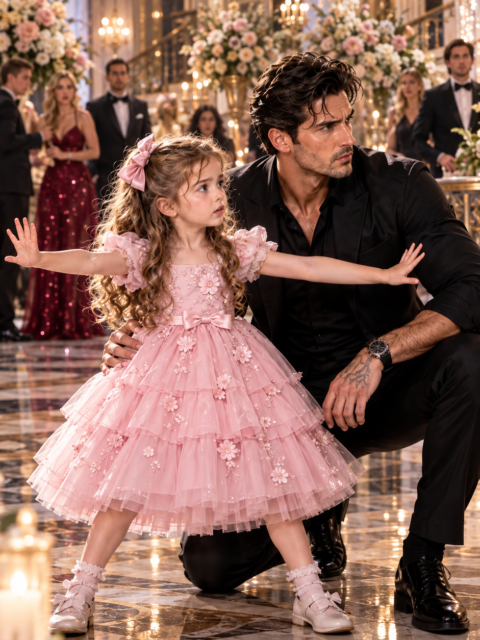
Sophie kicked her little boots, clutching Barnaby to her chest, her eyes wide with terror as she cried out: “Mommy! Mr. Alessandro!”
Before the intruder’s hand could fully lift the child from the floor, the heavy oak doors of the conservatory were kicked off their brass hinges.
Alessandro Romano entered like a tempest.
He was not in a tailored suit; he wore a black linen shirt with the sleeves rolled to his forearms, his eyes burning with a primeval, ferocious fury that nobody in Providence had seen since the night his wife was taken. In less than three seconds, the first intruder was disarmed and hurled through the glass table with concussive force.
The second man drew his weapon in panic, but Alessandro closed the distance with terrifying speed, seizing the man’s wrist and wrenching it downward with an iron grip that brought the operative crashing to his knees.
“You brought violence into the room where this child sleeps,” Alessandro whispered, his voice a low, vibrating growl of doom. “Tell Cruz he has one hour to abandon the state before I burn his foundation to the bedrock.”
Chapter Seven
The Iron Gate Confrontation
The retaliation was swift, absolute, and executed with mathematical finality.
Within forty-five minutes of the breach, forty armored vehicles bearing the Romano crest had completely encircled Hector Cruz’s waterfront headquarters. Not a single shot was exchanged; Cruz’s own lieutenants, terrified by the sheer ferocity of Alessandro’s awakening, disarmed their boss and handed him over to the federal authorities with a mountain of unredacted evidence that ensured Cruz would never see daylight again.
By 3:00 A.M., the perimeter of the Romano estate had been reinforced with triple-layered security, and the broken conservatory glass had been cleared by dawn.
Clara sat on the edge of the library sofa, her bruised cheek cooled by an ice pack, watching Sophie sleep soundly on the cushions. The little girl had been thoroughly checked by the estate physician and had fallen asleep holding both Barnaby and the gray river pebble Alessandro had returned to her earlier.
The library door opened softly. Alessandro stepped inside, carrying two cups of warm herbal tea. He set one before Clara and sat in the leather armchair across from her. His knuckles were bruised, his face shadowed with exhaustion, but the predatory menace had completely evaporated.
“I am sorry, Clara,” Alessandro said quietly, looking down at his tea. “I promised you this house was safe. Tonight, I failed that promise.”
Clara looked at the feared syndicate lord—a man who commanded empires, yet sat before her apologizing with genuine remorse. She touched her daughter’s soft hair, her heart swelling with an emotion she had tried to suppress for weeks.
“You didn’t fail us, Alessandro,” Clara said, using his first name for the very first time. “You stood between a bullet and my daughter without hesitating for a single breath. My husband was a good man, but he was always afraid. Tonight, I saw what true protection looks like.”
Alessandro looked up, his gray eyes catching the warm lamplight. “For seven years, I thought keeping my heart locked was strength. I thought if I didn’t care about anything, nothing could ever hurt me again. But when Sophie walked up to me in that hall… when she handed me that stone… I realized I was just a coward hiding behind an army.”
“You’re not a coward,” Clara whispered, reaching across the low table to touch his bruised knuckles. “You were just waiting for a reason to live again.”
Chapter Eight
The Fortress of Romano
One year later, the limestone estate of the Romano family looked entirely different.
The gloomy drapes that had kept the grand windows perpetually dim had been replaced with sheer, flowing linen that invited morning sunlight across the polished floors. The gardens, once strictly manicured into stiff, uninviting hedges, were now scattered with chalk drawings of hopping rabbits, yellow rubber boots, and a wooden swing hanging from the ancient oak tree.
Inside the grand dining hall, the long mahogany table was no longer reserved exclusively for grim men in dark coats whispering about territory. This morning, a brightly colored plastic placemat sat at the head of the table, flanked by a bowl of sliced strawberries and a plate of warm blueberry pancakes.
Alessandro Romano sat in his usual chair, reading the morning financial review. On his lap sat four-year-old Sophie, proudly wearing a miniature blazer that matched his own, dipping a pancake corner into maple syrup.
“Mr. Alessandro,” Sophie said solemnly, wiping sticky syrup from her chin with the back of her wrist.
“Yes, Lady Sophie?” Alessandro asked, setting the newspaper down and reaching for a linen napkin to dab her cheek with practiced tenderness.
“When I grow up, my promise is still true,” she announced, nodding firmly. “Only Mommy says you can’t marry two people, so you have to marry Mommy first so we can all share the big bedroom.”
From the doorway of the pantry, Clara stepped out holding a pot of fresh coffee, her cheeks blushing a delightful, radiant crimson. “Sophie! What did I tell you about matchmaking at breakfast?”
Alessandro didn’t look away. His gray eyes met Clara’s, crinkling at the corners with the deep, warm laugh that the entire city had learned to respect. He reached into the pocket of his vest, pulling out the small, smooth gray river pebble he had carried with him every single day since that foggy night at the gate.
He set the pebble gently beside Clara’s coffee cup, then reached for her free hand, lacing his fingers through hers in front of Sophie and the smiling staff.
“Your daughter gives very sound advice, Clara,” Alessandro murmured, his voice rich with peace and steady devotion. “And I have never been a man to break a promise to the Romano family.”
The city of Providence still spoke the name Romano with quiet awe. But inside the limestone walls, the king was no longer alone in the dark. He had found his fortress, his family, and a love that had proven stronger than seven years of winter.