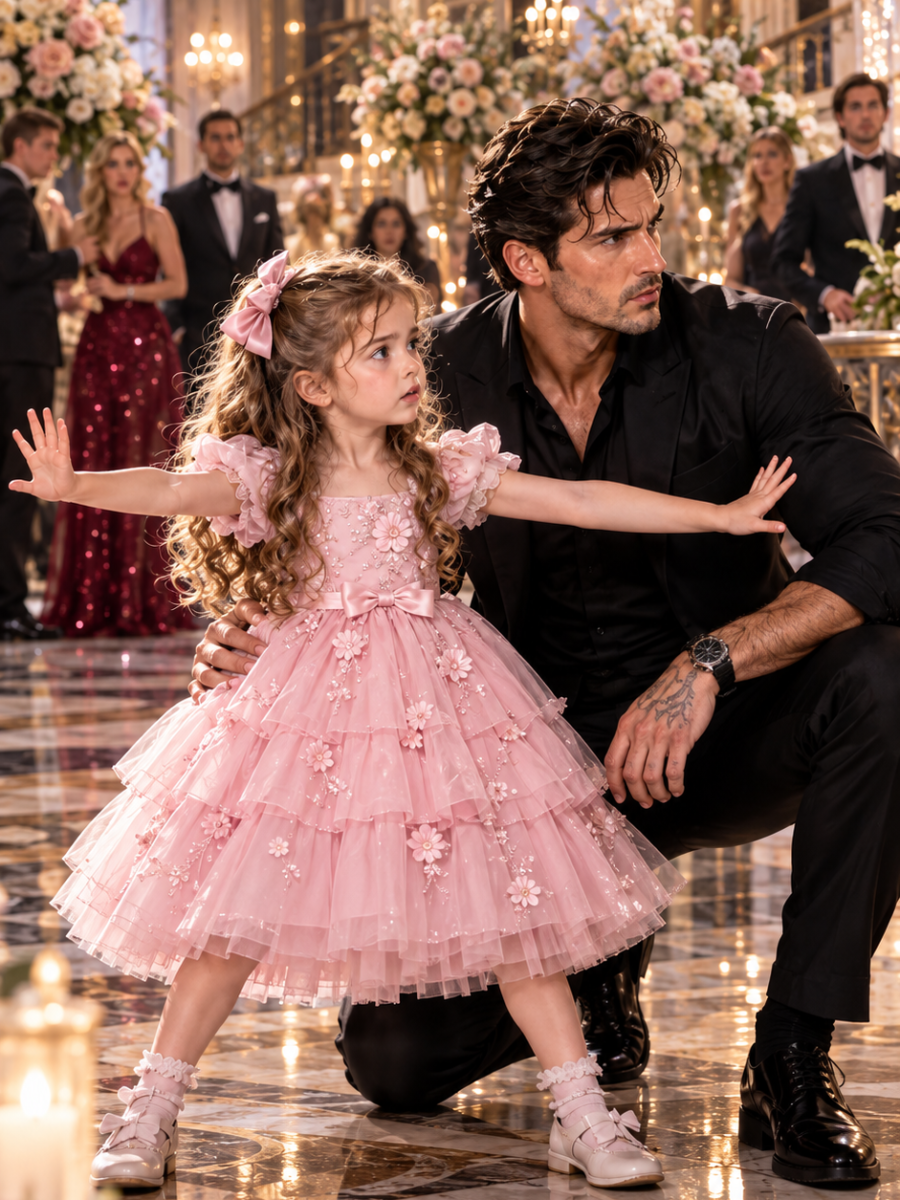
“He’ll Shoot Me First.” A 6-Year-Old Stepped Between a Gunman and Manhattan’s Most Feared Man — and Wouldn’t Move
Nova crossed an entire gallery of two hundred champagne-drinking guests, took Roman Kade’s hand, and refused to let go. Her mother Marisol screamed her name from across the room, terrified rather than angry. Then Nova whispered five words that locked every muscle in Roman’s body: he’ll shoot me first. Read every chapter to find out what Marisol overheard, and who wanted Roman dead.
Don’t Move
The gun was already hidden beneath the man’s jacket when the little girl stepped directly into the line of fire and took my hand.
Two hundred people were drinking champagne beneath the Bellacourt Museum chandeliers, laughing as though nothing in the room could touch them. Not one of them had noticed the three men watching me from across the gallery.
She had. And she couldn’t have been more than six years old. I felt her tiny fingers close around mine before I even looked down. For half a second, I thought she was lost. Children didn’t approach me. Adults barely did.
My name was Roman Kade, and people usually decided how close they wanted to stand to me long before I entered a room. Men lowered their voices when I passed. Women who recognized my face suddenly became fascinated by their champagne glasses. Businessmen who owed me favors smiled too quickly. Fear had a rhythm. I had learned to hear it years ago.
But the little girl beside me wasn’t afraid of me. She was afraid for me.
She wore a faded pink dress that had been repaired more than once. One shoulder showed a careful line of stitching that didn’t quite match the original fabric. Against her chest she clutched an old stuffed rabbit so tightly its bent ear disappeared beneath her arm. Half the fur was missing from its face. Her other hand was wrapped around mine. And she was trembling.
I stopped listening to the man speaking beside me. Stopped hearing the quartet. Stopped hearing the champagne glasses touching. All I could see was the child.
Then I noticed where she had come from. Across the room, near the service entrance, a woman in a cleaner’s uniform stood completely still. Her hand covered her mouth. Her face had gone white. Then she screamed. “NOVA!”
The little girl didn’t turn. That was the first thing that bothered me. A frightened child should have run toward the woman. Instead, Nova tightened her grip on my hand.
I bent down. Not because anyone told me to. Not because it was wise. I simply lowered myself until I was at her level.
Up close, Nova seemed even smaller. Her cheeks were pale. Her lips were pressed together as though she was trying very hard not to cry. The hand holding the stuffed rabbit shook. I kept my voice low. “What happened?” She didn’t answer. Instead, her eyes moved past my shoulder. Only for a second. But I saw it. Her fingers suddenly squeezed mine. Hard. “Don’t.”
I froze. Not because a six-year-old had ordered me to. Because of the way she said it. There was no childish uncertainty in her voice. No hesitation. She knew exactly what she had seen.
I studied her face. “What did you see?” Her eyes flicked toward the gallery again. Then toward my glass. That was when I remembered the three men. One near a marble column. Another farther back beside a display case. A third pretending to examine a painting. I replayed the last several minutes. They had not been looking at the art. They had been watching the glass in my hand.
I glanced down. Champagne. Untouched. I never drank at public events. Not anymore. Nova’s eyes remained fixed on it. A cold feeling settled behind my ribs. “Is it the drink?” She shook her head quickly. That frightened me more.
The cleaner finally broke through the edge of the crowd. “NOVA, COME HERE.” The girl flinched. But she still didn’t leave me. The woman looked terrified, not angry. There was a difference. Her gaze had shifted behind me. And then she stopped breathing. I saw it happen. Her eyes widened. Her mouth opened. No sound came out. She had seen it too.
Every instinct I had told me to stand. Move. Get Nova behind me. Find the threat before the threat moved first. But when I shifted my weight, Nova grabbed my wrist with both hands. The stuffed rabbit slipped slightly beneath her arm. She whispered again. “Please.” I went still.
Beyond Nova’s shoulder, the man beside the column adjusted his jacket. Small movement. Barely noticeable. His elbow moved outward. Then back. His hand disappeared beneath the fabric.
I didn’t look directly at him again. Looking would tell him I knew. Instead, I kept my eyes on Nova. “Where?” I asked. Her breathing changed. Faster now. The rabbit trembled against her chest. I expected her to point. She didn’t. Smart child. Far too smart for six.
She leaned closer. Her curls brushed the sleeve of my jacket. I lowered my voice until only she could hear. “Nova.” Her eyes finally met mine. They were enormous. Brown. Terrified. But there was something else there. Determination.
“What did you see?” Her lower lip trembled. She looked over my shoulder one more time. Then she leaned so close that her mouth was beside my ear. Nova whispered something so softly I almost thought I had misunderstood her. I pulled back. “What?” She swallowed. Her fingers tightened around mine.
Then I saw movement reflected in the glass display case behind her. The man near the column. His jacket opening slightly. His hand underneath it. And suddenly I understood why Nova had refused to step away from me. She wasn’t trying to hide. She had deliberately put her tiny body between me and him.
“NOVA,” the cleaner cried again. The girl ignored her. I stared at the child standing inches from me. “Why are you standing there?” Her eyes filled with tears. For the first time since she had crossed the gallery, she looked like what she actually was. A frightened little girl holding a broken rabbit. But she didn’t move.
Instead, she whispered the words that made every muscle in my body lock. “Don’t move.” I barely breathed. Then Nova looked past me toward the man beneath the marble column and whispered:
“He’ll shoot me first.”
Without Turning My Head
I</span ‘ve survived twenty years in businesses where a single misjudged second kills people. I understood, in that moment, with absolute clarity, that I could not simply stand up and move Nova aside. Any sudden motion might trigger exactly the outcome she was trying to prevent.
So I did the only thing available to me. I smiled, the easy, meaningless smile I’d perfected for exactly this kind of room, and I reached slowly into my jacket pocket as though retrieving a handkerchief. Instead, my fingers found the small transmitter I carried at every public event, pressed twice, the signal my security team would recognize instantly as active threat, non-verbal.
“You’re very brave,” I told Nova, keeping my voice light, conversational, the way a man speaks to a child who has simply wandered up to admire his watch. “I need you to keep looking at me. Can you do that?”
She nodded, tears finally spilling down her cheeks despite her obvious effort to hold them back.
Across the gallery, I caught the precise, practiced movement of two men in dark suits beginning an unhurried approach toward the marble column, men who looked, to two hundred unknowing guests, like nothing more than museum security making their rounds. My own security team. Already moving. Already converging. “A few more seconds,” I told Nova quietly. “You’ve done exactly the right thing. I need you to trust me for just a few more seconds.”
What Marisol Heard
My men reached the column in eleven seconds, close enough that the gunman’s hand never fully cleared his jacket before two hundred and ten pounds of trained security closed around him. There was no gunshot. There was barely a sound at all, the whole confrontation folding into the general murmur of the gala, two guests nearby assuming it was simply an overzealous drunk being quietly escorted out.
The other two men scattered the moment they understood the operation had failed, caught separately by my remaining team before they’d crossed half the gallery.
Only then did I finally rise, lifting Nova gently into my arms as her legs seemed to give out beneath her, the stuffed rabbit crushed between us. Her mother reached us a heartbeat later, pulling her daughter against her chest with a desperation that spoke to considerably more than ordinary parental fear.
“I need to understand what happened,” I told her, once Nova had been settled, shaking but unharmed, into a private room away from the gala’s continued, oblivious celebration. “Start from the beginning. Your name.”
“Marisol Reyes,” the woman said, her hands still trembling around her daughter’s shoulders. “I clean the service corridors here, three nights a week. Two hours ago, I heard something I was never meant to hear, Mr. Kade. And I’ve spent every minute since trying to decide whether telling anyone would get my daughter and me killed.”
The Service Corridor
“Tell me,” I said. “Everything. Whatever danger exists has already been contained, Marisol. You and Nova are safe now.”
“I was emptying bins near the loading dock,” she said. “Two men were having a conversation near the service entrance, assuming the corridor was empty. They were discussing tonight’s event specifically, mentioning your name directly, discussing timing and positioning as though planning something considerably more organized than ordinary conversation.”
“What exactly did they say?”
“They said the signal would come once you’d been handed your champagne,” Marisol said. “That the shooter would wait until you’d moved away from the main security detail near the entrance, into the gallery proper, before acting. They mentioned a name, Mr. Kade. Desmond. I didn’t catch a last name.”
“Why didn’t you simply report this to museum security?” I asked.
“I tried,” Marisol said, old humiliation entering her voice. “I approached the head of museum security directly, forty minutes ago. He looked at my uniform, decided I was simply an anxious cleaning woman imagining danger, and told me to return to my duties. I didn’t know what else to do, so when I saw Nova playing near the gallery entrance, waiting for my shift to end, I made an impossible choice. I told her what I’d heard, and what you looked like from photographs I’d seen in the newspaper. I told her to find you, somehow, and warn you.” Her voice broke. “I never imagined she’d actually put herself directly between you and a loaded gun.”
Three Men, One Column
I knelt in front of Nova again, considerably gentler this time, no longer needing to maintain the careful stillness that had defined our first conversation. “Why didn’t you simply tell me and then run?” I asked her. “Your mother asked you to warn me. You did that. You didn’t have to stay.”
Nova considered this question with the same grave seriousness she’d brought to everything that evening. “Because if I left,” she said, “you might have moved. And Mommy said the bad man was waiting for you to move away from your other guards. I thought if I stayed really close, he couldn’t shoot without maybe hitting me too, and maybe that would make him wait longer.”
The devastating, precise logic of a six-year-old child, calculated with more tactical clarity than half the security professionals I employed, settled over me with considerable weight. “You used yourself as a shield,” I said slowly, “to buy time for help to arrive.”
“I guess,” Nova said, suddenly looking considerably more like an ordinary, exhausted six-year-old than the composed, determined child who’d crossed the gallery. “I was really scared the whole time.”
“You were also remarkably brave,” I told her, genuine, overwhelming gratitude entering my voice for perhaps the first time in longer than I cared to examine. “I intend to make certain neither you nor your mother ever regret tonight’s courage, Nova. Whatever that requires.”
Whoever Sent Them
The captured gunman, once properly questioned by my own security team alongside federal investigators I’d summoned immediately, confirmed what Marisol had overheard. He’d been hired through an intermediary, payment arranged through channels that traced back, after careful investigation over the following days, to a man named Desmond Cole.
“Cole,” I said slowly, once my security chief presented the findings. “I know that name. He runs a logistics firm I outbid for a considerable shipping contract eight months ago. The loss nearly collapsed his company.”
“That appears to be the motive,” my security chief confirmed. “Financial records show Cole’s firm has been in severe distress since losing that contract. He apparently believed eliminating you would somehow restore his company’s position, or at minimum, satisfy whatever desperate calculation grief and financial ruin produced in him.”
“Desperate men make desperate choices,” I said, old weariness entering my voice despite the evening’s resolved danger. “I’d simply prefer those choices not involve hired guns at public galas, endangering two hundred innocent guests and nearly costing a six-year-old child her life.”
“We have more than sufficient evidence for federal prosecution,” my security chief said. “Conspiracy to commit murder, attempted murder, considerable additional charges given the public endangerment involved. I’d recommend proceeding through proper legal channels rather than any private resolution, Mr. Kade, given the comprehensive evidence we’ve assembled.”
Desmond Cole
Desmond Cole’s arrest, conducted quietly the following morning with comprehensive evidence ensuring charges would properly stick, unfolded without further violence, his own desperate scheme collapsing as completely as the business failure that had apparently driven him toward it.
“I never wanted actual violence,” Cole insisted, during his own formal interview, though the admission offered little genuine comfort given the evening’s near-catastrophic outcome. “I wanted you removed from competing contracts, Mr. Kade. I convinced myself eliminating the competition, however extreme, represented my only remaining path toward saving my company and my employees’ livelihoods.”
“You endangered two hundred innocent people,” I said, during the brief formal confrontation my attorneys arranged before his prosecution properly began, “including a six-year-old child, to protect a business that failed through ordinary competitive pressure, not through any wrongdoing on my part.”
His prosecution, pursued through comprehensive federal channels over the following months, resulted in convictions ensuring genuine accountability for a scheme that had nearly cost multiple lives purely to address a business dispute that proper legal and financial channels could have resolved considerably less catastrophically.
With Cole’s threat finally, formally addressed, I turned my full attention toward Marisol and Nova, whose combined courage had ultimately prevented what should have been an impossible tragedy.
The Rabbit’s Torn Ear
“I’d like to properly provide for both of you,” I told Marisol, several weeks after that extraordinary evening, once the legal proceedings had been properly set in motion. “Not simply as reward, though I understand if gratitude alone feels insufficient given what Nova actually risked. I’d like to ensure neither of you ever again face the kind of impossible choice you faced that night, cleaning corridors for wages that apparently required ignoring your own daughter’s safety simply to keep your position.”
“I don’t want charity,” Marisol said carefully, old pride evident despite her obvious continued gratitude for my attention toward her daughter.
“It isn’t charity,” I said. “I have considerable business interests requiring people I can genuinely trust, Marisol, a quality your family demonstrated more clearly in one evening than most of my current staff has shown in years. I’d like to offer you a position considerably better suited to your evident capabilities than cleaning service corridors three nights a week.”
Nova, who had accompanied her mother to this conversation and spent most of it quietly examining my office with the same careful, assessing attention she’d once directed toward three dangerous strangers, looked up from the stuffed rabbit she still carried everywhere. “Can we get Mr. Hops a new ear?” she asked. “His is really torn now.”
I looked at the worn, beloved rabbit, half its face missing fur, one ear barely attached after what had clearly been years of devoted love. “I think,” I said, genuine warmth entering my voice as it increasingly did around this remarkable, fearless child, “Mr. Hops has earned a considerably better ear than I could ever properly provide. But I’d be glad to help find him one, if you’ll let me.”