“Dance This Waltz, and I’ll Adopt You.” Then a Silver Medal Slipped From My Daughter’s Neckline — and Two Powerful Men Recognized It
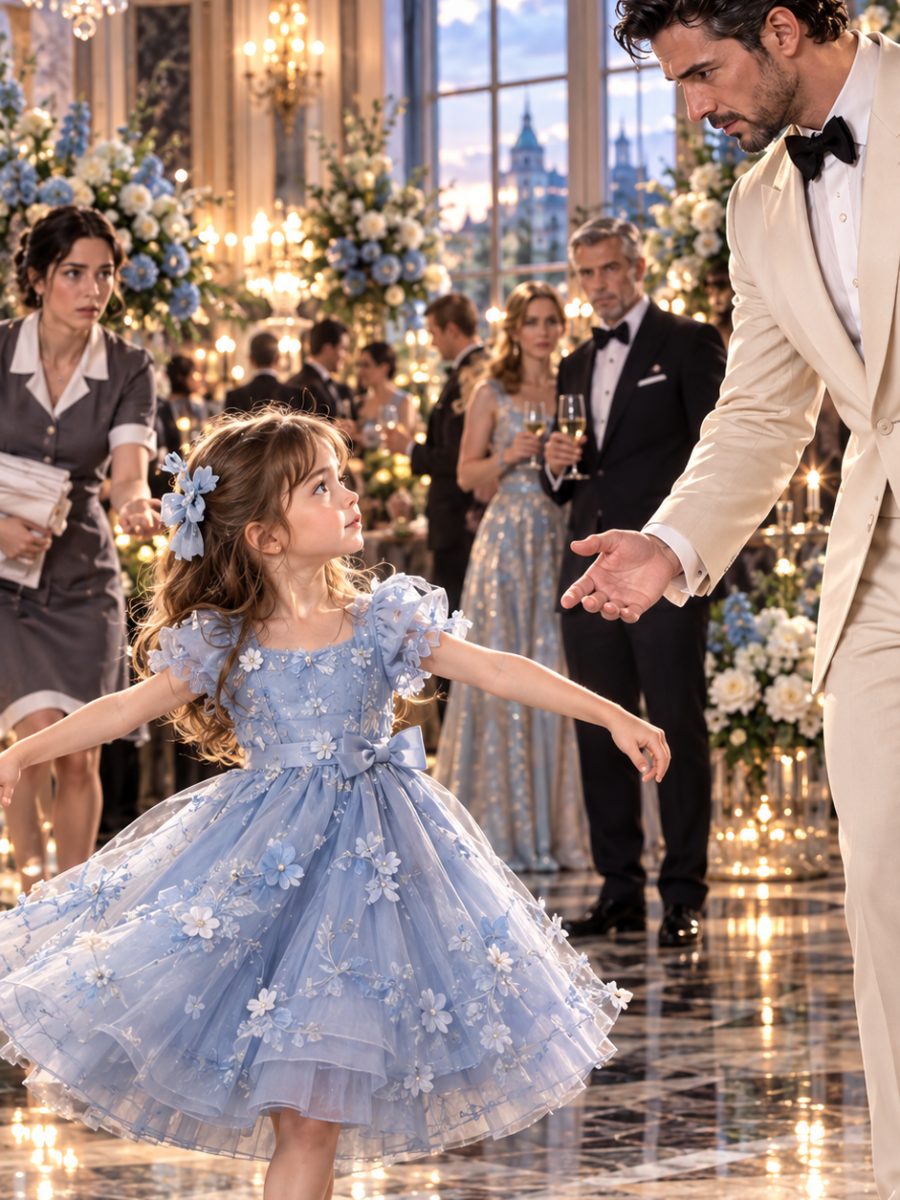
Lucy waltzed onto the Caruso ballroom floor in a secondhand blue dress, and as she turned beneath the chandelier, a thin silver chain slipped from her repaired neckline. Gabriel Caruso went pale. Across the room, another powerful man froze with his champagne glass halfway to his lips. Both men knew exactly what Lucy was wearing. Marisol, her mother, had no idea. Read every chapter to find out whose medal it was, and why only one man in that room was afraid.
The Music
“Dance this waltz, and I’ll adopt you.” Gabriel Caruso’s words silenced the ballroom.
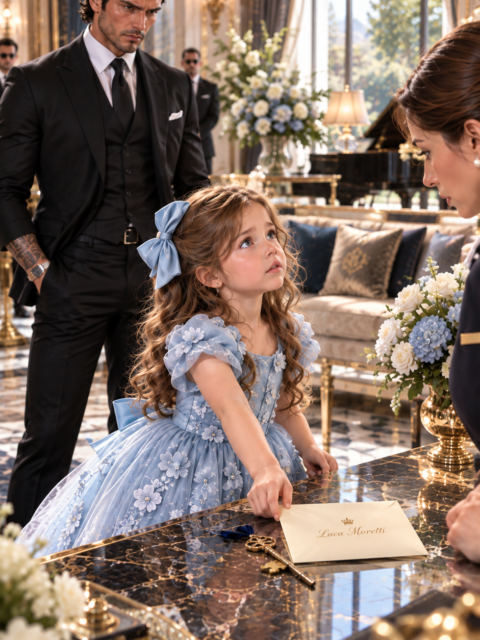
Beneath glittering crystal chandeliers, my five-year-old daughter Lucy stood frozen on the polished floor in a secondhand blue dress and scuffed shoes, surrounded by fifty guests dressed in silk, diamonds, and old money. Outside, November rain battered the windows of the Caruso estate. Inside, the string quartet kept playing as Lucy stared at the elegant women circling the floor.
“I’m little,” she whispered. “I don’t know how to dance like them.” No one laughed. Somehow, the silence was worse.
Lucy glanced toward the service door where I stood clutching folded linens. “They have pretty dresses. They look like they belong here.” Her small shoulders sank. “I’m just waiting for Mama.”
“Lucy!” I abandoned the linens and hurried toward her. Gabriel Caruso didn’t move. At forty-one, the chairman of Caruso Holdings controlled an empire of construction, freight, hotels, venues, and commercial property. I had worked in his household for eleven months, long enough to see politicians shake his hand and powerful businessmen lower their voices when he entered a room.
“Mr. Caruso,” I said, reaching Lucy, “she shouldn’t be here.” He ignored me. “You think the dress makes those women belong here?” he asked Lucy. She nodded seriously. “Yes.” Gabriel surveyed the diamonds and expensive gowns surrounding them, then looked back at her. “You don’t need their dress.” “Then what do I need?” “To hear the music.”
My stomach tightened. Ten minutes earlier, Lucy had been watching the dancers from the service entrance. She had lifted one heel and shifted her weight with the rhythm. I thought nobody had noticed. Gabriel had.
Lucy stepped onto the ballroom floor. She listened. Then she moved. Her first step was awkward. Her second uncertain. The third landed perfectly on the beat. Gabriel’s expression flickered with surprise.
Then Lucy turned beneath the chandelier. Something slipped from beneath the repaired neckline of her dress. A thin silver chain. A small medal. It swung against her chest as she completed the turn. Gabriel went pale.
Across the ballroom, another powerful man froze with his champagne glass halfway to his lips. Both men were staring at the medal. Gabriel took one slow step toward my daughter. The other man lowered his glass.
And as I looked between them, one terrible realization settled over me: they both knew exactly what Lucy was wearing.
Whatever secret that silver medal carried had just been exposed in front of everyone.
Two Men, One Medal
I reached Lucy before either man could, and I did what any mother would do. I tucked the medal back beneath her neckline and lifted her onto my hip. Her heart was racing. So was mine.
“Where did she get that?” Gabriel asked. His voice was quiet, nothing like the confident baritone he used to address a room. He was staring at my hands, not my face.
“It’s a keepsake,” I said. “From her father.”
Across the ballroom, the other man had set his glass on a passing tray and was already moving toward the doors, smiling at guests, shaking one hand, then another, unhurried in the way of a man who is walking very deliberately. I recognized him. Victor Salerno, who owned a construction firm and sat on half the charity boards in the valley. He had never once looked at me in eleven months. He did not look at me now. But at the threshold, he glanced back at Lucy, and what crossed his face was not curiosity.
It was fear.
“Ms. Reyes,” Gabriel said. “I need to speak with you. Not here. Please.”
Every part of me wanted to refuse, to take Lucy out into the rain and never return. But I had seen two powerful men react to a child’s necklace in the same instant, and I understood that walking away would not make it a secret again. “In the library,” I said. “The door stays open. And Lucy stays where I can see her.”
Danny Ross
“May I see it?” Gabriel asked, once I had settled Lucy in an armchair with a plate of cookies and my coat around her shoulders.
I lifted the chain from her neck myself and laid the medal in his palm. He turned it over carefully. On the back, worn nearly smooth, were three engraved letters: D.C.
“Saint Christopher,” he said. “My father gave one to each of his sons when we turned eighteen. This one has a nick on the rim, from when my brother dropped it down a stairwell in Naples.” His voice cracked on the last word. “This is Daniel’s.”
“Her father’s name was Danny,” I said. “Danny Ross. I met him at a diner in Newburgh where I was waitressing. He drove trucks and did roofing jobs and he laughed like a man who had nothing left to hide. He told me his family was gone. That he’d left them behind.”
“He wasn’t wrong,” Gabriel said.
“He died two years ago. A scaffolding collapse on a job site. They called it an accident. Lucy was three.” I heard my own voice stay steady and hated how much effort it took. “He wore this every day. He left it to her.”
Gabriel sat down slowly, as if his legs had stopped taking instructions. “Ms. Reyes,” he said. “My brother’s name was Daniel Caruso. He disappeared seven years ago, and I never once stopped looking.”
I looked at my sleeping daughter, at the dark curls and the stubborn chin, and at the man across the library who had the same chin, and all of it arranged itself in my mind with a terrible, quiet click. “Then Lucy,” I said, “is your niece.”
The Brother Who Left
Gabriel told it plainly, without flattering himself, which is how I first began to trust him.
“Daniel worked in the family construction company,” he said. “He was the honest one. Better at people than I ever was. Eight years ago, he came to me with a folder of documents and an accusation. Victor Salerno, who supplied our steel and had just become my closest business partner, was falsifying inspection reports. Cutting corners. Buildings that would stand until they didn’t.”
“And you didn’t believe him,” I said.
“I said he was being naive. That every supplier cuts something. I said if he wanted to accuse a friend of the family, he’d better bring proof I couldn’t argue with.” Gabriel looked at his hands. “We fought. Badly. The last thing I said to my brother was that if he couldn’t trust the family, he was welcome to leave it.”
“He left.”
“Within the week. I told myself he’d come back when he cooled off. Then a year passed. Then two. I hired investigators. They found nothing. He’d changed his name, cut every tie.” He drew a breath. “I found out tonight that he’d been alive for five of those years, driving trucks in Newburgh, raising a daughter with a woman who was cleaning my house.”
“Why did Victor Salerno look at my daughter like that?” I asked.
Gabriel didn’t answer immediately. When he did, his voice had gone very quiet. “Because Daniel took the folder with him. And whatever was in it, Salerno has spent eight years hoping no one would ever read it.”
A cold understanding moved through me, slow and heavy. “Danny kept a shoebox,” I said. “Under our bed. He told me never to open it unless something happened to him. And when something did, I was too grief-stricken to look.”
The Shoebox
I did not hand Gabriel the box. I brought it to the library myself the following evening, with Lucy at Mrs. Delaney’s downstairs, and I insisted on two conditions. I would open it. And whatever we found would go to a lawyer of my choosing, not his.
He agreed to both without argument. He even arranged for a public defender’s office contact, an attorney named Ruth Halloran, who had spent her career prosecuting construction fraud and had no reason to love the Caruso name.
The box held little. A worn leather notebook. A flash drive taped to the lid. Photocopies of inspection reports, each with a signature that had been traced from another document. A list of dates and building addresses, several with a small red cross beside them.
And a letter, folded in thirds, addressed in Danny’s handwriting: To whoever finds this. If it’s Marisol, I love you, and I’m sorry I didn’t tell you everything.
I read it aloud, because I could not have read it silently. Danny explained what he had found, and that he had taken the documents to protect people, not to punish anyone. He wrote about Lucy. He wrote about Gabriel, too: I don’t hate my brother. He just never learned that loyalty and honesty can be the same thing.
Gabriel had turned his face to the window by then. His shoulders were shaking.
“The scaffolding,” I said, when I could speak again. “The job where he died. Whose firm was it?” Ruth Halloran, who had been quietly turning pages, lifted her head. “Ms. Reyes,” she said, “according to this list, the site was one of Salerno’s. And Daniel had marked it three weeks earlier.”
What Victor Salerno Signed
Ruth Halloran did not rush. She spent six weeks assembling everything: the falsified inspection reports, engineering reviews of the buildings on Danny’s list, the site records for the scaffolding collapse. She gave every document to the state attorney general’s office and the federal prosecutors, and she told both Gabriel and me, repeatedly, not to speak to Victor Salerno directly.
Gabriel obeyed, which surprised everyone who knew him. He opened Caruso Holdings’ own records to investigators, including contracts that implicated his own company’s oversight failures. His board threatened to remove him. He handed them his resignation letter and told them to proceed.
“You didn’t have to do that,” I said.
“Yes, I did. My brother tried to warn me eight years ago, and I called him naive. If I hide behind the company now, I’m still calling him naive.”
The investigation confirmed Danny’s suspicions. Three of the buildings on his list had failed structural review and were closed for emergency repair before anyone was hurt. The scaffolding collapse, the engineers concluded, resulted from documented load violations that Salerno’s site manager had signed off on despite objections from the crew.
Salerno was indicted on charges of fraud, falsification of safety records, and, once a whistleblower from his own firm came forward, involuntary manslaughter in Danny’s death.
I attended the arraignment with Ruth. Victor Salerno never looked at me. But when the judge read the charge naming Daniel Caruso, also known as Danny Ross, I felt Lucy’s small medal press cold against my palm where I had tucked it in my coat pocket, and I thought, quietly, you did it, Danny. You finally did it.
A Line Gabriel Should Never Have Said
But I had not forgotten the ballroom, and neither had Gabriel.
“You said you’d adopt her,” I told him one evening in the library, several weeks after the indictment. “In front of fifty people. You said it as if she were a party favor.”
“I know.”
“You’d noticed the chain before that night, hadn’t you?” I said. “You saw it glint at the service door. You suspected. And instead of asking me, you made a spectacle of a five-year-old to see whether it would fall out.”
Gabriel did not deny it. “I’d like to say I acted from something nobler,” he said. “I didn’t. I was afraid I was wrong, and afraid I was right, and I did what I’ve always done. I turned it into a test, and a child paid for it.”
“She danced beautifully,” I said. “That was luck. It could have gone another way.”
“It could have.” He met my eyes. “I’m sorry, Marisol. Not for what we discovered. For how I went looking.”
It was the first time he had used my first name, and I let it stand.
“Here is what I need from you,” I said. “Lucy is not a prize, and she is not a replacement for the brother you lost. She is Danny’s daughter, and she is mine. If you want to be her uncle, you will be a real one, which means showing up on ordinary Tuesdays and never asking her to be anyone other than exactly who she is.” Gabriel nodded slowly. “That,” he said, “is the only kind of family I want.”
Lucy’s Uncle
We took a DNA test in the spring, at Ruth Halloran’s suggestion, for Lucy’s legal records and for nothing else. The results confirmed what the medal and the chin had already told us. Lucy Reyes was Daniel Caruso’s daughter, and Gabriel’s niece.
Lucy took the news with the seriousness she brought to everything. “So Mr. Gabriel is my daddy’s brother?” she asked, at our kitchen table, with the broom handle still leaning against the wall. “Yes.” “Is he going to adopt me?” “No, sweetheart. He’s going to be your uncle.” She considered this. “That’s better. Because I already have a mama.”
Gabriel had brought a new photograph in a small frame, a young man with a nicked Saint Christopher medal around his neck, laughing on a dock in Naples, and he set it gently on our windowsill. Lucy studied it, then looked at her uncle with sudden, sharp interest. “He’s got your chin,” she announced. “Both of you have it.”
“I’ve been told,” Gabriel said, and his voice caught.
In June, the Caruso family held a small memorial for Daniel in the ballroom, attended by fifty guests, though none of them were the kind who had once crowded its floor. Lucy wore a new dress, blue, because she asked for it. It fit her properly.
The quartet played a waltz. Gabriel offered his hand, and this time he did not say a word about adoption or bets or anything else. He simply asked, “Would you like to dance?”
Lucy looked at me. I nodded.
She stepped onto the marble, lifted her arms, and turned slowly beneath the chandeliers, her father’s medal swinging against her chest in the light, right where it belonged.