She Knelt Beside the Mafia Boss’s Screaming Son With a Glass of Warm Milk — What Leo Did With His Hand Next Left Rico Moretti Speechless
Three-year-old Leo Moretti hadn’t spoken a full sentence in six months, not since his mother was gunned down in a drive-by meant for his father. A waitress named Clara Vance risked her job to kneel beside him with warm milk while an entire restaurant of Brooklyn’s most feared men watched in silence. He stopped crying instantly. But what Leo did with his hand once he finally calmed left Rico Moretti unable to speak. Read every chapter to find out what happened next.
The King’s Table
The crystal chandelier at Il Destino vibrated. Not from an earthquake. Not from the subway rumbling beneath the Manhattan pavement. It was from the lungs of three-year-old Leo Moretti.
The restaurant was silent save for the child’s piercing wails. It was eight PM on a Friday — prime time. Usually, the clinking of silverware against bone china and the low hum of deals being made filled the air. Tonight, the air was thick with a suffocating tension that pressed against every chest in the room.
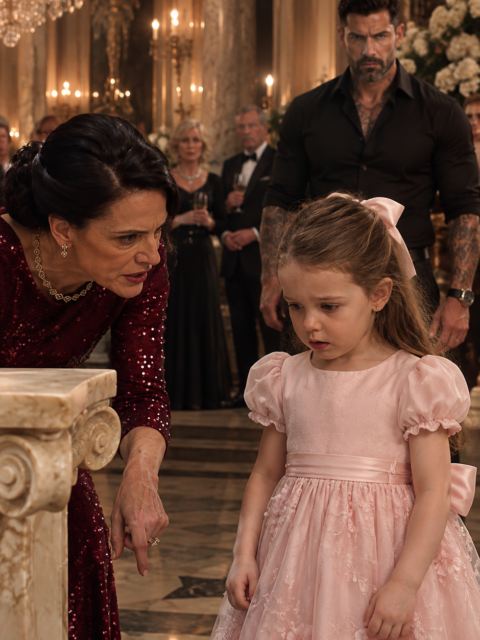
At the center table — the king’s table — sat Ricardo “Rico” Moretti. He was thirty-two, wore a bespoke Brioni suit that cost more than most people’s cars, and had eyes like shattered ice. He was the capo of the Moretti crime family, a man who had dismantled rival syndicates with a fountain pen and a silenced pistol. But right now, he looked defeated.
“Leo,” Rico growled, his voice low and dangerous. “Basta. Enough.” “No, no, I want no!” Leo swept a plate of untouched truffle risotto off the table. Ceramic shattered against marble. The entire restaurant flinched.
The manager, a sweating man named Marco, approached with trembling hands. “Mr. Moretti… perhaps a different dish for the young master?”
Rico slowly turned his head. The look he gave Marco could have curdled milk. “He doesn’t want food, Marco. He wants to torture me. Do I look like a man who knows how to stop a toddler?”
Rico ran a hand through his dark hair, gripping the roots. He had been a widower for six months. Six months of hell. Six months since his wife Elena had been gunned down in a drive-by that was meant for him. Since then, Leo hadn’t spoken a full sentence. He only screamed.
“Get him out of here,” Rico snapped at his head of security, a giant named Dante. Dante reached for the boy. “Come on, little boss.” Leo went feral. He bit Dante’s hand, drawing blood. Dante recoiled, cursing under his breath.
Rico slammed his hand on the table. Silverware jumped. “Is everyone in my employment incompetent? Silence him, or I shut this place down.” The threat hung heavy. Rico wasn’t speaking metaphorically. He owned the building. He could burn it down tonight if the mood struck him.
In the back corner near the kitchen doors, Clara Vance adjusted her apron. She was twenty-four, with tired eyes and hair pulled back in a messy bun. She had been working a double shift on an empty stomach. She needed this job. She had rent to pay and a past to outrun.
“Don’t do it, Clara,” whispered Sarah, another waitress. “That’s the Butcher of Brooklyn. If you go over there, you’re dead.”
Clara watched the little boy. She didn’t see a brat. She didn’t see a mafia heir. She saw a tiny red-faced human being who was drowning in grief. She saw the way he was clutching his own shirt, gasping for air between sobs. She knew that gasp. She knew that panic.
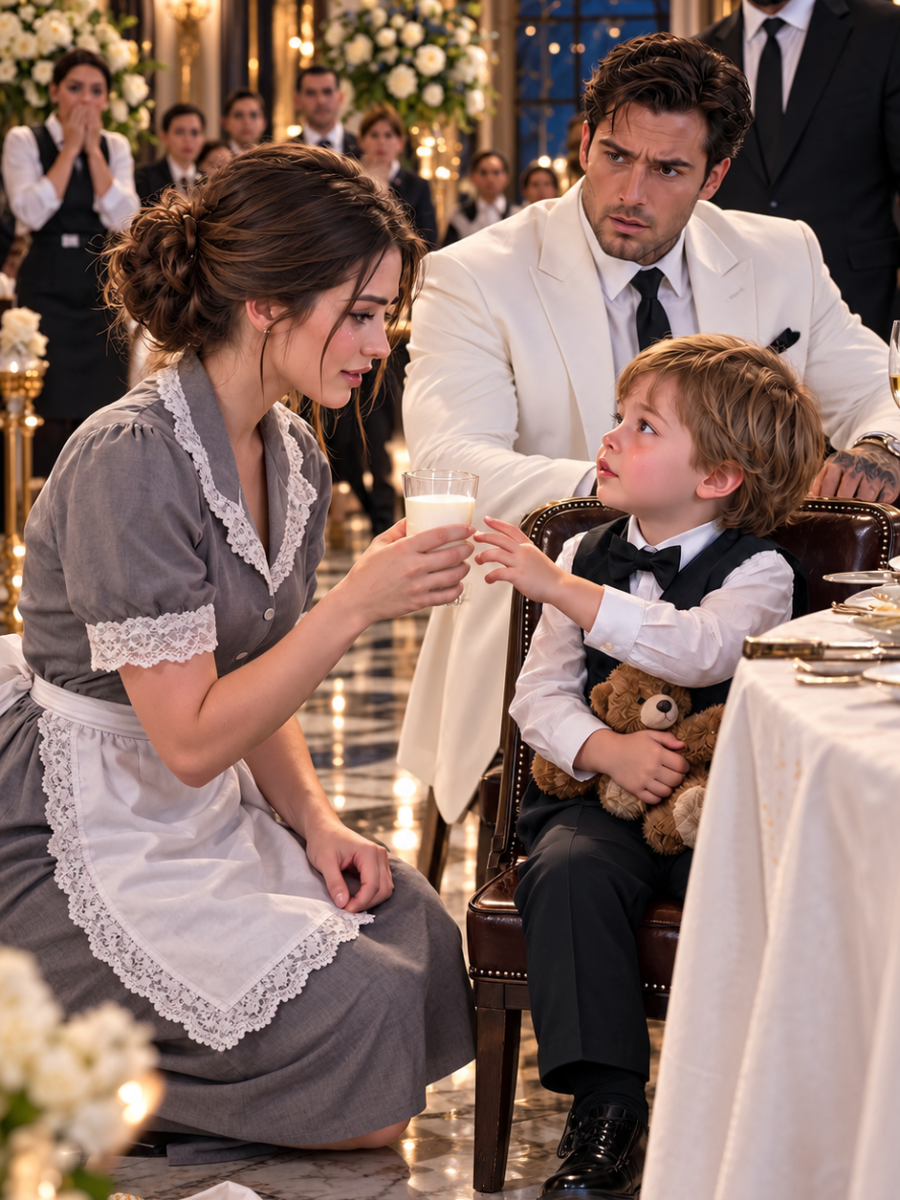
Clara ignored Sarah. She grabbed a glass of warm milk from the service counter, dropped a single cube of sugar into it, and walked onto the floor.
“Hey, you!” Marco hissed, trying to grab her arm. “Get back to the kitchen.” Clara pulled away and kept walking. The sound of her cheap rubber-soled shoes squeaking on the marble was the only sound other than Leo’s screams. She stopped at the table.
Rico looked up. His hand hovered near the inside of his jacket where his sidearm rested.
“Who are you?”
Warm Milk
“Clara,” she said simply, her voice steady despite the very real danger radiating from the man across the table. “I work here. And I think your son needs something considerably simpler than everyone’s been trying.”
Rico’s hand remained near his jacket, old instinct warring against the strange, careful calm this waitress carried despite the obvious danger of approaching him uninvited. “He needs to stop screaming. That’s what he needs.”
“He needs to feel safe,” Clara said, ignoring the implicit threat in Rico’s tone entirely, her attention already shifting toward Leo’s small, trembling form. She knelt slowly beside his chair, lowering herself to his eye level rather than looming over him the way every adult in the restaurant had been attempting.
“Hi, Leo,” she said softly, her voice carrying none of the panicked urgency everyone else had brought to their failed attempts at calming him. “I brought you something warm.”
Leo’s screaming faltered, his wide, tear-filled eyes finding Clara’s face with visible, startled curiosity. “Warm?” he managed between hiccupping sobs.
“Warm milk,” Clara said, offering the glass carefully. “With a little bit of sugar, just the way my own mom used to make it for me when I was sad.”
Leo’s small hands, still trembling from his extended meltdown, reached for the glass with careful, uncertain movements. He drank slowly, his breathing gradually steadying as the warm liquid seemed to settle something deeply unsettled within his small body. The entire restaurant remained frozen, watching this extraordinary transformation unfold in absolute, disbelieving silence, Rico’s own composure carrying genuine shock at what none of his considerable resources or intimidating authority had managed to accomplish in six devastating months.
What Leo’s Hand Remembered
Once Leo had finished the milk, his small body considerably more relaxed than anyone had witnessed in months, he set the empty glass down carefully and reached for Clara’s hand.
The restaurant, still watching this extraordinary scene with collective, disbelieving attention, fell into fresh, startled silence as Leo pressed Clara’s open palm directly against his own small chest, right over his heart.
“Feel,” he said quietly, his first full sentence in six months landing with a weight that made Rico’s breath catch audibly. “Mommy did this. Says heart still works when sad.”
Rico’s composure, already tested considerably by his son’s sudden transformation, finally, completely shattered. His hand fell away from his jacket entirely, old grief and fresh, overwhelming shock colliding as he watched his son perform a gesture he hadn’t witnessed since Elena’s death six months earlier.
“That’s…” Rico’s voice failed him momentarily, genuine emotion breaking through his carefully cultivated composure in front of his entire assembled organization. “That’s exactly what Elena used to do. I haven’t seen him do that since she died. He stopped, along with everything else.”
Clara looked up at Rico, genuine surprise evident at the unexpected significance her simple, intuitive comfort had apparently triggered. “I didn’t know that,” she said honestly. “I simply offered what felt natural, given how upset he seemed.”
Rico stared at his son, still calmly holding Clara’s hand against his small chest with a peace that had been entirely absent from his life for six devastating months, disbelief and overwhelming, fragile hope tangling together in his expression. “I need to understand,” he said slowly, his voice carrying genuine vulnerability he rarely allowed anyone to witness, “exactly how you managed something my entire staff, considerable resources, and six months of desperate effort couldn’t accomplish.”
A Past to Outrun
Clara hesitated, old caution about her own carefully guarded past warring against the genuine, extraordinary moment unfolding before her. “I lost my mother when I was young,” she said carefully. “Sudden circumstances, considerably traumatic for a child my age at the time. I understand what that particular kind of grief feels like, Mr. Moretti. Sometimes recognizing someone else’s pain simply requires having survived something similar yourself.”
Rico studied her with fresh, careful attention, understanding this simple explanation likely carried considerably more complicated history than her measured words fully revealed. “I’d like to properly thank you,” he said, “for accomplishing something genuinely remarkable tonight. My son hasn’t spoken a complete sentence in six months, and you managed it within minutes.”
“I was simply doing my job,” Clara said, though her voice carried visible uncertainty about how exactly tonight’s extraordinary intervention might affect her actual continued employment.
“Your job doesn’t typically include comforting my son,” Rico said, something considerably warmer entering his careful, controlled composure. “Marco,” he called, turning toward his still-sweating restaurant manager, “this woman will not be disciplined for tonight’s actions. In fact, I’d like to speak with her privately, once Leo has been properly settled.”
Leo, still holding Clara’s hand with quiet, contented determination, looked up at his father with an alertness that had been entirely absent throughout his preceding six months of grief-stricken silence. “Stay,” he said simply, looking directly at Clara. “Don’t go.”
Clara’s expression carried genuine, surprised warmth at this simple, direct request, old caution about her own complicated circumstances warring against the extraordinary connection she’d apparently, unexpectedly forged with this grieving little boy. “I think,” Rico said slowly, watching this exchange with fresh, careful consideration, “we have considerably more to discuss than simply tonight’s remarkable intervention, Ms. Vance. I’d like to understand whether you might be willing to consider a position considerably beyond simple restaurant service.”
The Offer
Rico’s formal proposal, presented the following morning at his private estate rather than the restaurant’s considerably more public setting, carried genuine, careful consideration for exactly the kind of ongoing support Leo apparently required.
“I’d like to offer you a position within my household,” he said, “specifically dedicated to Leo’s care and continued emotional recovery. I recognize this represents a considerable departure from restaurant service, Ms. Vance, but given what I witnessed last night, I believe you possess exactly the intuitive understanding my son genuinely needs.”
Clara considered this unexpected, significant offer carefully, old caution about her own complicated past warring against genuine, growing concern for the grieving little boy who had so unexpectedly connected with her simple kindness. “I need to be honest with you,” she said. “I have circumstances in my own past that might complicate this arrangement, Mr. Moretti. I’m not certain full disclosure would necessarily reassure you about my suitability for this position.”
“I’m not requesting a complete background investigation,” Rico said. “I witnessed something remarkable last night, something genuinely unprecedented throughout six devastating months of watching my son suffer without any effective intervention. I’m willing to extend trust based on that extraordinary demonstration, rather than requiring comprehensive disclosure of whatever private history you’re understandably protecting.”
Leo, present throughout this conversation with the same alert attentiveness he’d shown since the preceding evening’s extraordinary breakthrough, tugged gently at Clara’s sleeve. “Stay with me?” he asked simply, his characteristic directness cutting through whatever careful, adult negotiation might have otherwise complicated the moment.
Clara studied his hopeful, earnest expression, genuine warmth building beneath her own careful uncertainty about accepting such a significant, unexpected opportunity. “I’ll stay,” she said finally, watching Leo’s answering smile carry more genuine joy than she’d witnessed from him throughout their brief but already meaningful acquaintance. “For as long as you need me, Leo, I’ll be here.”
Full Sentences
The following weeks brought a genuine, gradual transformation to Leo’s continued recovery, Clara’s steady, intuitive presence providing exactly the kind of consistent emotional support his preceding six months of grief-stricken silence had genuinely lacked.
“He’s speaking in complete sentences now, most days,” Rico observed, watching Leo happily narrate an elaborate story about his toy dinosaurs to Clara during one of their now-regular afternoon routines. “I genuinely didn’t believe that kind of recovery was possible, given how completely he’d withdrawn following Elena’s death.”
“Grief doesn’t follow predictable timelines,” Clara said, watching Leo’s continued animated storytelling with genuine, warm attention. “But consistent safety and patience usually help, eventually, even when progress initially feels impossible.”
Rico studied her carefully, genuine curiosity about her own apparent expertise building alongside his growing personal interest in her steady, comforting presence throughout his household. “You mentioned losing your mother young,” he said carefully. “Is that where you learned to navigate grief this effectively?”
Clara’s expression carried old, careful hesitation before she finally, cautiously continued. “My mother died when I was eight,” she said. “Domestic violence, Mr. Moretti. My father killed her, then spent considerable years afterward continuing to threaten both my safety and my sister’s, until I finally found the resources to properly escape that danger permanently as an adult.”
Rico’s expression carried genuine, devastated sympathy at this unexpected, painful revelation. “I’m deeply sorry,” he said. “I didn’t realize your own history carried that particular kind of danger and loss.” Clara’s composure carried old, practiced steadiness despite the difficult admission. “It’s part of why I understand Leo’s grief so intuitively,” she said. “I recognize what it looks like when a child’s entire world collapses without warning. I simply wish someone had offered me the kind of patient, consistent comfort I’ve been able to provide him.”
The Man in the Parking Lot
The careful peace Clara had built within Rico’s household faced unexpected disruption nearly three months into her employment, when her estranged father, having apparently tracked her considerable relocation through channels she’d believed thoroughly secured, appeared outside the estate’s security perimeter.
“He’s been arrested twice for violating restraining orders against both myself and my sister,” Clara explained, her composure carrying old, exhausted fear despite Rico’s estate’s considerable security. “I genuinely believed I’d successfully escaped his reach when I relocated to New York. I don’t understand how he located me here.”
Rico’s protective fury, building rapidly at this unexpected threat to someone who had become genuinely precious to both himself and Leo, translated immediately into decisive, focused action. “He won’t reach you again,” he said firmly. “I have considerable resources for exactly this kind of situation, Clara. I intend to ensure your complete safety, permanently, regardless of whatever legal or otherwise necessary measures that requires.”
The security team’s investigation, conducted with urgent focus over the following day, confirmed Clara’s father had indeed violated multiple restraining orders in his pursuit, alongside a documented history of violence considerably more extensive than Clara had initially disclosed.
“I want a comprehensive restraining order filed immediately,” Rico instructed his legal team, “alongside whatever additional security measures prove necessary to ensure this man never again threatens Clara’s safety.”
Clara watched Rico’s decisive, protective response with genuine, overwhelming gratitude tangled with old disbelief that anyone would extend this kind of committed protection toward her personal safety. “I don’t know how to properly thank you,” she said. Rico’s expression carried genuine, gentle warmth despite the situation’s serious tension. “You’ve given my son his voice back,” he said. “Protecting you in return isn’t a debt requiring repayment, Clara. It’s simply what people who genuinely care about each other do for one another.”
What Rico Was Willing to Do
Clara’s father’s continued attempts at contact, addressed comprehensively through Rico’s combined legal and security resources over the following weeks, ultimately resulted in formal legal consequences serious enough to ensure his permanent removal from any position to threaten Clara’s safety going forward.
“It’s finally resolved,” Clara told Rico, once the legal proceedings had concluded with a considerably more permanent restraining order backed by genuine, comprehensive enforcement. “I don’t think I’ve properly processed how completely you handled this, Rico. Most people in my life have simply told me to handle my own problems.”
“You’re not simply an employee within this household anymore,” Rico said gently, reaching for her hand with a warmth that had grown steadily throughout their months of careful, deepening partnership. “Clara, I need to be honest about something I’ve been feeling for considerable weeks now, watching you transform both Leo’s recovery and my own understanding of what genuine partnership might actually look like.”
Clara studied him carefully, her own growing feelings evident beneath old caution about workplace complications and her complicated history with trust. “What are you feeling?” she asked softly.
“That I’ve fallen in love with you,” Rico said simply. “Not simply gratitude for what you’ve done for Leo, though that gratitude remains genuine and considerable. Something considerably deeper, Clara, built through watching your remarkable strength and compassion transform our entire household these past months.”
Clara’s answering smile carried genuine, overwhelming warmth despite months of careful, guarded caution about her own vulnerable feelings. “I think,” she said slowly, “I fell in love with both of you somewhere during these past months, Rico. Leo’s remarkable resilience, and your own genuine devotion to properly protecting both of us. I didn’t expect finding this kind of family when I walked toward your table that first extraordinary evening.”
Her Place at the Table
The year following that transformative evening at Il Destino brought genuine, complete healing to their entire unconventional family — Leo’s recovery continuing steadily, his natural joy and curiosity fully restored after months of devastating, silent grief, while Clara and Rico’s relationship deepened into something neither had initially anticipated during their extraordinary first meeting.
“Do you remember what I did with your hand?” Leo asked Clara one evening, now four years old and considerably more talkative than the traumatized toddler who’d first reached for her palm that unforgettable night.
“I remember,” Clara said, smiling at the memory that had first begun their family’s extraordinary transformation. “You showed me your heart still worked, even when you were sad.”
“It still works,” Leo confirmed solemnly, placing her hand against his chest once more, though this time carrying genuine, contented peace rather than that first evening’s devastating grief. “Extra good now, because you’re here.”
Rico, watching this tender exchange with the same profound gratitude that had defined their entire year together, reached for Clara’s other hand, a small velvet box already prepared for the proposal he’d been carefully planning for weeks.
“I believe it’s time I properly claimed my own place at this remarkable table you’ve built for both of us,” he said, kneeling beside his son with genuine, complete devotion. “Clara Vance, will you marry me, and let me spend considerably more years learning exactly how thoroughly you’ve healed this family’s broken heart?”
Clara’s answering yes, delivered through genuine, overwhelming joy, carried none of the careful caution that had once defined her guarded, complicated past — simply complete, hard-won happiness with the extraordinary family that one act of instinctive kindness had ultimately, permanently transformed.