“If Any Woman Here Can Play That Concerto Perfectly, I’ll Marry Her.” The Mafia Boss Laughed — Until the Maid Took Off Her Apron, Sat Down at His Steinway, and a Rival Boss Whispered Her Dead Father’s Name
I’m Elena Marlow, twenty-eight, and for years I made myself invisible in a mafia boss’s manor. Then Vincent Moretti made a joke in front of three hundred guests, and I sat down at his piano. Three weeks later, another boss looked at my face and said my dead father’s name. I had not been hired at Moretti Manor by accident. Read every chapter to find out why.
The Steinway
“I know this piece.”
The maid beside me grabbed my wrist. “Elena, don’t. Three hundred people are watching.”
“I know.”
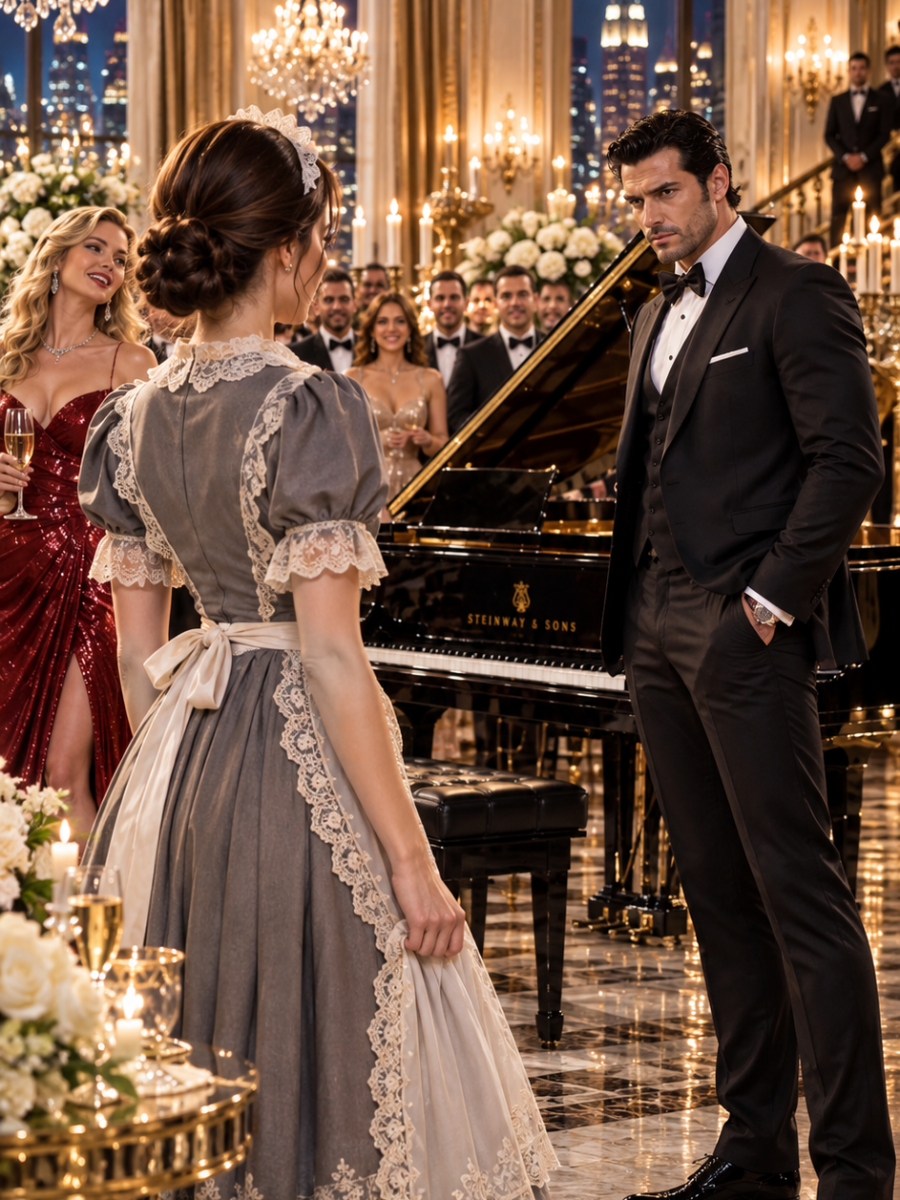
I put down my silver champagne tray, untied my apron, and walked toward Vincent Moretti’s nine-foot Steinway. Behind me, someone whispered, “She’s lost her mind.” Then the laughter began.
Three hundred of New York’s richest and most powerful people had just heard Vincent Moretti make an outrageous promise. “If any woman in this room can play that concerto perfectly,” the mafia boss had announced, “I’ll marry her.” They thought it was a joke. Until the maid sat down at the piano.
My name is Elena Marlow. I was twenty-eight, and I worked inside Moretti Manor, a stone fortress outside Manhattan where politicians, businessmen, celebrities, and men surrounded by armed guards drank beneath crystal chandeliers. I had learned one important skill there. How to become invisible.
People like Vivian Ashcroft made that easy. Earlier that evening, she had blocked my path while I carried champagne. She looked at my uniform, then at the women surrounding her. “Does Moretti hire maids from homeless shelters now?”
They laughed. I lowered my eyes and walked around her, forcing my hands not to shake. But all evening, I kept looking toward the Steinway.
Nobody in that ballroom knew what a piano meant to me. My father, Thomas Marlow, had repaired them for churches and theaters. When I was a little girl, I would sit backstage while he worked, listening to musicians rehearse. Eventually, I discovered something strange. I could reproduce what I heard. Nobody formally trained me. Dad taught me what he could. The rest came from listening. By seventeen, I could play pieces professional musicians feared.
But talent doesn’t stop life from happening. By twenty-one, Dad was sick. Concert halls became hospital rooms. Dreams became medical bills. Music became double shifts, cheap apartments, and secret nights playing an old upright piano after everyone else had gone home.
Then, that evening at Moretti Manor, Maestro Falk sat at Vincent’s Steinway and performed a concerto so brutally difficult that even Vincent’s armed men stopped talking. I knew every note. Every change. Every place where a musician could lose control.
When the final chord faded, Vincent lifted his whiskey. At thirty-six, he was the kind of man who never needed to ask for silence. He already owned it. He smiled. “If any woman here can play that perfectly, I’ll marry her.”
The ballroom erupted in laughter. Nobody moved. Then I removed my apron.
I crossed the ballroom. Vivian laughed loudest. “This should be entertaining.” I sat at the Steinway. For a moment, my hands hovered above the keys. Then I remembered Dad. A piano doesn’t care who owns the room.
I began.
The first few measures brought more laughter. By the eighth, nobody was laughing. The room became deathly quiet. I stopped seeing diamonds. Stopped seeing expensive gowns. Stopped seeing men with guns beneath their jackets. There was only the piano, and my father’s voice.
My fingers moved faster. The dangerous passage came, and I played it cleanly. Then another. Perfect. And when the long cadenza arrived, I did not play what was printed. I played the version my father had hummed to me at bedtime for twenty years, the one with the strange, aching turn in the middle that no one had ever written down.
When I struck the final chord, the sound seemed to hang beneath the chandeliers. Silence. Then chairs scraped backward. People stood. Maestro Falk stared at me. Vivian looked as though someone had slapped her.
Everyone was standing. Everyone except Vincent Moretti. He stayed seated, staring at me with an expression I couldn’t understand. I thought he was angry. I was wrong.
Back to top ↑
Three Weeks
Nothing happened.
That was the part I could not understand. I had walked out of that ballroom with applause ringing in my ears, expecting to be fired by midnight. Instead, Vincent Moretti rose from his chair, said nothing at all, and left the room. The guests drifted back to their drinks. Maestro Falk pressed my hand with both of his and murmured something I couldn’t hear. And I went back to my trays.
The next morning, the housekeeper told me, with a puzzled frown, that I had been moved to the east wing. A better room. Better hours. A small raise that appeared on my paycheck without explanation.
I waited for the other shoe to drop. For three weeks, it did not.
Vincent did not speak to me. He did not look at me, as far as I could tell. But every evening, when I passed the music room on my way to the kitchens, I found the door ajar and a single sheet of music laid on the Steinway’s lid. Bach. Chopin. A Schubert impromptu. A different piece every night. I never touched them. I would stand in the doorway for a moment, and then walk on.
Vivian Ashcroft was less patient. She cornered me in the service hallway on the sixth day. “I don’t know what trick you pulled,” she said, her voice pitched low and venomous. “But a maid does not play like that. Somebody coached you. Somebody planned it.”
“Nobody planned it, Miss Ashcroft.”
“We’ll see.” She smiled. “I have friends who would like to meet you.”
I did not know what she meant. I would learn soon enough.
The night it happened, a second gathering was being held at Moretti Manor, quieter than the first, with fewer women in jewels and more men in dark suits who did not drink. I was carrying a tray down the main staircase when the front doors opened and a man walked in.
He was in his late fifties, tall, with silver hair combed straight back and a face that might once have been handsome. His coat was black cashmere. His shoes did not make a sound on the marble. Even Vincent’s men, who feared nothing, watched him carefully as he crossed the floor.
Victor Hale. I knew the name. Everyone in New York knew it. Another mafia boss, a man whose name people avoided saying casually.
Then he looked up at the stairs, and saw me.
He stopped walking. The color drained from his face. The whiskey in his glass slipped slightly in his hand, and a few drops spilled onto the floor. I had never met him in my life. But Victor Hale stared at me as though he were looking at a ghost.
His lips moved. He whispered two words.
“Thomas Marlow…”
My father’s name. My blood turned cold.
Across the ballroom, Vincent slowly rose from his chair. And for the first time, I realized I hadn’t been hired at Moretti Manor by accident.
Back to top ↑
Not by Accident
Vincent Moretti took me by the elbow before I could set down the tray.
It was not rough. It was almost courteous. But there was iron in the grip, and he steered me through the crowd, across the marble, and through a side door I had never noticed, and shut it behind us. We were in a small library. A single lamp burned on a desk. On the wall hung a framed photograph of a thin, dark-haired man at a piano, smiling at someone outside the frame.
Behind the door, I could hear Victor Hale’s voice, raised, demanding something. Vincent’s men answered, flat and low.
“Sit down, Miss Marlow,” said Vincent.
“I’d rather stand.”
“Then stand.” He leaned against the desk and folded his arms. In the lamplight, he looked tired. I had never noticed that before. “You’ve been wondering for three weeks why I haven’t asked about the concerto.”
“I’ve been wondering why I haven’t been fired.”
“I’m not going to fire you.” His mouth twisted, almost a smile. “I owe you something. I owe your father more.”
The room seemed to tilt. “My father is dead. He died four years ago.”
“I know.” His voice was very quiet. “I sent the flowers.”
I remembered them. A large, plain arrangement of white lilies at the back of the chapel, unsigned. I had assumed they were from one of the churches Dad had worked for.
“Elena,” Vincent said, and it was the first time he had used my first name. “I did not hire you by accident. I found you six years ago, in a diner on Atlantic Avenue, and I paid your father’s hospital bills for three years. Every month. Through a lawyer, so you would never know.”
I stared at him. I could not speak. For three years, I had told myself a charity fund had taken pity on us. I had written thank-you letters to a post office box.
“Why?” I whispered.
“Because Thomas Marlow saved my life when I was seventeen.” He nodded toward the photograph on the wall. “That’s my father. Salvatore Moretti. He was a better pianist than he was a criminal, and he was a very good criminal. Your father tuned that Steinway for him for fifteen years. They were friends.”
I looked at the photograph again. The man at the piano was laughing, one hand lifted mid-gesture, as though someone had just said something clever.
“Nineteen years ago, my father was murdered,” said Vincent. “It was made to look like a heart attack. I was sixteen. I have spent every year since trying to prove it was not.” He drew a breath. “Your father was in the house that night. He was the only witness. And then he disappeared.”
The door behind him rattled. Someone was pounding on it. Vincent did not turn his head.
“Victor Hale’s father killed mine,” he said. “And Victor has spent two decades making sure nobody could prove it. When he saw you tonight, he saw the one thing he’s been afraid of for nineteen years.”
“You play like Thomas Marlow,” said Vincent. “And Thomas Marlow was the only man alive who knew what my father hid inside that piano.”
Back to top ↑
What Thomas Marlow Heard
I had always known my father had a secret. I had never known it was this large.
Vincent told it in the dim library, with the door bolted and his men standing guard outside, and I listened with my hands pressed flat against the cold wood of the desk.
The night Salvatore Moretti died was a rainy one in March. My father had come to the manor to tune the Steinway before a private concert. He was thirty-eight. He had a wife who was already sick, and a six-year-old daughter at home with a neighbor. He worked late. He was alone in the music room, bent over the open lid, when he heard two men arguing in the next room.
One was Salvatore. The other was Anton Hale, Victor’s father, a rival and an old friend. They were quarreling about a ledger. Salvatore had discovered that Anton had been skimming from the families’ shared accounts for years, and had been quietly moving the money into foreign banks. Salvatore had written it all down. Every transaction. Every account number. He intended to bring it to the Commission the next morning.
My father heard the argument stop. He heard a glass break. He heard a small, quiet sound that he never described to anyone, and then silence.
When he crept to the door, Salvatore was lying on the study floor, and Anton Hale was kneeling over him, going through his pockets for the ledger. He didn’t find it. Salvatore had given it to my father two hours earlier, in a brown envelope, with a quiet request to hide it somewhere safe until morning.
“Your father put it inside the piano,” Vincent said. “Behind the soundboard, in a cavity he built himself. Then he walked out of the manor, drove home, and never came back.”
“Why didn’t he go to the police?”
“Because Anton Hale owned half the police in the city.” Vincent’s jaw tightened. “And because he had a daughter. Anton found out, within a week, that Thomas Marlow had been in the house. He sent a man to your father’s shop. A warning. A fire, and then a very polite visit.” He looked at me. “Your father made a choice, Elena. He took you, and he left. He changed your name from Marlowe to Marlow, to make himself a little harder to find. And he kept silent for fifteen years.”
Fifteen years. I thought of the cheap apartments and the double shifts, of my father coughing in the next room, pretending nothing was wrong. I thought of him sitting at the old upright on certain nights, with the lights off, playing the same strange piece over and over.
The cadenza.
“It was a code,” I said. My mouth had gone dry.
“I think so.” Vincent’s eyes were very dark. “When you played tonight, you did not play Falk’s version. You played the one your father taught you. I heard it the moment you reached the turn. I’ve heard it only once before.” His voice dropped. “My father played that piece on the night he died. He told me it was a lock that only the right hands could open.”
Behind the door, the pounding had stopped. The silence was worse.
“I didn’t ask Falk to play that concerto by chance,” said Vincent. “I needed to know whether Thomas Marlow’s daughter could play it. And now Victor Hale knows that you can.”
Back to top ↑
The Cadenza
We waited until the manor slept.
It was after three in the morning when Vincent led me down the dark corridor to the music room. The great Steinway stood in the center, a black shape in the moonlight, its lid closed. He had sent the guards to the far wings. He had locked every door. Even so, he went around the room twice, drawing the curtains, checking the windows.
“I’ve had this piano taken apart three times,” he said, softly. “My men found nothing. Every expert I hired told me the soundboard was solid.”
“Then it isn’t in the soundboard.”
“Then where?”
I sat down on the bench. The keys were cold under my fingers. I thought of my father, of his quiet, stubborn voice, of an upright piano in a cramped kitchen in Queens. I thought of the way he had always stopped, in the middle of the cadenza, and held a single note a little longer than the score allowed.
“It’s the note,” I whispered.
I began to play. Slowly this time, without the chandeliers or the crowd. Just the music, and the moon on the lid, and Vincent standing very still at my shoulder. The first movement drifted by. The dangerous passage. The long climb to the cadenza, and then the turn, the strange, aching, impossible turn.
I held the note.
An F-sharp, three octaves up, sustained with the pedal down. Something inside the piano answered it. A faint, metallic hum. A vibration in the wood, and then, from somewhere beneath the keybed, a soft click.
Vincent went down on his knees and ran his hand along the underside of the case. “There,” he breathed. A narrow panel, no wider than a hand, swung open. A tiny steel drawer, built so cunningly into the frame that no technician would ever have found it.
It opened to the pitch. Only the right note, held for the right length of time, would release the catch. My father had built a lock out of music.
Inside was a worn brown envelope. A cassette tape in a plastic case. And a folded sheet of notepaper, yellowed at the edges, with my name written across the front in my father’s tidy hand.
I unfolded it with fingers that would not stop shaking.
Elena. If you are reading this, then you have grown into the pianist I always knew you would be, and I am sorry I could not tell you in person. I have carried this secret for fifteen years, because I was afraid that telling it would cost me you. I was wrong to be so afraid. A piano does not care who owns the room, my girl. Neither should you. Play it loud. —Dad.
I could not read the rest. The page blurred. Vincent took the envelope gently from my lap, and I pressed the heel of my hand against my mouth and let myself cry, in the moonlit music room, for the first time in four years.
The cassette, when it played, was ten minutes of Salvatore Moretti’s voice and Anton Hale’s. A heated, dangerous, unmistakable argument, recorded on a small machine my father had slipped into the piano before the evening began. At the end of it, a single, clear sentence in a cold old man’s voice. You should have trusted me, Sal.
Then, from the dark of the corridor behind us, a floorboard creaked. Vincent’s head snapped around. A thin, familiar voice said, “How touching.” Vivian Ashcroft stepped into the doorway, with a pistol in her small white hand.
Back to top ↑
The Storm
“I told you I had friends,” Vivian Ashcroft said.
She stood in the doorway in a silk robe, her hair loose, her face stripped of everything but a thin, brittle smile. Behind her stood two men in black coats. They were not Vincent’s. I had never seen them before.
“Victor Hale asked me to keep an eye on this house three years ago,” she said. “I’ve been sleeping with the housekeeper’s cousin and charming your guests ever since. It’s been very dull. Until a maid played a concerto.”
“Vivian,” said Vincent evenly. He had not moved from where he knelt beside the piano. His hand was very close to the open drawer. “You’re making a mistake.”
“Don’t speak to me like I’m a child, Vincent.” The pistol did not waver. “Put the envelope and the tape on the floor.”
“No.”
A flicker of something crossed her face. She had expected fear. She hadn’t expected him to look bored. “Then I’ll take her instead,” said Vivian. “Boys.”
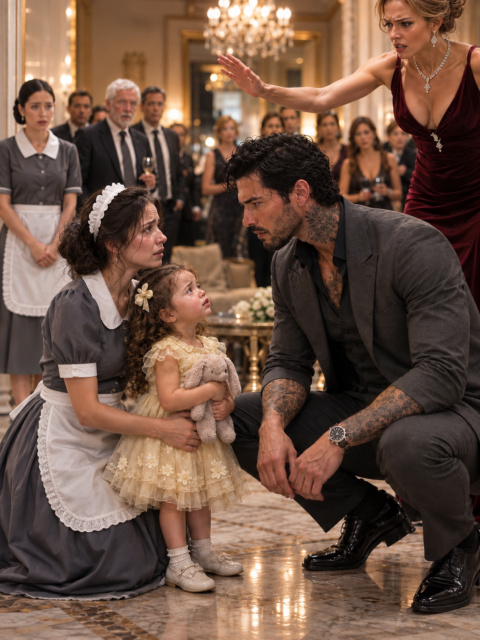
The two men crossed the room in four strides. I screamed. One of them clamped a hand over my mouth. The other drove his fist into Vincent’s stomach, and I saw him fold, wheezing, onto the carpet. A boot caught him under the ribs.
“The ledger and the tape,” said Vivian, sweetly, “for the girl. You have until dawn. Victor will send instructions.”
They dragged me out through the garden doors, into the storm.
It was raining so hard I could not see the gates. The wind drove it sideways, and the sky split open with white light. A black sedan waited at the edge of the lawn. I was shoved into the back seat, and the door slammed, and the car lurched down the gravel drive in the dark.
I was taken to a house I did not know, a gray stone building near the river, with a high wall around it and the smell of damp and old tobacco inside. They put me in a small room with a bed and a single barred window. The door locked behind me.
I sat on the edge of the mattress with my arms wrapped around my knees. I was soaked and shivering. I was not, I realized, afraid. I thought I would be. But all I could think about was my father’s note, folded safe against my chest where Vincent had tucked it as they dragged me away.
Play it loud.
Near dawn, the door opened. Victor Hale stood on the threshold in his black cashmere coat. Up close, I could see that he was older than I had thought, and very tired.
“Miss Marlow,” he said gently. “I’m sorry for the inconvenience. I have wanted to meet you for nineteen years.”
He sat down in the chair by the door, and looked at me for a long moment with eyes the color of old ice.
“You have your father’s hands,” said Victor. “I’d like you to play something for me.”
There was a piano in the corner of the room. An old upright, covered with a sheet. I had not noticed it in the dark. “And then,” said Victor Hale, “you’re going to tell me exactly where Thomas Marlow hid what he took.”
Back to top ↑
The Last Chord
I played for him.
I do not know why. Perhaps because I had no other choice. Perhaps because the upright was out of tune and slightly sticky and smelled of old felt, exactly like the piano in my father’s kitchen. I sat down, drew the sheet from the keys, and started the concerto, and as I played, I watched Victor Hale’s face.
It was a remarkable thing to see. The cold ice thawed, just a little. His shoulders loosened. His eyes went distant. When I reached the cadenza, I held the long, aching turn, and I saw him close his eyes.
“Your father played that for me once,” he said softly. “In 1998. I was eighteen. I’d come to the shop with a broken violin my mother had left me. He fixed it for nothing. He told me music was a thing you could keep even if you lost everything else.” He opened his eyes. “I killed his best friend, Miss Marlow. Or my father did. It’s the same thing.”
I stopped playing. My hands lay still on the keys.
“I didn’t know until I was thirty,” he said. “My father confessed it on his deathbed. He asked me to protect the family’s name. I’ve spent twenty years doing it, and every day I have hated myself a little more.” His voice was flat and weary. “I wanted the tape and the ledger because I could not bear for the world to know what my father was. But I’m so tired.”
“Then let me go,” I said.
“I can’t. Vivian has my men now. She’s far more ambitious than I thought, and far more dangerous.” A thin smile. “I’m afraid I’ve been the foolish one. She has been feeding information to a third party. Someone who would like both our families gone.”
The window behind him lit with the flash of headlights.
It was dawn. Rain still hammered the glass. In the courtyard below, a dozen black cars had pulled up in a ragged line. Doors slammed. Men in raincoats poured out, and at their head, in his shirtsleeves, with a bruise already purpling along his jaw, walked Vincent Moretti.
He had come unarmed. I saw that at once. His hands were open at his sides. Behind him walked three other men, each of whom I knew by sight from the portraits in Moretti’s library. The heads of the Commission. Old men, gray and implacable, who had not left their houses in years.
Vincent stopped in the middle of the courtyard, in the pouring rain, and looked up at the window. He did not shout. He did not threaten. He simply took a small cassette player from his coat pocket, held it up, and pressed a button.
The sound carried clearly through the glass, thin and tinny against the storm. A man’s voice. You should have trusted me, Sal.
Victor Hale went white.
“I made copies,” Vincent called up, through the rain. “Eleven of them. One for each family. Come down, Victor. Or the Commission will come up.”
Vivian Ashcroft stood in the doorway of the room, and she had lost all her color. Her pistol was gone. Her two men had vanished. “Victor,” she said, in a small, high voice. “Victor, you said that—”
“I said a great many things,” said Victor Hale. He rose slowly from the chair, as though every joint hurt, and straightened his cuffs. He looked at me. For one strange, quiet second, I thought I saw something very like gratitude.
“Play the last chord,” he said gently. “Please. I’d like to hear it before I go.”
I turned back to the keys. I played the last chord, loud and clear, the way my father had always meant it to be played. And Victor Hale walked down the stairs, alone, into the rain.
Back to top ↑
A Promise Kept
The Commission met for six hours in the gray stone house. I was not permitted in the room. I sat on a bench in the hallway with a blanket around my shoulders and a cup of tea I never drank, and I listened to the low rumble of old men deciding how to end something that had lasted nineteen years.
Victor Hale surrendered himself that night. He did not run. He walked into a police station in a dark coat, carrying the ledger, and he confessed to everything. His father’s fraud. The theft from the shared accounts. The murder of Salvatore Moretti. He spared nobody, least of all himself. The newspapers called it the biggest organized-crime scandal in a generation.
Vivian Ashcroft was arrested at the airport, with two passports and a suitcase full of cash. It turned out that she had been working for a distant cousin of Victor’s, a man who had hoped to see both families collapse. He, too, was found. It took the Commission only nine days.
By the spring, the old war was over. Salvatore Moretti’s name was cleared of the quiet slanders that had followed it for nineteen years, and a small plaque was placed in the lobby of a concert hall in Brooklyn. It read For Salvatore, who loved music more than power.
And in a cemetery in Queens, beside a plain gray headstone, Vincent Moretti and I stood together in the rain, holding a bunch of white lilies.
“I’d like to apologize,” he said. “For involving you. For not telling you sooner. For the three weeks.”
“You left me music every night.”
“I wanted to see if you’d touch it.”
“I wanted to,” I admitted. “Every night.”
He was quiet for a while. A gray rain slid down the stone. The lilies bent under the weight of the water. “Elena,” said Vincent Moretti, at last, “I made a promise in my ballroom. I said that if any woman could play that concerto perfectly, I would marry her.”
“I didn’t play it perfectly.”
“No?”
“I played my father’s version. It’s not the printed score. Technically, Maestro Falk would say I made several mistakes.”
The corner of his mouth moved. “I see.”
“So you aren’t obliged.” I looked down at the headstone. Thomas Marlow. Piano maker. Father. “You don’t owe me anything.”
“I know.” He took a small velvet box from his coat. It was plain and old and slightly worn. He opened it. Inside was a ring with a single small diamond, in an old-fashioned setting. “This was my mother’s. My father gave it to her the night he played the same concerto for the first time. He told me once that a man who could not keep a promise was not worth the piano he sat at.”
My breath caught.
“I am not asking you because I made a promise,” said Vincent quietly. “I’m asking because I have been standing in the doorway of that music room for three weeks, listening to a maid play Chopin in the dark, and I have never wanted anything so much in my life.”
The rain had stopped. A single ray of thin gold light came through the clouds and lit the wet grass.
I thought of a diner on Atlantic Avenue, a stack of unpaid medical bills, a note in a steel drawer. I thought of my father’s hands. I thought, a piano does not care who owns the room.
“Ask me properly,” I said.
So he did, standing in the rain, in front of my father’s grave, with his hat in his hand. And I said yes.
We were married in June, in the ballroom of Moretti Manor, under the same crystal chandeliers. Three hundred guests came. Nobody laughed. At the end of the ceremony, I walked to the nine-foot Steinway, in my wedding dress, and sat down, and held a single F-sharp until it filled the room.
Somewhere in the silence, I heard my father smile.
More Trending Stories You Can’t Put Down