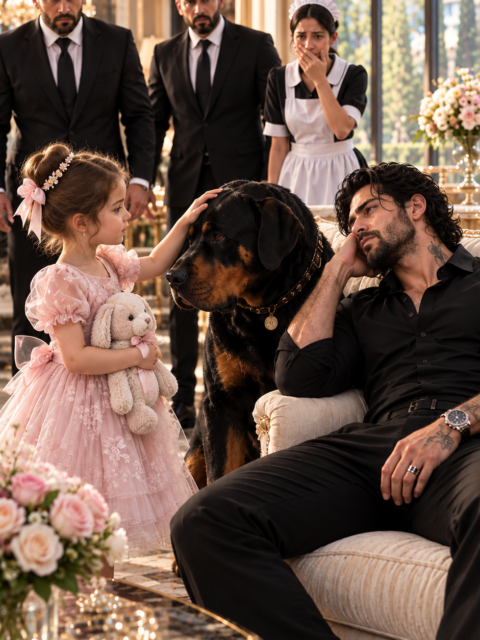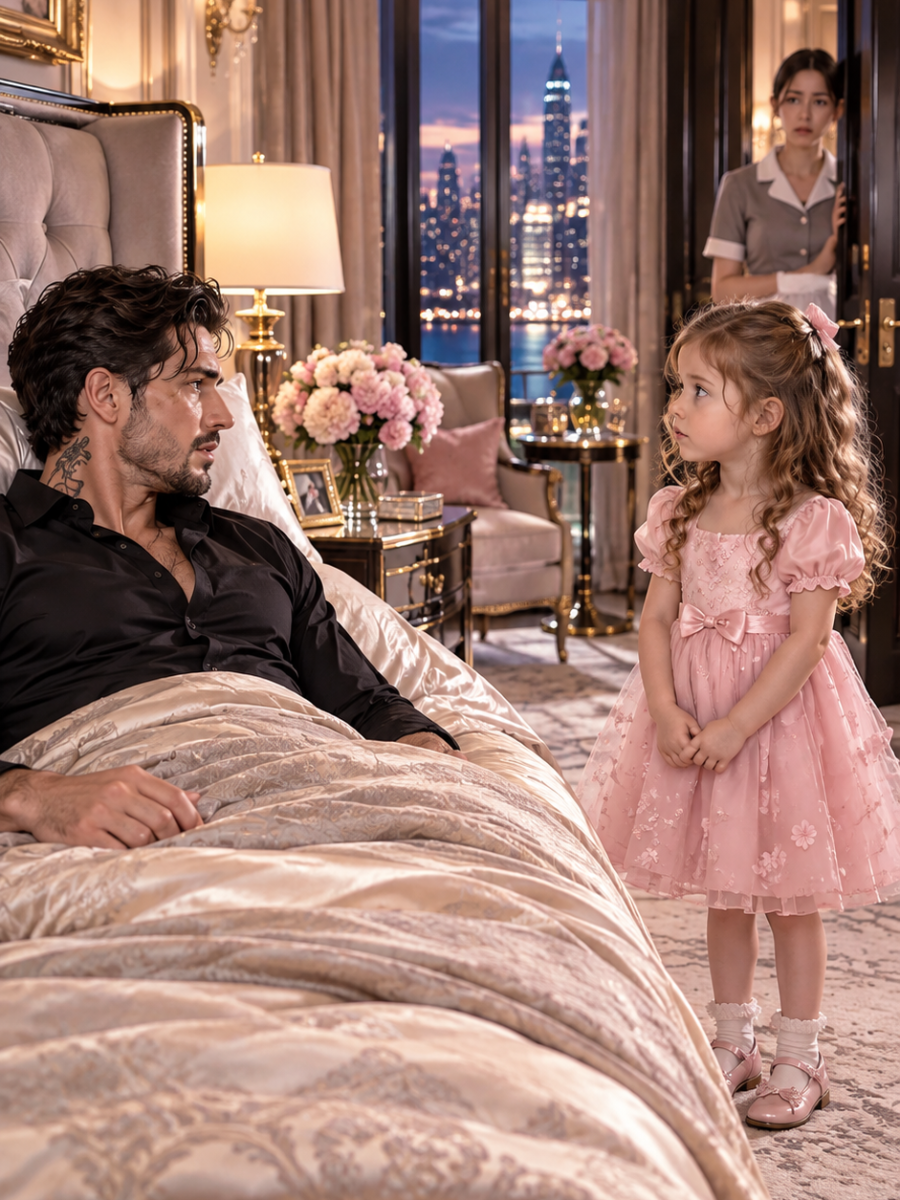
The Mafia Boss Asked, “Are You Afraid?” — The Little Girl With Hearing Aids Signed, “No.”
Nobody opened Damian Volkov’s bedroom door. Not the servants, not the guards, not the nurses who left in tears. Then Nora Bell’s five-year-old daughter Poppy found it open, walked in, and when the most feared man in Baltimore asked whether she was afraid, she signed a single word. What she noticed next, with eyes that had learned to see everything, explained why he never got better. Read every chapter to find out what was hiding in plain sight at Grayhaven House.
The Forbidden Door
“Get away from me.” Damian Volkov’s voice cut through Grayhaven House. “Anyone who comes through that door will regret it.”
That warning ruled the mansion. Nobody opened Damian Volkov’s bedroom door. Not the servants. Not the guards. Not even the nurses who arrived determined to help him and eventually left carrying tears, humiliation, or silence.
Baltimore had feared Damian for years. His name could empty a room. His family controlled shipping terminals, warehouses, clubs, construction companies, and enough old loyalties along the harbor that most people knew better than to ask where the legitimate businesses ended. Damian had once moved through that world as though nothing could touch him.
Then someone he trusted poisoned his wine. He survived. Barely. For eleven weeks afterward, survival looked nothing like victory. Pain tore through his chest and limbs without warning. His hands trembled. Sometimes his legs simply refused to hold him. Bright light hurt. Noise made everything worse. Doctors said the toxin had cleared his bloodstream. Its damage had not.
Damian hated that answer. He hated the physicians. The physical therapists. The nurses. His own weakness. Eventually, he hated anyone who entered his room. So the door stayed closed. Until my daughter found it open.
My name is Nora Bell. I had been at Grayhaven House for nine days, hired through an agency to do the work nobody else wanted: laundry, linens, the long marble corridors at night. My daughter Poppy was five. She had worn hearing aids since she was two and used American Sign Language the way other children use their mouths, which is to say constantly and with opinions. I couldn’t afford childcare. The housekeeper had looked at Poppy, looked at me, and said, “Keep her quiet and keep her away from the east wing.”
I did. For nine days.
On the tenth evening, I turned from the linen cart, and Poppy was gone. Her hearing aids were in my apron pocket, because she had complained they buzzed near the generator. Without them, she moved through the world in a silence that made her braver than any child I knew.
I found her at the end of the east corridor, in front of a door that stood open an inch. A lamp burned somewhere inside, very low. And a man’s voice said, thick and hoarse, “I told you to get out.”
She couldn’t hear him. She did not need to. She pushed the door wider and walked in.
He was propped against the headboard in the dim light, gray-faced, thinner than any photograph I’d seen of him, his hands trembling against the blanket. Damian Volkov looked at a five-year-old in a purple cardigan and said, harshly, “Are you afraid?”
Poppy watched his mouth. She was very good at that. She looked at his shaking hands, at the closed curtains and the untouched tray, at every detail of the room. Then she lifted her own small hands and signed, slowly and clearly: No.
I ran in behind her, breathless, apologizing before I had crossed the threshold. “Mr. Volkov, I am so sorry. She doesn’t hear you. She’s deaf. She’s hard of hearing. She didn’t mean—”
“What did she say?” he asked. His voice had changed. It was still rough, but the fury had drained out of it, leaving something startled and very tired.
“She said no,” I whispered. “She says she isn’t afraid.”
Damian looked at his trembling hands, then at my daughter, then at me. “Ask her why,” he said. And Poppy, who had watched every word cross his lips, signed something so simple that my breath caught in my chest.
What Poppy Signed
“She says,” I began, and had to stop, because my voice wasn’t working. I tried again. “She says your hands are scared. But you aren’t.”
The room went very still. Damian stared at his own hands, at the fine, relentless tremor in his fingers, and something moved across his face that I didn’t have the training to name.
Poppy signed again, and I translated as quickly as I could. “She says it’s very loud in here. She can feel it in the floor. She says the house is loud, even though it’s quiet.”
“Loud,” Damian repeated slowly. “Yes. Everything is loud. The nurses talk. The guards shuffle. The clocks.” He closed his eyes. “I can’t stand the sound of a spoon in a teacup. Do you understand how insane that sounds?”
Poppy tilted her head. She reached up and, with the awful casual honesty of children, tapped the side of her own ear where her aids usually sat. Then she signed: Sometimes I take them out. Then it is quiet. Quiet is nice.
I translated. Damian was silent for a long moment. Then he said, very carefully, as though the request might break something, “Would you sit with me? Both of you. Without talking. Just for a few minutes.”
We sat. Poppy climbed onto the armchair beside the bed with her knees tucked under her, and I sat on the edge of the ottoman. No one spoke. The lamp hummed faintly. Outside, a harbor wind moved against the curtains.
Somewhere in those ten minutes, Damian Volkov’s breathing changed. It deepened. The clench in his shoulders eased by a fraction. He was not healed, and I was not naive enough to think so. But it was the first time in eleven weeks, I later learned, that anyone had entered his room and left him quieter than they’d found him.
When Poppy finally slid off the chair to leave, she paused at the foot of the bed and signed something else, one small, deliberate gesture toward the untouched water pitcher on his nightstand. I didn’t understand it. But I saw Damian’s eyes follow her hand, and for the first time, he looked at that pitcher the way a man looks at something he has never actually examined.
Quiet Hands
I expected to be fired by morning. Instead, at seven, the head of household security, a broad, careful man named Ilya Markov, knocked on our small room off the laundry and told me Mr. Volkov wanted to see me. Alone. “He said to bring the child if she wants to come,” Ilya added, and there was something wary and hopeful in his expression, like a man who had watched something he’d assumed was impossible.
Damian was awake and sitting up. The curtains were still drawn, but one had been pulled back an inch. He looked me over with a hard, sharp intelligence that reminded me that the man in the bed had run a city’s worth of trade for years.
“Ms. Bell. I’ve been told you’re not a nurse.”
“No, sir. I’m a housekeeper.”
“And your daughter signs.”
“Since she was two. I learned alongside her.” I hesitated. “I’m not fluent. She corrects me.”
The corner of his mouth moved, not quite a smile. “I’d like you to stay on. Not as a housekeeper. I want you and Poppy nearby. Quietly.” He held up his trembling hand. “I can’t tolerate most people at the moment. I don’t know why you’re different.”
“She doesn’t fill silence, sir,” I said. “She’s never been taught that silence is something to fix.”
He considered that. “Then teach me,” he said. “Teach me how she says things without saying them.”
So began the strangest job I’d ever held. I stayed at Grayhaven, moved to the second floor, and spent mornings and afternoons in a room where the only sound was the faint whisper of fabric and, gradually, the clumsy first signs of a mafia boss learning the manual alphabet from a five-year-old.
He was a terrible student at first. His hands shook so badly that half his letters came out as nonsense, and Poppy, with the merciless clarity of the very young, told him so. But he kept trying. And I noticed, day by day, that when his hands were busy forming a word, the tremor eased slightly, as though the effort gave the trembling something to hold onto.
Which is how, three weeks in, I noticed something that had nothing to do with signing. Damian slept better on mornings when the water pitcher on his nightstand had been left untouched. And on days when it was freshly refilled by Dr. Halvorsen’s assistant, his symptoms flared, hard, within an hour.
Sparkles in the Water
I did not trust my own suspicion, so I asked Poppy. I sat with her one evening in our room, colored pencils between us, and signed as neutrally as I could: Do you remember the water pitcher in Mr. Volkov’s room?
She nodded, then signed, matter-of-factly, in a rapid stream I had to slow down to follow. The white-coat man puts sparkles in it. Little ones. From a bottle in his pocket. He does it when nobody is looking. I looked.
My mouth went dry. When did you see this?
Every day. When I bring Mr. Volkov his pictures. She had, I realized, been slipping drawings into that room daily since the first evening. He doesn’t see me because I’m small. And I don’t make noise.
I asked her to show me the bottle. She held up two fingers, about an inch apart. She drew it on a scrap of paper: a small brown glass vial with a dropper.
Dr. Ansel Halvorsen had been the Volkov family physician for nearly nine years. It was Halvorsen who had treated Damian on the night of the poisoning, Halvorsen who had prescribed the eleven weeks of medication, Halvorsen who assured everyone that the toxin had cleared and the remaining symptoms were nerve damage that would improve with time.
I sat awake most of that night. I thought about how many people had passed through that room, how many nurses had left in defeat, and how nobody, not one of them, had thought to look at a water pitcher because the answer everyone wanted was inside Damian, not beside him.
In the morning, I asked Ilya Markov for five minutes alone. “I need to tell you something,” I said. “And I need you to promise me you won’t repeat it to anyone. Not the doctor. Not the staff. Not even the family.”
The Sample
Ilya Markov listened without interrupting. He was a man who had spent twenty years watching rooms for danger, and I saw the exact moment when he understood that he had been watching the wrong things.
“You’re certain,” he said quietly, “that it’s a five-year-old’s testimony.”
“No,” I said. “I’m certain it needs to be tested. Poppy could be wrong. But if she isn’t, every day that passes is another day he’s being poisoned.”
Ilya did not take the accusation to Damian’s family or the police. He took it to the one person he trusted absolutely, Damian himself. And Damian, hearing it through Ilya’s careful summary and my own halting signing to Poppy for confirmation, asked only one question.
“How do we collect a sample without alerting Halvorsen?”
We did it the next morning. Ilya swapped the pitcher for an identical one, filled from a bottle Poppy and I had watched arrive that afternoon. The original went into a sealed evidence bag, driven personally by Ilya to a private toxicology lab in Towson, run by a woman named Dr. Renata Okafor who owed Damian nothing and had no reason to protect him. Ilya told her only that he needed a full heavy-metals and alkaloid screen, chain of custody documented.
Four days later, she called.
Damian, Ilya, and I sat in the dim bedroom with the phone on speaker, and I signed the conversation in real time to Poppy, who insisted on being present. “The sample contains trace concentrations of thallium,” Dr. Okafor said. “Low, consistent, and clearly deliberate. It’s the kind of dosing designed to mimic chronic nerve damage. Whoever is administering it understands the effects extremely well.”
Damian said nothing. His hands, resting on the blanket, went completely still, the first time I had ever seen them do so. Then he said, very softly, in a voice that made the hairs on my arms rise, “Nine years. He sat beside me for nine years.” And I understood that the trembling had never been the only thing wrong with him.
Dr. Halvorsen’s Tonic
Only then did Ilya bring in the state authorities. Damian, to my astonishment, insisted on it. “I have spent my entire adult life settling things privately,” he said. “Look where it got me. If this is going to end, it will end on paper, with signatures, in a courtroom I can’t influence.”
A detective named Ruth Ostrander from the Maryland State Police, and an assistant U.S. attorney, spent two days at Grayhaven, taking statements. They interviewed me twice. They interviewed Poppy once, with a certified ASL interpreter present and me in the room, and the interpreter told me afterward, quietly, that in twenty years she had rarely encountered a child witness so precise.
They arrested Dr. Ansel Halvorsen at his Roland Park home before he knew anyone suspected him. In his study, they found an identical brown vial, half full, and a ledger of payments from an account that took forensic accountants six days to trace.
The account belonged to Damian’s cousin, Alexei Volkov.
Halvorsen broke in interrogation within hours. It had been Alexei who had asked him to supply the original poison in Damian’s wine, eleven weeks earlier. When Damian survived, Alexei panicked. If Damian recovered fully, he would investigate. If he died of a second, obvious poisoning, the police would look at the family. So Halvorsen had been instructed to keep Damian weak, isolated, and irritable, driving away every nurse who might notice, until the family council voted to name Alexei acting head.
“That vote,” Ilya told me later, “was scheduled for Friday.”
It was Wednesday when Poppy walked through an open door. I have thought about that gap every day since, about how thin the margin was, and how close a five-year-old’s stubborn habit of watching had come to being ignored.
The Man Who Poisoned the Wine
Alexei Volkov was arrested at the family council meeting he had spent months preparing for. Federal agents walked into the room in front of eleven of Baltimore’s most influential men and read him his rights beside the empty chair he had planned to occupy.
Damian watched none of it. He had refused to attend. “I don’t need to see it,” he told me, sitting propped against pillows, a blanket over his knees, learning a new sign from Poppy. “I need to be somewhere quiet.”
The prosecution took nine months. Alexei’s lawyers argued that the case rested on the testimony of a hearing-impaired child. Dr. Okafor’s toxicology reports, the financial ledgers, and Halvorsen’s plea agreement, in which he testified against Alexei in exchange for a reduced sentence, made that argument collapse. Alexei Volkov was convicted of attempted murder and conspiracy.
Halvorsen lost his license and received twelve years.
Damian’s recovery, once the ongoing doses stopped, was slow but steady. Within three weeks, the tremor eased. Within two months, he could stand without assistance. His sensitivity to light and noise faded gradually, though never entirely. Some days, even after the toxins were gone, he still preferred the curtains drawn and the house very quiet.
“It’s not what I lost,” he told me one afternoon. “It’s what I found. I never once, in forty years, asked what silence was for.”
Poppy, drawing at his desk, glanced up as though she had heard him, though her aids sat on the shelf beside her. She signed: It’s for listening.
I did not translate it. He had already understood.
Learning the Alphabet
Damian offered to pay for everything. I told him no, at first. Then, at Poppy’s request, I told him something more specific.
“She wants to go to a school where everyone signs,” I said. “The Maryland School for the Deaf. She’s been asking for a year. I couldn’t afford it. But I don’t want you buying her a life, Mr. Volkov. I want you to help her attend a school. That’s all.”
“Damian,” he said. “If we are having this conversation, it should be Damian.”
“Damian,” I agreed.
He covered the tuition without ceremony, through a scholarship fund he set up in his mother’s name, open to any family in the state. He did it under a false name and asked that nothing be publicized. “Nobody should know it comes from me,” he told me. “If they learned, they’d say it was blood money.”
“Isn’t it?” I asked, before I could stop myself.
He was quiet. Then he said, “It was. I intend to spend the rest of my life making it something else.”
He began winding down the family’s questionable holdings, quietly, through lawyers, without announcement. He sold the clubs. He restructured the shipping terminals under legitimate ownership. He reported every improper contract he could find to the state attorney’s office, a decision that cost him nearly a third of his income and every friend who had stayed loyal for the wrong reasons.
And every Thursday evening, in the quiet room at Grayhaven, Poppy taught him a new page of the dictionary.
By spring, Damian could sign whole sentences. Clumsy ones, with his hands still occasionally trembling. But one evening, watching Poppy fall asleep in the armchair, he signed a sentence to me, slowly, carefully, and looked at me to see whether I had understood. I had. It said: Thank you for the open door.
An Open Door
I stayed at Grayhaven for another year, first as a housekeeper, then, at Damian’s insistence and with my own contract, as the director of the scholarship fund. Poppy started at the Maryland School for the Deaf that fall. She came home the first day with her hands moving so fast I could barely follow, telling me about friends, teachers, a teacher who was also Deaf, a world where nobody asked her to translate herself.
Damian’s door has stayed open ever since.
The house has changed. The curtains are drawn back most mornings. There is a small chalkboard in the kitchen, where the household staff have started writing signs for one another. The guards, hardened men who once refused to speak above a mutter, now greet Poppy with awkward, sincere fingerspelling.
Damian still has bad days. His tremor returns when he is tired. Some sounds still hurt him, and he steps out of rooms when the noise becomes too much. But he no longer hides behind a closed door. He simply says, plainly, “I need a quiet hour,” and we give it to him, and afterward he returns.
On Poppy’s sixth birthday, he gave her a small gift, wrapped in newspaper because he did not trust himself with ribbon. Inside was a hand-carved wooden hand, forming the sign for a single word.
I recognized it at once. So did Poppy. She looked at it, then at him, and signed with a broad, delighted grin: You learned it.
He signed back, slowly, sure of every letter: No. I’m not afraid.