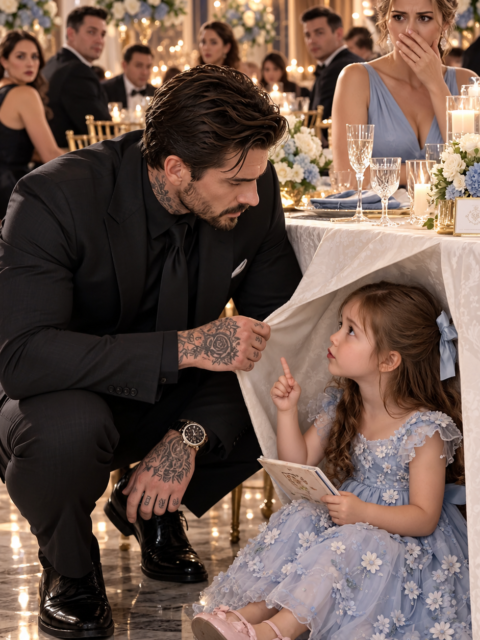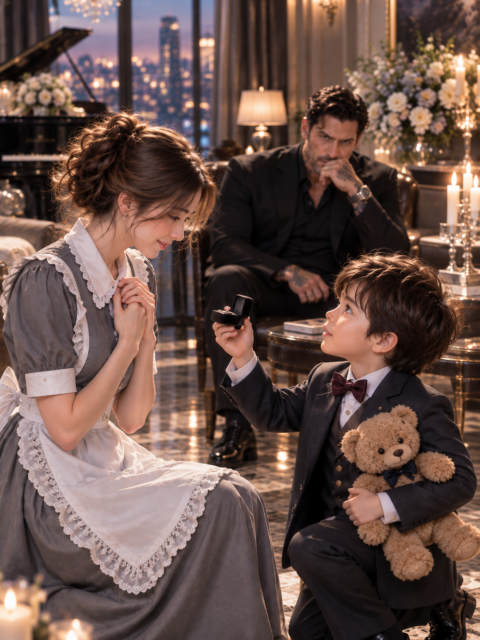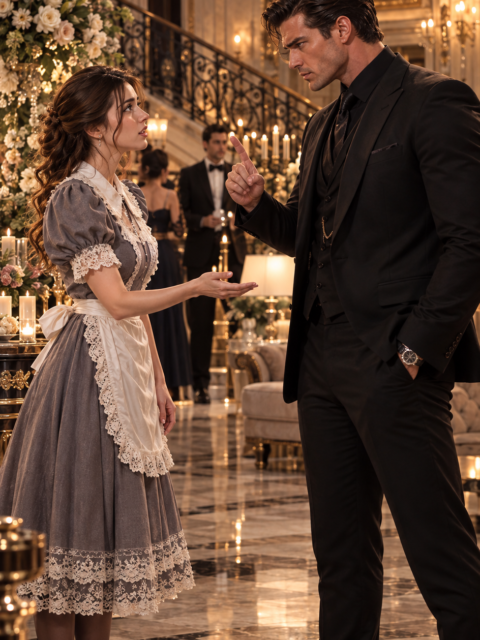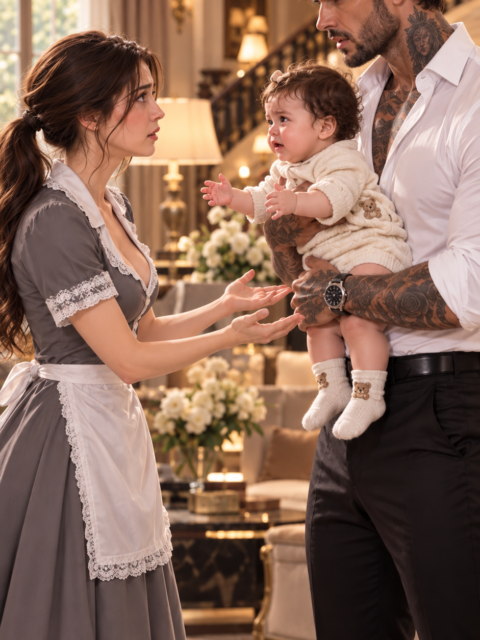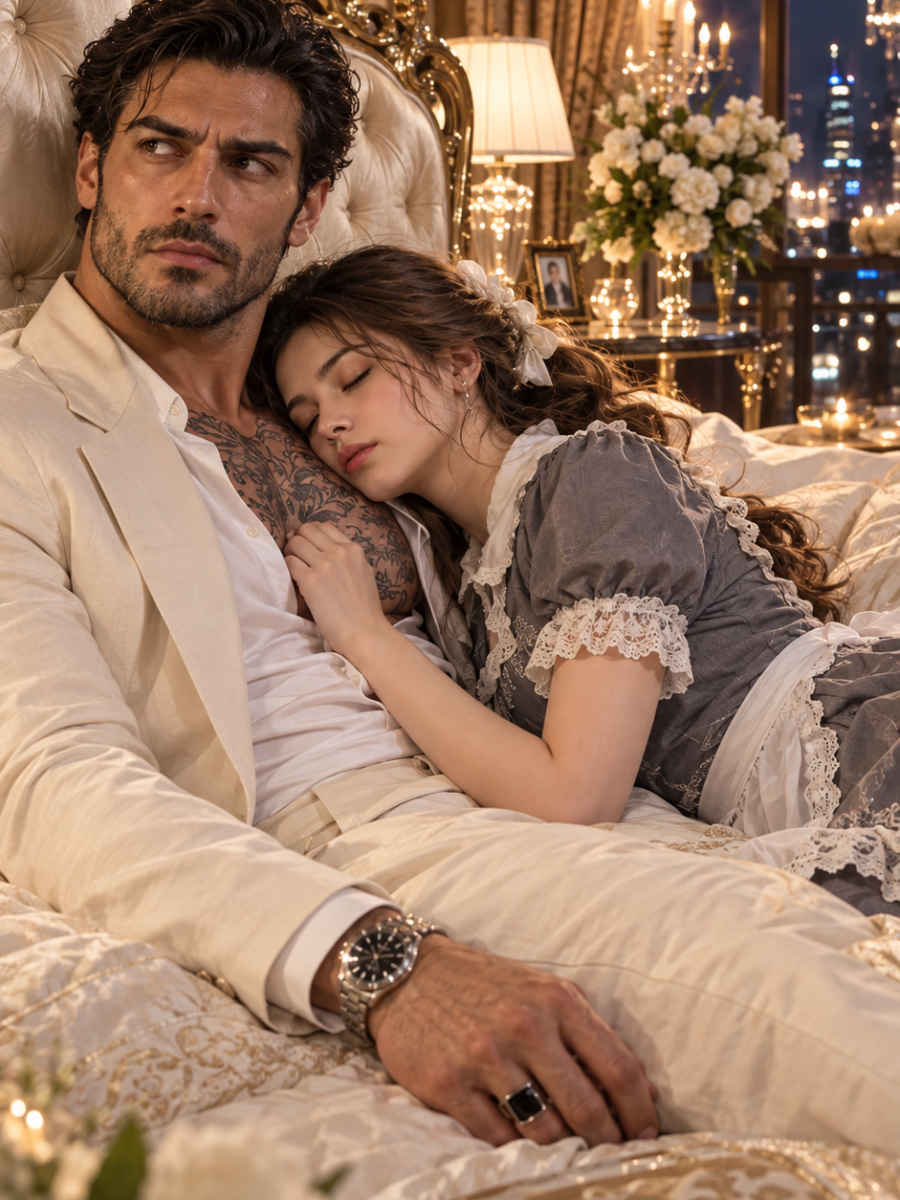
“If I Stop Working, I Don’t Get Paid.” The Night Maid Didn’t Fear the Paralyzed Mafia Boss… Until He Found a Photograph of Her Father Beside the Man Who Shot Him
I’m Vincent Romano. Before a sniper’s bullet shattered my spine, men twice my size lowered their voices around me. Afterward, they lowered their eyes. Then a twenty-seven-year-old night housekeeper looked at me, kept scrubbing the floor, and told me she didn’t get paid if she stopped. Read every chapter to learn why she was exhausted, who she was protecting, and who was waiting in my own house to finish what the sniper started.
The Woman With the Mop
“Do you want me to stop cleaning?” she asked, not even looking up. “Because if I stop working, I don’t get paid.”
Nobody had spoken to me like that since a sniper’s bullet shattered my spine two years earlier.
My name is Vincent Romano. I run Philadelphia, or I did, before a Tuesday afternoon outside St. Agnes when a single shot from a rooftop put me in a chair for the rest of my life. Before the shooting, men twice my size lowered their voices around me. Afterward, they lowered their eyes. It was worse than fear. Fear at least takes you seriously. What I got was pity, careful and polite, delivered in hallways by men who watched my legs and then pretended they hadn’t.
Then Hannah Parker arrived.
She was twenty-seven, the new night housekeeper, hired by an agency my staff used to avoid looking at anyone too closely. She was thin, with shadows beneath her eyes and her hair tied back with a rubber band, and she worked as if she had a quota carved into her bones. I first noticed her at one in the morning, outside my study, on her knees with a bucket, scrubbing a floor that had never been dirty. The sound of the brush ran through the quiet like a clock.
“Stop,” I said.
The brush went on.
“Did you hear me?”
“Yes.”
“Then why are you still cleaning?”
That was when she told me about the pay. She said it without defiance, like someone stating the weather. I sat in my doorway, in my chair, with a hundred men’s reputations in my pocket, and I had no answer. I went back into my study and closed the door. I could hear the brush for another twenty minutes.
Weeks passed. She came at eleven, left at six, and moved through my mansion like a ghost with a purpose. I noticed that the guards stopped flinching around her, because she never flinched around them. I noticed she hummed under her breath when she thought no one could hear. Most of all, I noticed she was the only person in my house who didn’t treat my anger like a loaded weapon. She treated it like a mood. Something that would pass, if you left it a little room.
It was the strangest thing. I started staying up later.
I didn’t know it yet, but the woman with the mop had not come to my house by accident. And one night soon, in my own kitchen, she would disobey me for the first time.
Back to top ↑
One Pill
The phantom pain came on a Thursday, at three in the morning, as it always did. It starts in the calves, in legs that tell my brain they are on fire when I know they are dead. It comes in waves that fold a man in half. I had been taught to ride it out alone, in the dark, with my jaw locked, because no one in my house had ever offered me anything else.
I was in the kitchen, gripping the edge of the counter, when the light came on.
“Where’s your medication?”
“Leave.”
Hannah stood in the doorway with a dust cloth in her hand. She did not leave. She asked again, patiently, whether it was in the kitchen or the bedroom, as if I were a stubborn patient and she had met a hundred like me.
“Cabinet above the sink,” I ground out.
She came back with a glass of water and one pill. I looked at it with contempt. “Two.”
“The bottle says one.”
“I know what I take.”
“And I know what the label says.” She put the pill in my hand and folded my fingers over it, the way you’d close a child’s fist around a coin. “Take it. If it isn’t enough in half an hour, we’ll call your doctor. We won’t just double it because you’re angry.”
Nobody refused me anything. For twenty years it had been the single law of my life. She stood there in a gray uniform two sizes too big, with an infected-looking blister on one wrist and her lip chapped from lack of sleep, and she refused me. I took the pill. I hated how much better I felt when she stayed in the kitchen until the pain began to ebb.
Afterwards, I began to look at her properly. The dark circles beneath her eyes weren’t just tiredness. They were the kind that settle in after months of too little food and too many shifts. Her hands shook slightly when she lifted the bucket. Twice I saw her put a palm flat against a wall before she started up the stairs, and wait there until the dizziness passed.
“You’re sick,” I said one morning, as she was leaving.
“I’m tired.”
“Those are not the same thing.”
“They are when you have bills.” She gave me a small, tight smile and went out into the grey dawn, and I sat at the window and watched her walk to the bus stop, a thin figure under a thin coat, and realized I did not know where she lived, or whom she went home to, or why she never once asked me for anything.
That should have worried me. I run a business built on knowing what people want. The woman who wanted nothing was the one I should have checked first.
Back to top ↑
The Storm
Three nights later, a storm took the power out of the whole east side.
It was after two in the morning, and the mansion was black. I woke alone in my bedroom, reached for the transfer bar beside my bed, and misjudged the distance in the dark. My arms gave out. The floor came up hard. A lamp crashed beside me, and for a bad, humiliating minute I lay on the carpet with my legs tangled under me, unable to move, in a house full of men I didn’t want to call.
Then footsteps. A flashlight. A pair of small, strong hands under my arms.
“I’ve got you,” Hannah said. “On three.”
She was half my weight. I don’t know how she did it. She shouldered me back into the bed with a grunt, tucked a pillow under my knees, and checked my head for cuts, all in the dark, all without a word of reproach. When I was settled, she stepped toward the door to fetch a guard. She made it three steps before she collapsed across the foot of my bed.
I shouted for Marco. Light flooded the room a minute later, from battery lanterns and torches. Hannah lay curled on my quilt, her skin burning to the touch, a dark stain spreading across one sleeve.
My own doctor, Dr. Weiss, arrived within the hour. His diagnosis was brisk: severe fever, dehydration, exhaustion, and a deep laceration on her forearm, three or four days old, badly infected. He said it was a miracle she’d walked into my room on her own feet. He wanted an ambulance.
“No hospital,” Hannah whispered. Her eyes were barely open.
“Why?”
“I can’t afford it.”
“You can.”
“No charity.” She said it with such stubborn clarity, even half-delirious, that Dr. Weiss and I looked at each other over her head. I gave in. Dr. Weiss set up an IV in the guest room, and I sat in the hallway in my chair with the lanterns dying, feeling a helplessness I hadn’t felt since the day I’d woken up in a hospital bed.
That was when Marco came down the corridor. He was my second, loyal for fifteen years, the man who had taken the bullet’s place in running my business when I couldn’t. He had her cleaning bag in his hand.
“Vincent. This fell out when I carried her. I thought you’d want to see.”
A photograph slid onto my lap.
It showed Hannah, younger, laughing, standing beside a gray-haired man in a worn flannel jacket. His arm was around her shoulder. And I knew his face. I had spent two years of my life looking for it.
My hands went cold. I turned the picture over. The back, in a woman’s careful handwriting, said: Dad and Hannah, three days before the Romano shooting.
I wheeled into the guest room. Hannah’s eyes were open, and for the first time since she’d walked into my house, she looked terrified. “You weren’t supposed to see that,” she whispered.
Back to top ↑
Thomas Parker’s Daughter
The man in the photograph was Thomas Parker. I knew his name the way a man knows his own scars.
The day I was shot, a traffic camera two blocks from St. Agnes caught a gray-haired man in a flannel jacket walking away from a parking garage beside a younger man with a long case on his shoulder. The younger man was a hired sniper, who was found dead three months later in a Delaware motel with two bullets in his chest. The older man was never found. I’d put a half-million-dollar bounty on his head. I had personally sworn, on my mother’s grave, that when I found him I would take him apart.
“Sit up,” I said to Hannah. I did not recognize my own voice.
She tried and couldn’t. Dr. Weiss had slid out of the room at some point, closing the door. I sat at the foot of the bed in the grey light, with her father’s face in my hand, and I understood that she had walked into my house, scrubbed my floors for three months, and taken my money, all while knowing who I was.
“Did you come here to kill me?” I asked quietly.
“No.” Her voice cracked. “God, no.”
“Then why?”
“Because I needed to find out who hired the man my father walked away with.” She pressed the heel of her hand to her eyes. “He didn’t do it, Mr. Romano. He’s not a killer. My father was a gunsmith for forty years. Someone hired him to repair a rifle. He didn’t know what it was for until after the shot, when he saw the news. He went to the man who’d hired him and asked what was going on, and that man told him that if he said one word to anyone, I would be next.”
The room was very still.
“He ran,” she said. “He’s been hiding for two years. He calls me from a pay phone every Sunday. I tried to go to the police, and they said a man with his file would be arrested on sight. I tried to find the person who hired him, and I got nowhere. Then I found out the agency was hiring a night housekeeper for your house. I thought if I could get close to the people around you, I could find the man who set the whole thing up.”
“Who?”
“I don’t know his name. My father only ever saw his hands.” She swallowed. “He said there was a ring. A black onyx ring with a gold stripe.”
It was a small thing. It meant nothing to me then. It would only mean something when I saw it again.
“And the wound?” I said.
She looked at the bandage on her arm. “Last Friday, I was in the garage corridor around midnight, trying to see who came to meet your staff. A man grabbed me from behind. He had a knife. He said if I kept sniffing around, I’d end up like my father.” She looked at me. “I couldn’t go to a doctor. I didn’t know who to trust. I didn’t know who he worked for.”
I did not say anything for a long time. Outside the window, the storm was ending. But inside me a very different one was only beginning, because the man who had threatened her was one of my own.
Back to top ↑
The Man I Was Hunting
I was angry. I want to be honest about that. For two years I’d carried the face of Thomas Parker in my head like a loaded gun, and the person who might lead me to him was sleeping a few yards away. I could have called my men. I could have had her father found by dawn.
That was the first instinct, and I recognized it for what it was: the instinct of a man who had been waiting for someone to blame.
But I couldn’t stop thinking about her hands. The way she’d closed my fingers around the pill. The way she’d said I’ve got you in the dark, a woman with a knife wound, a fever, and an entire world to lose, who had still gotten out of her sickbed to help me off the floor. She could have left me there. She could have walked out the front door that night with whatever she’d come to find.
When she woke in the morning, I was sitting in the chair by her bed. I hadn’t slept.
“Where is he?” I asked.
She closed her eyes. “I won’t tell you.”
“I’m not going to hurt him.”
“You have a bounty on his head.”
“I had a bounty,” I said. “I withdrew it an hour ago. Marco’s calling off the dogs.”
That made her look at me. In her eyes I saw something I wasn’t prepared for, which was hope, and then the immediate, trained fear of hoping.
“Hannah. Look at me.” I put my hand on the edge of her blanket, not her hand, but close. “For two years I thought your father destroyed my life. I’ll want his answers. But I won’t take them from him by force. You’ve been working three jobs, haven’t you? That’s why you’re so thin.”
She was silent for so long that I thought I’d gone too far. Then she nodded. “He’s sick. His lungs. He needs medication I pay for under a false name. I clean at night for you, mornings at an office building, and weekends at a diner.” Her voice broke at last. “I have been so tired, Mr. Romano. I just wanted to find who did it before he died. I wanted him to be able to come home.”
That was the moment the anger left me. It didn’t evaporate. It was taken from me, gently, by a woman who had never once been afraid of it. I looked at this stranger who had spent two years protecting a dying man she loved, and I knew with total certainty that I’d have done the same.
“Tell me where he is,” I said. “I’m not asking as the man you work for. I’m asking as someone who would like to help.”
“Route 9,” she whispered. “The Paradise Motel. Room 14.”
I’d barely told the guards to bring the car around when my phone buzzed. It was Marco’s number, but the voice on the other end was silent, and in the background I heard a car engine, and someone saying, “Room 14. Move.”
Back to top ↑
The Motel on Route 9
I learned about betrayal that night the way you learn about cold water, all at once.
I had told exactly two people the location of Thomas Parker’s motel: Hannah, and the man standing beside my chair. Marco had been in the hallway when she woke. He had listened to her answer from the doorway, and he had stepped back into the shadows and made a phone call. I understood only afterward why the ring was familiar. It was on his hand, the black onyx with a gold stripe, the one he had worn every day for fifteen years, which I had never once looked at.
It took my driver Luca four minutes to put it together after Hannah described it. By then we were already on the highway.
“Faster,” I said.
Hannah sat beside me in the back seat, wrapped in a blanket, refusing every one of Dr. Weiss’s instructions to stay in bed. “That’s my father,” she’d said, and I hadn’t argued. She held my sleeve with fever-hot fingers and kept her eyes on the road.
The Paradise Motel was a low, tired building with a flickering sign and one lamp on at the far end. Three black cars were parked in front of Room 14. Marco’s men. Four of them were already crossing the lot with their jackets open.
I don’t know what I’d have done if I had been alone. I was a man in a wheelchair, in a mansion’s worth of money and a thousand miles from the man I’d been. But I wasn’t alone. Luca had brought six of my loyal guards, the men who’d stayed when I could no longer walk, and Hannah was beside me, and that was all that mattered.
“Marco!” I shouted.
The night froze. Marco stepped out from behind the car, tall and calm, in a charcoal overcoat. His hand rested on his belt. I watched him look at me, at Hannah, at the guards behind me, and run the arithmetic on a plan that was already ruined.
“Vincent,” he said. “This isn’t what it looks like.”
“You hired a sniper to shoot me outside a church.”
He didn’t answer. That was answer enough.
Behind him the door of Room 14 opened. A gray-haired man in a flannel jacket stood in the frame, thinner than the photograph, leaning on a cane, a plastic oxygen tube looped over his ears. He looked at Hannah. His face crumpled.
“Hannah,” Thomas Parker said. “Honey, I told you never to come.”
Then Marco drew his gun, and for the first time in two years, I wished with every cell in my body that I could stand.
Back to top ↑
Marco
The shot never came.
It was Thomas. The old man stepped out of the doorway with a hand held up, wheezing, and put himself squarely between Marco’s gun and his daughter. “If you want to finish it,” he said, in a small cracked voice, “you finish me. You know what I’ve got in my pocket.”
Marco’s face changed. It was a small thing, a flicker. It was the first honest expression I’d seen on him in two years.
“What does he have?” I asked.
“A tape.” Thomas coughed, steadied himself on the cane. “I’m a gunsmith, Mr. Romano. Not a criminal. When your man came to me with that rifle and a roll of cash, I didn’t like the smell of it. I put a recorder in my shop. I’ve got his voice. Every word, the fee, the date, the name of the church.” He looked at Marco. “I should have gone to the police. I was afraid. He told me he’d come after my girl.”
“Old man.” Marco’s voice was thin. “Give me the tape.”
“No.”
I hadn’t known until then what my men would do. They had followed me when I was whole. They had followed me for two years in a wheelchair. I looked at the six who’d come with me, and at Marco’s four. And I said, very softly, “Marco. Fifteen years. Why?”
He laughed, and it was ugly. “Because you stopped. Everyone could see it. You were going legitimate, Vincent. Closing the old business, selling the old routes. Your father built this family on blood, and you wanted to run it like a bank. Somebody had to protect it.”
“So you shot me.”
“I didn’t want you dead.” He said it like a plea. “I wanted you out of the chair that mattered. You were supposed to retire. It was never supposed to be your spine.”
It was the sentence that ended him. Marco’s own men heard it. One of them, a tall, quiet man named Dom who had worked for me since I was thirty, lowered his weapon. Then the second. The third. They didn’t shout. They simply stopped, one at a time, and stepped away from the man who’d bought their loyalty with a lie.
Marco stood alone in the lot with a gun he could no longer use. I had spent two years dreaming of what I’d do when I found the man who destroyed my life. In every version I killed him.
“Hannah,” I said. “Call the state police. Ask for Captain Ortiz.”
She stared at me. Then she took out her phone.
“I’m not an executioner,” I told Marco. “I was, once. But a woman in a gray uniform taught me something. A man doesn’t have to do the worst thing he can do. He can do the right one.”
Marco was still standing there, white-faced, when the first siren cut through the trees. And as the blue lights rolled over Hannah’s face, she turned to me and said, softly, “You didn’t have to do that.”
Back to top ↑
Paid in Full
Marco pleaded guilty. The tape, the testimony of a gunsmith with six months to live, and the sworn statements of four of his own men did the rest. He was sentenced to thirty-five years, and he never looked at me during the verdict.
Thomas Parker was given immunity in exchange for his testimony. He spent his last winter in a warm room in a private hospice paid for under his own name, with a window that overlooked a garden. Hannah sat beside him every evening. On the last night, he asked to see me.
I wheeled into the room and found him propped up on pillows, tiny and gray. He took my hand, which no one but Hannah had done in a long time.
“I’m sorry,” he said. “For the rifle. For two years of running.”
“You saved my life by keeping that tape,” I said. “And you gave me your daughter.” I did not know until I said it that I meant it. “I’ll look after her.”
“She won’t let you,” he said, and smiled. “She’ll say it’s charity.”
He died at dawn, with Hannah’s hand in his. I stood at the back of the funeral in the rain, in my chair, with my head bare. When it was over she walked over and stood beside me, her face blotchy and quiet, and neither of us spoke for a long time.
The months that followed were hard. I took up physical therapy, not in the hope of walking, because the doctors had been honest, but because Hannah had told me once that I could be angry at my body and still be good to it. I built a legitimate foundation out of what remained of my father’s empire, one that paid for hospice care for people who couldn’t afford it. I named it the Parker Fund. Hannah refused to let me put her name on the board for three weeks, and then she agreed on the condition that she be allowed to read every grant application herself.
One night in spring, I found her on the floor outside my study. She had a bucket beside her, a brush in her hand, and a very small smile.
“You don’t work here anymore,” I said. “You run the Fund.”
“I know.” She kept scrubbing. “Old habits.”
“Do you want me to stop you?”
She looked up. The shadows were gone from beneath her eyes, and she had finally put on a little weight. She set down the brush and wiped her hands on her jeans.
“Because if I stop working,” she said, “I don’t get paid.”
“You’ll be paid for the rest of your life,” I said. “Whether you work or not.”
“That sounds like charity.”
“It isn’t.” I held out my hand, the way she had once held out a pill to me. “It’s the other thing.”
She took it. She stayed on the floor beside my chair, her head resting against my knee, a knee I couldn’t feel, and for the first time in two years I did not feel the absence. I only felt the weight of her, warm and certain, the one person who had never lowered her eyes.
Read Next