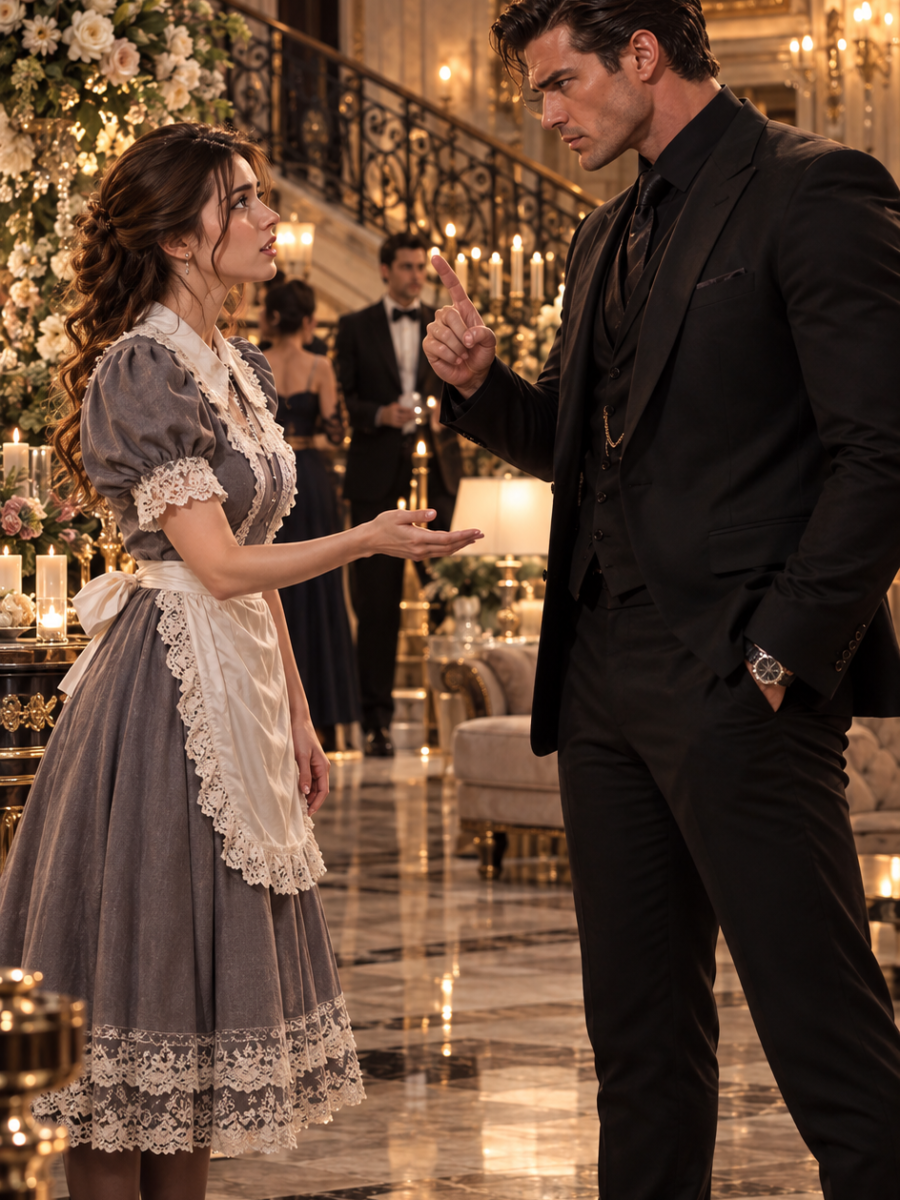
“Dance With Me, or My Brother Dies at Midnight.” The Waitress Begged the Most Powerful Mafia Boss in New York — Then the Chandelier Fell, and the Father She Buried Six Years Ago Walked Down the Staircase
I’m Victor Moretti. At 11:42 P.M., in the middle of my private gala, a waitress put down her tray and asked me to dance. She had eighteen minutes to save her brother, and I had been hiding something from her for six years. Read every chapter to find out what I knew about Tessa Montgomery before she ever crossed my ballroom.
Eighteen Minutes
“Dance with me, or my brother dies at midnight.”
The beautiful waitress extended her trembling hand toward me. Three of my armed guards instantly moved. I raised one finger, and they stopped.
Above us, the enormous gold clock read 11:42 P.M. Eighteen minutes remained.
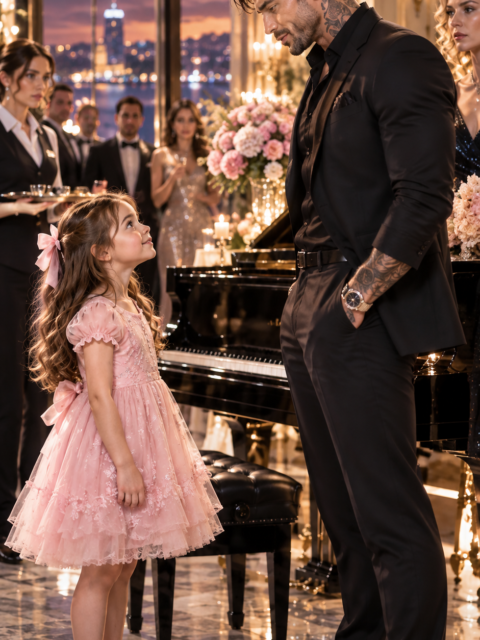
My grand Manhattan ballroom looked almost unreal that night. Towering crystal chandeliers floated above black Italian marble, sweeping staircases, antique gold walls, and hundreds of candles. Politicians, billionaires, and elegantly dressed guests filled the vast room beneath soft golden light. Yet only two of us seemed to matter. I stood in a perfectly tailored midnight-black suit. Facing me was a woman in an elegant black-and-white waitress uniform, with her silver tray abandoned on a table behind her.
I studied her. “You interrupted my private gala to ask me to dance?”
She forced herself to meet my eyes. They were wide and brown, and I knew them better than she could possibly have guessed. “I came to save my brother.”
I took her hand.
Gasps swept through the ballroom. As we moved beneath the central chandelier, I rested my hand carefully at her waist, the way you hold something that might break. I felt her pulse in her wrist.
“Talk.”
“My brother owes your organization fifty thousand dollars. Your man promised he’d die at midnight.”
My jaw tightened. “I gave no such order.”
She missed a step. “What?”
“Who threatened him?”
Before she could answer, I noticed bruising near her wrist. Dark, fingerprint-shaped. My expression darkened. “What happened?”
“Two men broke into my apartment last night. They said they worked for you.”
“I didn’t send them.”
The color drained from her face. I could see her working it through, the way you work through a sum that will not balance. Then who had?
I leaned closer, and my voice dropped. “Your brother isn’t the target.”
A tiny red light moved across her black-and-white uniform. It slid over her shoulder, then her collarbone, and settled just above her heart.
My eyes snapped toward it. “Tessa, down!”
I pulled her against me.
CRASH!
The chandelier shattered above us. Crystal rained across the marble like hail. Guests screamed and scattered, and I shielded her beneath my body while glass sheeted over my shoulders. Her breath came violently against my chest.
“They wanted you,” she gasped.
I stared at the impact beside her abandoned tray. A neat, round hole, in a table she had been standing beside sixty seconds ago.
“No,” I said, and my voice had gone ice-cold. “They wanted you.”
The gold clock above the staircase read 11:59. In my pocket, my phone began to vibrate.
Back to top ↑
Midnight
One message. I read it with the glass still sliding off my shoulders.
SHE WAS NEVER SUPPOSED TO SURVIVE SIX YEARS AGO.
I think my heart stopped. It is not a figure of speech. For one second, the whole ballroom was white noise, and there was only the screen of my phone and the unsigned sentence burning on it.
Tessa had stopped breathing too. She was reading it over my arm. “What does that mean?”
I did not answer. I could not. Because I knew precisely what it meant, and I had spent six years making sure that she never would.
Before I could find a word, every light in the ballroom died.
Total darkness. The candles had been snuffed in a single breath, as if someone had passed a hand along the length of the room. Women screamed. Glass crunched underfoot. My guards were shouting my name from three directions, and above it all, from the great gold clock, a deep bronze note rolled through the black.
Midnight began striking.
One. Two. Three.
I pulled Tessa behind me, with my back to the nearest column and her fingers clutching the lapel of my suit. Four. Five. I counted without meaning to. My men would be sweeping the corridors. They would not reach us in time.
Six.
Then a man’s voice emerged from somewhere in the darkness, calm and warm and unhurried, as if he were calling a child in for supper.
“Tessa.”
She froze. I felt it go through her entire body, a stillness so complete that I thought she might fall.
“No,” she whispered. “No.”
I turned toward her. “Who is it?”
She was crying. Tears slid silently down her face, silver in the thin light from the street windows. “I know that voice,” she said. “I know its warmth. Its anger. The way it says my name.”
Seven. Eight. A pale light stirred at the top of the great gold staircase, and a silhouette resolved out of the dark. A man in a long coat. Tall. Gray at the temples. He stood very still against the balustrade, as though he had every right to be there.
Tessa gripped my suit with both hands. “Six years ago,” she said, in a thin, broken voice, “I stood beside a coffin. I watched that man’s name carved into stone.”
The silhouette began to descend.
Nine. Ten.
And then, as he stepped into the beam of a security lamp, I saw his face. I will admit what I felt, because I have promised myself I will tell this story honestly. For the first time in my adult life, I was shaken. Genuinely, physically shaken, with a cold hand closing around my throat.
“You know him?” Tessa whispered.
I did not answer.
The stranger stopped three steps from the bottom, and he smiled. Eleven. Twelve. The clock fell silent, and the smile widened.
“Victor,” said Daniel Montgomery, pleasantly, with his hands in the pockets of his coat. “You still haven’t told her what really happened six years ago?”
Tessa slowly turned toward me. My silence frightened her more than the shattered chandelier. Because suddenly she understood that I had not met her tonight by accident.
Back to top ↑
The Man on the Stairs
“Daddy?”
It came out of her like something that had been waiting six years for an excuse. Tessa took one step away from me, then another, her face shining with tears and wonder and a terrible, helpless joy. “Daddy, you’re alive. You’re alive.”
I caught her arm. It was a gentle grip, and she stared at my hand as though it were a stranger’s.
“Don’t,” I said, very low.
“Let me go.”
“Tessa. Look at his hands.”
She looked. Daniel Montgomery had descended the last stair and stood on the black marble in the gleam of the emergency lamps, and in each of his hands he held something small and black. They were remote detonators. And behind him, from the shadows of the staircase, came six men in dark suits with their pistols drawn.
Not my men. I knew every one of mine by their step. These were strangers, quiet and professional, and they moved with the discipline of people who had been paid very well for a very long time.
The ballroom had emptied around us. Guests had fled through the side doors. My own guards were trapped in the east corridor, pounding on doors that had been chained from the outside. Rocco Vega, my chief of security, whose face I had trusted for eight years, was nowhere to be seen.
“Hello, sweetheart,” said Daniel.
His voice cracked, very slightly, on the last word. I would have given a great deal, then, to believe that the crack was real.
“You died,” said Tessa. “There was a fire. I was in the car.”
“I know.” He looked at her with an expression of terrible tenderness. “I’m so sorry about that, darling. It was never meant to go that way.”
“Mom died in that car.”
“Yes. That was unfortunate.”
I have heard men say a great many monstrous things in my life, in dark rooms, over cold tea. But I have never heard anything as casual as the way Daniel Montgomery said the word unfortunate.
“Dad,” said Tessa, and her voice had begun to shake. “What are you saying?”
“I’m saying that the man standing beside you has been lying to you for six years.” Daniel’s eyes moved to me. “Haven’t you, Victor? You were there that night. You pulled her out. You’ve been paying for her therapy, her apartment, her brother’s school fees, all through shell companies, because you couldn’t bear the guilt.” He smiled. “She thinks she’s a stranger to you.”
Tessa turned slowly to face me. Her mouth had opened a little. She was waiting, I understood, for me to say that it was a lie.
I have lied in every way a man can lie. I have lied with silence, with money, with a gun. But I looked at that woman’s face, with the glass in her hair and the bruises on her wrist, and I found I could not do it.
“It’s true,” I said.
She flinched as if I had slapped her. “Tell me,” said Tessa. “Everything. Right now. Before the midnight he promised arrives.”
Back to top ↑
Six Years Ago
I was thirty-one. My father was still alive, then, and still the head of the Moretti family. I was the heir, and I was trying, with only partial success, to be worthy of the name.
Daniel Montgomery had been our accountant for twelve years. A quiet, cheerful man in a rumpled gray suit who kept our books so cleanly that the Treasury Department never found a thing. He had a wife and two children in Queens. He coached Little League. My father trusted him with every secret we owned.
In the autumn of that year, we discovered that he had been stealing.
Forty-one million dollars, over six years, moved a little at a time into accounts in the Caymans. It was elegant work. We might never have found it, except that one of his junior clerks, a nervous kid named Marco, came to my father in tears and confessed that he had seen the numbers.
My father gave me the order on a Tuesday. He said it quietly, over breakfast, while stirring his coffee. “Take care of Montgomery, Victor. Make it look like an accident.”
I did not want to do it. I want that understood, though I have never been able to say it in front of a judge. I had never killed a man who had not come at me with a weapon. But I was thirty-one, and he was my father, and I was afraid.
I followed Daniel’s car on a rainy Friday night, up the Taconic Parkway. He had his wife in the passenger seat and his daughter in the back. They were on their way to a weekend cabin. I did not know, until I saw them, that he planned to take the family along.
I do not know why he did it. I have thought about that for six years. I think he meant it, at first, as a kind of insurance, a human shield. But somewhere on that road, he must have realized that I was behind him. Because he stopped the car, got out, and ran into the woods, and left his wife and daughter inside.
The car rolled. It was a steep embankment, and the guardrail had been loosened by a recent storm. It tumbled once, twice, and came to rest against a tree. And then, as I stood in the road with my hands useless at my sides, it began to burn.
I do not remember deciding to go down that hill. I remember the heat. I remember a woman’s scream cutting off, and then the smell. I remember the back door jammed shut, and my coat wrapped around my fist, and a girl of twenty-two, with her hair on fire, looking up at me with huge brown eyes.
I pulled her out. I could not reach the woman in front.
When the ambulances came, I was gone. I stood in the trees across the highway with my hands burned and my suit in ruins and watched them put Tessa Montgomery on a stretcher. Her father’s coffin, three days later, held a charred body I later learned he had bought from a funeral home in New Jersey.
I told my own father that Montgomery had died in the crash. It was, in the circumstances, a lie he could believe. But I knew the truth. The man had faked his own death with his family’s, and it had cost him his wife and nearly his child.
“I’ve watched over you ever since,” I told Tessa, in the dark ballroom. “Not because I was kind. Because I was the reason you were in that car.” And behind me, Daniel Montgomery began to laugh.
Back to top ↑
What Daniel Wanted
Tessa did not speak for a long time. I watched her face, and I tried to read it, and could not. She had gone very still. She looked at her father. She looked at me. She looked at the pale lamp on the staircase, and the glittering shards of crystal on the marble, and the six silent men with their guns.
“Why are you here?” she said, finally. Her voice was clear. “If you’ve been alive for six years, why now?”
Daniel put his hands in his pockets. The detonators vanished. It was a courtesy, perhaps, or a way of showing that he did not need them. “Forty-one million dollars is a good deal of money, my dear. But it isn’t infinite. The accounts I opened were rather clever, but they require a particular code to release the final balance. A code your friend’s late father sealed in a safe in this very hotel.”
I had not known that. I said so. He nodded, with a small, pleased smile.
“Of course you didn’t. Antonio kept it from you. He was a cautious man, even about his son.” Daniel’s eyes were bright with amusement. “He locked the codes in a vault beneath the east wing. And the vault opens with only one thing. The fingerprint of whoever pulled my daughter from that car.”
The room tilted. I understood, then, what he was telling me. The hand that had burned on that hillside, the scar on my right palm that I had never explained to anyone, was the key.
“It’s a lovely little piece of poetry, isn’t it?” said Daniel. “Your father’s idea. He wanted to know that if anyone ever tried to take it, they’d have to go through you.”
“You framed him,” said Tessa. “The threat to Noah. The two men in my apartment.”
“I needed you here tonight.” His tone was almost gentle. “I needed Victor to feel something. A man who’s cold as ice is difficult to move. But a man who thinks he owes a girl his conscience is easy.” He nodded toward the doorway. “Rocco, bring Noah in.”
A tall, heavyset man in a security jacket stepped out of the shadows with a young man in front of him, hands bound, a strip of tape across his mouth. Noah Montgomery, twenty, with his mother’s chin and a purple bruise across one cheek.
It was Rocco Vega. Eight years in my service. He did not meet my eyes.
Tessa made a small sound, like something tearing. I felt her sway, and I put an arm around her without thinking, and for the first time she did not pull away.
“Here is how this will work,” said Daniel, with the courtesy of a man ordering dinner. “Victor will open the vault. I will take what is mine. Noah and Tessa will go home, and no one will ever hear of me again.” A beat. “And if Victor declines, I will detonate the charges I have placed in the foundations of this building. Three hundred people died at the Marlowe Hotel in 1994. I read about it. It was dreadful.”
“There are no more guests,” I said. “They’ve all gone.”
“There are two hundred staff in the basement.” He smiled. “I checked.”
I had faced down knives, guns, and my own father. I had never felt anything like the cold that moved through me then. “Open it, Victor,” said Daniel Montgomery. “Or I’ll show my daughter what real fire looks like.”
Back to top ↑
Tessa’s Choice
“No,” said Tessa.
It was a small word, but it carried across the dark ballroom like a bell. Daniel’s smile flickered. She stepped out of my arm and walked toward him, slowly, across the broken glass, in her black-and-white waitress shoes, and I think every man in that room forgot his weapon for a moment.
“No, Dad,” she said. “He won’t open the vault.”
“Darling.” Daniel spread his hands. “Think of your brother.”
“I am.” Her voice shook, but she did not stop. “I’m thinking about the night Mom died. I’m thinking about how I woke up in a hospital bed with half my hair burned off, and the nurse told me my father was dead, and I cried for a month. I’m thinking about the stone in Greenwood Cemetery with your name on it.” She stopped, ten feet from him. “I put flowers on it every year.”
Something moved in his face. It was small. Perhaps it was shame. Perhaps it was only calculation. “I didn’t have a choice.”
“You had a choice.” She wiped her cheek with the back of her hand. “You left us in a burning car. You could have opened the door. You could have said one word.”
“Tessa.”
“I’m not finished.” And for the first time, I saw it. Beneath the grief, beneath the shock, something hard and clear and entirely her own. “I forgave you, you know. For six years, I told myself that you must have been afraid, that you must have had a reason. That you would never have left us if you’d had another choice.” Her eyes glittered. “I’m done forgiving you.”
She turned her back on him. It was the bravest thing I have ever seen anyone do. She walked back across the glass to me, and she slid her hand into mine.
“Victor,” she said, low and steady. “Don’t open it. I don’t care what he does.”
“Tessa, your brother—”
“Noah would say the same.” She looked across the ballroom at the bound boy, whose eyes above the tape were wet and furious and nodding. “He would say the same thing. Look at him.”
I looked. Noah Montgomery was nodding, hard, over and over, his chin trembling.
My phone buzzed against my chest.
I had not looked at it in four minutes. When I drew it out with my free hand, the screen showed three words from the one man in my organization whose loyalty I had never questioned. Enzo Greco, my consigliere, who had been sitting at table nine all evening, drinking nothing.
Basement cleared. Charges disarmed.
I glanced at Tessa. Her eyes had met mine, and she had seen it too.
“I never trusted Rocco,” I said, quietly, so only she could hear. “Not since the spring. I’ve had Enzo watching him for three months.”
A tiny, astonished smile touched the corner of her mouth.
“Daniel,” I said aloud, in a voice that carried the length of the black room. I let go of her hand, stepped forward, and raised my scarred right palm for him to see. “You were right. I did pull your daughter out of that fire. But you made one mistake.”
He frowned. “And what is that?”
“You assumed I came alone.” And across the ballroom, every dark archway lit up with the red dots of twenty rifle sights.
Back to top ↑
The Last Stair
It was all over in about nine seconds. I remember each one separately, the way you remember things that change a life.
Daniel’s six men looked at the red dots. One of them, a young man with a thin mustache, dropped his pistol immediately and raised his hands. The others hesitated. In the corridor behind us, the chained doors burst open with a roar, and my guards poured out, unhurt, their faces black with fury.
“Don’t,” said Daniel. His voice was higher than before. “Don’t. I have the detonators.”
“No, you don’t,” said Enzo Greco, stepping out of the dark archway by the east wing with a small remote in his hand. He tossed it, quite casually, onto the marble. It skidded to a stop at Daniel’s feet. “That’s the one you gave Rocco. It’s a dead battery and a calculator. We found the real ones an hour ago.”
Rocco Vega bolted.
He shoved Noah to the floor, drew a gun from his jacket, and fired twice at nothing, wildly, at the dark. Tessa screamed. I moved without thinking, and my shoulder caught Rocco in the ribs, and we crashed together across the shattered crystal. His gun spun away.
Something warm slid down my cheek. A shard of chandelier had caught me above the eye. I did not care. I had Rocco by the collar, and I was thinking about eight years of trust.
“Why?” I asked.
“Money,” he spat. “He promised me ten million.”
“Of course he did.”
I let him fall. Two guards seized him.
When I looked up, Daniel Montgomery was at the foot of the great staircase, backed against the balustrade, with his hands raised. His coat hung open. There was glass in his hair. All the gentle, patient warmth had drained from his face, and what was left was something small and frightened, like a man who has lost a bet he did not know he was making.
“Tessa,” he said. “Sweetheart. Tell them. Tell them I didn’t mean any of it. I was only trying to protect the family.”
She stood a few feet away, her arms around Noah. She had cut him free. He was sobbing into her shoulder, and she was stroking his hair. She looked at her father over the top of her brother’s head.
“You didn’t protect us,” she said. “You never did.”
It was strange, how quiet it became. A man’s whole life, I think, can end in a single sentence, if the right person says it.
Daniel stared at her. Then he turned, with a movement so quick that I did not understand it until it was done, and bolted up the stairs. He took them two at a time. At the landing, he whirled, and from inside his coat he drew a small black pistol.
He aimed it directly at Tessa.
I do not remember firing. I know that I did. I know that the sound was enormous in the ruined hall, and that Daniel Montgomery’s hand jerked upward and the pistol went spinning over the banister and shattered a mirror, and that he fell, slowly and almost gracefully, with one hand clutching his shoulder, down six stairs, to lie at the bottom among the shards.
He was alive. He looked up at me with a strange, puzzled expression, and said, in a small voice, “You could have killed me.”
“Yes,” I said. “That’s the difference between us.”
I had never called the police in my life. I took out my phone, with a hand that was not quite steady, and dialed 911. Behind me, Tessa let out a breath she had been holding for six years.
Back to top ↑
A Dance Without a Clock
Tessa did not speak to me for forty-one days.
I counted them. It was a foolish thing to do, and I did it anyway. She took Noah home to Queens, and she did not answer my calls, and she did not open the envelopes my lawyer sent. I did not blame her. I had held a truth for six years like a stone in my pocket, and she had every right to throw it back.
Daniel Montgomery was arraigned on thirty-one counts. Fraud. Conspiracy. Kidnapping. Attempted murder. He pleaded guilty before the trial began. I never learned why, though I suspect it was the only act of self-respect left to him. He was sentenced to forty years. Tessa did not attend. Noah did, and sat in the second row, with his hands folded, and did not cry.
Rocco Vega testified against him. Enzo Greco handled the rest.
I gave the police the vault codes, and every account in the Caymans, and a statement of my own. It took eleven hours. In it, I described, in plain language, what I had done on the Taconic Parkway six years ago, and what I had failed to do. The detective who took it was silent for a long time when I finished. “You understand this isn’t going to look good,” he said.
“I understand.”
“You could have walked out of that ballroom a hero.”
“I’m not looking to be one.”
It was in the spring that I sold the Moretti family’s interests. Not all at once. It took months of lawyers and negotiations and one memorable dinner with a very angry cousin. But by June, the clubs were gone, and the warehouses, and the quiet, shadowed network of favors and threats and debts. What remained was a legitimate hotel chain, a construction firm, and a small charitable trust I had set up in the name of a woman I had failed to save.
Her name had been Margaret Montgomery. She had taught third grade.
On the forty-second day, my assistant brought me a letter. It had no return address, and the handwriting was small and neat and unfamiliar. Inside was a single sheet of paper, and four words.
Ballroom. Tonight. Midnight.
I went. I do not remember the drive. I remember only that the ballroom had been repaired, the black marble polished, the chandelier restored, and that the great gold clock above the staircase had been stopped at exactly 11:42. Someone had taken the hands off. Or perhaps the mechanism had simply given up.
She was standing at the center of the floor, in a simple dark dress, with her hair loose over her shoulders. No tray. No uniform. She turned when she heard me, and I stopped three feet away, because I did not trust myself to go closer.
“Victor.”
“Tessa.”
“I’ve been thinking,” she said, “about what I would say to you.” She took a breath. “I’m furious. I want you to know that. I’m furious that you lied, that you let me thank a lawyer for a scholarship you paid for. I’m furious that you were there.”
“You have every right.”
“But you pulled me out.” Her voice was quiet. “You went down that hill with your hands burning, and you pulled me out. And you’ve spent six years being punished for it by yourself.” Her eyes were wet. “I don’t think I can forgive you all the way. Not yet. But I’d like to try.”
I do not think I breathed.
“So,” said Tessa Montgomery, and she held out her hand, as she had once before, beneath a chandelier, with eighteen minutes on the clock. “Dance with me.”
“Is there a deadline?”
“No.” She smiled, small and watery and entirely real. “No deadline. No clock. Just this.”
I took her hand. There was no music, so we made our own, a slow, slightly lopsided waltz across the black marble, with the stopped clock overhead and the moon coming in through the tall windows. Her head came to rest against my shoulder, and I closed my eyes.
It was not forgiveness. Not yet. But it was something that might, in time, become it.
Above us, in the silent ballroom, the gold clock ticked once, and then began, very gently, to run again.
More Trending Stories You Can’t Put Down