“Leave My Papa Dante Alone, or I’ll Hit You With My Broom!” A Three-Year-Old Faced Three Armed Men for the Mafia Boss… Then Pointed at the Real Killer
I’m Dante Rienzi, and I staged the whole robbery myself. Three men, a mask, a gun I knew was unloaded. I did not plan for a barefoot three-year-old in a purple dress to step in front of them with a plastic broom, or for her to scream a sentence that would unravel six years of lies. Read every chapter to learn who killed my daughter, and why a toddler knew his face.
Sweepy
“Leave my Papa Dante alone, or I’ll hit you with my broom!”
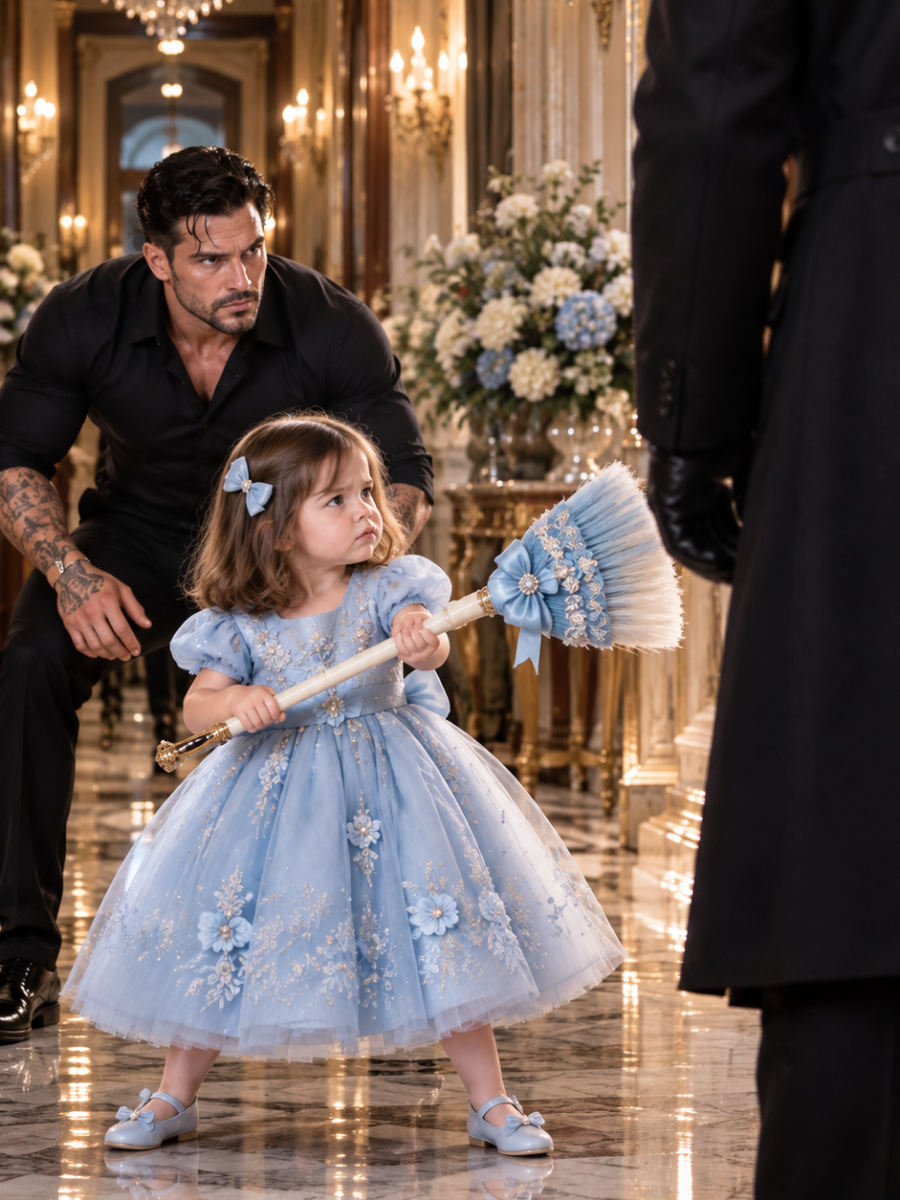
The hallway of my New Jersey mansion was marble from floor to ceiling, and her voice rang off every inch of it. Three armed men in black masks stood in the dim light of a single wall sconce. Between them and me stood a three-year-old girl in bare feet.
Her name was Noemi Vega. She wore her favorite dark-purple princess dress, the hem brushing her ankles, and her thick chestnut curls were tied up with a purple satin bow. Her brown-hazel eyes blazed. In her small shaking hands she held a plastic broom with a smiling face drawn on the handle in marker.
“Take one more step, mister,” she said to the gunman in front, “and Sweepy’s gonna bonk you!”
The man raised his pistol. I could see his finger on the trigger. I could see her tiny shoulders trembling. She didn’t move an inch.
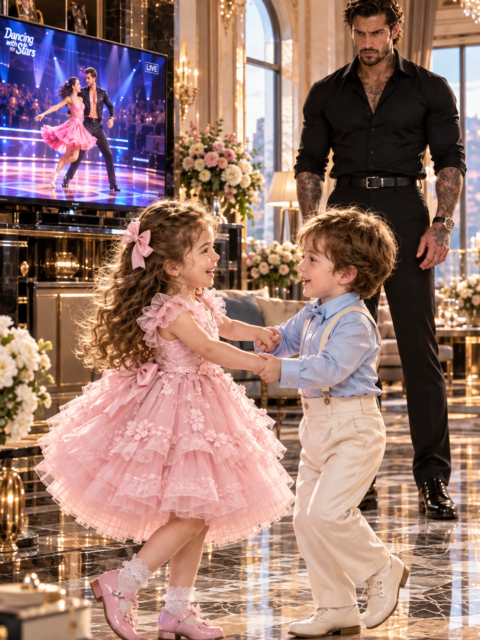
My name is Dante Rienzi. In New Jersey, the men who say it do so quietly. I’m forty-two, six-foot-four, with black ink running down both arms and a reputation that has kept three of the five families out of my territory for ten years. I was standing in the shadows of my own staircase, watching a little girl risk her life for me.
And the worst part, the part that stopped my heart, was that she was defending me from a robbery I had arranged myself.
The men were mine. The masks were mine. The pistol was a prop. I’d designed that break-in to find a traitor in my organization, and I had planned it with the precision I bring to everything. I had not planned for a child. I had thought she was upstairs, in her mother’s room, asleep.
“I don’t care if you have a gun!” she shouted. Her voice cracked. “You’re not taking him away!”
I stepped out of the dark. “Noemi. Get back.”
She turned her small face up to mine, and in it I saw something I hadn’t seen in six years. Not fear. Not respect. Total, furious love. She planted her feet and spread her arms in front of me like a tiny shield.
“No,” she said. “You can’t take my papa.”
That was the moment I stopped being the man who had planned a robbery. I lunged past her and seized the nearest masked man, tore off his mask, and revealed the face of Vito, my most trusted soldier.
“He works for me, sweetheart,” I said, hoarse.
She stared at Vito, then at me, her lower lip trembling with outrage. “You were playing bad guys? That’s naughty!” But she hadn’t heard the second sound yet, the one from the east door.
Back to top ↑
Grumpy Dante
Seven months earlier, a woman named Marisol Vega came to my gate with a battered suitcase and a three-year-old on her hip.
I hadn’t hired her. An old friend of hers, my cook’s sister, had passed along a recommendation: a single mother who’d worked three jobs to keep her daughter fed, looking for a live-in housekeeping position. Excellent pay. Health insurance. A safe home. She accepted without asking who owned the house. I think she learned my name from the mailbox.
She had one rule for her daughter, and she repeated it so many times that the staff began to say it back to her. Never go into Mr. Rienzi’s private study.
Noemi, naturally, treated this the way all three-year-olds treat rules.
The first morning I noticed her, she marched into my kitchen carrying half a chocolate-chip cookie, wearing mismatched socks, and held it up to me like a medal. “Papa Dante! I saved you some!”
I stared down at her. In ten years nobody had offered me anything without wanting something in return. “I’m not your papa.”
She considered this with great seriousness, her head tilted. “Okay,” she said. “Grumpy Dante.”
Behind me, two of my bodyguards started coughing. One had to leave the room. I took the cookie. It was warm from her hand, and a little squashed. I ate it standing at the counter, and I felt something in my chest, long frozen, give a very small crack.
After that, she followed me everywhere. She decided I was lonely, and she was right, and I never told her so. She appointed herself my sentry, patrolling the hallway outside my office with her plastic broom, a gift from her mother. She named it Sweepy. Sweepy’s job, she explained, was to bonk anyone who was mean to her friends.
“Do I count as a friend?” I asked her once.
“You count as a papa,” she said. “But you said no. So I’m waiting.”
I had no answer. I’d learned that not having an answer was the best tribute I could give her.
The day she broke the rule, I was in a meeting. A crooked paper butterfly she’d folded in the kitchen had drifted through the half-open door of my study, and she had gone after it. When I returned, I found her standing on tiptoe in front of my desk, her stuffed bunny clutched to her chest, staring at the glass case I kept there.
Inside the case was a paper butterfly, delicate and slightly crooked, folded by someone very small.
“Who made this pretty one?” Noemi whispered. I stood in the doorway, and for the first time in six years, I told someone the truth. “My daughter.”
Back to top ↑
The Study
“Where is she?” Noemi asked.
My jaw tightened. I had learned to keep it tight. “She died six years ago.”
She was three. She didn’t flinch the way adults do, or offer me a hollow sentence. She studied the butterfly for a long moment, her small forehead creased. “Maybe she misses making butterflies with you,” she whispered.
I couldn’t answer. I stood in the doorway of the one room in my house I’d allowed no one to enter, and I couldn’t breathe. Gianna had been five when she died. She had folded that butterfly the week before. It was the last thing she ever made.
The next morning, outside my study door, I found another butterfly. It was folded badly, with one wing bigger than the other, and a purple crayon heart drawn on it. I picked it up with hands that had once broken a man’s jaw. I carried it into the room, and I put it in the glass case beside my daughter’s.
I stood there, alone in the dark, with two crooked butterflies, and for the first time in six years I smiled. I smiled through tears. I was ashamed of both.
It was around then that the leaks began.
A shipment of ours was hijacked at the Elizabeth docks. A meeting I’d told only four men about was ambushed by a rival crew. Two of my routes were sold to the Caldera family before I had even signed the paperwork. Someone close to me was feeding them information, and for months I couldn’t find him. I had a short list of men who’d known each detail, and every one of them had been with me for ten years or more. I trusted them. That was exactly the problem.
So I made a plan. A fake break-in, at night, when the house was quiet. A trusted soldier, Vito, in a mask, entering from the west. Three of my own men playing intruders. I would stand in the dark and watch every man in my organization as the alarm went up. The traitor would reveal himself by how he reacted: whether he ran, or called someone, or went for the study where I kept my ledgers.
Everything was carefully planned. Except one small, stubborn, barefoot girl, who heard the commotion from the second floor and decided to save me.
After the broom, after the unmasking, after Noemi flung herself at my leg and said into my trousers, “I thought somebody was gonna take you too,” I knelt down in the marble hall.
“Too?”
“Like they took your little girl.” She said it like a fact, the way she said everything. “But I wasn’t gonna let them.”
I gathered her into my arms. My soldiers stood around us in the dim light, hardened men with scars and records, and I watched every one of them look away. They had never seen me cry. In six years, nobody had. I held a toddler in a purple dress, with a plastic broom between us, and I wept without sound into her curls.
Then my security radio crackled. “Boss. Vito came through the west entrance, like we planned.” A long pause. “But somebody else just came in through the east.”
Back to top ↑
A Plan With One Flaw
Behind me, a gun clicked.
“Put the child down, brother.”
I knew the voice before the words had finished. I’d known it for thirty years. It belonged to the man who had stood beside me at my wedding, who had carried my father’s coffin, who had held my arm at my daughter’s funeral and said nothing, because there was nothing to say.
Enzo Mancuso. My oldest friend. The brother I’d chosen.
I did not turn right away. I held Noemi against my chest, her small heart racing against mine, and in the silence of the hallway I understood how my plan had failed. I had designed it to expose a traitor by how he reacted to a fake attack. I had never considered what a man might do if he saw an opportunity. Enzo hadn’t reacted to the break-in. He had used it. In the chaos of a staged robbery, a real intruder with a real gun would never be questioned.
“Enzo,” I said, evenly. “You’re early.”
“So are you, Dante.” His footsteps came slowly down the hallway, unhurried. “I wondered when you’d start to look at me. I thought I had longer.”
“You sold my routes to Caldera.”
“I sold your routes to the highest bidder. I’ve been selling them for four years.” He sounded almost fond. “You’ve grown soft. You’ve grown careless. You’ve built an empire and then forgotten how to defend it. Somebody had to benefit from your weakness.”
The two men behind him raised their weapons, real ones, with real bullets. I could hear Vito and my other soldiers freeze, pinned between a boss they had loved and a man they had trusted. Marisol appeared at the top of the stairs in a robe, hand clamped over her mouth.
“Noemi,” I whispered, bending my head so only she could hear. “Close your eyes, sweetheart. Count to ten.”
She didn’t. She was staring over my shoulder into the dark, and her small face had gone strange. It wasn’t fear. It was recognition. She tugged at my collar and lifted her head, her enormous eyes widening, and I felt her whole body stiffen against my chest.
“Papa Dante,” she said, in a voice I’d never heard from her. “Papa Dante, I know him.”
“Noemi, hush.”
“I know him.” Her voice rose. She wriggled around in my arms, pointed one trembling finger at the man behind me, and screamed.
“PAPA DANTE! THAT’S THE MAN FROM YOUR LITTLE GIRL’S PICTURE!”
Back to top ↑
The Man in the Drawing
The picture was in the glass case.
I had forgotten it. Not the butterfly. The thing beneath it, folded in quarters and tucked under the base, so old that the creases had gone soft. A drawing in crayon, done by a five-year-old, that I had found in my daughter’s school bag the night she died. I had never thrown it out, and I had never unfolded it.
Noemi had. In the days she spent wandering in and out of my study, with her bunny and her butterfly and her small, relentless curiosity, she had found it, unfolded it, studied it, and refolded it with the care of a child who knows she isn’t supposed to be there.
“There’s a man in it,” she said now, in my arms, shaking. “In the picture. He’s standing by the car. Gianna drew him with a gold ring and a mean face. She wrote his name.” Her voice dropped. “Under the picture. It says Uncle Enzo is hiding something under Papa’s car.”
The hallway went completely silent.
I turned around. Enzo Mancuso stood ten feet from me with a pistol in his hand and a gold ring on his finger, and for the first time in thirty years I looked at his face and saw a stranger’s.
“She told her mother,” Enzo said quietly. “The girl saw me in the garage. She was playing, and she saw me under the car, and she thought it was funny. She drew it. She showed Laura. Laura came to find me.” He lifted one shoulder. “It would have been simple, Dante. The bomb was meant for you. I only needed you in that car that Thursday.”
My arms tightened around Noemi. I could not feel them.
“You didn’t take the car that morning,” Enzo said. “You had a meeting. You gave Laura the keys. You said she could take Gianna to the aquarium.” He smiled, thin and terrible. “I didn’t mean the child. I want you to know that. I never meant the child.”
Six years. For six years I had believed I’d failed to protect them because of something I’d done wrong, some rival I hadn’t crushed, some enemy I’d forgotten. I had built an empire out of that guilt. I had grown colder every year, because it was easier to be cold than to be a man who gave his wife the keys.
And the man who’d done it had stood beside me at the funeral and held my arm.
I do not remember what sound came out of me. I remember Noemi’s small hand on my cheek, her palm warm and sticky with cookie crumbs. I remember her whisper in my ear, so quiet that only I could hear:
“It’s not your fault, Papa Dante. Gianna told me.”
I didn’t ask what she meant. Because in that second, Enzo raised his gun, and the little girl in my arms squirmed free, grabbed a plastic broom from the floor, and swung it with all her strength at the man who had killed my daughter.
Back to top ↑
The Second Gun
It was a plastic broom. It weighed almost nothing. It struck Enzo Mancuso’s wrist with a hollow little bonk, and the shot he’d been about to fire went wild into the ceiling.
That was all it took. In the second of confusion, Vito, the soldier I’d unmasked, threw himself into the nearest gunman. My men, frozen for an eternity, exploded into motion. I caught Noemi around the waist and dove behind the staircase, pulling her under me, shielding her small body with mine. The hallway filled with the sound of gunfire.
It was brutal and brief. The marble cracked. A vase exploded. Someone screamed, and I felt a white-hot punch in my shoulder that I hadn’t the time to register. I only knew that my arms stayed locked around the child, and that she was breathing, and that nothing else mattered.
“Papa Dante,” she whimpered. “You’re bleeding.”
“I’m all right.”
“You’re not. You’re all red.”
“Stay down, baby. Stay with me.”
Then it was quiet. I raised my head. Enzo’s two hired men lay in the hallway, disarmed and groaning. My soldiers stood over them. And at the foot of the stairs, with one hand clutching his bleeding wrist and the other still holding a pistol, Enzo Mancuso stared at me.
“It’s over,” I told him.
“It’s never over, Dante.” He raised the gun. His hand was shaking. “Caldera will never let you live. They’ll come for you, and for the girl, and for the mother.”
“No,” said a quiet voice. “They won’t.”
Marisol stood on the staircase, trembling, with a phone held out in front of her like a weapon. “I called the police eight minutes ago,” she said. “I told them everything I could hear. They’ve been listening this whole time.”
For a moment nobody breathed. Then, far off, through the walls and the marble, I heard the thin rising wail of sirens.
Enzo Mancuso looked at me. In his eyes I saw something I’d been waiting six years to see, and it wasn’t triumph and it wasn’t fear. It was the exhausted face of a man whose lie had finally run out of road.
He lowered the gun. He let it fall.
I started toward him with a hand that wanted only one thing. And a very small voice, trembling and furious behind me, said, “No, Papa Dante. That’s naughty.”
Back to top ↑
Naughty
I stopped.
It’s a strange thing to say, but a three-year-old stopped me. I stood in the wreck of my own hallway, bleeding through my shirt, six feet from the man who had murdered my wife and daughter, with every instinct and every year of my life screaming at me to finish it. And behind me a small girl with a broom said naughty in a voice that shook with fear and conviction.
I turned. Noemi stood on the marble in her purple dress, her bow crooked, her face streaked with tears. She was holding Sweepy against her chest. She wasn’t looking at Enzo. She was looking at me.
“Gianna wouldn’t want you to,” she said.
I did not ask her how she knew. I didn’t need to. I knelt down in front of her, and my shoulder burned, and I looked into her enormous brown-hazel eyes. “All right,” I said. “All right, sweetheart.”
The police came through the front door ten seconds later. Enzo was in handcuffs before he could draw a breath to protest. As they led him out, he turned his head and looked at me one last time. I didn’t answer. There was nothing left to say to him.
It took four hours at the hospital to remove the bullet. I woke with Marisol sitting beside my bed, her eyes swollen, her hands wrapped around a paper cup. She told me what the detectives had found. Enzo’s phone was a goldmine. Four years of messages to the Caldera family, payment records, names, routes, dates. And one file, a short one, labeled in a plain hand: Thursday. A transcript of a conversation recorded six years earlier. Enzo’s own voice, planning a bomb. He had kept it, I realized, the way some men keep trophies.
He was convicted of the murders of Laura and Gianna Rienzi, along with a dozen counts of conspiracy and racketeering. The jury deliberated for ninety minutes. The Caldera family was dismantled within the year. Eleven of its members were indicted on the strength of what Enzo had recorded. I testified against every one of them. I told the court what I’d been, and what I had done, and what I had stopped doing.
Two of my soldiers asked me afterward what I intended to do with the organization. I looked at them and said I intended to retire it. I could see they’d been waiting a long time for the answer.
I came home from the courthouse that spring to a quiet house. On the study desk, beside two crooked butterflies, was a third, and a note in a small, uncertain hand: Papa Dante, can I stay?
Back to top ↑
Papa Dante
I found her in the kitchen, standing on a stool in her pajamas, trying to reach the cookie jar. Marisol was beside her, laughing, one hand hovering behind her daughter’s back in case she fell. When they saw me in the doorway, they both went quiet.
“I got your note,” I said.
Noemi climbed down, very slowly. She stood in front of me with her hands behind her back, the way she did whenever she’d done something she wasn’t sure I’d like. “I know you said no,” she whispered. “Before. When I said it. I’m not asking you to say it. I just want to stay.”
I got down on one knee. My shoulder still ached in cold weather, and I’d learned to ignore it. “Noemi. What was it I said, the first morning?”
“You said you weren’t my papa.”
“I was wrong,” I said. “I think I’ve been wrong about a lot of things.” I looked up at Marisol, who was crying quietly with one hand over her mouth, and back at the little girl who had stood in front of three guns with a plastic broom. “I don’t know how to be somebody’s papa. I’m not sure I’m any good at it. But if you’ll let me try, I’d like to.”
She looked at me for a long moment, very serious. Then she threw both arms around my neck, and I felt her small body shake with laughter and tears together.
“Okay,” she said into my collar. “Papa Dante.”
Marisol stayed. I didn’t ask her to be my housekeeper again, and she didn’t offer. She began studying for the nursing license she’d put off for years, with tuition I paid in full and she tried to refuse for three weeks. By autumn she was in classes. By spring she was working at a children’s hospital in Newark, and coming home at night to a house that no longer had guards, or ledgers, or locked doors.
I sold the warehouses. I turned the old study into a room with a big window and a small table, and I put my daughter’s butterfly in the middle of the shelf, beside Noemi’s crooked ones. I started a foundation named for Gianna and Laura that paid the funeral costs of children whose families couldn’t afford them. Noemi insisted on cutting the ribbon herself. She did it with the scissors from her art box, and when the photographer asked her to smile, she held up Sweepy instead.
On her fourth birthday, she gave me a present, wrapped in newspaper and tied with a purple bow. Inside was a paper butterfly, folded very badly, with wings that didn’t match.
“This one’s from me,” she said. “And this one’s from Gianna.” She held out a second butterfly, slightly crooked, creased and soft with age. “She said I could give it to you for your birthday.”
I do not know how she found it. I do not want to know. I took them both in my tattooed hands, and I held them against my chest, and my daughter’s small crooked wings brushed my heart.
“Thank you, Noemi.”
“You’re welcome, Papa Dante.” She yawned. “Can Sweepy sleep over?”
“Sweepy can sleep anywhere she likes,” I said. And I carried them both upstairs, the little girl and the broom, to a bedroom with a window that faced the garden, where the butterflies were just beginning to come.
Read Next