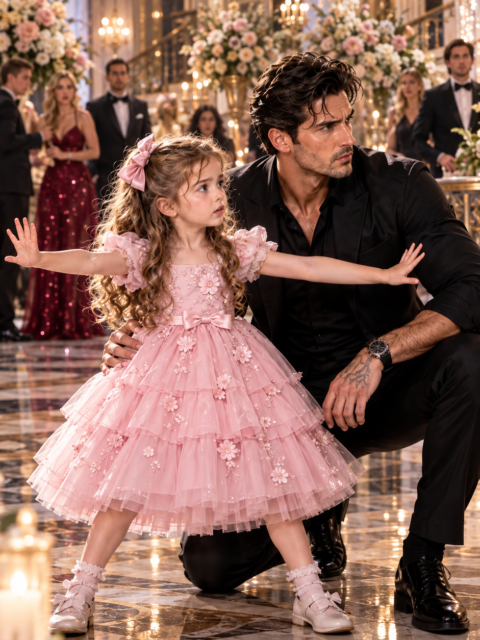
Alessandro Vitali does not believe in accidents. Reassigned to seat 14A beside a six-year-old girl named Sophie, he expects nothing more than a quiet flight to New York. Then her sketchbook falls open to a taped photograph of her mother — a woman Alessandro has spent six years believing died in the same underground garage ambush that nearly killed him. The math arrives before he can stop it: six years and two months, worked backward past the coma, past the gunfire on Mott Street, past the last ordinary weekend he ever spent with the woman he loved. Someone lied to him. Someone may have lied to her too. Read every chapter to find out who kept them apart, and why.
Seat 14A
Alessandro Vitali did not believe in accidents.
The belief had been drilled into him by twenty-three years in a world where coincidence was almost always a disguise for something else. So when the boarding agent at Charles de Gaulle reassigned his seat to 14A without explanation, his hand moved automatically toward the inner pocket of his jacket where a particular card lived.
Then he looked down.
The small girl in the aisle seat was already buckled in. Dark hair pulled into two red clips. Gray-blue eyes watching him with the patient, evaluating stillness of a child who had not yet learned to perform interest she didn’t feel. She was holding a red sketchbook against her chest with both arms.
“Your seat is the middle one,” she informed him.
“I know.”
“I asked them to move me so I could have the window. I told them my ears hurt better when I can see the wing.”
“Did it work?”
“Yes.” She considered him for another moment. “You can sit down. I don’t bite.”
He sat.
The flight attendant came through with pre-departure drinks. He declined. The girl accepted apple juice with the gravity of a diplomat accepting a treaty, waited until the cart passed, and then turned to him with the same directness. “What is your name?”
“Alessandro.”
“That’s a long name.”
“It can be.”
“Do people call you Alex for short?”
“Some people do.”
“Do you like it when they do?”
He considered the question. It was not a question he had been asked before. “No,” he said. “I don’t.”
“Then I’ll call you Alessandro.” She nodded once, satisfied, and turned back to her sketchbook. “My name is Sophie.”
He was not a man who spent time around children. His world did not contain them. The few children he had encountered in his adult life were the guarded, silent children of other men in his position, trained early to understand that adults in their orbit were not safe to trust. This child was not that. This child spoke like someone who had been spoken to.
“Are you drawing something?” he asked.
“The Eiffel Tower. I saw it from my mom’s studio window every morning when I woke up. I’m drawing it so I don’t forget.”
“Are you moving?”
“We’re visiting. New York. My mom has to see someone at a gallery.” She said this with the practiced clarity of a child who had been told the itinerary and memorized it. “We’re staying for a week. Maybe longer if the gallery person likes her work.”
“That sounds exciting.”
“It’s okay.” She picked up a green pencil. “I’ve never been on a plane before. It’s louder than I thought.”
The cabin settled into the rhythm of a long-haul flight. The seatbelt sign clicked off. Passengers began to shift and settle. Alessandro opened the folder he had been planning to review — projections for a shipping subsidiary that needed restructuring — and read the same paragraph three times without absorbing any of it.
He was aware of the small presence beside him. The particular quiet of a child who did not need to fill silence. The soft scratch of pencil on paper. The occasional sigh when a line did not go where she wanted it to.
Four hours into the flight, she fell asleep against his arm.
He did not move. He did not shift his arm to a more comfortable position. He did not slide the folder out from under her elbow. He sat very still and let her sleep, and he did not examine why he was unwilling to disturb her.
The thing that happened next happened because of a tray table.
The flight attendant came through with the second meal service. Sophie woke, blinked, and immediately began reorganizing her space. Sketchbook onto her tray table. Pencils into the seat pocket. The small Eiffel Tower backpack unzipped and rezipped.
And in the process, the sketchbook fell open.
The photograph was taped inside the front cover. Small. Worn at the corners. Taped with the careful precision of a child who understood that some things could not be replaced.
Alessandro looked at it for exactly three seconds. He knew because he counted them afterward, trying to reconstruct the order in which his mind had assembled what his eyes were seeing. The jawline first. Then the small silver cross on a chain at her throat. The one she had never taken off. Not even to sleep. Not in any of the mornings he had watched her wake.
Then the way her head was tilted back mid-laugh at whatever the person behind the camera had said, in a room he had never seen, in an afternoon light that was not New York light. European light. Older. Softer. More forgiving.
Then the blood left his face.
“That’s my mom,” Sophie said, apparently satisfied to have settled some question she had been forming. “Her name is Camille.”
He did not immediately speak. He set the sketchbook back down on his own tray table with the careful neutrality he used for objects that could not be dropped.
“She’s beautiful,” he said. His voice came out steady. He noted that. Filed it.
“I know,” Sophie said, already turning to the next page. “Everyone says that.”
“What is your full name, Sophie?”
“Sophie Camille Laurent.” She said it with the mild ceremony children used for full names. “Camille is my middle name. It’s also my mom’s name. So I have her name and my own name at the same time.”
“And when is your birthday?”
She told him. The month. The day. The year.
He wrote nothing down. He did not have to. He did the math he had not known he was about to do.
Six years and two months.
He worked it backward. Past the year of the coma. Past the ambush in the underground garage on Mott Street. Past the last weekend she had spent in his apartment before he had left for the meeting that ended everything.
The number arrived in his chest like something dropped from a very great height.
His hands did not move. That was the first discipline. His face was the second. His voice, the hardest, was the third.
“Six is a good age,” he said.
“It’s the best age,” Sophie said without looking up. “You know almost everything, but nobody makes you do anything about it yet.”
He watched her draw. The gray-blue eyes narrowed in concentration. The small frown that surfaced at the bridge of her nose when she was choosing a color. The exact crease he had watched in every mirror he had passed for thirty-nine years.
She had his hands. The Vitali hands. Three generations of them. He saw it now that he was looking. The shape of the fingers. The way she held the pencil.
For the rest of the flight, Alessandro did not open his folder. He did not accept the second whiskey the attendant offered. He did not speak. He did not move very much at all, except once to shift his weight when his left leg began to go numb from the specific stillness he had imposed on his body for the last four hours.
He kept his eyes on the seat back in front of him and let his mind do the work.
The thing he knew for certain first: the child was his. Then the thing he had to verify: that Camille had known and had not told him — or had told him and been prevented from telling him. Then the questions branching out from each of those possibilities. Each of them terrible in a different way.
He worked each branch to its end. He kept his face blank.
By the time the cabin lights came up for descent, he had a rough architecture. Not a plan yet. A frame.
Baggage Claim
He saw her before Sophie did.
Camille Laurent stood near the baggage carousel in a gray coat, exactly where a mother waiting for an unaccompanied minor’s connecting flight tag to be verified would stand, and for one full second Alessandro Vitali, a man who had built an empire on never once losing his composure in public, forgot entirely how to walk toward another human being.
She was thinner than he remembered. There was a new, careful stillness to her, the particular alertness of someone who had spent years scanning rooms for exits. And when her eyes found Sophie walking beside an unfamiliar man in a dark coat, and then traveled up to that man’s face, Alessandro watched six years of grief and shock and something considerably more frightened than either move across her features in the space of a single held breath.
“Alessandro.” His name, from her mouth, after six years, landed like a wound reopening.
“Camille.”
She grabbed Sophie’s shoulder and pulled her back half a step, an instinctive, protective motion that told him everything about what she believed him to be. “Sophie, sweetheart, go get your suitcase from the belt. The blue one, remember?”
Sophie, sensing the sudden change in the air the way children always do, glanced between them and obeyed without argument, moving off toward the carousel.
“You’re alive,” Camille said, once her daughter was out of earshot, her voice shaking with a fury Alessandro hadn’t expected. “Six years, Alessandro. Six years, and you never once tried to find us. I told myself you simply didn’t care enough to look. I told myself that was easier to accept than the alternative.”
“What alternative?”
Her jaw tightened. “That you knew exactly where we were the entire time, and simply decided a mistress’s daughter wasn’t worth the trouble of claiming.”
The words landed with a force that nearly staggered him. “Camille, I was told you died. In the hospital. Three weeks after the ambush. I have attended your funeral in my own mind every year since, on the anniversary, alone, because I couldn’t bear to visit an actual grave.”
Camille went very still. “That’s not possible. I woke from that coma in a hospital in Queens, Alessandro. My sister flew in from Paris the moment she heard. She told me you had ordered the attack yourself — that the ambush was never meant to kill you at all, that it was meant to eliminate me, because I’d become an inconvenient complication you no longer wanted managing your image. She said hospital security had already turned away two men who’d tried to enter my room asking about my condition, men connected to your organization.”
Alessandro felt something in his chest go cold and precise, the particular sensation of a man recognizing, all at once, the shape of an old and deliberate cruelty. “I never sent anyone to your hospital room, Camille. I was in a different hospital myself, in critical condition for eleven days. When I woke, I was told you had died from your injuries three days after I lost consciousness. I was shown an obituary. I attended a memorial service, arranged by people I trusted, for a closed casket I was told contained you.”
Camille’s hand had risen slowly to cover her mouth, six years of carefully maintained fear and grief visibly reorganizing itself around a horror considerably larger than either of them had understood alone. “Someone told each of us the other one had betrayed us,” she said slowly. “Someone made very sure, Alessandro, that neither of us ever had a reason to look for the other again.”
What They Each Were Told
They found a quiet corner of the arrivals hall, Sophie occupied nearby with her sketchbook on a row of plastic seats, close enough to watch but far enough not to hear, while Alessandro and Camille reconstructed, piece by careful piece, six years neither of them had understood correctly.
“Tell me exactly what you were told,” Alessandro said. “Everything. Who told you, and when.”
“My sister, Élise, arrived four days after the ambush,” Camille said. “I was still barely conscious, in and out, my memory of that first week is fragmented at best. She told me a man had come to her in Paris — she said he identified himself as representing your family’s interests — and explained that the attack had been arranged by you personally, to eliminate what he called a liability before it became public and embarrassing. He gave her documentation, she said. Photographs of me. Financial records suggesting I’d received payments from your organization that looked, dressed up correctly, exactly like the kind of arrangement a man in your position makes with a mistress he intends to eventually discard.”
“None of that is true,” Alessandro said. “I never sent anyone to Paris. I never authorized any payment to you under any arrangement. Camille, I loved you. Whatever else you came to believe about me, that much was never a performance.”
Something in her expression cracked slightly, old grief resurfacing beneath six years of careful, protective anger. “Then who was this man, Alessandro? Who had documentation detailed enough to be convincing, timed precisely enough to reach my sister before I could speak for myself?”
“Someone who understood exactly how to manufacture a lie both of us would believe,” Alessandro said slowly, his mind already working through the mechanics with the same cold precision he applied to any operation targeting his organization. “I was told you died by Salvatore Greco, my father’s old associate, a man I trusted enough to let manage every detail of my recovery while I was too sedated to manage anything myself. He showed me an obituary from a small Queens paper. He arranged what he called a memorial, though I understand now, looking back, that I never actually saw a body, and never asked to, because grief made me too much of a coward to look.”
“Salvatore Greco,” Camille repeated slowly. “I don’t know that name.”
“He wouldn’t have approached you directly,” Alessandro said. “That’s not how a man like Salvatore operates. He would have used an intermediary, someone with no visible connection back to him, precisely so that if either of us ever compared notes the way we’re doing right now, the trail wouldn’t lead anywhere obvious.”
Camille studied him for a long moment, old fear warring visibly with a hope she seemed almost afraid to fully permit herself. “Why would he do this? What did either of us matter enough to warrant that kind of effort?”
“That’s the question I intend to answer,” Alessandro said, his voice dropping into the particular, quiet register that his own men had learned, over twenty-three years, to recognize as considerably more dangerous than shouting. “Because the ambush itself was never fully explained to my satisfaction either, Camille. I was told it was a random act, opportunistic thieves who happened to target the wrong car on the wrong night. I believed that for six years because I had no reason not to. I think, now, that I was lied to about considerably more than just your death.”
Mott Street
Alessandro summoned the original case file that evening, a set of documents he had never once requested in six years, too consumed at the time by grief and the demands of running an organization mid-recovery to question a narrative Salvatore Greco had assembled and delivered to him fully formed.
What he found, reading it now with six years of hard-won caution applied retroactively, told a story considerably more deliberate than opportunistic street violence. The ambush had involved four men, professionally armed, positioned with advance knowledge of Alessandro’s exact route and timing through the Mott Street garage — details that would have required either careful, sustained surveillance or an informant close enough to Alessandro’s own schedule to know it in advance.
Three of the four shooters had died at the scene, taken down by Alessandro’s own security detail in the chaotic exchange that had also left both Alessandro and Camille critically wounded. The fourth had escaped, never identified, the investigation into his identity apparently abandoned within weeks — an unusual outcome, Alessandro now recognized, for an organization that typically pursued unresolved threats against its leadership with obsessive, exhaustive thoroughness.
“Salvatore closed that investigation personally,” said Marco Esposito, Alessandro’s current head of security, a careful, quietly competent man Alessandro had promoted two years after the ambush precisely because he’d had no involvement in the original chaos surrounding it. “I’ve pulled the internal memos. He cited insufficient leads and the organization’s need to project stability during your recovery. At the time, given the circumstances, nobody questioned it.”
“Find out who benefited,” Alessandro said. “From my prolonged incapacitation. From Camille’s disappearance. From an investigation into a professional assassination attempt being quietly closed within weeks rather than pursued.”
Marco’s research, conducted carefully over the following days with a discretion Alessandro had specifically instructed given how badly the last six years had already demonstrated the cost of trusting the wrong people, surfaced a name that landed with grim, clarifying inevitability: Dante Colombo, head of a rival organization that had spent nearly a decade contesting Vitali territory along the Brooklyn waterfront, a conflict that had cooled considerably in the years following the ambush — cooled, Alessandro now understood, because Dante had believed his primary rival sufficiently weakened by grief and prolonged recovery to no longer warrant open aggression.
“Colombo’s organization made significant, quiet gains into contested waterfront contracts in the eighteen months following your recovery,” Marco reported. “Gains that would have been considerably harder to secure against a fully functional, fully focused Alessandro Vitali rather than a man operating at reduced capacity while grieving a death that, we now believe, never actually happened.”
“He didn’t just want me dead,” Alessandro said slowly, the full, cold shape of six years of manufactured grief finally settling into place. “Killing me outright would have simply triggered a war he wasn’t fully prepared to win. He wanted me broken instead — grieving, distracted, operating at half capacity for years, while he quietly took everything a fully present version of me would have defended. And Salvatore Greco helped him do it.”
The Obituary
The obituary itself, once Marco’s team tracked down the original submission records at the small Queens paper that had run it, provided the final, damning thread connecting Salvatore Greco directly to Dante Colombo’s operation.
The notice had been submitted and paid for in cash by a woman using a name that, cross-referenced against Marco’s growing database of known Colombo associates, matched a longtime employee of a funeral home Dante’s organization had quietly controlled for over a decade — a useful, unremarkable front business perfectly suited to manufacturing exactly the kind of convincing, official-seeming death record Salvatore had needed to present to Alessandro during his recovery.
“Salvatore didn’t act alone,” Marco said, laying out the full financial trail across Alessandro’s desk. “There’s a pattern of payments here, going back to just after the ambush, routed through three shell accounts before landing in an account Salvatore controlled personally. Combined, just under two hundred thousand dollars over eighteen months, all originating from entities we’ve now confirmed connect back to Dante Colombo’s organization.”
Alessandro absorbed this with the particular stillness he reserved for information requiring immediate, careful action rather than immediate emotional response. “Salvatore stood beside my father for thirty years. He held me as a child. He sat beside my hospital bed for eleven days while I was too sedated to know he was there, and used every one of those days to build the lie that would define the next six years of my life.”
“There’s something else,” Marco said carefully. “Salvatore passed away fourteen months ago. Natural causes, according to the record — a heart attack, at his home in Staten Island. Whatever answers he might have provided directly, Alessandro, died with him.”
The information landed as a particular kind of frustration — the door to a full, direct confession closing permanently, leaving only the financial architecture of the betrayal rather than the man’s own explanation for choosing it. “Then Colombo is the only remaining thread,” Alessandro said. “And he doesn’t yet know that Sophie exists, or that Camille and I have found each other again.”
“Are you certain of that?” Marco asked.
Alessandro considered the question carefully, running through everything that had happened in the forty-eight hours since Charles de Gaulle. “No,” he admitted. “I’m not certain of anything where Dante Colombo is concerned. Which is precisely why I want protection on Camille and Sophie starting immediately, discreet enough not to frighten either of them further, but thorough enough that nothing reaches them without my knowledge.”
That evening, as Marco’s team quietly began establishing a security perimeter around the modest Queens apartment where Camille and Sophie had been staying with Camille’s sister, one of Marco’s surveillance officers flagged an unfamiliar sedan that had circled the block twice in the past hour, slowing each time in front of the building, its windows tinted too darkly to identify the occupants inside.
Dante Colombo
The sedan did not return a third time, and Marco’s team was unable to conclusively identify its occupants or connect it directly to Colombo’s organization, but the incident was enough to convince Alessandro that caution, rather than confrontation, needed to govern his next several moves.
“I want to understand exactly what Colombo currently believes,” Alessandro told Marco the following morning. “If he doesn’t yet know about Sophie, I have an advantage I don’t intend to waste through carelessness. If he does know, I need to understand how, and how quickly, before he decides what to do about it.”
Marco’s careful inquiries through the organization’s usual channels of information — favors owed, old debts finally called in, a network built over decades of careful relationship management — surfaced a worrying detail within two days. A member of Colombo’s inner circle had made inquiries, just that week, with a contact at Customs and Border Protection regarding a passenger manifest for a Paris-to-New York flight, specifically asking about a woman traveling with a young child.
“They know,” Alessandro said flatly.
“They may simply be confirming a rumor,” Marco cautioned. “Colombo maintains surveillance on your movements as a matter of course, Alessandro, the same way you maintain surveillance on his. A reassigned airline seat, an unusual flight pattern for you personally — it’s possible something as simple as your own travel itinerary triggered curiosity before anyone actually understood what they were looking at.”
“I’d rather assume the worst and be wrong,” Alessandro said, “than assume the best and be catastrophically mistaken.”
He arranged, through an intermediary both organizations had used for decades to manage disputes without triggering open conflict, a private meeting with Dante Colombo himself — a request that, under ordinary circumstances, given the history of violence between their two organizations, would have been almost unthinkable. Dante agreed with a swiftness that suggested, to Alessandro’s careful reading, that he was at least as curious about what Alessandro now knew as Alessandro was about confirming Dante’s own awareness.
They met on neutral ground, a private dining room in a restaurant equally trusted, or equally distrusted, by both organizations, each man arriving with a single unarmed associate as a gesture of the delicate good faith such meetings required.
“You look considerably more alert than the last time anyone in my organization had reason to observe you,” Dante said, settling into his chair with the easy, dangerous confidence of a man who had spent six years believing he’d successfully neutralized his greatest rival. “I understand congratulations may be in order. A daughter, I’m told. Rather a surprising development, this late.”
“You knew,” Alessandro said, his voice carrying none of the fury actually burning beneath his composed exterior. “You knew about Sophie before I did, apparently, given how quickly your people confirmed her existence.” Dante’s smile didn’t waver, but something behind his eyes sharpened with the particular satisfaction of a man finally able to openly acknowledge a victory he’d spent six years enjoying in careful silence. “Salvatore Greco was an excellent investment, Alessandro. Even six years and one heart attack later, the returns keep arriving.”
The Watcher on the Corner
“Say it plainly,” Alessandro said. “You orchestrated the ambush. You paid Salvatore to lie to both Camille and me, separately, precisely so that neither of us would ever compare notes and understand what actually happened.”
“I’ll admit to nothing that could be recorded,” Dante said, still smiling, “but I will observe, purely as commentary on an interesting hypothetical, that a rival weakened by prolonged, private grief is considerably easier to out-maneuver than one who dies outright and leaves an organization to rally around vengeance. Grief is patient. Grief doesn’t call for retaliation the way a funeral for a murdered boss does. Grief simply… erodes, quietly, for years, while someone else builds what you’re too distracted to defend.”
“And now that the grief has ended,” Alessandro said, “what exactly is your plan, Dante?”
Dante’s expression shifted, the performative civility of the meeting finally giving way to something colder and more calculating. “That depends considerably on what you intend to do with what you now know. I’d genuinely prefer this remain a private matter between us, resolved through the kind of quiet arrangement our organizations have used for decades to avoid the expense and instability of open war. But I want to be direct with you, Alessandro, in a way our earlier pleasantries perhaps weren’t: a child connects you to something I spent considerable resources trying to eliminate. I would strongly encourage you to think carefully about how much attention you draw to her existence going forward.”
The threat, delivered with Dante’s characteristic smooth restraint, landed with absolute clarity despite never once being stated outright. Alessandro rose from the table with the same controlled stillness he’d maintained throughout the entire conversation, though something in his chest had gone entirely, permanently cold.
“I understand you perfectly,” Alessandro said. “I want you to understand something in return, Dante. I spent six years believing I had nothing left worth protecting beyond my own organization. That made me, I’ll admit, a somewhat careless and grief-diminished version of myself, exactly as you intended. That version of me no longer exists. Whatever you’re calculating about how far I’m willing to go to protect my daughter, I’d encourage you to recalculate considerably higher.”
Walking to his car afterward, Marco already briefing him on the surveillance team’s continued coverage of Camille’s building, Alessandro’s phone buzzed with an alert that stopped him cold on the sidewalk: a photograph, sent from an unknown number, timestamped ten minutes earlier — Sophie, walking hand in hand with her aunt outside a Queens elementary school Alessandro hadn’t even known she’d been enrolled in that morning, the photograph’s angle making clear it had been taken from a car parked directly across the street.
What Camille Weighed
Camille’s fury, when Alessandro arrived at her sister’s apartment twenty minutes later with the photograph and a security team considerably larger than the discreet perimeter Marco had previously arranged, was aimed, understandably, at the entire world she had spent six years successfully keeping her daughter separate from.
“This is exactly what I was afraid of,” she said, pacing the small living room while Sophie, blessedly unaware of the photograph’s existence, sat coloring in the next room under her aunt’s careful watch. “This is exactly why I never came looking for you, Alessandro, even after I stopped believing you’d ordered the ambush yourself. I built an entire life in Paris specifically so my daughter would never have to know what a photograph like that even means.”
“I understand,” Alessandro said quietly. “And I understand if you want to take her back to Paris tonight, away from all of this, away from me entirely if that’s what actually keeps her safest.”
Camille stopped pacing, studying him with an expression caught between old grief and a wariness that had clearly cost her considerable effort to maintain over six years of careful, protective vigilance. “Would you let us go? Genuinely, if I decided that was the only safe option?”
“I would hate it,” Alessandro said honestly. “I would spend the rest of my life regretting six years I already lost and however many more followed. But yes, Camille. If you decided Sophie’s safety required distance from me, I would arrange it, and I would make sure Dante Colombo understood clearly that distance meant she was no longer a lever he could pull against me at all.”
Camille sat down slowly, the fight visibly draining out of her into something more exhausted and considerably more complicated. “That’s not actually the choice I want to make,” she admitted quietly. “I spent six years grieving a version of you I believed had ordered my death. Finding out that wasn’t true doesn’t erase the reality of what world you actually live in, Alessandro, or the danger that comes with it regardless of who specifically is responsible for today’s photograph.”
“I know.”
“But Sophie has spent her entire life without a father,” Camille continued, “and I’ve watched, over six years, exactly how much that absence costs her, in small ways she doesn’t even have words for yet. I don’t know how to weigh that against a man following her outside her school.”
“Then let me handle Dante Colombo completely,” Alessandro said, “so that weighing is never actually necessary. Give me the time to make this threat disappear permanently, through whatever means that requires, and I promise you’ll never have to choose between Sophie’s safety and Sophie having a father at all.” Camille studied him for a long moment, old love and old fear tangled together in an expression Alessandro found himself desperately hoping he correctly understood. “How long,” she asked quietly, “before I know whether that promise is one you can actually keep?”
Leverage
Alessandro did not answer Dante Colombo’s threat with the kind of violent retaliation their organizations’ history might have predicted, a restraint that surprised even Marco, who had spent two years watching his employer’s careful, controlled approach to every prior conflict.
“A war gets Sophie killed eventually, one way or another,” Alessandro said, when Marco raised the obvious alternative. “Dante wants exactly that kind of escalation — it gives him justification, cover, a war he can frame as defensive rather than the outcome of his own six-year deception. I want something considerably more permanent and considerably less likely to put my daughter in the middle of gunfire.”
What Alessandro built instead, over the following three weeks, was a case — meticulous, financial, and devastatingly thorough, assembled by Marco’s team alongside forensic accountants Alessandro trusted from outside his own organization specifically to avoid any risk of another Salvatore Greco embedded quietly within his ranks.
The case connected Dante Colombo directly to the Mott Street ambush through the same shell account architecture that had funded Salvatore’s six years of manufactured grief, supplemented by testimony from two of Salvatore’s former associates who, once approached carefully and offered protection rather than threats, confirmed the arrangement in considerable, damning detail.
Rather than deliver this evidence to Colombo directly as leverage for a private negotiation, Alessandro made a decision his own father would likely have found unthinkable: he arranged, through the same careful federal contact structure several other families in his broader orbit had quietly maintained for exactly this kind of last resort, to have the complete financial case delivered anonymously to federal racketeering investigators already circling Colombo’s organization for unrelated reasons.
“This removes me from the equation entirely,” Alessandro explained to Camille, once the evidence had been transferred and the wheels of a considerably larger, considerably more permanent process had begun turning. “Dante can’t retaliate against Sophie to punish me for something that, as far as his own organization will ever be able to determine, originated from federal investigators rather than Vitali retaliation. And once he’s facing serious federal charges for a documented, professional assassination attempt, his organization’s remaining leadership will have considerably more urgent problems than continuing a six-year-old vendetta against a rival’s child.”
The federal raid came three weeks later, a coordinated operation that swept up Dante Colombo and four of his most senior lieutenants on charges including racketeering, conspiracy, and attempted murder tied directly to the Mott Street ambush — and on the morning the arrests became public, Alessandro received a single text from Marco that finally, completely allowed him to breathe for the first time in six years: “It’s done. Colombo’s finished. Sophie’s safe.”
A Frame, Filled In
Dante Colombo’s organization collapsed over the following months with the particular speed of a criminal enterprise suddenly deprived of its central authority, its remaining territory quietly absorbed by smaller, less ambitious operators rather than contested by a Vitali organization that, for the first time in Alessandro’s tenure, had no interest in expanding into the vacuum.
“We don’t need it,” Alessandro told his own captains, several of whom had expected exactly the kind of aggressive territorial expansion the moment might have justified. “Let it go to whoever wants the headache badly enough to fight for it. I have other priorities now.”
Camille and Sophie did not return to Paris, not permanently, though Camille kept her studio there and traveled back regularly enough that Sophie grew up, over the following years, genuinely bilingual and comfortably at home on both sides of the Atlantic — an arrangement Alessandro found himself, somewhat to his own surprise, entirely willing to accommodate around whatever schedule kept both of them happiest.
He did not become, in the months and years that followed, an entirely different man. The world he operated in did not simply dissolve because he had found something worth protecting inside it. But he became, Camille told him once, on an ordinary Tuesday evening watching Sophie explain an elaborate, entirely invented mythology involving her stuffed animals, a considerably more careful version of the man she’d fallen in love with a decade earlier — careful in the specific way of someone who finally, fully understood exactly how much there was left to lose.
On Sophie’s seventh birthday, held in the garden of the house Alessandro had quietly purchased three blocks from Camille’s own apartment rather than presuming any arrangement neither of them had fully discussed, Sophie presented her father with a drawing she’d clearly worked on for weeks — the Eiffel Tower, still, though considerably more detailed than the sketch that had once fallen open on a tray table over the Atlantic, with three small figures standing at its base, hand in hand.
“That’s you,” she said, pointing. “And that’s Mom. And that’s me in the middle, because I’m the one who found you.”
Alessandro studied the drawing for a long moment, the particular stillness he’d once reserved for information requiring careful, controlled processing now settling over something considerably gentler than any negotiation he’d conducted in twenty-three years of careful, disciplined restraint.
“You did find me,” he agreed. “I don’t think I ever properly thanked you for the seat reassignment.”
Sophie considered this with her familiar, evaluating seriousness. “You’re welcome,” she said. “I told them I wanted the window. I didn’t know it would also get me a dad. That part was a surprise.”
“For both of us,” Alessandro said, and found, watching her turn back to add one more careful detail to her drawing, that the stillness in his chest had finally, after six long years, stopped feeling like something dropped from a great height, and started, instead, to feel simply like peace.