Tell Me, Mister… Can I Borrow You for One Whole Day?
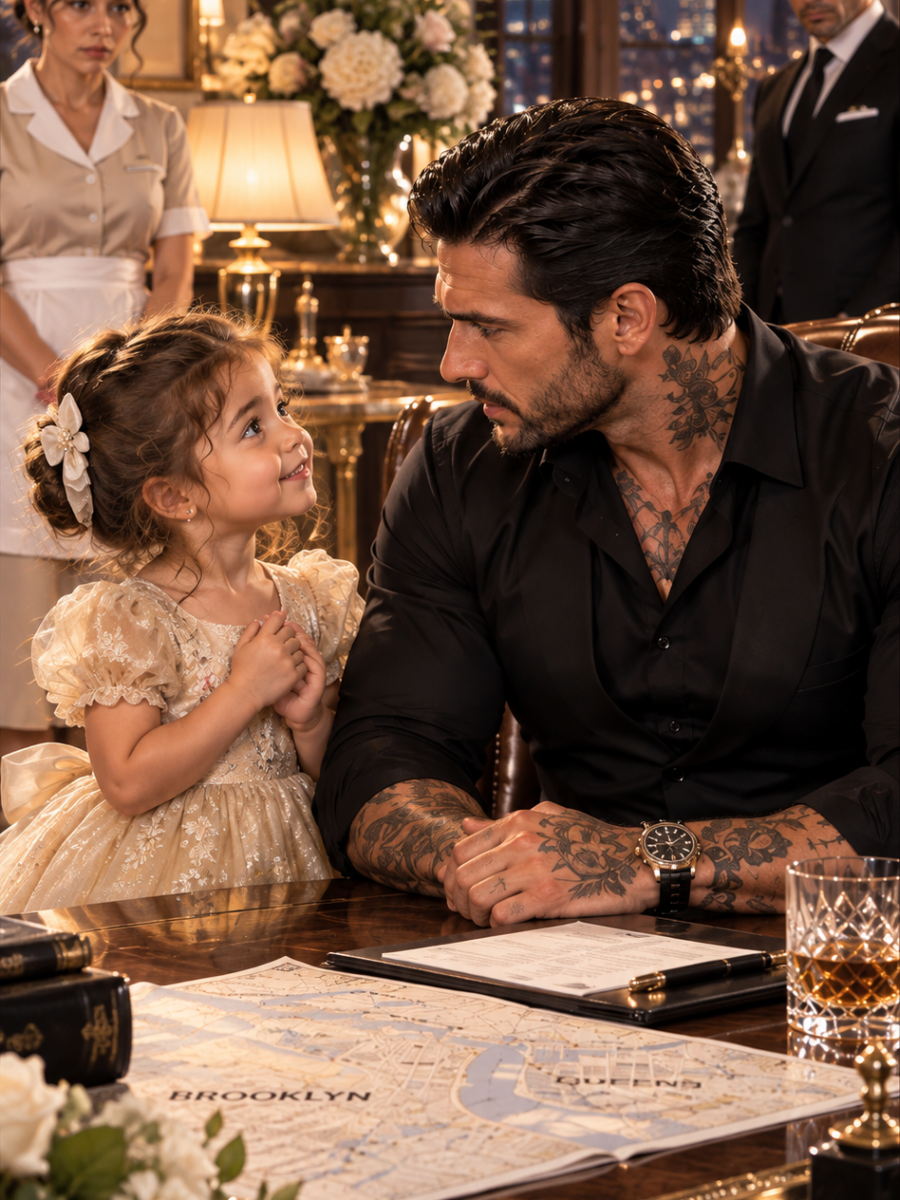
Twelve of New York’s most dangerous men had spent the night deciding which city blocks would burn before dawn. Maps of Brooklyn and Queens covered the walnut table, a loaded pistol rested on black velvet, and cigar smoke drifted beneath the crystal chandelier. But at the head of the table sat Aleandro Moretti, whose name alone cleared five-star restaurants. When a three-year-old girl in a yellow dress stepped out of the shadows with a purple crayon and asked to borrow him for preschool Family Day, the empire froze—and a silent ten-year betrayal began to unfold.
Chapter One
The Purple Crayon on Black Velvet
Twelve of New York’s most dangerous men went utterly, terrifyingly silent.
Minutes earlier, the temperature in the private executive boardroom of the Moretti penthouse had hovered near a boiling point. Tactical blueprints of cargo terminals across Brooklyn and Queens covered the thirty-foot walnut table. A custom semi-automatic pistol rested flat against a square of midnight-black velvet beside an open ledger. Thick rings of Havana cigar smoke drifted upward into the facets of the Austrian crystal chandelier.
At the head of it all sat Aleandro Moretti. Broad-shouldered, thirty-six years old, draped in a charcoal bespoke three-piece suit that fit with military severity, Aleandro was the undisputed sovereign of New York’s waterfronts. His voice alone had made district attorneys drop indictments; his mere presence in a Manhattan restaurant was known to prompt diners to leave cash on their tables and quietly exit through the side doors.
Now, standing right beside his velvet gun mat, was a three-year-old girl.
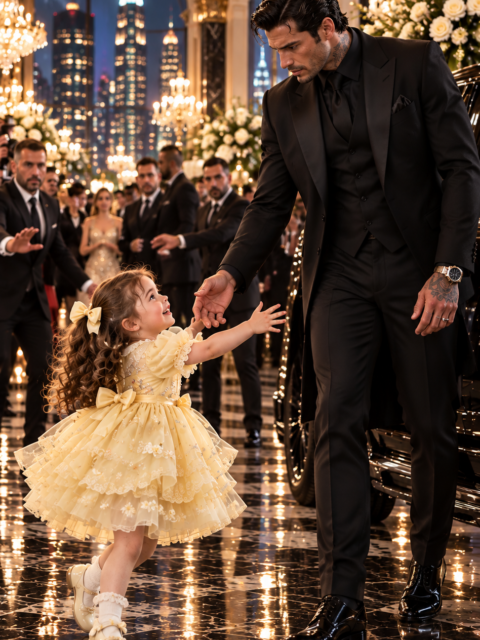
She wore a bright sunflower-yellow sundress over a white short-sleeved shirt, her scuffed Mary Jane shoes barely peeking from the hem. In her tiny, round fist, she clutched a blunt purple crayon. Her large, chocolate-brown eyes took in the room without an ounce of fear, blinking against the haze of tobacco smoke.
Every lieutenant at the table held his breath, waiting for Aleandro’s legendary wrath to erupt. A stray dog that barked outside his gates was relocated; a maid who dropped a teacup was dismissed before sunset.
Instead, Aleandro slowly raised a single forefinger.
The reaction was instantaneous. Without a single word spoken, twelve hardened mobsters pushed back from the table. Chairs were lifted by their armrests to avoid scraping against the parquet floor. Maps were rolled, ledgers snapped shut, folders scooped into leather cases. Within eight seconds, the room had evaporated of men.
Marco Ricci, Aleandro’s loyal underboss and closest confidant for ten years, was the last to leave. At the double mahogany doorway, Marco paused, his gaze flicking back toward the small girl for half a second.
Half a second. Nothing more. But Aleandro’s gray, predatory eyes caught the microscopic calculation in his lieutenant’s expression.
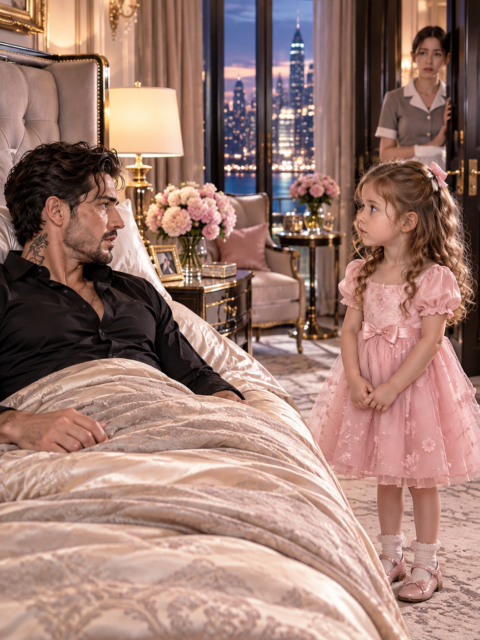
Then the pantry door banged open, and Maria Alvarez rushed into the room, gasping for air. Pale as chalk, trembling violently in her gray maid’s uniform, she dropped to her knees on the polished wood.
“Mr. Moretti, forgive me!” Maria wept, her voice trembling in terror. “My sister’s sitter canceled at the last minute—I swear I told Sophia to stay in the laundry room with her coloring books! I will pack our things and leave immediately, sir!”
Aleandro said nothing. His gaze had shifted.
Sophia had already pulled herself onto the heavy leather armchair directly opposite him, and with calm, serious strokes, was drawing a smiling face on the black velvet right beside his loaded pistol.
Chapter Two
The Family Day Agreement
Aleandro leaned his elbows on the polished walnut, steepling his scarred fingers beneath his chin.
“What is your name?” he asked, his deep baritone rumbling through the quiet room.
“Sophia,” the little girl answered, completing the purple smiley face with two round dots for eyes. She blew away a flake of wax crayon from the velvet, totally unbothered by the deadly firearm resting six inches away.
“And why,” Aleandro asked, his gray eyes fixing upon her with an intensity that had broken rival capos, “do you want to borrow me?”
Maria remained on her knees, covering her mouth in desperate terror. “Sir, please, she doesn’t know what she is saying—”
“I do know,” Sophia announced, cutting her mother off with sovereign childhood authority. She set the purple crayon down on the table, folded her tiny hands neatly over her lap, and looked directly into Aleandro’s face.
“Tomorrow is Family Day at my preschool,” she explained, her voice carrying the solemn cadence of a supreme court judge. “All the other boys and girls are bringing their daddy or their grandpa. My daddy went to heaven when the leaves were green last year. So Mama told me this morning that maybe I should stay home and help her fold towels.”
Maria squeezed her eyes shut, a hot tear escaping down her pale cheek. Eight months earlier, Miguel Alvarez had collapsed from a sudden, fatal heart attack at thirty-four years old on a construction scaffolding. That evening, little Sophia had waited by their cramped apartment window until midnight, clutching a crayon drawing for a father who would never walk through the door again.
Aleandro looked at the kneeling mother, then back at the three-year-old girl in the sunflower dress.
“So you want me?” Aleandro murmured.
“For one whole day,” Sophia said firmly. “You look like you know how to be in charge of things. Nobody will tell you that we can’t come in.”
Maria gasped softly in the background. Men who controlled maritime unions, concrete syndicates, international shipping terminals, and political wards had failed to make Aleandro Moretti pause for breath. Yet this tiny girl in yellow had him completely speechless.
“And what does this day require?” Aleandro asked, a subtle, unreadable twitch stirring at the corner of his chiseled jaw.
“First, we go to my school,” Sophia counted on her small fingers. “We sit on the little red rug and sing the greeting song. Then we go to the park by the fountain. You push me on the big yellow swing until my toes touch the sky. And then… strawberry ice cream. Two scoops. Mama says we don’t have dollars for ice cream this week, but you look like you have dollars.”
Aleandro stared at her. “One day. School. Park. Swings. Strawberry ice cream.”
Sophia nodded, her brown curls bouncing with serious approval.
“And normal clothes,” she added firmly. “The other daddies don’t wear funeral suits.”
Chapter Three
No Funeral Suits
Aleandro turned his head toward the heavy double doors of the boardroom. “Marco.”
The mahogany panel swung open instantly. Marco Ricci stepped through the threshold, a leather-bound planner in hand, a gold pen uncapped, wearing the exact same respectful, loyal smile he had displayed beside Aleandro for a decade.
“Yes, Boss?” Marco asked smoothly.
“Clear my schedule tomorrow,” Aleandro ordered in a flat, uncompromising tone. “Cancel the morning meeting with the waterfront delegates. Push the Queens logistics sit-down to Thursday.”
Marco’s gold pen froze in mid-air. For the briefest fraction of a second, his polished mask slipped. “All of it, Boss? The Falcone family is expecting our answer on the Brooklyn warehouse transfer by noon tomorrow. If you don’t show, they might interpret it as—”
“I don’t care what they interpret,” Aleandro replied, his voice dropping into that terrifying, icy quiet that brooked no debate. “Clear the calendar. All of it.”
Marco swallowed hard, nodding quickly. “Understood, Boss. I’ll handle the notifications.” He turned and walked out, his steps brisk and deliberate.
Aleandro stood from his leather chair. He looked at Maria, who was still kneeling on the floor, shaking. “Get up, Maria. Go help your daughter wash her hands. And make sure she is ready by eight o’clock tomorrow morning.”
At 7:45 A.M. the following morning, the private elevator of the penthouse opened into the marble foyer.
Maria stood holding Sophia’s hand, both of them frozen in stunned disbelief. Standing before them was Aleandro Moretti—completely transformed. The tailored charcoal three-piece suit, the silk necktie, and the gold cufflinks were gone. In their place, Aleandro wore dark denim trousers, clean leather boots, and a soft, dark-navy cashmere sweater with the sleeves pushed up his forearms.
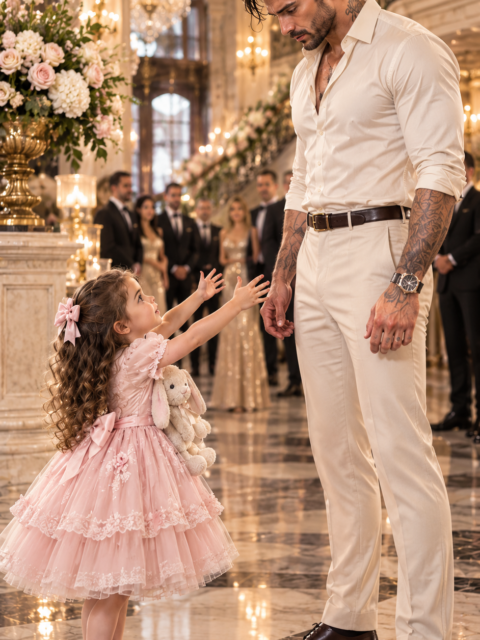
Sophia clapped her hands together with immense, joyful satisfaction. “You look like a real daddy now!”
Aleandro crouched down, an uncharacteristic, genuine smile softening his scarred cheek. He held out his large, calloused hand. “Shall we go, Lady Sophia?”
Sophia slipped her tiny fingers into his palm, completely unaware of the black sedan lingering across the street with tinted windows rolled down two inches.
Chapter Four
The Swing That Touched the Sky
St. Jude’s Early Learning Center on 14th Street was buzzing with the chaotic, joyful energy of thirty preschoolers and their parents.
When Aleandro walked through the door carrying Sophia on his shoulders, an unnatural ripple of silence parted the room. He was six-foot-three, broad-shouldered, radiating an unmistakable aura of command that even casual knitwear could not entirely mask. Bankers, attorneys, and accountants instinctively pulled back their shoulders and cleared their throats.
Sophia, however, beamed with radiant pride. “That’s my Mr. Aleandro! He is in charge of things!”
For two hours, the most feared syndicate lord in the Tri-State area sat cross-legged on a circular braided rug. He helped Sophia glue macaroni onto paper plates. He listened solemnly to the alphabet song. When a rambunctious five-year-old accidentally knocked over Sophia’s cup of orange juice, Aleandro simply wiped the table with a paper napkin, gently patting the boy’s shoulder: “Accidents happen, young man. Watch your perimeter.”
By noon, they had arrived at Madison Square Park.
The autumn sun broke through the golden maple canopies, warming the breeze. In the playground, Aleandro placed Sophia onto the high yellow swing. He pulled the rubber seat back and gave a steady, rhythmic push.
“Higher!” Sophia shrieked with delighted laughter, her yellow sundress fluttering in the wind. “Higher, Mr. Aleandro! I want to touch the sky!”
Aleandro pushed her gently, higher and higher, watching her joyous, innocent face. In that moment, the endless bloodshed, the cold ledgers, the paranoia of thirty-six years melted away. He felt a sudden, sharp ache in his chest—a realization of how much humanity he had traded away for an empire of shadows.
Then they walked to the artisan ice cream parlor on the corner. Aleandro placed a crisp hundred-dollar bill on the counter, ordering a waffle cone piled high with two enormous scoops of fresh strawberry ice cream with rainbow sprinkles.
Sophia sat on a green park bench, happily dabbing ice cream all over her chin. “This is the best day of my whole life,” she announced, offering him a spoonful. “You can have a taste, Mister.”
Aleandro took the tiny spoonful, the sweet strawberry flavor shockingly vivid. But as he looked past her curls toward the perimeter of the park, his eyes turned to flint.
Two men in dark windbreakers were standing beside the park fountain, pretending to read newspapers while speaking into concealed earpieces.
Chapter Five
The Silence in the Penthouse
Aleandro did not panic. He did not rush. A master of urban warfare knows that sudden movement triggers an ambush.
He lifted Sophia into his arms, using a linen handkerchief to gently clean the melted strawberry cream from her cheeks. “Time to go home, little bird. Mama is waiting.”
He bypassed the main street, cutting through the marble lobby of a five-star hotel where his personal driver, Cassian, had been discreetly instructed to position an armored SUV in the underground bay. Within fifteen minutes, they had slipped through Manhattan traffic, entering the private subterranean elevator of the Moretti penthouse.
When the elevator doors opened directly into the foyer, the stillness of the penthouse was unnatural.
Usually, the hum of the laundry machines, the scent of lavender floor wax, and Maria’s soft humming filled the corridors. Today, the penthouse was as cold and silent as a crypt.
“Mama?” Sophia called out, running ahead into the kitchen. “Mama, look! I had two scoops of strawberry!”
The kitchen was empty. On the granite island sat an overturned laundry basket, fresh white towels spilled across the floor. Beside them lay Maria’s silver crucifix necklace—the broken chain glinting under the recessed lights.
Aleandro swept into the room, scooping Sophia into his left arm before she could reach the fallen necklace. His jaw tightened until the bone showed white through his skin. He set Sophia inside his private, reinforced library, locking the bulletproof steel door behind her.
“Stay here, Sophia. Watch your cartoons. I will bring Mama back in ten minutes.”
He walked back into the living room. On the glass coffee table, pinned beneath a familiar gold fountain pen, was a handwritten note.
“Pier 42. Warehouse Seven. Come alone without your funeral suit, Aleandro… or the girl will have no mother to come home to.”
Chapter Six
The Shadow of Ten Years
The handwriting on the note was unmistakable: it was the neat, slanted script of Marco Ricci.
Aleandro picked up the gold pen. Ten years. For a decade, Marco had sat beside him at every banquet, vetted every bodyguard, signed every shipping manifest. When Aleandro had suffered two bullet wounds in an ambush six years ago, Marco had dragged him out of the alleyway and stayed by his hospital bed for three days.
Or so Aleandro had believed. Now, the puzzle clicked together with terrifying precision. The ambush six years ago had been orchestrated to clear Marco’s path to leadership. And yesterday, when Aleandro cleared his entire schedule for a three-year-old child, Marco had seen the ultimate opportunity: Aleandro unarmed, isolated, distracted by sentiment, leaving the penthouse unguarded.
Marco hadn’t just allied with the Falcone family; he had promised them Aleandro’s empire by midnight.
Aleandro walked into his master dressing suite. He opened the concealed floor safe beneath his wardrobe. He pulled out a black tactical vest, strapping it tightly over his navy cashmere sweater. He slid two customized silenced semi-automatic pistols into his shoulder holsters, checking the magazines with a single, sharp snap.
His satellite phone chimed. It was Cassian.
“Boss,” Cassian’s voice came over the encrypted frequency. “We intercepted the Falcone syndicate communications. Marco has sixteen mercenaries stationed at Pier 42. He told Falcone that you went soft over a housekeeper’s daughter, and that tonight the Moretti throne belongs to him.”
Aleandro looked in the mirror. In his dark navy sweater, he did not look like an unfeeling ghost anymore. He looked like a father whose sanctuary had been violated.
“Assemble the outer guard,” Aleandro commanded, his voice vibrating with absolute doom. “Surround Pier 42. But do not fire a single shot until I walk through the door.”
Chapter Seven
The Trap at Pier 42
Pier 42 was a rusting industrial relic jutting into the East River, surrounded by oily black water and driving autumn fog.
Inside Warehouse Seven, the harsh glare of halogen work lamps illuminated stacks of rusted shipping containers. In the center of the concrete floor, tied to a heavy wooden chair, was Maria Alvarez. Her lip was split, her uniform torn, but her eyes held fierce, maternal defiance.
Standing before her was Marco Ricci, dressed in an expensive black wool overcoat, holding a glass of Scotch. Flanking him were six armed mercenaries with assault rifles.
“You picked the wrong boss to serve, Maria,” Marco sneered, checking his gold wristwatch. “Aleandro was a titan once. Today, he’s cross-legged on a kindergarten rug eating strawberry ice cream. A man who goes soft over a child doesn’t deserve to rule New York.”
The heavy iron sliding doors of the warehouse groaned as they were kicked off their rollers with concussive force.
The fog rolled across the concrete floor. Out of the mist walked Aleandro Moretti.
He was alone. He wore no suit. His dark navy sweater was dark with rain. His gray eyes were fixed on Marco with a stillness that froze the mercenaries in their tracks.
Marco took half a step backward, his glass rattling. “Aleandro… you actually came. Alone.”
“I came for what belongs to my house, Marco,” Aleandro said, his voice quiet, echoing off the corrugated steel ceiling like rolling thunder.
“Your house is finished!” Marco screamed, drawing his weapon. “Shoot him! Take him down!”
Not a single rifle fired.
From the shadows of the high catwalks above, red laser sights flickered to life. Thirty elite marksmen of the Moretti inner guard stepped into the light, their weapons aimed squarely at Marco and his mercenaries.
Cassian stepped from behind a container, holding the contract Marco had drafted with the Falcone family. “The Falcones just surrendered their shipping permits to us fifteen minutes ago, Marco. They traded your head for their lives.”
Marco dropped his gun, his knees buckling under him. “Aleandro… please… ten years! We built this together!”
Aleandro walked past the trembling traitor without even looking at him. He drew his pocket knife and sliced the ropes binding Maria’s wrists, lifting her gently to her feet.
“Ten years,” Aleandro murmured to Marco over his shoulder. “And you never learned that a man is never more dangerous than when he has a family to protect.”
Chapter Eight
More Than Just One Day
Marco Ricci was handed over to federal prosecutors alongside thirty years of unredacted evidence, his name erased from New York’s history forever.
By 9:00 P.M., the rain had stopped. A warm, clear night settled over Fifth Avenue as the elevator opened back into the Moretti penthouse. Maria, her bruised face cleaned and bandaged by the estate physician, walked into the living room, her eyes welling with tears.
Aleandro unlocked the heavy library door.
Sitting on the leather sofa, fast asleep with a cartoon playing on the screen, was little Sophia. Tucked under her arm was her purple crayon, and beside her was a drawing of three figures: a mommy, a little girl in yellow, and a tall man in a navy sweater.
Maria rushed forward, dropping to her knees and burying her face in Sophia’s curls, weeping with overwhelming gratitude. “My baby… my sweet baby…”
Sophia woke up, blinking sleepily. She saw her mother and threw her arms around Maria’s neck. “Mama! You’re home! Mr. Aleandro and I had strawberry ice cream!”
Aleandro stood in the doorway, leaning against the walnut frame, watching the reunion with a warmth in his chest that no empire or billion-dollar contract had ever given him.
Maria looked up, her voice trembling. “Mr. Moretti… how can I ever thank you? We have nothing to repay you with.”
Aleandro walked over, crouching beside them on the Persian rug. He reached into his pocket and placed the black velvet mat on the coffee table—the one where Sophia had drawn the smiling purple face beside his gun.
“You already paid me, Maria,” Aleandro said softly, looking from the mother into the little girl’s bright, sleepy eyes. “Sophia borrowed me for one day. But I find I don’t want the lease to expire.”
Sophia clapped her hands together, smiling brightly. “Does that mean you can be my daddy tomorrow too?”
Aleandro looked at Maria, whose cheeks flushed with a soft, radiant warmth. He took Maria’s hand, then Sophia’s, holding both within his broad, protective grip.
“Tomorrow,” Aleandro smiled—a real, brilliant smile that New York had never seen before. “And every day after that.”
The city of New York still feared the name Aleandro Moretti. But inside the penthouse high above Fifth Avenue, the king had finally found the only title that truly mattered: a father.