“You Did It! You Laughed.” My 3-Year-Old Made Connecticut’s Most Feared Mafia Boss Laugh — Then She Opened Her Purse
Adrian Cole hadn’t laughed since his younger brother died. Then a three-year-old in his black silk tie made him laugh in front of twenty-seven frozen witnesses, and the sound turned Clara’s blood cold, because Nora was copying a dead man Clara had loved. Inside a plastic purse, beneath crayons and a crushed cookie, lay the one object that could expose everything, including the truth about how James Cole really died. Read every chapter to find out who Adrian avenged, and whether he got the right men.
The Tie
“You did it!” My three-year-old daughter pointed at Adrian Cole as twenty-seven people stood frozen around us. “You laughed.”
Everyone thought Nora had somehow amused Connecticut’s most feared mafia boss. But I knew why Adrian’s laugh had turned my blood cold. My daughter was copying the dead man whose child I had secretly raised for nearly four years.
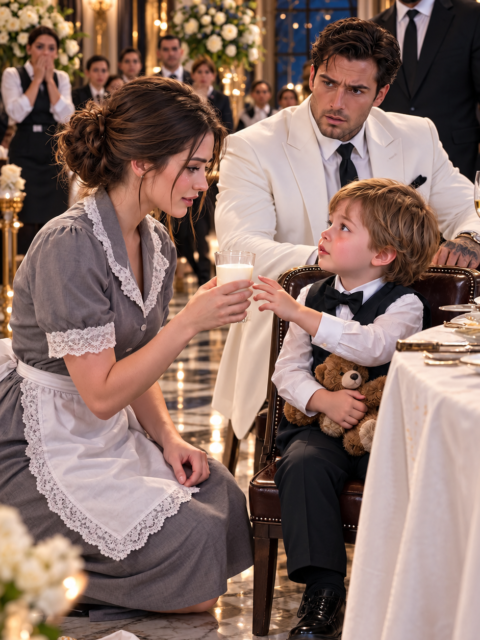
That morning, I was polishing a crystal vase near the breakfast room when Nora appeared at the bottom of Adrian’s sweeping white staircase. She wore a yellow cardigan. One of Adrian’s black silk ties hung almost to her knees. A plastic purse was tucked beneath her arm like a businessman’s briefcase. Nora glanced dramatically at her bare wrist, lifted a toy phone to her ear, and lowered her voice. “Handle it.”
Every guard looked up. Then she marched toward the front doors using Adrian’s slow, commanding stride. Three steps later, she tripped over the tie. Nora stood again, straightened it with ridiculous dignity, and muttered: “Unbelievable.”
Adrian laughed. Just once. Low. Rough. Genuine. One of his armed men actually turned around in shock. Mrs. Holloway stopped speaking. My fingers tightened around the vase. Adrian Cole hadn’t laughed since his younger brother died. And when he leaned back, revealing that familiar crease beside his left eye, I suddenly saw James.
Four years earlier, James Cole had stood outside a Boston coffee shop laughing after I told him his overpriced espresso tasted like expensive mud. He had Adrian’s blood. The same dark eyes. The same stubborn confidence. But none of Adrian’s darkness. Then James died. His car went off a rain-slicked road outside Boston. Police called it an accident. People close to Adrian whispered otherwise. Adrian buried his only brother on Tuesday. By Wednesday night, three men connected to a rival family had vanished. Nobody asked questions.
“You did it!” Nora repeated. Adrian’s laughter disappeared. His eyes settled on her. “Did what?” “You laughed.” Silence swallowed the room.
At thirty-eight, Adrian controlled an empire respectable newspapers described as logistics and private security. Everyone else knew better. Trucks moved when Adrian permitted them to move. Men disappeared when Adrian decided they knew too much. Yet Nora stood directly in front of him without fear. For weeks, she had copied him. His walk. His expressions. The way he adjusted his cuff before giving an order. Everyone found it adorable. I found it terrifying. Because some of those habits weren’t Adrian’s. They belonged to James.
Adrian slowly crouched in front of her. My heart nearly stopped. James used to crouch exactly that way when speaking to children. Adrian glanced at Nora’s plastic purse. “What’s in the briefcase, sweetheart?” Nora smiled. “A secret.” My breath caught. She tightened her tiny fingers around the handle. “Nora,” I said quickly. “Come help Mommy.” Too late. She opened the purse.
Adrian’s entire body went still. Inside, beneath crayons and a crushed cookie, lay an old silver pocket watch. James’s pocket watch. I had hidden it for years. Adrian picked it up with trembling fingers. Then he turned it over. The initials J.C. were engraved on the back. His eyes slowly lifted toward me. “Where did my brother’s watch come from?”
Nobody moved. Then Nora answered for me. “My daddy gave it to Mommy.” The room seemed to tilt. Adrian stared at Nora. Then at me. Then back at the little girl whose eyes looked painfully like his brother’s. His voice dropped to a whisper. “Clara…” I couldn’t breathe.
“How old is she?”
Three and a Half
“Not here,” I said. My voice came out steadier than I felt. “Please. Not in front of everyone.”
Adrian looked at the twenty-seven people in the front hall: guards, staff, two men from the trucking division waiting for their morning briefing. Every one of them was staring at the pocket watch in his hand. He closed his fingers around it.
“Out,” he said, not loudly. “All of you. Tomas, take the front door. Nobody comes back in until I say.”
The room emptied in under a minute. Mrs. Holloway, seventy years old and unafraid of anyone, squeezed my shoulder as she passed, hard enough to hurt. Nora, in her enormous tie, watched them go with interest. “Where’s everybody going?”
“Sweetheart,” I said, “will you sit on the stairs and color for a little while? Mommy needs to talk to Mr. Cole.”
She looked at Adrian, considered him, and made up her mind. “Okay. But you have to say please. Mommy says please is important.”
Adrian, who had never in his life been told what to say in his own house, said quietly, “Please.”
Nora settled on the third step with a crayon and her toy phone. I took Adrian into the breakfast room, closed the door halfway so she could see me through the gap, and stood with my back against the wall because my knees had stopped working.
“Three and a half,” I said. “She turned three in the spring. Her birthday is April ninth.”
I watched him count. It didn’t take him long. Four years since the funeral. Nine months before that would place the beginning of her in a week he had missed, a week in which his younger brother had been happier than Adrian had ever seen him, and hadn’t explained why.
“James knew,” Adrian said slowly. It wasn’t a question. “Did he know she existed?” And I said the sentence I had rehearsed a thousand times in the dark, the one I had never once managed to say aloud. “No. He died eleven days before I found out I was pregnant.”
James
I told him everything, because I was too tired to do anything else.
I had met James Cole outside a coffee shop on Newbury Street, the espresso comment and the laughter and the immediate, entirely inconvenient feeling that I had met someone I would still be thinking about at ninety. I was a paralegal then, in a small firm that handled estate work. He told me he worked for the family business. He was vague about it in the way of men who are trying to be honest without frightening you.
It took me two months to understand what the family business was. It took him another month to tell me he was trying to leave it.
“He wasn’t like you,” I told Adrian. “He hated it. Not you. He never once said a word against you. But the rest of it, the things men did in your name, the accounts he had to look at. He said he wanted a life where his name was something he could say out loud.”
Adrian sat in the breakfast room chair with the pocket watch in both hands. He did not interrupt. He did not move. In the whole time I had worked for him, I had never seen him listen so completely.
“Two weeks before he died, he gave me the watch,” I said. “Your father’s. He said if anything ever happened, I should keep it, and that I would know what to do with it. I thought he was being dramatic. I laughed at him.” My throat closed. “Then it rained on a Thursday night.”
“They told me it was the road,” Adrian said. His voice was very quiet.
“They told everyone. There were skid marks, a guardrail. A rainy night, a fast car. The police closed it in three days.” I looked at him directly. “And then Wednesday, three men vanished.”
Adrian’s face did not change. But his hands, on the watch, went white at the knuckles.
“That’s why I never came to you,” I said. “I didn’t know who killed him. I didn’t know whether the people who did might come for a child they didn’t know existed, or whether you would. When the week after the funeral turned into what it turned into, I understood that I was pregnant with James’s daughter, in a city where his brother’s name made people disappear. So I ran.”
Why I Took the Job
“Then why are you here?” Adrian asked. “In my house. Polishing my vases.”
It was the question I had been dreading, and also the one I most wanted him to ask.
“Because I didn’t believe it was an accident,” I said. “Not then. Not now. James drove that road every week for years. He’d never have lost control of that car. And the more I thought about what he told me in those last weeks, the less I believed the story.”
“What did he tell you?”
“That he’d found something in the books. That someone in the organization had been moving money that wasn’t yours to move. He said he was going to bring it to you, and then he was going to leave.” I pressed my hands flat against my thighs. “He said he was afraid you wouldn’t believe him. Because whoever it was, you trusted them.”
Adrian was very still. “Who?”
“He didn’t say. He said he wanted proof first. He said he’d left it somewhere safe.” I met his eyes. “I took a job at your estate eight months ago, under my mother’s maiden name. I told myself it was to look for anything James might have hidden. To listen. To see who came and went. But the truth is, I wanted my daughter to know her family. Even if she didn’t know that’s what they were.”
“She’s been copying my brother,” Adrian said, and it sounded like a man discovering the ground under him had a basement. “The walk. The way I fix my cuff. It isn’t mine. It’s his.”
“Some of it,” I said. “The rest is yours. She has both of you in her. I couldn’t stop it. I didn’t want to.”
He looked down at the watch, and his thumb moved to the engraved initials. “Show me what my brother thought you’d know how to do with this.”
“I never knew how to open it,” I admitted. “I’ve tried for four years. It won’t open. But Nora, last week, pressed her thumb on the back and it clicked. I only found out this morning, when I saw her holding it.” I took a breath. “Adrian. I think there’s something inside the case.”
What Was Behind the Watch
The back plate lifted off with a soft metallic breath. Beneath it, behind the movement, folded into a square no larger than a postage stamp, was a piece of thin, yellowed paper.
Adrian unfolded it with great care. His brother’s handwriting, small and slanted, ran across it in three lines.
If you are reading this, I couldn’t tell you myself. The proof is in a box at Fairfield Savings, Norwalk branch, in the name of Nora Bell. The key is in Mama’s music box. Don’t trust V.M. I’m sorry. I love you.
Adrian read it once. He read it again. Then he set it down on the table between us with the kind of exaggerated gentleness men use when they are afraid their hands will break something.
“Nora Bell,” I said. “That’s her name. That’s what he wrote.”
“My brother,” Adrian said hoarsely, “named a box after a daughter he never knew he had.”
“He didn’t know. Nora Bell was his mother’s maiden name.” I realized my own face was wet. “He must have picked it because it was safe. She doesn’t exist on paper, not under that name. Nobody would ever look.”
Adrian rose slowly. He walked to the window and stood with his back to me, looking out over the frost-covered lawn. I understood, watching his shoulders, that he was fighting something enormous.
“V.M.,” he said at last. “Victor Marchetti.”
I said nothing. Victor Marchetti had been Adrian’s consigliere for eleven years. He was the man who stood at Adrian’s right hand at every meeting, who had helped bury his father, who had sat beside Adrian at James’s funeral and cried real tears. He was also, at that very moment, on the other side of the front door, waiting to be let back in.
The Box in Norwalk
Adrian did not go to the bank himself, and he did not send any of his own men. He asked me whom I trusted, and when I couldn’t answer, he called a lawyer he hadn’t spoken to in six years, an attorney named Ruth Halloran who had once spent a year trying to indict him and now had no reason to protect him.
“I want this done properly,” Adrian told her, on the phone, in a voice I hadn’t heard from him before. “Chain of custody. Federal witnesses. I don’t want a single one of my people within a mile of this.”
The safe-deposit box, opened three days later at the Norwalk branch under a court order and in the presence of two federal agents, contained a battered black ledger, two flash drives, a stack of photocopied bank transfers, and a small cassette recorder that still worked.
The ledger was in James’s handwriting. It documented, over eighteen months, transfers totaling more than four million dollars from the Cole organization’s legitimate accounts into shell companies owned by Victor Marchetti. Alongside it, the recordings captured Marchetti’s voice speaking to an unidentified man. Adrian, listening through headphones in Ruth’s office, went perfectly still at the third sentence.
“The younger one found the books,” Marchetti’s voice said. “He’s going to the brother on Friday. It has to look like an accident.”
The unidentified man asked a question. Marchetti answered it. “Brake line. The Ferraro name is convenient. Adrian will do the rest. He always does.”
Adrian took off the headphones. His hands were steady, but his face had gone the color of old paper.
“The Ferraros,” he said, very softly. “Wednesday night. The three men.”
Ruth Halloran, who had spent her career watching men receive terrible news, said nothing at all. And Adrian Cole, who had built an empire on never showing anyone what he was thinking, put both his hands over his face.
Three Men on a Wednesday
I did not comfort him. I want to be honest about that. I sat across the table in Ruth’s office and watched a man learn that he had spent four years avenging his brother on people who hadn’t killed him, and I felt sorrow, and anger, and a hard clear line between the two.
“Those men had families,” I said.
“Yes.”
“Nothing you do now brings them back.”
“No.” Adrian lowered his hands. His eyes were red and quite steady. “I’m not going to ask you to forgive me, Clara. I don’t have the right. I want you to know that I know what I did, and that I will answer for it.”
“To whom?”
He glanced at Ruth. “To whoever the law says. I’m going to need a very good lawyer, and I’m going to need her to tell me what I can and can’t say.” A pause. “I’m not going to hide behind anyone. Not behind my name. Not behind my brother’s daughter.”
Ruth stirred. “Mr. Cole. As your counsel, I have to advise you that this is not a decision to be made in a single afternoon.”
“I understand.” He looked at her, and then at me. “But I’m making it in one afternoon anyway. Because if I wait, I’ll talk myself out of it. That’s what I’ve done for twenty years.”
Ruth exhaled. “Then let’s do it right.”
They did. Over the next six weeks, Adrian Cole met with federal prosecutors and state investigators. He surrendered the ledger and the recordings, provided testimony about Marchetti’s embezzlement and the conspiracy to murder James Cole, and, through counsel, negotiated the terms of his own cooperation regarding the deaths of the three Ferraro associates.
I did not ask what those terms were. He did not volunteer them. But I noticed that he took down the portrait of his father from the front hall.
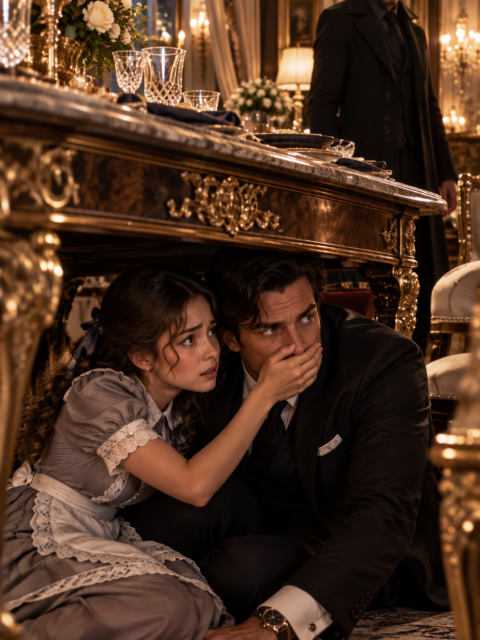
And I noticed something else. Three weeks after the box was opened, Victor Marchetti came to the estate for what should have been an ordinary meeting, and instead found four federal agents waiting in the front hall.
Victor Marchetti
I watched it from the top of the staircase, holding Nora against my hip with a hand over her ear, in the same spot where she had stood in Adrian’s tie three weeks earlier.
Victor Marchetti was sixty-one, silver-haired, immaculately dressed, with the gentle face of a man who had comforted widows for a living. He took in the agents, and then Adrian standing beside them, and I saw him do the arithmetic. It took less than a second.
“Adrian,” he said, with perfect calm. “Whatever you’ve been told—”
“I heard your voice,” Adrian said. “On a cassette. Saying brake line. Saying the Ferraro name was convenient.”
Marchetti’s composure did not break. It simply retreated, the way water retreats from a shoreline before something much larger arrives. “James was going to destroy this family.”
“James was going to save it.”
“Your brother,” Marchetti said, and for the first time, contempt entered his voice, “was a sentimental fool who wanted to hand this entire empire to the federal government on a silver plate. I did what your father would have done.”
“My father would have asked me first,” Adrian said, very quietly. “That is the only difference between him and you. And it’s the only reason I’m still standing here.”
The agents stepped forward. Marchetti did not resist. He straightened his cuffs, once, with the small precise motion of a man dressing for an appointment, and turned to Adrian one last time. “You’ll regret this.”
“I regret everything,” Adrian said. “Take him.”
They did. The front doors opened, and the morning light fell across the marble, and Nora, who had been watching with the solemn attention she gave to everything, whispered into my neck, “Is he a bad man, Mama?”
“Yes,” I said, honestly. “But he can’t hurt anybody anymore.” Nora considered this, then lifted her head and looked down the staircase at the man in the black suit standing alone in the front hall, and said, in a clear, ringing voice that filled the room: “Uncle Adrian? Are you sad?”
The Crease Beside His Left Eye
Marchetti was convicted eleven months later on charges of conspiracy to commit murder, racketeering, and embezzlement. He was sentenced to life.
Adrian’s own reckoning took longer, and was less tidy. He pleaded guilty to charges connected to the Ferraro associates’ deaths, and the sentence he accepted was a serious one. Ruth Halloran told me, afterward, that she had never in her career seen a client insist on a harsher term than the prosecutors had offered. “He kept saying it wasn’t enough,” she said. “I don’t think it ever will be, to him.”
Before he surrendered to the court, he made three requests of me. He did not ask for forgiveness. He asked for something much smaller.
“I’d like Nora to know she had a father who loved her mother,” he said, “even though he never got to meet her. And I’d like her to know his name.”
“She will,” I said. “Every year. On his birthday. We’ll go to his grave, and I’ll tell her about the espresso.”
“And,” Adrian said, and hesitated, which I had learned was very rare, “I’d like to write to her. Not now. When she’s older. Just letters. Whatever she wants to read, or never read.”
I thought about it for a long time. “Yes,” I said. “As long as they’re honest.”
The trust he set up for Nora was administered by Ruth, with instructions that no money came from anything unlawful, and that Nora would have full control of it at twenty-five. I did not touch it. I went back to paralegal work, at a firm two towns over that handled estates, and Nora and I built a small, quiet, ordinary life.
She still copies people. Yesterday, she mimicked the mailman so well that the mailman laughed. But every once in a while, when she thinks no one is watching, she crouches to speak to a smaller child, a slow, gentle, unhurried crouch that belongs to no one alive.
And on a spring afternoon, three years into Adrian’s sentence, I brought her to visit him for the first time. She marched through the visiting room in her yellow cardigan, sat down across the table, and said, with great authority, “Hello, Uncle Adrian. I’ve been practicing.”
“Practicing what?” he asked.
She adjusted an invisible cuff. Then she grinned. And Adrian Cole laughed, low and rough and completely unguarded, with the crease beside his left eye deep as a signature. Nora looked at me across the table, delighted, and mouthed the words she had said that first morning, the words that had cracked open four years of silence.
You did it.