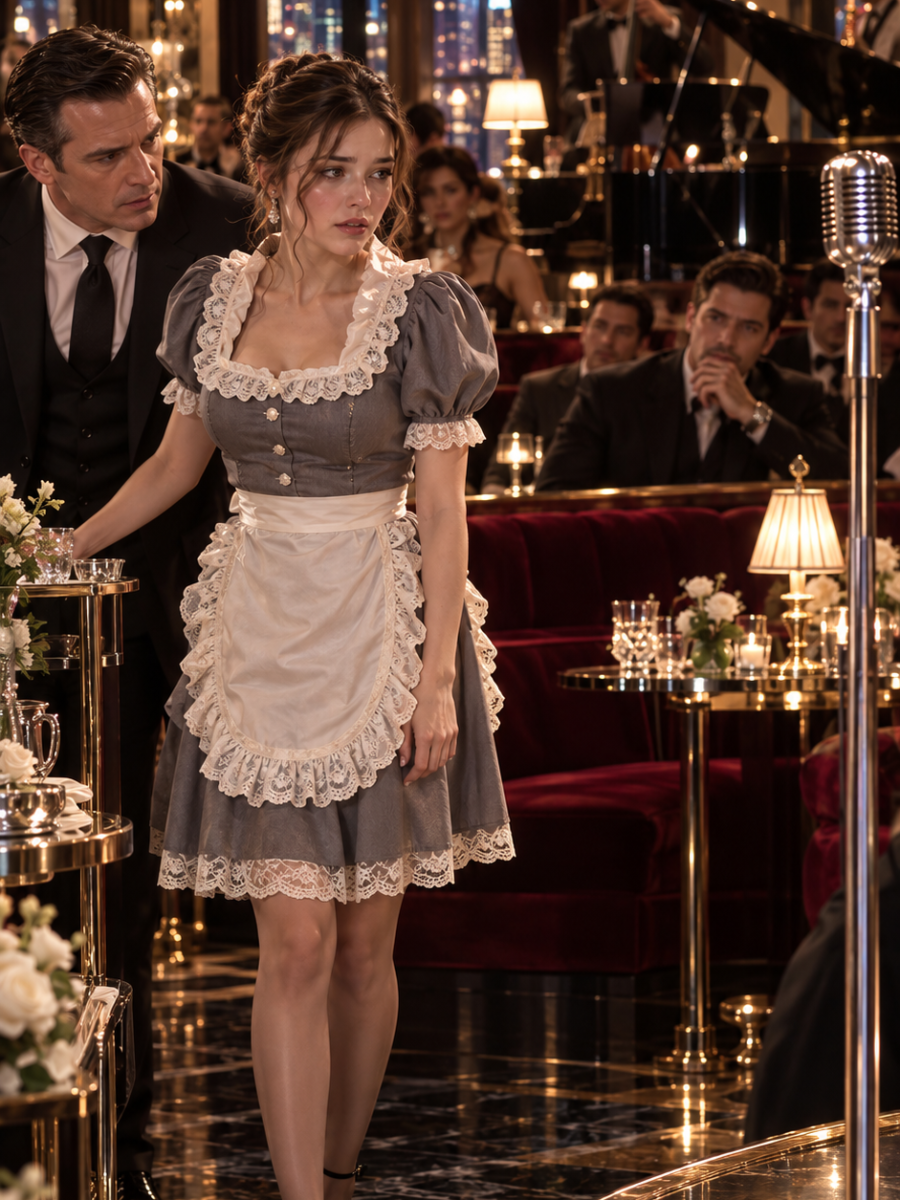
“Please Don’t Make Me Sing Tonight.” The Club Maid Warned Her Boss — Then the Mafia Kingpin Stood Up for the First Time in Three Years
The One Thing I Fear
“Please don’t make me sing tonight.”
The whisper was barely louder than the clinking of cut-crystal tumblers, but across the dimly lit velvet expanse of Booth One, my pale hazel eyes caught the tension in her small frame. Sienna Holloway gripped the heavy silver serving tray so tightly her knuckles were translucent against the metal, her dark hair pinned into an immaculate, defensive bun.
Her manager, Phillip Hastings, wiped a sheet of cold sweat from his forehead. “You can sing? You’ve been scrubbing private dining suites for eight months, Sienna!”
Sienna’s gaze flicked sideways, crossing the amber glow of the lamps toward my table. “Yes,” she whispered, her throat moving with a dry swallow. “But if I sing, everyone in this room may discover the one thing Lorenzo Bianchi fears most.”
For exactly 1,095 days, I had not smiled.
Not once.
My name is Lorenzo Bianchi. To the Chicago Police Department, I was an untouchable real estate titan; to the underworld that operated beneath River North’s iron bridges, I was the butcher who dismantled Miami’s Navarro cartel cell by cell. Three years earlier, there had still been a sliver of warmth beneath my bespoke charcoal suits and cold authority. Sophia Romano had been responsible for that. She was an architect, a gentle civilian whose sketches of sunlit libraries and vaulted ceilings had made me believe, for one fleeting year, that a monster could build a normal life.
Then someone learned where my heart was buried.
On a sweltering July evening, a car bomb meant for my armor-plated Mercedes detonated outside an Italian bistro on Michigan Avenue. I had stepped back inside to retrieve Sophia’s forgotten silk shawl. That thirty-second detour saved my life. The shockwave blew out every plate-glass window for three blocks. Sophia died in the fireball before her body touched the asphalt.
Whatever was human in me died with her.
Today was the third anniversary of her funeral. I had spent two solitary hours at her private white marble mausoleum in Graceland Cemetery, placing a single white magnolia on the carved granite, before coming to the Velvet Note. Tucked into the basement of an unassuming River North commercial high-rise, this supper club was where politicians exchanged handshakes with men whose tailored coats concealed suppressed automatics.
I sat in Booth One. My twenty-five-year-old Macallan remained untouched. Beside me sat my underboss, Matthew Rossi, and two stone-faced bodyguards. My eyes were fixed on the empty stage, where a vintage brass Shure microphone stood lonely beneath an amber spotlight.
Manager Phillip was having a nervous breakdown. The world-renowned jazz chanteuse booked from New York had just been clipped in a multi-car pileup on the Kennedy Expressway. She was in the trauma bay, the supper club was packed with fifty powerful men who had paid five thousand dollars a table, and everyone in River North understood one immutable law: you do not disappoint Lorenzo Bianchi on the anniversary of Sophia Romano’s death.
“What do you mean she can’t perform?” Phillip hissed into his cell phone. “Lorenzo Bianchi is sitting twenty feet away!”
Sienna took a slow, trembling breath. At twenty-four, she was slender, wearing the plain black uniform of the service staff. She had moved from New Orleans eight months ago to pay for her younger brother’s experimental chemotherapy at Northwestern Memorial Hospital, burying herself under twelve-hour shifts.
She slowly set the silver tray on the side table.
“What are you doing, girl?” Phillip stammered.
Sienna didn’t answer him. Her eyes lifted, crossing the smoky haze of the club, and locked directly onto mine. For three seconds, nobody moved. The air between Booth One and the kitchen pantry turned brittle as spun glass.
I set my glass down on the mahogany table with a quiet clink.
Sienna took one step forward. Her worn oxfords carried her across the Persian runner, her fingers trembling as she walked toward the raised mahogany stage. And for the first time in 1,095 days, I leaned forward in my seat.
She took the brass microphone in both hands, closed her eyes, and as the piano player struck a hesitant introductory chord, the first three notes she sang hit my chest like a hollow-point bullet.
↑ Back to Chapter 1
The Melody From Graceland
It was a low, smoky, melancholic blues—a melody that had never been recorded in a studio, never pressed onto vinyl, and never performed on a public stage in the history of music.
It was “Whispers in the Magnolia.”
The song Sophia Romano used to hum in the dark on our private balcony overlooking the Chicago River while she leaned her head against my bare shoulder. A song she told me her grandmother in the Louisiana bayou had taught her when she was six years old. A song she swore belonged to only two living souls on this earth: herself and me.
Sienna’s voice was velvet, laced with a raw, aching sorrow that paralyzed the entire room. Conversations ceased mid-sentence. Fork tines froze halfway to open mouths. Politicians put down their cigars. The piano player, an old veteran of the South Side clubs, instinctively fell into the mournful tempo, his chords wrapping around her voice like a warm, dark coat in an October storm.
“Lay your head upon the cypress branch, my darling…
The river knows the debts you cannot pay…
When the night is colder than the stone that bears your name…
Love will find the shadow where you lay…”
Beside me in Booth One, underboss Matthew Rossi dropped his gold lighter. The metal clattered loudly against the table, but Matthew didn’t pick it up. His face had turned a sickening, waxen gray, his eyes bulging as he stared at the young woman on the stage.
I didn’t notice Matthew. The blood was roaring in my ears so violently the chandeliers seemed to sway. I pushed my chair back with a scrape that sounded like tearing sheet metal. My bodyguards reached to stand, but I shoved them back into the leather cushions with a single jerk of my forearm.
I walked slowly down the center aisle, six feet three inches of terrifying focus, my gaze never leaving the singer’s face. Two hundred people parted before me as though I were a walking firestorm. I stopped at the foot of the stage, right beneath the golden spotlight.
Sienna opened her eyes. They were dark amber, framed by thick lashes, and filled with tears that caught the stage light like diamonds. She finished the final lyric on a soft, dying vibrato that left the room in breathless, reverent silence.
Nobody applauded. Nobody dared.
“Where did you learn that song?” I asked. My voice wasn’t loud, but it carried the weight of an executioner’s bell.
Sienna looked down at me from the stage. Her chin trembled, but her eyes held a steady, defiant courage that reminded me of someone I had buried three years ago.
“Sophia taught me,” she whispered.
I reached out, wrapped my fingers around her wrist, and pulled her off the stage toward the private VIP corridor: “Into my office. Now.”
↑ Back to Chapter 2
The Silver Locket of New Orleans
The heavy soundproof oak door of my private greenroom clicked shut, cutting off the murmur of the club. I released her wrist immediately. Sienna rubbed the red mark my grip had left on her skin, backing up against the wall beside a framed vintage poster of Miles Davis.
My hand reached into my jacket, my thumb hovering near the walnut grip of my custom Beretta. “Sophia Romano had no surviving family. Her parents died in an apartment fire in Biloxi when she was twelve. She grew up in a state orphanage. I had my intelligence network run three separate forensic audits on her life before I proposed. Who the hell are you?”
Sienna took a ragged breath. Her hands were shaking so hard she could barely unbutton the top two buttons of her black serving collar. She reached beneath the fabric and pulled out a tarnished silver chain. Hanging from it was a circular locket engraved with a small magnolia blossom.
She snapped the clasp open with her thumbnail and held it out toward me.
I took the metal into my palm. Inside was a tiny, faded color photograph: Sophia at sixteen, laughing in a sunlit garden in New Orleans, holding a six-year-old little girl with messy chestnut braids and the exact same amber eyes.
“I’m her half-sister,” Sienna whispered, tears finally escaping and running down her pale cheeks. “Our mother had me with a jazz musician from the French Quarter after Sophia was put into the system. When Sophia turned twenty-two and started her architectural career in Chicago, she found me. She paid for my schooling. She sent money to New Orleans every single month so our younger brother, Leo, and I could have an apartment.”
My breath hitched in my chest. “Why didn’t she tell me? I was her fiancé. I would have bought you a mansion on the Gulf Coast!”
“Because she knew who you were, Lorenzo!” Sienna cried out softly, her voice thick with agonizing conviction. “Sophia loved you with every fiber of her soul. She spent nights crying on the phone with me, telling me that you were a good man trapped in a terrible world. But she also knew that if your rivals ever found out she had a family, we would become targets. She kept us hidden in Louisiana to keep us alive!”
The room seemed to shrink. All the cold, calculating logic of my empire dissolved into bitter, burning regret. Sophia had carried that burden alone—protecting her sister and brother from the shadow of my name, never asking for a single dime of my millions.
“Why are you in Chicago, Sienna?” I choked out, my fingers curling tightly around the silver locket.
“Leo,” she sobbed, burying her face in her hands. “He’s ten years old. He has acute lymphoblastic leukemia. Northwestern Memorial had the only clinical trial that could save him. I moved here eight months ago. I’ve been working sixteen-hour days between the laundry and the club to pay the forty-thousand-dollar copays. Tonight… the singer didn’t show up. I saw your face from the pantry, Lorenzo. You looked like a dead man walking. Sophia always told me: ‘If Lorenzo ever loses himself in the dark, that song will remind him that he has a soul.’”
A hot tear slipped down my face, burning against the scar on my cheekbone. For three years, I had believed that love was a weakness that had destroyed my world. But standing before me was a girl risking everything, scrubbing floors in secret, just to keep her brother alive—carrying the exact same selfless courage that had drawn me to Sophia.
The door behind us suddenly clicked open, and Matthew Rossi stepped into the greenroom with a chrome automatic drawn: “Step away from the boss, girl.”
↑ Back to Chapter 3
The Traitor in Booth One
I didn’t move my body, but my hand shifted inside my overcoat. “Lower the gun, Matthew.”
Matthew’s eyes darted frantically between me and Sienna. His forehead was soaked in perspiration, his breathing fast and shallow beneath his silk tie. “Boss, she’s a plant! The Navarro cartel used women before! How do we know she isn’t here to finish what they started three years ago? Let me take her down to the basement and interrogate her—’
“I said lower the gun,” I repeated, my voice dropping into the freezing register that signaled an execution. “You don’t draw steel in my presence without an order.”
Matthew hesitated, his jaw working as if chewing on broken glass, before slowly decocking the hammer and returning the weapon to his shoulder holster. “I was only thinking of your safety, Lorenzo.”
“Leave us,” I commanded. “Wait at Booth One.”
Matthew backed out through the heavy oak door, his eyes lingering on Sienna with a venomous terror that my subconscious mind immediately cataloged. In twenty years of mob warfare, I had learned to read fear in every dialect. Matthew wasn’t afraid that Sienna was an assassin. Matthew was terrified of what Sienna knew.
I turned back to Sienna. She was shivering, clutching her apron.
“Sienna,” I said quietly. “When Sophia was in Chicago… did she ever speak about Matthew Rossi?”
Sienna wiped her tears, her eyes narrowing as she searched her memory. “She… she told me once, two weeks before the explosion, that she didn’t trust your underboss. She said she was designing a private summer estate for you in Lake Geneva, and she found a secondary set of architectural blueprints inside Matthew’s office. Blueprints of your penthouse security vault and your private garage on Michigan Avenue.”
My blood turned into liquid nitrogen.
Three years ago, the bomb had been planted inside the chassis of my Mercedes inside a secure underground garage that required a biometric keycard to enter. At the time, Matthew had claimed that the Navarro cartel had bribed a corrupt night mechanic. We executed the mechanic forty-eight hours later without asking questions.
“Did she leave any documents?” I demanded, stepping closer.
“She gave me a sealed yellow envelope on the night of our last phone call,” Sienna said, her voice trembling. “She said: ‘If anything ever happens to me, Sienna, don’t open this unless Lorenzo comes to you with the magnolia song.’ I have it in my locker downstairs.”
I pulled my phone from my pocket and dialed my chief cyber-intelligence specialist: “Freeze Matthew Rossi’s accounts, tap his vehicle GPS, and put four snipers on the alley exits. We have a rat in the house.”
↑ Back to Chapter 4
The Guard at Northwestern
We took the service elevator down to the basement locker rooms. From behind a vent in locker number fourteen, Sienna retrieved a thick manila envelope sealed with red electrical tape. Inside lay Sophia’s handwritten journal, along with two flash drives containing cloned bank manifests from the Navarro cartel’s offshore holding accounts in Grand Cayman.
My eyes scanned the account numbers. On July 12th—two days before the car bomb—a wire transfer of three million dollars had moved from Navarro’s shell corporation into an anonymous trust in Zurich.
The beneficiary account code was MR-CHICAGO-09.
Matthew Rossi.
The man who had stood beside me at Sophia’s funeral, weeping crocodile tears, was the very man who had sold the garage access codes and tipped off the Navarro hit squad so he could take over the Chicago syndicate once I was dead. When the bomb killed Sophia instead of me, Matthew had feigned undying loyalty, urging me to wipe out the Navarro family so the only witnesses to his betrayal would be permanently erased.
“He killed her,” I whispered, the words tearing from my throat like broken glass. “He sat at my table for three years while he murdered the only light I ever had.”
Sienna grabbed my sleeve, her face pale. “Lorenzo… my brother. If Matthew realizes what I’ve told you—’
“Leo is protected,” I said immediately. I pulled out my phone and dialed Dr. Keller, head of pediatric oncology at Northwestern Memorial. “Dr. Keller. This is Lorenzo Bianchi. Patient Leo Holloway in Room 412. Settle every invoice in full from my private foundation account. Upgrade him to the VIP private suite on the ninth floor, and place eight of my personal tactical security officers outside his door. If anyone not on my authorized list steps within fifty feet of that boy, shoot them.”
“Right away, Mr. Bianchi,” Keller answered without hesitation.
I looked down at Sienna. She was staring at me in complete disbelief, her chest heaving with silent, overwhelming relief. “You… you paid his entire treatment?”
“Your brother will receive the finest medical care on the eastern seaboard,” I vowed, handing the silver locket back to her palm and closing her fingers over the metal. “You kept Sophia’s memory alive when I was too dead to breathe. Now it’s my turn to protect her family.”
I turned toward the steel stairs leading back up to the supper club.
“Stay in the greenroom with two of my men, Sienna,” I ordered quietly. “It’s time to settle the final bill of Michigan Avenue.”
I racked the slide of my Beretta, adjusted my cuffs, and walked back up the stairs toward Booth One with an executioner’s calm.
↑ Back to Chapter 5
The Voice of Judgment
When I returned to the main hall of the Velvet Note, the club was still buzzing with whispered conversations about the maid’s performance. Matthew Rossi sat in Booth One, swirling his scotch with a manicured hand, trying to appear relaxed despite the sweat glistening on his collar.
“Everything handled with the girl, boss?” Matthew asked, leaning forward with a conspiratorial smirk. “Did you have her dismissed?”
“No,” I replied, taking my seat opposite him. “She’s performing an encore.”
Matthew’s smile faltered. “An encore? Lorenzo, this is an exclusive venue. We have the deputy mayor at table four. We can’t have kitchen maids parading around—’
“I own the building, Matthew,” I said softly. “I decide who sings.”
I raised my right hand. At my signal, the club’s heavy iron security shutters slammed shut over the street windows with a series of deafening metallic booms: CLANG! CLANG! CLANG! The heavy oak double doors locked with the hum of magnetic deadbolts. The guests gasped, several politicians rising in panic, but thirty of my armed soldiers stepped out from behind the velvet curtains, submachine guns resting casually at their chests.
“Nobody leaves,” I announced into the quiet room. “A private family matter has just come to light.”
Sienna walked back onto the stage, dressed not in her uniform, but in an elegant black trench coat I had provided. She stepped to the brass microphone, her chin held high.
Instead of music, the club’s master sound system crackled to life with an audio recording recovered from the Navarro cartel’s decrypted servers. The voice of Navarro’s chief lieutenant boomed through the speakers:
“Account MR-CHICAGO-09 confirmed. Three million transferred to Zurich. When will the Mercedes be parked at the bistro?”
Then came the reply. A familiar, oily voice that every man in the room recognized instantly:
“Eight-thirty sharp on July 14th. Make sure the blast is large enough that nothing walks away. Once Lorenzo is ash, the Chicago territory belongs to me.”
The entire supper club exploded into horrified murmurs. Matthew Rossi’s face turned the color of chalk. His scotch glass slipped from his fingers, shattering across the mahogany table.
In a flash of cornered desperation, Matthew reached for his shoulder holster, his gun clearing the leather. But I was already moving. I crossed the booth table in an explosion of motion, my left hand catching his gun wrist and slamming it against the solid oak with bone-snapping force.
The weapon dropped. Matthew screamed in agony as I hauled him out of the booth by his silk lapels, dragging him into the center aisle beneath the crystal chandeliers, and threw him to the floor at the foot of the stage.
“Three million dollars, Matthew?” I whispered, standing over him like an avenging demon. “You sold Sophia’s life for three million dollars?”
“Lorenzo… please! They forced me! The cartel threatened my family!” Matthew sobbed, clutching his broken wrist on the floor.
“You have no family,” I said coldly. I looked at the elder capos sitting in the surrounding booths. “Don Corleone. Don Falcone. You have heard the recording. What is the sentence for treason?”
The eldest Don from the West Side stood up, his face carved of stone. “Treason against the Don is death. Strip his holdings. Let justice be done.”
My bodyguards dragged Matthew Rossi out through the loading dock doors into the rain, and for the first time in three years, the ghost that had haunted my chest finally stopped screaming.
↑ Back to Chapter 6
White Magnolias on the Hill
By dawn the following morning, Matthew Rossi’s syndicate assets had been seized, liquidated, and transferred into an irrevocable trust supporting pediatric cancer research across Illinois. The corrupt remnants of the Navarro conspiracy were completely eradicated.
The autumn sun rose clear and golden over Chicago, burning away the mist along Lake Michigan. My black town car drove through the iron gates of Graceland Cemetery, climbing the gentle, tree-lined hill toward Sophia’s private marble mausoleum.
I walked up the stone steps, holding a bouquet of fresh white magnolias flown in from New Orleans that morning. Beside me walked Sienna, wearing a simple woolen coat, and walking between us, holding both of our hands, was ten-year-old Leo.
The boy’s color was returning, the new medical protocol having already begun to halt his leukemia’s progress. He wore a warm Chicago Cubs knit cap over his thinned hair, his amber eyes wide with wonder as he looked at the grand neoclassical mausoleum.
We stepped inside the cool, quiet marble chamber. The morning light filtered through the stained-glass window, casting shades of rose and azure across Sophia’s carved name.
I knelt before the crypt, placing the magnolias at the base of the stone. For three years, this room had been a prison of self-loathing, a place where I came to drown in the unbearable guilt of having survived while she died in flames.
“Sophia,” I whispered, touching the cool granite. “I know the truth now. The man who hurt you will never walk beneath the sun again. And your brother and sister are safe. I swear on my life, they will never know fear again.”
Leo stepped forward, placing a small hand on the carved stone beside my flowers. “Thank you, big sister,” he said softly, a tear tracing his cheek. “Your prince took care of us, just like you promised.”
Sienna stood behind me, resting her hand gently upon my shoulder. Her touch was warm, real, and completely devoid of fear. I stood up and turned toward her. In her amber eyes, I saw not only the echo of Sophia’s love, but the beginning of something new—a light that refused to let the darkness win.
“You brought me back from the grave, Sienna,” I said softly.
“Sophia did,” she smiled through her tears, slipping her hand into mine. “She just used my voice to find you.”
We walked out into the morning sunshine, and as the cemetery gates closed behind us, I felt the crushing iron band around my ribs shatter into pure, radiant warmth.
↑ Back to Chapter 7
The Velvet Melody
Six months later, on a brisk Friday in April, the Velvet Note had been completely reborn.
The backroom deals, the concealed weapons, and the dark underworld debts had been purged from the club forever. I had bought out the venue, renovated the acoustics, and transformed it into River North’s premier jazz sanctuary, with fifty percent of all annual proceeds permanently dedicated to the Sophia Romano Memorial Cancer Fund.
The club was packed to capacity with genuine music lovers, artists, and families. The air smelled of wood smoke, roasted espresso, and fresh gardenias.
Sitting in Booth One—the very booth where I had sat in frozen grief six months ago—was ten-year-old Leo. His hair had grown back thick and dark, his cheeks were rosy, and his doctors had officially declared his leukemia in full molecular remission. He wore a sharp little navy blazer, grinning as he sipped an ice-cream soda and tapped his feet to the music.
The house lights dimmed to an intimate amber glow.
The piano player struck the opening chords, and Sienna stepped onto the stage. She was breathtaking. She wore an emerald satin gown that caught the golden light, her dark hair cascading down her shoulders in elegant waves. She took the brass microphone in both hands, her amber eyes sweeping the crowd before settling, with undeniable warmth, on Booth One.
She began to sing. Not a song of grief or revenge, but a vibrant, soaring jazz ballad full of hope, freedom, and love. Her voice filled every corner of the room, lifting the spirits of every soul inside.
I stood at the back of the room, leaning against the polished mahogany bar in a simple tailored suit. For twenty years, I had believed that power was measured in fear, that survival meant turning one’s heart into stone.
As Sienna finished her final note to thunderous, standing applause, she looked across the sea of cheering patrons directly into my eyes.
She raised her glass toward me from the stage, her lips forming a silent thank you.
I caught her gaze. And slowly, effortlessly, the hard lines around my mouth softened. The cold gray in my hazel eyes dissolved into genuine light.
For the first time in 1,275 days, Lorenzo Bianchi smiled.
She laughed with pure, radiant joy, and as the music swelled around us, I knew that the darkness had finally lost—and our song was just beginning.
↑ Back to Chapter 8