My Daughter Wandered Into a Sealed Room in a Mafia Boss’s Mansion — Then He Found His Dead Wife’s Locket Around Her Neck
Claire Bennett brought her daughter to work rather than leave her without care for a single unavoidable night. Nora followed a stray cat through a forbidden door and found Adrian Kane sitting alone in his dead wife’s bedroom, sealed and untouched for three years. When he noticed the silver locket around the sleeping child’s neck — one that had only ever belonged to his late wife Isabella — he opened it and found a photograph that shouldn’t have existed, and four words in his wife’s handwriting that changed everything he understood about the last three years of his life. Read every chapter to find out who Nora really is, and why Claire never told him.
The Oak Door
“Mama, why are you so sad?” Claire Bennett looked at her three-year-old daughter and realized she had no good answer.
The preschool had closed unexpectedly. Every babysitter she called had failed her. And today, of all days, every employee at the Kane estate had been ordered to work until midnight. So Claire made the only choice she had. She brought Nora with her.
At the estate, Claire created a little nest in the servants’ room with warm milk, cookies, colored pencils, Nora’s stuffed rabbit, and her favorite book. Then she knelt before her. “Three rules, baby. Stay in this room. Never wander into the main house. And never, ever go near the big oak door upstairs.” Nora solemnly offered her pinky. “I promise, Mama.” Claire kissed her forehead. Neither knew it was their last ordinary moment.
By late morning, Nora had finished coloring and grown restless. Then she spotted a white cat through the window. Snow. Nora had secretly named the stray weeks earlier. When Snow disappeared toward the mansion, Nora remembered her promise. But she also imagined her little friend alone in the cold. Three-year-old hearts don’t always understand dangerous rules. So Nora followed.
Across the courtyard. Through an unlatched side door. Past portraits of stern men. Up the staircase Claire had forbidden her to climb. At the end of the second-floor corridor stood the enormous oak door. It was slightly open. Snow slipped inside. Nora followed.
She didn’t know guards had once been ordered to shoot anyone who crossed that threshold. She didn’t know the room had remained sealed for three years. And she certainly didn’t know it had belonged to the dead wife of Adrian Kane, the most feared mafia boss in the city.
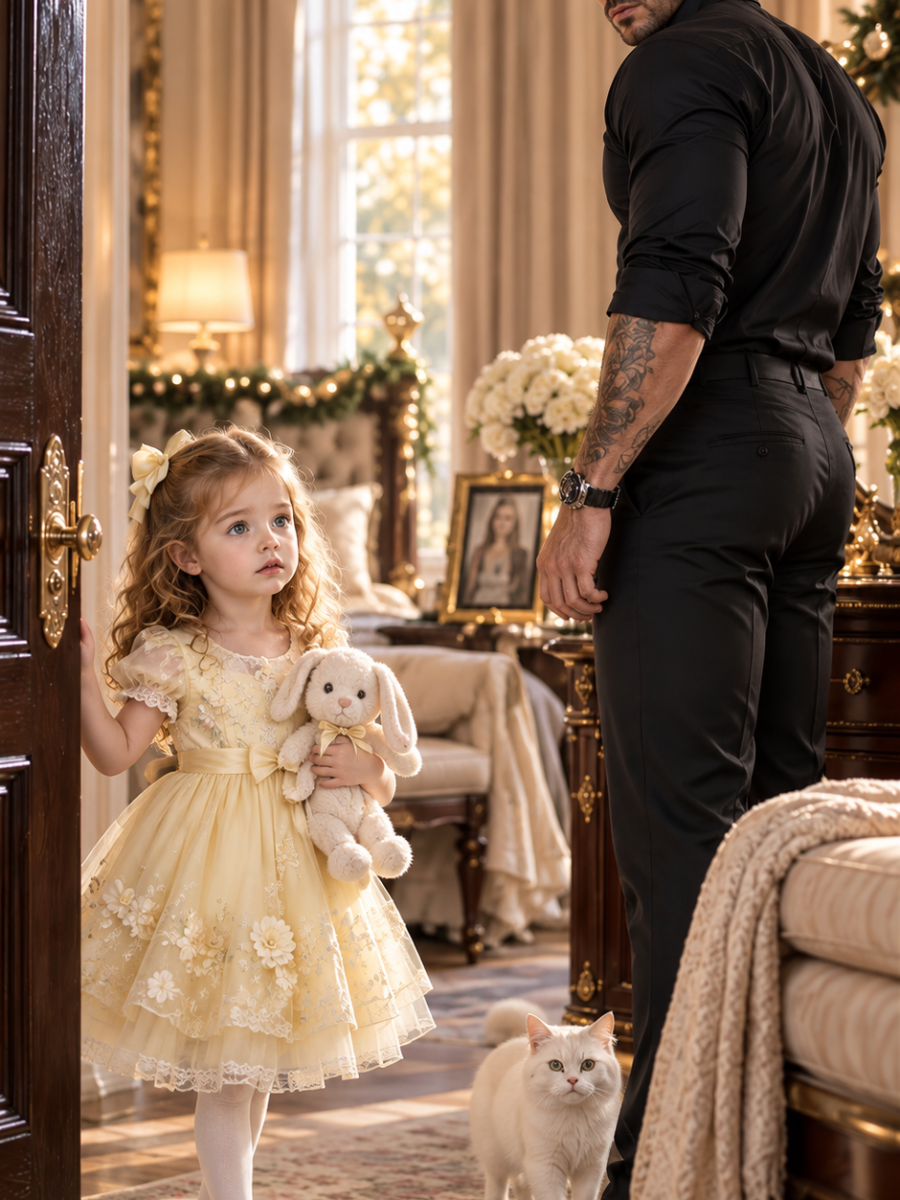
Inside, everything remained untouched. A woman’s perfume bottles. A book left open beside the bed. Photographs turned facedown. And sitting in the darkness was Adrian Kane himself.
Nora should have screamed. Instead, she looked at the lonely man and asked, “Are you waiting for somebody?” Adrian slowly raised his head. Nobody had spoken to him inside this room for three years. Before he could answer, Nora climbed beside him, dragging a blanket over both of them. “You look cold.”
Minutes later, the guards reached the doorway. Every weapon lowered. Nobody moved. Nora was asleep against Adrian’s chest. And the man they believed had forgotten how to feel was holding her as though letting go might destroy him.
Then Adrian noticed something hanging from Nora’s neck. A tiny silver locket. His breathing stopped. He knew that locket. He had placed it around his wife’s neck on their wedding day. Only one existed.
Adrian’s hand began to tremble. He opened it. Inside was a photograph that should have been impossible. His dead wife was holding a newborn baby. On the back, in her unmistakable handwriting, were four words. HER NAME IS NORA.
The guards watched Adrian slowly turn toward the sleeping child.
Then he whispered the question that would tear the Kane family apart. “Who is your mother?”
Her Name Is Nora
Claire arrived at the sealed room fifteen minutes later, summoned by a frantic guard, her heart nearly stopping at the sight of her daughter curled against Adrian Kane’s chest inside the one room she’d spent three years learning to fear even by reputation.
“Nora!” She rushed forward, and Adrian’s hand rose, not aggressively, but with an authority that stopped her mid-stride.
“She’s safe,” he said, his voice carrying a rawness that seemed entirely at odds with the reputation Claire had absorbed through years of careful, distant employment in his household. “But I need you to explain something to me, Ms. Bennett, and I need the complete truth, immediately.”
He held up the locket, still open, the impossible photograph visible even from where Claire stood frozen in the doorway. Her face drained of color.
“Where did she get this?” Adrian asked, his voice dangerously quiet.
“I gave it to her,” Claire said, her voice barely steady. “Two years ago, on her first birthday. I told her it was a special gift, something precious that belonged to someone who loved her very much.”
“This locket belonged to my wife,” Adrian said. “Isabella. She died three years ago, Ms. Bennett, during a labor complication that also, I was told, cost the life of our child. A daughter. I have grieved both of them every single day since, inside this exact room, believing there was nothing left of either of them beyond photographs and memory.”
Claire’s composure finally, completely broke, tears falling as three years of carefully guarded secrecy collapsed under the weight of an accidental discovery neither she nor anyone else had ever planned for. “I need to explain everything,” she said. “Properly, Mr. Kane. Please. Just — not here, not in front of Nora, if she wakes up in the middle of it.”
Adrian studied her for a long moment, old grief and fresh, overwhelming confusion visible in equal measure across features that Claire had genuinely never seen this exposed in three years of distant, careful employment. “My study,” he said finally. “Now. And Ms. Bennett — I want the complete truth, regardless of how difficult it may be to explain.”
Once Nora had been settled, still sleeping, in the careful watch of Adrian’s own sister, who had arrived within minutes of the guards’ urgent call, Claire followed Adrian to his study with the particular dread of someone about to reveal a secret she’d spent three years believing would never actually need explaining. “I need you to understand something before I tell you anything else,” she said, her voice trembling but resolved. “Nora is your daughter, Mr. Kane. Biologically, completely, in every way that matters. I carried her. I did not create her.”
What Claire Carried
Adrian’s expression carried a devastating, careful hope warring against three years of grief he’d built his entire understanding of loss around. “Explain that,” he said. “Completely.”
“Four years ago,” Claire said, “I answered an advertisement placed through a fertility clinic, seeking a gestational surrogate for a couple struggling with a medical condition that made carrying a pregnancy to term dangerous for the intended mother. I never knew their names at the time — the arrangement was handled entirely through legal representatives and the clinic itself, structured specifically to protect everyone’s privacy given the intended parents’ particular need for discretion.”
“Isabella had a heart condition,” Adrian said slowly, understanding beginning to reorganize itself around this fresh, devastating context. “Her doctors warned her for years that pregnancy could be genuinely dangerous. We discussed surrogacy privately, only between ourselves and her medical team, precisely because Isabella didn’t want anyone — not even our closest family — to know about her condition until we had a healthy child to actually celebrate.”
“The embryo was created using your genetic material and hers,” Claire continued. “I carried the pregnancy to term, delivering Nora at St. Augustine’s Hospital, in a private wing arranged specifically for the necessary confidentiality. Isabella and a doctor I only knew as Dr. Voss were present for the delivery. You weren’t in the room, according to what I was told at the time — apparently attending to urgent business matters that couldn’t be postponed even for the birth itself.”
Adrian’s face went pale with a fresh, horrified recognition. “I was handling an emergency involving a rival family’s incursion into our territory,” he said slowly. “Isabella insisted I attend to it, told me the delivery would proceed smoothly regardless, that she’d call the moment anything actually required my presence. I have spent three years believing that decision, made in a moment I couldn’t have known would matter so catastrophically, cost me both my wife and my daughter in the same devastating hour.”
“Isabella suffered a sudden, severe complication after Nora was born,” Claire said gently, watching grief and fresh understanding move across Adrian’s face in equal measure. “Not during the delivery itself — Nora was born healthy, exactly as planned. It happened perhaps twenty minutes afterward, while Isabella was holding her for the first time, the same photograph you found in that locket. Dr. Voss worked desperately to save her. It wasn’t enough.”
“Then how,” Adrian said, his voice cracking with a fresh, overwhelming grief, “did I come to believe my daughter died alongside her? Who told me that lie, and why has my daughter spent three years being raised by a stranger rather than by her own father?” Claire’s hands trembled as she reached for the answer she’d clearly dreaded delivering since the moment Adrian first opened that locket. “Dr. Voss made a decision that night,” she said quietly, “that I have spent three years believing was the only thing keeping your daughter alive at all.”
The Night Isabella Died
“Explain,” Adrian said, his voice carrying a controlled fury directed not at Claire, but at a decision made three years earlier without his knowledge or consent.
“Dr. Voss came to me directly, within an hour of Isabella’s death,” Claire said. “She was frantic, genuinely terrified, though it took me considerable time afterward to fully understand why. She told me you had arrived at the hospital in a state she described as barely controlled — devastated by Isabella’s death, and already, in that raw first hour of grief, saying things about the rival family incursion that suggested you intended a response considerably more violent and immediate than anything I understood the full scope of.”
“I was not thinking clearly,” Adrian admitted, old shame visible beneath his grief. “I remember very little of those first hours beyond a consuming rage I directed at everyone and everything within reach. I don’t remember what I said to Dr. Voss specifically.”
“She believed,” Claire continued carefully, “that handing you a newborn daughter in that exact state — grieving, furious, apparently already planning retaliation against a dangerous rival organization — put the baby at genuine risk, either through your own instability in that moment, or through exposure to whatever violent response you were planning that might have drawn your enemies’ attention directly toward an infant they could use as leverage against you.”
“So she lied to me,” Adrian said slowly. “Told me my daughter died alongside her mother, rather than trust me with the truth.”
“She told me,” Claire said, “that keeping Nora hidden, at least temporarily, was the only way to guarantee her safety until you’d had time to properly grieve and stabilize. She asked if I would be willing to continue caring for Nora, compensated generously and legally through the same clinic that had arranged the original surrogacy, until she judged it safe to reveal the truth. I agreed, believing at the time it would be a matter of weeks, perhaps a few months at most.”
“Three years,” Adrian said, the number landing with a fresh, devastating weight. “She let this deception continue for three years.”
“I asked her, repeatedly, over the following months,” Claire said, her voice breaking with old, complicated guilt, “when it would be safe to tell you the truth. Each time, she told me the danger from the rival family remained too active, that revealing a living heir would make Nora an immediate target in an ongoing conflict she believed hadn’t yet fully resolved. I want you to understand, Mr. Kane — I never once intended to keep your daughter from you permanently. I believed, every single time Dr. Voss delayed the reveal, that it was genuinely, temporarily necessary. By the time enough years had passed that I began seriously doubting her judgment, Nora was already thriving, already calling me Mama, and I found myself terrified of what disrupting that stability might actually cost her, regardless of how wrong the entire arrangement had become.
Dr. Voss’s Decision
Adrian summoned Dr. Elena Voss to his estate that same evening, the physician arriving with the particular guarded caution of someone who had clearly anticipated, someday, having to answer for a decision she’d made under genuine, well-intentioned pressure that had nonetheless stretched into three years of continued deception.
“I need to understand your reasoning,” Adrian said, his voice carrying a controlled fury that made even his own guards, stationed discreetly nearby, visibly tense. “Completely, from the very beginning, before I decide what consequence this deception actually deserves.”
Dr. Voss’s explanation, delivered with a steadiness that suggested she’d rehearsed this exact conversation many times in her own mind without ever expecting to actually need it, largely confirmed everything Claire had already shared. “I made the initial decision in a moment of genuine crisis,” she said. “You were, by every account available to me that night, barely functional with grief and rage. The rival family’s incursion that same evening had already resulted in violence, and I genuinely believed, incorrectly perhaps, but genuinely, that revealing a newborn daughter in that exact climate created immediate, serious danger.”
“And the following three years?” Adrian pressed. “What justified continuing the deception long after that initial crisis passed?”
“Fear, mostly,” Dr. Voss admitted. “Once the lie had continued for months rather than weeks, I found myself trapped by the scale of what I’d already done. Revealing the truth after six months felt considerably more damaging than revealing it after six weeks might have been. That fear compounded, Mr. Kane, month after month, until three years had somehow passed and I had never found what felt like a safe, appropriate moment to finally undo what I’d started.”
“You stole three years of my daughter’s life from me,” Adrian said, his voice dropping into something considerably more dangerous than his earlier controlled fury. “Three years I can never recover, based on a single crisis decision that you then chose, repeatedly, not to correct.”
Dr. Voss did not attempt to minimize the accusation, accepting it with a grim, resigned acknowledgment that suggested she’d long since made peace with whatever consequence her decision might eventually bring. “I understand if you intend to end my medical license, or pursue whatever legal or personal consequence you believe this deserves,” she said quietly. “I made an impossible decision under genuine crisis, and then compounded it through years of cowardice rather than correction. I don’t believe either explanation fully excuses what it ultimately cost you and Nora both.”
Adrian sat with the full weight of the revelation for a long moment before finally responding, his fury tempered, though not erased, by a colder, more practical consideration. “I’m not interested in destroying your career over a decision I might have made similarly, in your position, faced with a man as unstable as I apparently was that night,” he said slowly. “But I want to understand one final detail before I decide anything else. The rival family incursion you cited as justification — is that threat still active today? Because if revealing Nora’s existence now creates genuine, ongoing danger, I need to understand that immediately, before I decide how publicly to acknowledge my daughter going forward.”
Three Years of Silence
“The rival family that threatened your organization three years ago no longer exists in any meaningful capacity,” Dr. Voss said. “I understand their leadership was fully dismantled within the following eighteen months, through means I wasn’t privy to the details of. Whatever danger justified my original decision ended considerably before I finally worked up the courage to reveal the truth today — which I recognize makes my continued silence over these past eighteen months considerably harder to justify than the initial crisis itself.”
Adrian absorbed this final, damning detail with a controlled stillness that Claire recognized, even in her limited time observing him, as considerably more dangerous than any visible outburst might have been. “So for the last eighteen months at minimum,” he said slowly, “there was no genuine danger justifying my daughter’s continued absence from my life. Simply your own fear of finally admitting what you’d done.”
“Yes,” Dr. Voss said quietly. “I have no adequate defense for that specific failure.”
Adrian’s judgment, delivered after considerable private deliberation over the following days, resulted in Dr. Voss’s permanent removal from any medical role connected to his family or organization, alongside a formal report to the appropriate medical licensing board detailing her conduct — a consequence considerably more measured than his organization’s usual response to betrayal, chosen deliberately, he explained to Claire, because he recognized the original decision had, whatever its costly consequences, been made from genuine if ultimately misguided concern rather than malice.
“I’m not interested in becoming the kind of man who solves every grievance with violence,” he told Claire, during one of the many careful, difficult conversations that followed as they worked to understand exactly how Nora’s life would now be structured going forward. “Isabella would have been horrified by that version of me, and I find I have limited interest in becoming him now, three years after her death, especially not over a decision made in genuine crisis even if poorly maintained afterward.”
Claire, meanwhile, faced her own difficult reckoning — genuine relief that the truth had finally surfaced, tangled with fresh, overwhelming fear about what her own role in Nora’s life might become now that her biological father had not only survived to claim her, but clearly intended to be fully present going forward.
“What happens to me?” she finally asked Adrian directly, during a conversation she’d been dreading since the moment he’d first opened that locket. “To us, I mean — Nora and me. I’ve raised her for three years, Mr. Kane. She calls me Mama. I understand you have every legal and moral right to reclaim your daughter completely now that the truth is known. But I need to understand what that actually means before I lose the only child I have ever loved as completely as my own.”
What Claire Was Afraid Of
Adrian studied her for a long moment, something considerably gentler than his earlier fury settling into his expression as he considered a question he’d apparently been turning over privately since the very first evening. “I’ve thought about this constantly,” he admitted. “You’re not simply a woman who carried my daughter as a medical arrangement, Ms. Bennett. You’ve raised her, loved her, been the only mother she’s ever known for three formative years of her life. I don’t believe severing that bond serves Nora’s actual wellbeing, regardless of what my own grief and fury initially wanted to demand.”
“What are you suggesting?” Claire asked carefully.
“I’d like Nora to live here, with me, permanently,” Adrian said. “I’ve lost three years I can never recover, and I’m not willing to lose any more time as a distant, occasional presence in her life. But I don’t believe that requires removing you from her life entirely. I’d like to offer you a permanent position here — not as household staff, Claire, but as Nora’s mother in every practical sense that matters, living here alongside us, sharing in raising her, formally and completely, for as long as that arrangement genuinely serves her wellbeing.”
The offer, considerably more generous and thoughtful than Claire had allowed herself to hope for during her most anxious imaginings of this exact conversation, still carried a complicated weight she needed time to properly process. “I need to think about what that actually means,” she said. “For Nora, and for myself. Living inside your world, Mr. Kane — the guards, the danger, the reputation that follows you everywhere — that’s a considerably different life than the quiet one I’ve built for her these past three years.”
“I understand,” Adrian said. “And I want to be honest, Claire — I’m working to build something considerably safer and more legitimate than the world I inherited from my own father. It won’t happen overnight, and I won’t pretend the transition is without genuine risk during the process. But I don’t intend for my daughter, or for you, to live inside the same dangerous world that cost Isabella her life.”
Claire took two weeks to consider the offer properly, weeks during which Adrian carefully, patiently built his own relationship with Nora without ever pressuring Claire’s decision, understanding intuitively that rushing this particular reconciliation risked damaging exactly the stability he claimed to want most for his daughter.
“I’ll stay,” Claire told him finally, watching Nora contentedly split her attention between them both during what had become a comfortable, regular evening routine. “Not because I’m afraid of losing her, though I won’t pretend that fear isn’t part of it. I’ll stay because I think Nora deserves both of us, completely, rather than choosing between the mother who carried her and the father who’s spent three years grieving a daughter he never should have lost in the first place.”
The Room, Reopened
The sealed bedroom that had once represented three years of frozen, unprocessed grief was finally, carefully reopened the following spring, its contents respectfully preserved but the space itself transformed into something considerably more alive — a reading nook for Nora, filled with her own books and toys alongside careful, deliberately preserved photographs of the mother she would never remember but would always know completely, through the stories both Adrian and Claire made sure to share regularly.
“This was your first mommy,” Claire told Nora gently, showing her the same photograph from the locket, now properly framed rather than hidden away in secretive concealment. “She loved you so much, sweetheart, even though she only got to hold you for a few minutes before she had to go be with the angels.”
“And you’re my mommy now,” Nora said, with the simple, uncomplicated clarity children often bring to circumstances adults spend considerable effort overcomplicating.
“I am,” Claire agreed. “Both things are true at exactly the same time. You’re lucky enough to have two mommies who love you completely, even though only one of us gets to be here with you every day.”
Adrian, watching this exchange from the doorway, felt something in his chest ease that had remained tightly wound since the night Isabella died — not the absence of grief, which he suspected would remain a permanent, quiet companion for the rest of his life, but a genuine, hopeful peace that had felt entirely unreachable for three difficult years.
On what would have been Isabella’s birthday that following month, the small, rebuilt family visited her grave together, Nora carrying a small bouquet of white flowers she’d carefully selected herself, understanding, in whatever way a four-year-old could genuinely grasp such complicated grief, that this quiet ritual mattered considerably to both of the adults who loved her.
“Do you think she’d be happy?” Claire asked quietly, watching Nora carefully arrange her flowers against the headstone. “That things turned out this way, I mean. Complicated, and painful to get here, but ultimately whole.”
Adrian considered the question with the same careful seriousness he now brought to every decision touching his daughter’s life. “I think,” he said slowly, “Isabella would be considerably more grateful than upset that her daughter grew up loved so completely, by two mothers who each gave her exactly what she needed, even if the path getting here was far more painful and complicated than either of us would have ever chosen willingly.”
Nora, finished with her careful arrangement, ran back toward them both, reaching for one of each of their hands with the easy, permanent confidence of a child who had never once, despite everything, doubted that she belonged completely to both the people now walking beside her.