“Go Ahead. Laugh.” A Billionaire Dared the Hotel Maid to Dance for His Five Hundred Guests — Then Her First Turn Silenced the Orchestra, and His Son Went Pale With Fear
I’m Nora Bell, and for twelve years I have been invisible. Tonight, in front of five hundred of Chicago’s wealthiest people, a billionaire dared me to humiliate myself. I danced instead. His son recognized me, and he looked terrified, because he knew exactly why I disappeared. Read every chapter to find out what happened twelve years ago, and what Walter Ashford buried beneath his tower.
Entertain Us
“Go ahead,” I said quietly. “Laugh.”
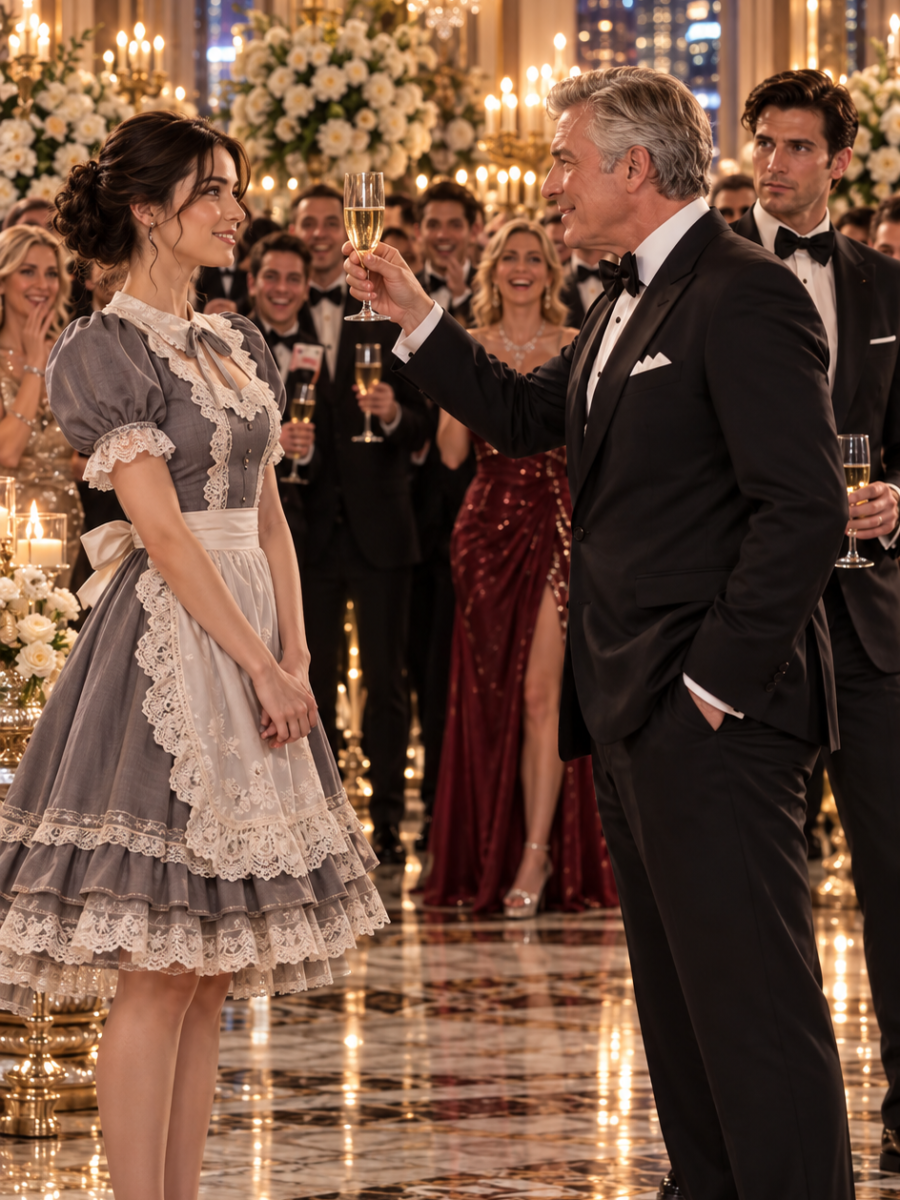
Walter Ashford raised his champagne glass, clearly enjoying himself. “Entertain us.”
Five hundred of Chicago’s wealthiest people turned toward me. I looked down at my black-and-white maid uniform, then back at the billionaire who expected me to humiliate myself for his guests.
“You really want me to dance?”
Walter’s mocking smile widened. “Unless you’re afraid.”
He had no idea what he had just awakened.
It had begun forty minutes earlier, in the service corridor behind the grand ballroom of Ashford Tower. I was carrying a tray of crystal flutes toward the doors when the orchestra started to tune. A single cello note rose through the wall, long and low and aching. And I stopped.
I don’t know why. I had walked past that ballroom a hundred times in the three years I had worked there, and I had learned the trick of hearing music without listening. But that night the cello got into my ribs. My right foot slid half an inch against the floor. My hand lifted off the tray. I did not even notice until a tall, silver-haired man stepped out of the ballroom doors and watched me with amused interest.
“Well,” said Walter Ashford. “Look at the maid. She’s rehearsing.”
I should explain Walter. He was sixty-one, chairman of Ashford Holdings, and the owner of the tower, the hotel inside it, and a quiet share of every other glass building in the Loop. He did not remember my name. He had never needed to. I was one of two hundred uniforms who kept his floors clean and his glasses full, and my name tag read NORA B.
“I’m sorry, sir,” I murmured. “I was just—”
“Dancing. I saw.” He smiled the way a man smiles at a dog that has learned a trick. “Come. Our guests would love it.”
I tried to refuse. The guest list that night included half the city, and a few hundred phones. He took my elbow, not roughly, but with the assurance of a man who had never been told no, and walked me through the doors into a room full of chandeliers.
That was how I came to be standing barefoot on the marble. I had slipped off my work shoes without thinking. They were killing my feet.
And so I told him to watch.
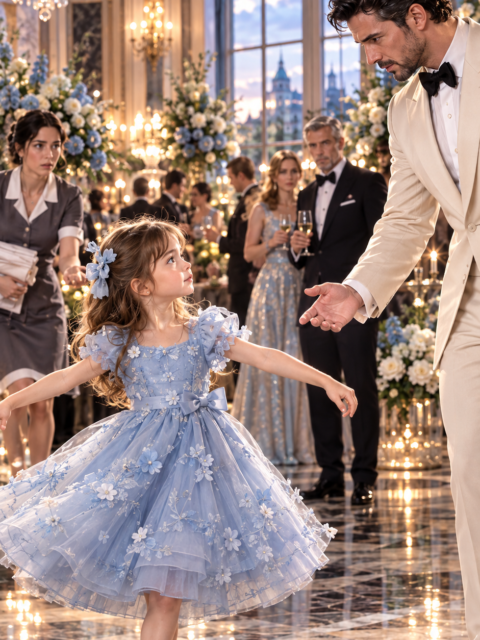
My right arm swept upward. My foot slid across the polished floor. My body turned sharply, and then the orchestra exploded through Ashford Tower. Piano. Strings. The cello.
Walter’s laughter died instantly.
It was not the piece he had hired them to play. It was something older, a slow, sweeping, devastating piece I had not heard in twelve years. I would learn later that the conductor had recognized the way I stood, and had thrown away his program to follow me. But in that moment, I did not wonder. I was already moving.
I spun once, twice, and somewhere at the front of the crowd, a young man in a black tuxedo went white as paper. His lips shaped a name. It was not the one on my tag.
Back to top ↑
Who Is She?
I could feel the room change. It happens, in a good performance. A silence settles over a crowd like snow, and you know, without looking, that nobody is checking their phones.
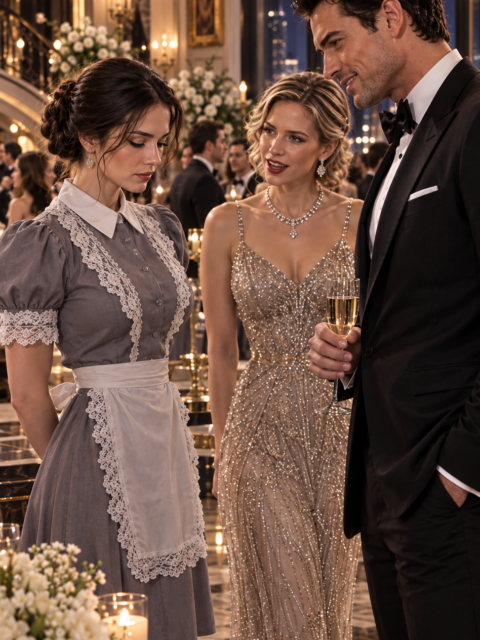
Moments earlier I had been invisible. Just the hotel maid, threading trays between people wearing diamonds worth more than I earned in years. Someone to be ordered around, mocked, and forgotten. Now a woman beside Walter had stopped laughing. A man froze with his glass halfway to his mouth. Someone lowered a phone, and then another.
I accelerated. One traveling step. A sweeping extension. Then I launched across the marble, landed softly, and drove straight into another turn, the ruffles of my uniform flaring around me. The orchestra climbed with me. Somewhere in the crowd, a woman gasped.
My body remembered everything. Every rehearsal. Every blister. Every competition. Every hour spent becoming someone Chicago once knew by name.
Before everything disappeared. Before I disappeared.
My eyes caught Ethan’s as I turned. Just for half a second.
Ethan Ashford. Walter’s son. Thirty-three years old, with his father’s jaw and none of his father’s confidence. He stood motionless at the front of the crowd, and he was not watching me with amazement. He was watching me with fear. His gaze followed my feet, then my posture, then my face, and I saw the exact second recognition struck him.
“Oh my God,” he whispered. I read it on his lips.
Walter glanced toward his son, confused. I couldn’t stop now. The music was building toward its crescendo, and twelve years of silence were breaking apart with every step. I turned again. One rotation. Two. Three. Then I threw myself into the final turn, and my foot struck the marble, and my body snapped into position. One arm high above my head. The other stretched across the ballroom. Perfectly still. The last ruffles of my uniform settled slowly around my legs.
The orchestra struck one enormous final note.
Then silence.
Five hundred people stared at me. Walter’s mocking smile had vanished. A woman in emerald silk stood frozen at his side, her hand at her throat. Vivian Ashford, his wife. A champagne glass trembled in someone’s fingers.
Then a whisper rose from somewhere near the bar. “Wow.”
Another voice followed. “Oh my God.”
I didn’t look at any of them. I looked at Ethan. Because twelve years ago, I had not been carrying trays through luxury ballrooms. Twelve years ago, Chicago knew my name. It had been announced beneath bright lights, printed in newspapers, engraved on a trophy. I had spent years convincing myself that woman was gone.
Apparently, I was wrong. Ethan remembered her. But something about his expression made my stomach tighten. Recognition alone could not explain that fear.
Walter turned toward his son. “Ethan?”
Ethan did not answer. He could not take his eyes off me.
“Who is she?”
The entire ballroom seemed to wait. Ethan swallowed. And suddenly I understood that he had not merely recognized the former champion standing in a maid uniform.
He knew why she had disappeared. And judging by the terror on his face, he knew exactly what would happen if she remembered the truth too.
Back to top ↑
The Stairwell
“Nora Whitlock,” Ethan said.
His voice was barely a breath, but in the silence it carried to every corner of the ballroom. I felt the name land on me like cold water. I had not heard it spoken aloud in twelve years. I had folded it up and put it away in a place I did not go.
A murmur went through the crowd. An older woman at table four pressed her hand to her mouth. A man in a gray tuxedo said, “The national champion? The Whitlock girl?” and somebody else answered, “She died, didn’t she? I thought she died.”
“No,” said a voice from the orchestra. “She did not die.”
It was the conductor. He had set down his baton and was staring at me over the music stands. White hair, kind eyes, a lined face I would have known anywhere. Tomas Alvarez. He had been my accompanist, from the time I was eleven until the winter I vanished.
“I wondered,” he said softly. “The first time I saw her carrying trays through the lobby, three years ago, I thought, no, it’s impossible. I told myself it was a resemblance.” His eyes filled. “Nora. Forgive me. I should have said something.”
I couldn’t answer. My legs had begun to shake in the aftermath, the way they do when the adrenaline leaves, and the room was spinning at the edges.
Walter Ashford stood in the middle of it all, with his glass in his hand and his face shuttered. If I had known him better, I would have recognized the look. I had only ever seen it once, a long time ago, and I could not remember where.
“Whitlock,” he said slowly. “Daniel Whitlock’s daughter.”
“Yes, sir.”
“Well.” He smiled, a thin, cold shape that did not reach his eyes. “What a remarkable surprise. Ethan, you look unwell. Come with me, we’ll take some air.” He turned to the room, all charm. “Ladies and gentlemen, a small interruption. Please enjoy the rest of your evening.”
It was a perfect performance. In five seconds he had taken a scandal and turned it into a charming anecdote. Half the room was already murmuring again. The orchestra, uncertain, began a gentle waltz.
I slipped out through the service door before anyone could stop me. I knew every back corridor in that tower, and I took the one nobody used, a stairwell behind the pastry kitchen that smelled of flour and old concrete. I sat on the third step and put my head between my knees.
My father’s name was Daniel Whitlock. He had died twelve years ago, and I had spent every one of those years being told that he had done something terrible.
I did not remember it. That was the thing no one understood. The night he died, I had hit my head, and I woke up in a hospital bed three days later with a hole in my memory the size of a night. The doctors called it trauma. A good man in a gray suit explained that my father had embezzled from the company he built, that he had taken his own life in shame, and that I was lucky to have survived the fall.
That good man had paid my medical bills. He had given me a job, when I was too ashamed to use my name. I had been grateful to him for twelve years.
His name was Walter Ashford.
A door opened on the landing above. Footsteps. Quick, uneven. “Nora,” said a hoarse voice. “Please. I need to tell you before he finds us.”
Back to top ↑
The Night I Lost
Ethan Ashford came down the concrete steps with his bow tie undone and his hands held open in front of him, like a man approaching a frightened animal. In the weak light, he looked about nineteen.
“I’ve been waiting twelve years to say this,” he said. “And I’m so afraid I’ll say it wrong.”
“Then say it plainly.”
He sat down two steps above me and did not try to touch me. “Your father didn’t kill himself.”
The stairwell went very still.
“He didn’t embezzle anything,” Ethan said. “It was my father who emptied the accounts. Whitlock and Ashford Development was a fifty-fifty partnership, and your dad had found out Walter was moving money out. He’d gone to the lawyers. He was going to testify.” Ethan’s hands were shaking. “They met on the tower site the night of your championship. It was supposed to be a private conversation. My father brought me along. He said it was time I learned the business.”
“You were there.”
“I was twenty-one. I stood in the shadows by the elevator shaft with a flashlight in my hand, and I heard them arguing. Your father said he’d go to the police in the morning. And my father said—” His voice cracked. “He said, ‘Daniel, I’m sorry. I really am.’”
I was suddenly very cold.
“Then there was a sound,” Ethan whispered. “And your father was gone. Over the railing. Fourteen floors.”
I made a sound I did not recognize.
“And then you came running up the stairs. You’d skipped the after-party to find him. You must have heard his voice on the construction floor.” He pressed the heel of his hand to his eye. “You saw. You saw my father standing at the edge, and you screamed, and you turned and ran, and you fell. Down the whole flight. I heard your head hit the concrete.”
It came back then. Not in a rush, but in flashes, like a film played in bad light. A cello, and a stage, and my father in the third row, fingers tapping on his knee. My costume, deep blue. The trophy, heavy as a loaf of bread. The long cab ride to a place I had never wanted to see, and a thin yellow light at the top of a half-built stairwell, and a man’s voice saying, Daniel, I’m sorry.
“I didn’t remember,” I said. “They told me I had a concussion. They said I’d fallen at the site because I was grieving.”
“My father told them that. He said you’d found out about your father’s death, and you’d run.” Ethan wiped his eyes. “I wanted to tell you. I was a coward. I stood in your hospital room door three times and I couldn’t make myself walk in. And then you left. You vanished. I looked for you for two years, and I told myself you’d gone somewhere safe.”
“Why did you stay silent?”
“Because he’s my father,” said Ethan simply. “And because I was twenty-one, and I was afraid. That’s the only honest answer I have.” He raised red, wet eyes to mine. “Tonight, when I saw you dance, I knew the music would bring it back. That piece was in your head the night it happened. I could see it in your face. You remembered.”
“Yes.”
“Then he knows too. He saw your face. He knows you’ll piece it together.” Ethan took hold of my wrist, gently, urgently. “Nora, he’ll act tonight. He’s never let a loose end live.”
Above us, at the top of the stairs, a door swung open on its hinges. A low, calm voice drifted down the stairwell. “Ethan. There you are.”
Back to top ↑
What Walter Owns
Walter Ashford descended slowly, one hand on the rail. Behind him, two men in dark suits stood in the doorway, silent, with the expressionless faces of people who are paid not to have opinions.
“Nora,” he said warmly, as if he were greeting a favorite niece. “My dear girl. I’ve been so worried. You left so suddenly. Ethan, you’ve upset her. You really shouldn’t have followed.”
“Don’t,” said Ethan hoarsely. “Dad. Please.”
“Please what?” Walter’s smile did not waver. “Please stop being a gracious host? My son has had a long evening. He’s confused about some things that happened a very long time ago, and I’m sure he’ll feel better once he’s had some rest.”
I rose from the step. My knees were not steady, but my voice, when it came, was flat. “You told me my father stole from his own company.”
“I told you what the evidence showed.” He sighed, a man burdened by kindness. “I protected you from the worst of it, Nora. Don’t you remember? I paid every bill. I found you work. I made sure nobody came asking questions.”
“You made sure nobody came asking me anything.”
That stopped him, very slightly. In the dim light, his face went smooth and still, like water over a stone.
“You’ve had a shock,” he said. “I think you should come upstairs and rest. I’ll have my driver take you home. Tomorrow, we’ll talk about your future. A woman of your talent should not be carrying trays.” He turned his head. “Gentlemen.”
The two men started down the stairs.
And behind them, in the doorway above, a voice rang out across the stairwell. It was clear and cultured and absolutely steady.
“If either of you touches that girl, I will call the Chicago police from this phone, and I will keep the line open.”
Vivian Ashford stood on the landing in her emerald silk, a slim cell phone in one hand and her chin high. Her hair had come half loose from its pins. Her face was white with fury.
“Vivian,” said Walter evenly. “This is not the time.”
“It’s twelve years past the time.” She came down two steps. “I have kept my mouth shut for a very long time, Walter. I told myself I didn’t know. I told myself that a man could not do what you did and then eat breakfast with me.” Her hand was shaking, but her voice never wavered. “Tonight I watched that child dance. I watched her stand in the middle of your ballroom and tell the truth with her feet. And I’m done lying.”
I stared at her. “You knew?”
“I suspected,” she said. “And suspecting was my crime.” She looked at her husband. Something older than anger moved across her face. “There is something in this tower you thought I’d never find, Walter. I found it in 2019. I have been carrying it with me ever since.”
Walter’s face, for the first time, changed.
“Ethan,” Vivian said without taking her eyes off her husband. “Take Nora to my car. Bring her the trophy. It is in the trunk, and she will know what to do with it.”
Back to top ↑
The Trophy
I had not seen it in twelve years.
It lay on a folded blanket in the trunk of Vivian Ashford’s black sedan, in the underground garage of the tower, under the buzzing white light. A heavy crystal-and-silver trophy, a figure of a dancer in mid-leap, taller than my forearm. On the base, a small engraved plate. National Champion, Senior Division. Nora Whitlock.
The night of the competition, I had been so tired I had left it with the event staff. I had never gone back for it. I had assumed it was lost.
“I found it in a storage unit,” Vivian said. She had followed us down, still holding her phone, still shaking. “It was in a box marked WHITLOCK in my husband’s handwriting. I took it out for a moment. And I felt something loose in the base.”
She pressed a catch beneath the silver plate. A thin panel slid sideways.
Inside was a small black flash drive and a folded sheet of paper.
My hands were not steady. I unfolded it. It was a single page, typed, with a signature at the bottom in Walter Ashford’s looping hand. It was dated the day after my father died. It read: Daniel Whitlock’s fall was not an accident. Should this document be found, I wish it known that I, Walter Ashford, acted alone, and that my son was not present.
I looked up. “He wrote his own confession.”
“He wrote it as insurance,” Vivian said. “Against a business partner who might one day turn on him. He kept it hidden. Then he forgot where, or thought I never would find it.” She bit her lip. “It’s a lie in one place. Ethan was there. Walter protected him by erasing him. I think that was the only truly loving thing he ever did.”
“And the drive?”
Ethan answered, very quietly. “That’s mine.”
We all turned to look at him. He stood a few feet away, hands in his pockets, shoulders hunched.
“The night it happened, I had my phone out,” he said. “I’d been filming the tower site for a class project. I hadn’t turned it off. When I got home, I realized it had recorded everything. The sound. The argument. All of it.” His voice was raw. “I put it on a drive. And I couldn’t destroy it, and I couldn’t bring myself to use it. So I gave it to my mother, years later, and told her to hide it somewhere safe. I never told her what was on it.”
“I did not know what was on it,” Vivian said. “But I knew I had to keep it.”
I held the drive in my palm. It weighed nothing. It weighed everything. Twelve years of a stranger’s mercy and a father’s good name, and a dead man’s last words, all in a thing the size of my thumb.
“Forgive me,” said Ethan. “I know I’m twelve years too late.”
“I don’t forgive you,” I said. It came out quieter than I’d expected. “Not yet. But I want to hear what you do next.”
He nodded, once, as if I had given him something precious. And then he turned to his mother and said, “Where is Walter?”
Vivian’s phone buzzed in her hand. She looked at the screen, and the color left her face. “Upstairs,” she said. “He’s gone back to the ballroom. He’s taking the microphone.”
Back to top ↑
Five Hundred Witnesses
We reached the ballroom just as he began to speak.
Walter Ashford stood at the center of the dais with a microphone in one hand, as smooth and gracious as a man receiving an award. The guests had returned to their tables. Dessert was being served. The orchestra waited with its instruments in its lap.
“Friends,” he was saying. “I want to apologize for the earlier interruption. A young woman, a former employee of mine, became a little unwell. I’m sure you were all as moved as I was by her performance. It’s a tragedy, truly, when a gifted young person loses her way.” He paused for effect. “I am happy to say that I will personally be seeing to her care.”
There were murmurs of approval. Somebody even applauded.
I walked down the center aisle in my maid uniform, barefoot, with the trophy in both arms.
It was the same marble I had danced on. It was silent now. I could hear my own heartbeat. Conversations died around me as I passed. People turned in their chairs. Behind me came Ethan, then Vivian, then Tomas Alvarez, who had abandoned his podium without a word.
Walter saw us. His smile slipped.
“Ah. Nora. There you are. My dear—”
“I’d like the microphone,” I said.
“I think you should sit down.”
“I’d like the microphone, Mr. Ashford.” I did not raise my voice. I had not raised my voice in twelve years. “Or I’ll shout.”
He held on for a long moment. Then, because five hundred people were watching and he could not afford to be seen refusing a distressed girl, he handed it over with a small, brittle smile.
I stood on the dais where he had stood, and I told them the truth.
I did not tell it well. I’m not a speaker. I told it in short, plain sentences, in the order I had learned it. My name. My father’s name. The fall from the fourteenth floor of a half-built tower. The note. The lie. The twelve years of gratitude that I had given to the man who had ruined me.
When I reached the end, I held up the flash drive and handed it to Tomas Alvarez, who handed it to the technician at the back of the room, who, after a long pause, plugged it into the projector.
The screen above the dais flickered. The audio began first. A man’s calm, regretful voice. Daniel, I’m sorry. I really am.
Then a sound that I will never forget as long as I live. And then silence, and then a young man’s ragged breath in the dark.
Walter Ashford stood with his face turned toward the screen. He did not move. He did not blink. In a ballroom full of the most powerful people in Chicago, he looked, for the first time in his life, like what he was. A frightened old man.
Ethan stepped up beside me. His hands shook, but his voice was clear.
“That’s my voice at the end,” he said to the room. “That’s me. I was there, and I said nothing for twelve years. I’ll testify to every word.”
At the back of the ballroom, the double doors opened. Four uniformed officers walked in, with a woman in a dark blue coat at their head. Vivian Ashford lifted her chin. “I called them from the garage,” she said. “I told them to wait until the music stopped.”
Back to top ↑
The Last Turn
They took Walter out through the front doors, in full view of the guests, in his perfect tuxedo. He did not resist. At the threshold, he turned to look back at me once, and I thought he would say something. A threat, perhaps, or an apology. But all he did was look. And then the doors closed behind him, and the long ballroom exhaled.
It took a year for the courts. It was a long, slow, grinding year of depositions and forensic accountants, of attorneys in gray suits and a judge who looked at the old recording with a face of stone. Ethan testified for eleven hours across three days. He did not ask for leniency. He took the stand in a plain dark suit and said, in a voice that never once broke, that he had been a coward, and that cowardice was his own responsibility, not his father’s.
Walter Ashford was convicted of murder in the second degree, with embezzlement and fraud stacked behind it. He was sixty-two years old. He will not leave prison.
My father’s name was cleared on a Tuesday morning in March. The judge read the verdict aloud, and then, because she was a kind woman, she read a second statement. The court recognizes Daniel Whitlock as a man of integrity, and extends to his family its profound regret.
The partnership agreement came out of probate three months later. My father’s fifty percent, held in trust for twelve years, belonged to me. It included, as it turned out, a controlling interest in the hotel at the base of Ashford Tower.
I did not want it. Not at first. I had spent too many years scrubbing its floors to feel anything but a faint, sour nausea at the thought. But Tomas Alvarez sat across from me in his dusty apartment one afternoon, pouring tea from a chipped pot, and said, “Nora, what would your father have done?”
I thought about it for a long while.
The Daniel Whitlock Academy opened on the sixth floor of the tower, on the first of September. It is a free school of dance and music for the children of hotel workers, cleaners, porters, and line cooks. There are forty-one students. The ballroom, once used for galas, is now used for recitals, and the floor, the polished marble floor where I once spun in a maid’s uniform, is sprung and padded and covered with a fine layer of rosin.
I teach the advanced class on Tuesdays and Thursdays. My students call me Miss Nora. They do not know, most of them, that I used to carry trays.
Ethan comes sometimes. He sits at the back of the room, on a folding chair, and does not speak. After the recital, he stays to stack the chairs. He has given his entire inheritance to a scholarship fund in my father’s name, and he lives in a small apartment on the north side, and he has never once asked me for anything.
I have not forgiven him all the way. I do not know that I will. But last month, when the cello began to play and my students lifted their arms in a single, ragged, beautiful line, I looked over and saw him crying, silently, with his face in his hands, and I realized that the weight I had carried for twelve years had grown very small.
That evening, after everyone had gone, I stayed behind in the empty ballroom. The chandeliers were dark. Moonlight lay in long silver bars across the floor.
I took off my shoes. I lifted one arm. I let the music in my head begin.
And I danced. One step. Another. Then the last turn, slow and unhurried, the way I had never been allowed to do it before.
When I stopped, there was no applause. Only the soft hum of an old building and the warm, steady silence of a room that finally belonged to me.
I stood very still, one arm raised, and for the first time in twelve years I did not feel like I was disappearing.
More Trending Stories You Can’t Put Down