A Billionaire Humiliated Me Beneath the Chandeliers and Promised to Marry Me If I Could Dance — He Had No Idea What I Used to Be
Alexander Blake mocked a cleaning woman in front of an entire ballroom, offering to leave his date and marry her on the spot if she could dance. He had no idea the woman holding his dirty glasses had once been taught to own that floor, before her mother’s death and her father’s grief quietly took the dream away. Then Lena set down the tray, pulled the pins from her hair, and said three words that silenced the room: clear the floor. Read every chapter to find out what happened next, and whether Alexander deserved the chance to make it right.
Clear the Floor
“If you can really dance, I’ll leave her and marry you tonight.” Alexander Blake said it loudly enough for the entire ballroom to hear. For one second, every sound inside the Copacabana Club disappeared. The orchestra softened. Champagne glasses stopped halfway to painted lips. Then the room erupted. Not with joy. With the polished, poisonous laughter of people who had never worried about rent, scrubbed wine from marble, or smiled at someone who treated them like furniture.
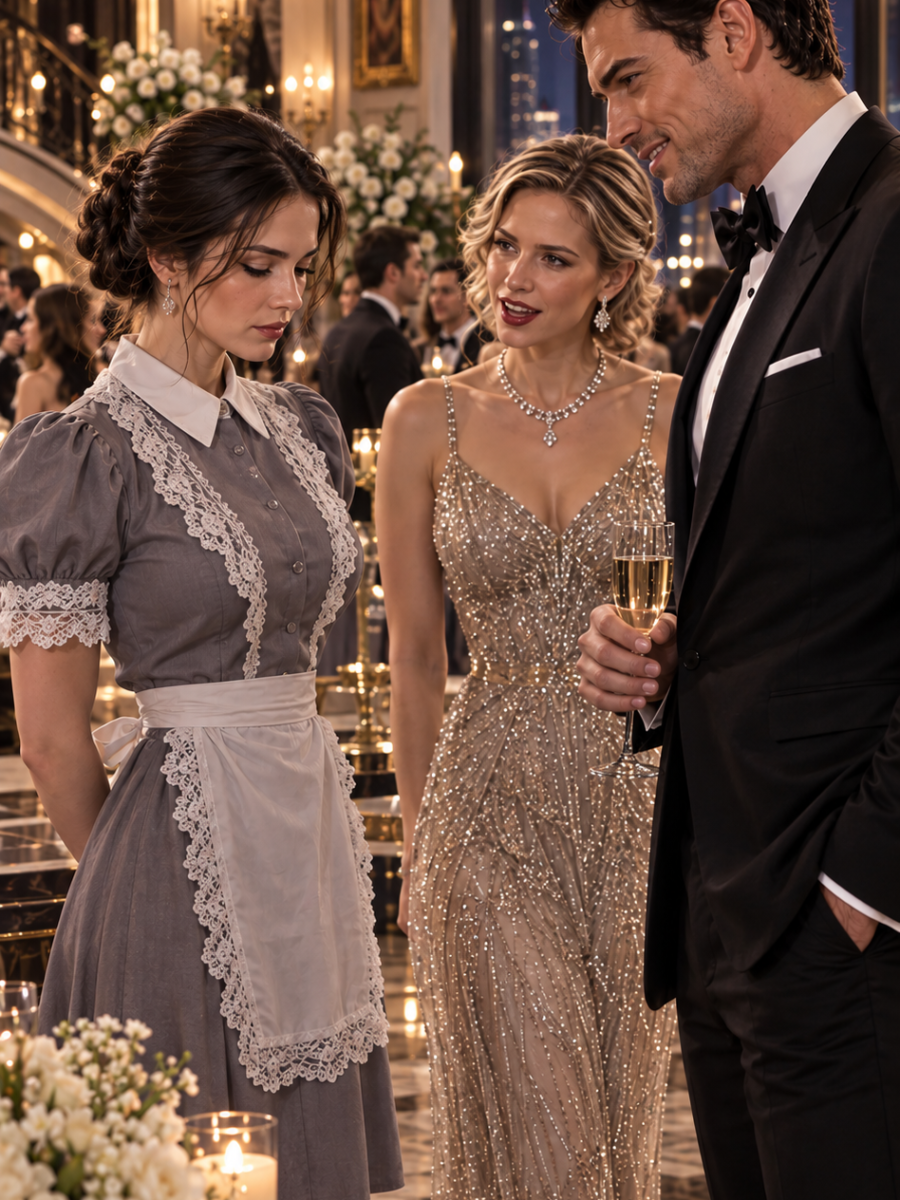
I stood beneath a crystal chandelier with a metal tray pressed against my ribs, wearing the plain black uniform that made me useful and invisible. Alexander stood ten feet away in a flawless tuxedo, one hand around a champagne flute. Beside him was the woman he had offered to abandon as part of the joke, diamonds flashing against her silver gown. I did not know her name. But I saw her smile vanish.
Alexander tilted his head. “Well?” he asked. “Can you dance, or do you only clean up after people who can?” Another wave of laughter rolled across the ballroom. My fingers tightened beneath the tray. Two empty glasses touched with a soft chime. Alexander noticed. His mouth curved higher, as though the fear he expected from me had finally appeared. I wanted to look away. Instead, I held his gaze.
He had called me “the cleaning woman” because he did not know my name. Most of the guests did not. They knew I appeared when a glass broke or when their celebration needed to be erased. To them, I was hands without a history. A uniform without a voice.
Alexander lifted his drink toward me. “Dance well enough, and I’ll marry you before midnight.” The woman beside him touched his sleeve. “Alexander.” “It’s a joke, Victoria.” So that was her name. Victoria withdrew her hand. “She doesn’t look like she thinks it’s funny.” The laughter thinned. Alexander’s eyes remained on me. “Come on, Cinderella. Give us something to remember.”
My supervisor stood near the service doors. When I glanced at him, he gave the smallest shake of his head. Do not answer. Do not embarrass the guest. Do not lose this job. I understood every warning inside that movement. My rent was due in eleven days. My father’s medication had become more expensive again. Alexander could forget this moment by morning. I would still have to survive it.
The orchestra began another piece, perhaps hoping music would smooth over the humiliation. Instead, the opening rhythm went through me like a blade. One, two, three. Hold. Turn. For a heartbeat, the ballroom disappeared. I was eight years old again inside a narrow dance studio with cracked mirrors and a wooden floor polished by thousands of hopeful feet. My mother knelt in front of me, tying the ribbon around my shoe. I had been crying because I kept missing the same turn.
“I can’t do it,” I whispered. She placed her hand over my heart. “You were born for this, Lena. The music already knows you.” I stood. I tried again. And I turned perfectly.
My mother made me believe a dream could be more than something pretty children said before reality corrected them. We had almost no money, but she repaired costumes by hand and traded cleaning work for extra studio hours. At night, we watched dancers on our small television while she folded laundry. “One day,” she told me, “people will stop talking when you step onto a floor.” I laughed. “Everyone?” “Everyone.”
The memory shattered beneath another burst of laughter from Alexander’s table. Now an entire ballroom had stopped talking, but not for the reason she imagined. Alexander checked his watch. “Do I need to offer money instead?” The words landed differently. Several guests looked down. Victoria’s face hardened. “That’s enough.” He turned to her. “You’re jealous of the cleaning woman now?” “I’m embarrassed by you.”
The room shifted. Only slightly, but I felt it. For the first time, the laughter was no longer entirely on his side. Alexander felt it too. His jaw tightened, and when he faced me again, the joke had become something sharper. “Are you deaf?”
I set the tray on the nearest empty table. The metal touched the marble with one clean click. Every whisper stopped. My supervisor took a step forward, then froze when several guests looked toward him. I removed my gloves one finger at a time and placed them beside the tray. Alexander’s expression changed. Not fear. Confusion. He had expected me to shrink. “What are you doing?” he asked.
I looked toward the dance floor. The chandeliers reflected in the marble like broken stars. Couples had moved aside, leaving a circle of polished space between Alexander and me. I could feel every eye. I could also feel the old instinct returning. My shoulders settled. My spine lengthened. My weight shifted naturally over the balls of my feet. The movement was barely visible, but Victoria saw it. Her gaze dropped to my posture. “You’ve trained,” she said quietly. Alexander laughed once. “She cleans a ballroom. That doesn’t make her a dancer.”
The orchestra reached a phrase my mother used to count aloud. One, two, three. Hold. Turn. My chest tightened. After my mother died, I had promised myself never to think about that studio again. The accident came on an ordinary afternoon. A police officer knocked at our door, and I watched my father’s hand slide from the handle as he listened. There was a closed casket at the funeral. No final goodbye. Only white flowers and the certainty that the woman who had filled every room with music would never come home.
My father changed afterward. Bills spread across our kitchen table. Then came the notices. One day, I returned from class and found my dance shoes inside a cardboard box. “What is this?” I asked. He could not look at me. “You need to work now.” “I have rehearsal.” “Not anymore.” “But the recital is next month.” “There won’t be a recital.” “You promised Mom.” His palm struck the table. “Your mother is gone.” The silence afterward was worse than the shout. His shoulders folded. “I’m sorry. Dreams don’t pay rent.”
I was fourteen when I left the studio. There was no final bow. No applause. No goodbye. My dream did not die. It simply stopped being allowed. I worked in restaurants, hotels, offices, and private homes. I learned how to erase myself so customers felt comfortable. I learned that wealthy people discussed secrets in front of staff because they did not consider us part of the room. Most importantly, I learned never to look at a dance floor for too long. Until tonight.
Alexander stepped closer. “You’re wasting everyone’s time.” I looked at him. “No,” I said. “You did that when you called me over.” A murmur passed through the guests. His smile disappeared. “Remember who you’re speaking to.” I glanced at the empty floor, then back into his eyes. “Maybe you should remember who you’re speaking to.” Victoria inhaled sharply. My supervisor closed his eyes.
Alexander stared at me, and for the first time since he called across the room, he no longer looked entertained. He looked uncertain. That uncertainty gave me something I had not felt in years. Space.
I reached behind my waist and untied the plain black apron. The knot loosened. The fabric slid from my body. I folded it carefully and placed it beside the gloves and tray. The orchestra faltered, then stopped. No one laughed now. I pulled the pins from my hair. Dark waves fell over my shoulders. Somewhere behind Alexander, a champagne glass touched a table too quickly. Victoria watched me with an expression I could not read. Alexander’s gaze moved from my face to my posture and back again. “What exactly are you trying to prove?” he asked.
I stepped onto the marble. My old shoes were gone. My mother was gone. The studio was gone. But the count was still inside me. One. Two. Three.
I lifted my chin beneath the chandeliers. “Clear the floor.”
One, Two, Three, Hold, Turn
The conductor, sensing something he couldn’t fully name but understood mattered, raised his baton and gestured for the orchestra to begin again, this time deliberately, giving me the exact phrase I needed.
I closed my eyes for one final second, feeling my mother’s hand settle over my heart the way it had a lifetime ago, and then I moved.
The first turn came instinctively, my body remembering choreography my mind had spent a decade trying to forget. The chandelier light caught the movement of my hair, my arms, the unexpected grace of someone the entire room had assumed knew only how to carry trays and disappear.
Gasps rippled through the crowd. Not polite murmurs, but genuine, startled sound, the particular collective intake of breath a room makes when it witnesses something it never expected to see.
I danced the way my mother had taught me — not simply technically correct, though a decade of forced distance hadn’t erased the discipline her patient instruction had built into my very bones, but with the particular emotional honesty she’d always insisted mattered more than perfect form. Every turn carried grief. Every extension carried longing. Every count carried a promise I’d never been given the chance to fulfill.
Alexander stood frozen at the floor’s edge, his earlier mocking confidence entirely collapsed into something considerably more complicated — shock, certainly, but beneath it, something that looked almost like shame.
Victoria’s hand had risen to cover her mouth, her earlier discomfort transformed into visible, genuine awe. Several guests had actually begun to applaud, quietly at first, then with growing, spontaneous enthusiasm as the music built toward its climax.
As the final phrase approached, I executed the turn my eight-year-old self had once struggled so desperately to master, the same turn my mother had promised would eventually come naturally, and as I completed it perfectly, exactly the way she’d always believed I could, the entire ballroom fell into a silence considerably different from the one that had greeted Alexander’s original, cruel joke — a silence that finally, completely belonged to me.
What the Room Saw
The applause, when it finally broke free, carried a genuine warmth that contrasted sharply with the earlier cruel laughter, guests rising from their seats with an enthusiasm that visibly startled Alexander, who remained standing exactly where he’d first issued his careless, humiliating challenge.
I stood motionless at the floor’s center, breathing hard, tears I hadn’t fully realized were falling tracing down my cheeks, ten years of suppressed grief and denied dream finally, publicly released in front of a room that had expected only humiliation.
Victoria approached first, her earlier discomfort transformed into something considerably warmer. “That was extraordinary,” she said quietly. “I don’t think anyone in this room expected anything close to what we just witnessed.”
“Thank you,” I managed, my voice unsteady with emotion I hadn’t fully processed yet.
Alexander finally moved, crossing the remaining distance between us with an expression I couldn’t quite categorize — not his earlier mocking confidence, but something genuinely humbled. “I owe you a considerable apology,” he said, his voice carrying none of his earlier careless cruelty. “I made an assumption about you that was not only incorrect, but genuinely cruel, and I did so in front of an entire room specifically to entertain myself at your expense.”
“You did,” I confirmed, unwilling to soften the accusation despite his apparent contrition.
“I also made a promise,” he said slowly, “in front of this same room, that I intend to properly address, though I suspect marriage was never actually the appropriate response you were hoping for tonight.”
My supervisor appeared then, his earlier fearful caution transformed into something considerably more complicated, given the extraordinary scene that had just unfolded in front of the club’s most influential guests. “Lena,” he said carefully, clearly uncertain how to navigate a situation his usual protocols had never once anticipated, “I think we need to discuss what happens now, both for tonight and for your continued employment here, given everything that’s just occurred in front of literally everyone who matters to this establishment’s reputation.”
Eleven Days
Alexander’s expression hardened with fresh, protective resolve. “If Lena’s employment here is genuinely in question because of tonight’s events,” he said, turning directly to my supervisor, “I want to be entirely clear that any consequence directed at her, rather than at my own admittedly inappropriate behavior, will become a considerably larger problem for this establishment than one uncomfortable evening.”
My supervisor’s composure visibly wavered under this unexpected intervention. “Of course, Mr. Blake. I simply meant—”
“I understood what you meant,” Alexander said, his tone carrying none of his earlier casual cruelty. “I’d like to speak with Lena privately, if she’s willing, once she’s had time to properly process tonight’s events.”
I studied him carefully, old wariness warring against a genuine curiosity about whatever explanation he might actually offer. “I have eleven days until my rent is due,” I said honestly, unwilling to pretend my circumstances remained anything close to comfortable despite tonight’s unexpected spectacle. “And my father’s medication costs considerably more than my current wages properly cover. Whatever conversation you’re hoping to have, Mr. Blake, I’d appreciate you understanding that my actual priorities tonight remain considerably more practical than romance or apology.”
Something shifted in Alexander’s expression at this blunt, honest admission — not offense, but genuine, focused attention. “Tell me about your father,” he said.
I hesitated, old protective instinct warring against exhaustion that made honesty feel, unexpectedly, considerably easier than continued careful management. “He’s struggled since my mother died,” I said. “Grief, initially, then physical health complications that have only worsened over the years. I’ve been managing his care alongside my own employment for nearly a decade now, ever since I left school early to help support both of us.”
“You left dance for him,” Alexander said slowly, the pieces visibly reassembling themselves with fresh understanding.
“I left dance because dreams don’t pay rent,” I said, echoing my father’s own devastating words from a decade earlier, “and because someone needed to keep both of us fed and housed once my mother’s income disappeared alongside her. I don’t regret that choice, Mr. Blake, but I also don’t need your pity or your guilt-driven charity simply because tonight’s humiliation happened to expose talent I’d otherwise have kept permanently hidden.”
The Envelope
“I’m not offering pity,” Alexander said, his voice carrying genuine, careful consideration rather than his earlier casual dismissiveness. “I’m offering acknowledgment that I witnessed something remarkable tonight, talent that clearly deserves considerably more opportunity than circumstance has apparently allowed it, and a genuine desire to help correct that, if you’re willing to accept help offered with actual respect rather than the cruelty I initially showed you.”
I remained skeptical, old exhaustion making trust considerably harder to extend than his careful words suggested it should be. “What exactly are you proposing?”
“I have connections throughout the professional dance world,” Alexander said. “Considerable resources I could direct toward properly training you, connecting you with instructors and companies capable of recognizing exactly what tonight’s performance demonstrated so clearly. Not charity, Lena. Investment in genuine talent that circumstance alone kept hidden.”
“And my father’s care?” I asked, unwilling to consider any opportunity that might require abandoning my primary, ongoing responsibility.
“Considerably more manageable resources than your current employment likely allows,” Alexander said. “I’m not proposing you choose between your father’s wellbeing and your own dream, Lena. I’m proposing you finally have access to resources that make both genuinely possible simultaneously.”
The following days brought careful, deliberate consideration on my part, old wariness about wealthy men’s promises warring against genuine, cautious hope that Alexander’s offer might actually prove as sincere as his words suggested.
When I finally agreed to meet him properly, away from the ballroom’s chaotic aftermath, he arrived with a sealed envelope, which he placed on the table between us without any of his earlier performative confidence. “Before you open this,” he said, “I want you to understand it’s not a payment for tonight’s entertainment, or an attempt to buy forgiveness for my cruelty. It’s simply the first, concrete step toward what I’m hoping might become a genuine partnership in helping you reclaim exactly what you were always meant to have.”
Madame Fischer’s Studio
Inside the envelope, I found not simply money, though a generous check was included specifically earmarked for my father’s ongoing medical care, but a formal letter of introduction to Madame Elise Fischer, director of the city’s most prestigious professional dance academy, along with a scheduled audition considerably sooner than I’d believed possible given my decade-long absence from formal training.
“She’s agreed to see you personally,” Alexander explained, watching my stunned reaction with careful attention. “I described what I witnessed at the club as accurately as I could manage, though I suspect words alone couldn’t properly capture what actually happened on that dance floor.”
“I haven’t trained properly in ten years,” I said, old fear resurfacing despite the extraordinary opportunity suddenly presented. “Madame Fischer’s academy trains dancers who’ve maintained rigorous, continuous practice their entire lives. I don’t know if whatever remained of my ability Tuesday night translates into anything genuinely sustainable.”
“I believe it does,” Alexander said simply. “But regardless of what Madame Fischer ultimately decides, I want you to understand this opportunity carries no obligation toward me personally. Whatever happens between us going forward, professionally or otherwise, remains entirely separate from whether you choose to pursue this audition.”
The audition itself, conducted three days later in Madame Fischer’s elegant, considerably intimidating studio, unfolded with a nervous energy I hadn’t experienced since childhood — old fear of failure tangling with fresh, desperate hope that a decade of denied dream might genuinely find its way back to where it belonged.
Madame Fischer, a formidable woman whose own considerable reputation preceded her, watched my performance with an inscrutable expression that gave away nothing until I’d completed the final combination she’d requested.
“Your technique carries considerable rust,” she said finally, her tone carrying no obvious warmth despite the assessment’s underlying significance, “exactly what I’d expect from ten years away from consistent, professional training. But your instinct, your musicality, the emotional honesty you bring to even a hastily prepared audition combination — that cannot be taught, Ms. Alvarez. That’s either present or it isn’t, and yours is considerably more present than most dancers I’ve trained who never once experienced a single day’s interruption. I’m prepared to offer you a place in my academy’s adult intensive program, provided you’re willing to commit to the considerable work required to properly rebuild everything a decade’s absence has cost you.
What Alexander Actually Offered
The months that followed brought a genuine, demanding transformation to my daily life — rigorous training under Madame Fischer’s exacting instruction, careful balance between rebuilding my dance technique and continuing my father’s necessary care, and, gradually, a genuine friendship with Alexander that neither of us rushed toward anything more complicated than careful, mutual respect.
“I keep waiting for the catch,” I told him honestly, several months into my training, watching him review paperwork related to my father’s ongoing medical arrangements with the same careful attention he’d apparently brought to every aspect of his promised support. “Wealthy men don’t typically offer this kind of sustained investment without eventually expecting something in return.”
“I understand your skepticism,” Alexander said. “I gave you every reason to expect exactly that kind of transactional cruelty, given how thoroughly I demonstrated it the night we met. But Lena, I want to be direct — I’m not investing in your training because I expect romantic obligation in return. I’m doing it because witnessing your dance that night, and understanding everything you sacrificed to survive circumstances that should never have required such sacrifice, genuinely changed something in how I understand my own considerable privilege.”
Victoria, whose own composure that difficult first evening had ultimately proven considerably more principled than Alexander’s careless cruelty, became an unexpected but genuine friend throughout this transformative period, her own relationship with Alexander having quietly, mutually concluded in the weeks following that extraordinary ballroom confrontation.
“I couldn’t continue a relationship with someone who treated another person’s humanity as entertainment,” she told me once, during one of our own developing friendship’s early conversations. “Watching you dance that night reminded me exactly what genuine grace actually looks like, considerably more than anything Alexander’s careless wealth had ever demonstrated up to that point.”
“Do you think he’s genuinely changed?” I asked her directly, curious about her own honest assessment given her considerably longer history with Alexander than my own brief, extraordinary acquaintance. Victoria considered the question carefully before answering. “I think,” she said slowly, “watching someone he’d carelessly humiliated respond with that much dignity and unexpected grace forced him to confront something about his own character he’d probably never once properly examined. Whether that reckoning produces lasting change, Lena, honestly depends considerably on what choices he continues making now that the initial shock and guilt have had time to fade.”
The Recital
Ayear after that extraordinary, humiliating evening first transformed into something entirely unexpected, I stood backstage at Madame Fischer’s academy’s annual showcase, considerably more prepared and considerably more whole than the frightened woman who had once set down a serving tray and declared, against every reasonable expectation, that the floor should be cleared for her alone.
My father, present in the audience for the first time in a decade, his own health considerably stabilized through the medical care Alexander’s initial support had made properly possible, watched with visible, overwhelming emotion as I prepared for my featured solo performance.
“Your mother would be so proud,” he told me quietly, backstage before the performance began, old grief and fresh healing tangling together in his careful words. “I’m sorry it took me so long to understand that keeping this dream alive for you mattered considerably more than my own fear of losing you the way I lost her.”
“You did what you believed necessary to survive,” I told him gently, understanding, finally, that his own devastating grief had shaped choices neither of us had fully processed properly until circumstances forced this remarkable, unexpected reckoning. “I don’t blame you for that anymore, Dad. I’m simply grateful we both found our way back to this moment eventually.”
Alexander, present in the audience alongside my father, watched my performance with the same genuine, focused attention he’d shown throughout our entire year of careful, deliberate friendship — a relationship that had, gradually and without either of us fully planning it, evolved into something considerably warmer than either of us had initially anticipated.
As I completed my final turn, the same perfect execution my mother had once promised would eventually come naturally, the audience’s genuine, enthusiastic applause carried none of that first devastating evening’s cruel spectacle, simply authentic recognition of exactly the talent and dedication a decade of denied dream had never actually managed to fully extinguish.
“The music already knew you,” Alexander told me afterward, backstage, his voice carrying genuine, unguarded warmth. “Your mother was right about that, all those years ago.”
I smiled, old grief finally settling into something considerably more peaceful now that her promise had, against every reasonable expectation, finally, completely come true. “She usually was,” I said. “About considerably more than simply dancing, it turns out.”