“Why Are You Walking Like Me?” A 3-Year-Old Copied the Mafia Boss’s Grieving Walk for Fourteen Days — Then He Finally Turned Around
For eighteen months, Dante Falcone had walked past his dead wife Carmela’s locked sitting room alone, every afternoon at four o’clock. Then Sophia, his housekeeper’s daughter, began quietly copying his grieving walk, seven small steps behind him, until the fourteenth afternoon when he finally turned around and asked her why. Read every chapter to find out what happened once he stopped walking alone.
Seven Small Steps
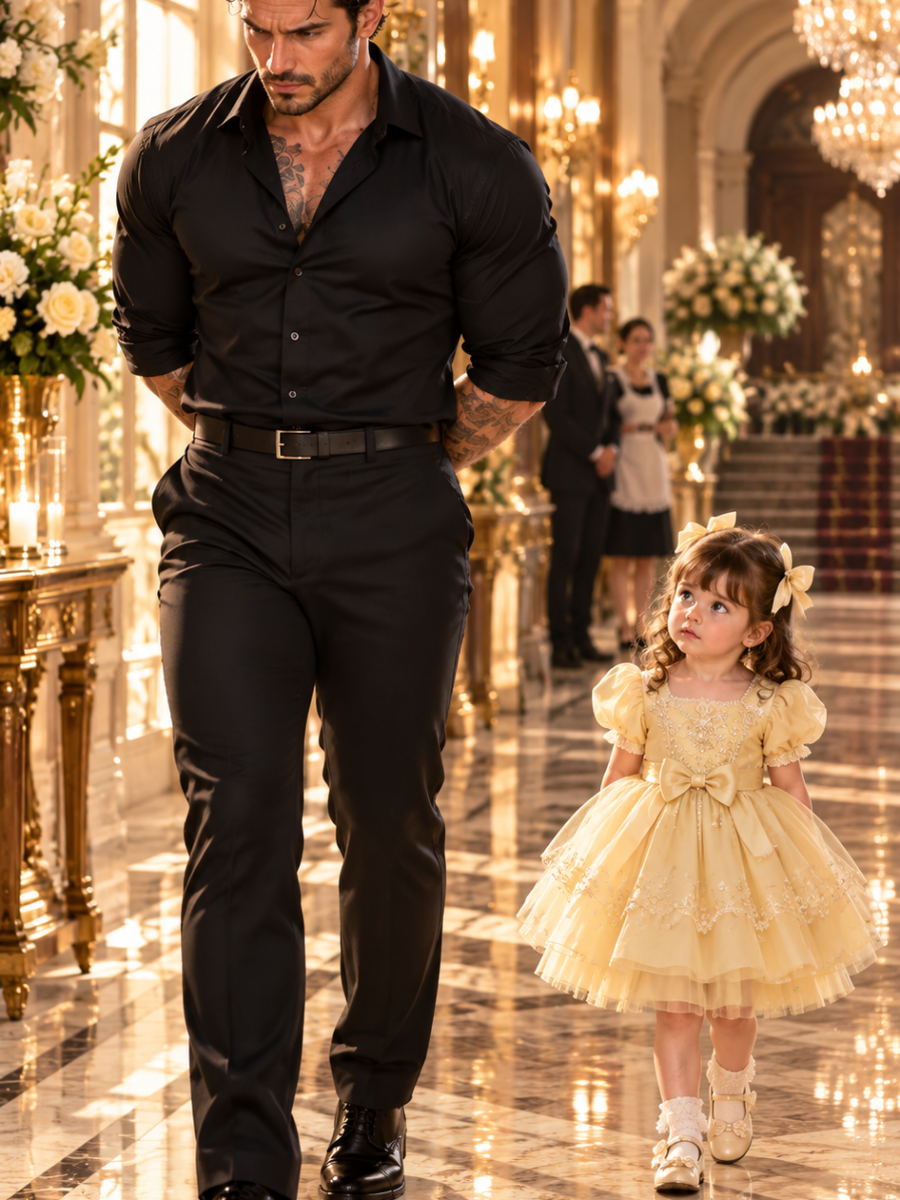
“Why are you walking like me?” Dante Falcone’s voice cut through the marble hallway. Three-year-old Sophia froze twelve feet behind him, tiny hands clasped behind her back, shoulders stiff, wearing the fiercest little scowl she could manage. Everyone stopped breathing.
Sophia looked up at the feared mafia boss. “Because you look lonely.”
For eighteen months, nobody had dared interrupt Dante’s four o’clock walk. Every afternoon, he passed the locked sitting room that had belonged to his wife, Carmela, who had died in an ambush at exactly four o’clock. Since then, grief had become his ritual.
Then Sophia arrived. Her mother, Rosa, worked as a housekeeper at the estate and occasionally brought her daughter when childcare fell through. One afternoon, Sophia watched Dante walk. Hands behind his back. Shoulders square. Head lowered. She copied him. The next day, she did it again. Soon, every afternoon, seven tiny steps followed Dante through the marble corridor. If he stopped, she stopped. If he tilted his head, she tilted hers.
The entire household knew. Everyone except Dante. Until the fourteenth afternoon.
Dante suddenly stopped. Sophia stopped too. Slowly, he turned. “Why are you walking like me?” Rosa rushed forward, terrified. “Mr. Falcone, I’m so sorry. She’s only three—” Dante raised a hand. Then he looked at Sophia.
She stepped closer. “Because you look lonely.” Dante’s expression changed. Sophia pointed toward Carmela’s locked room. “You walk by yourself every day.”
For the first time in eighteen months, Dante’s hands loosened behind his back. Then his mouth twitched. Once. Twice. And the most feared man in the house laughed.
Sophia smiled. “There.” Dante blinked. “There what?” She stepped closer. And before Rosa could stop her, Dante bent down and reached for the little girl.
But what happened next would make Rosa realize Sophia had touched something inside Dante that no one else had been able to reach.
What Dante Reached For
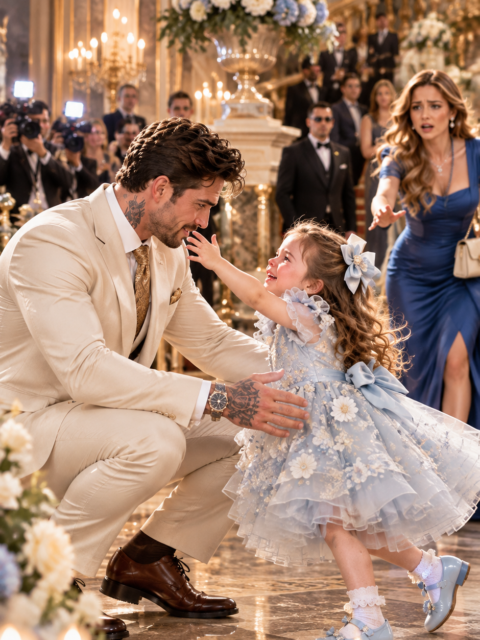
He lifted her, carefully, the way a man lifts something he’s afraid might shatter, and Sophia wrapped both arms around his neck without a moment’s hesitation, entirely unaware of the enormity of what she’d just done.
Dante stood there, in the middle of the marble hallway, holding a three-year-old who smelled like crayons and apple juice, and Rosa watched something break open across his face that eighteen months of careful, guarded grief had kept perfectly sealed.
He didn’t cry. Not exactly. But his shoulders, which had carried themselves rigid and squared for eighteen devastating months, dropped slightly, as though some weight he’d forgotten he was holding had finally, briefly, been set down.
“Mr. Falcone,” Rosa said carefully, uncertain whether to apologize again or simply let this extraordinary moment continue uninterrupted. “I had no idea she’d been doing this.”
“I know,” Dante said quietly, still holding Sophia, his voice carrying a rawness none of his household had heard from him in a year and a half. “Nobody told me. I think, perhaps, nobody wanted to be the one to end whatever this was.” He looked down at Sophia, who had settled against his shoulder with the easy comfort of a child entirely unafraid of a man the rest of the household approached with careful, practiced caution. “How long has she been following me?”
Four O’Clock
“Fourteen days,” Rosa admitted. “She started the first afternoon I brought her, after my usual sitter canceled. I noticed her watching you from the stairwell, and I assumed she’d simply lose interest. She didn’t.”
“Why didn’t you stop her?” Dante asked, though his tone carried curiosity rather than accusation.
Rosa considered the question carefully. “Because the first few days, I was afraid to,” she admitted honestly. “By the time I understood she meant no disrespect, simply a child’s strange, earnest way of keeping someone company, I found I didn’t want to interrupt it either. You seemed, forgive me for saying so, less alone those afternoons, even walking in complete silence.”
Dante set Sophia down gently, though she immediately reached up and took his hand with the same unbothered confidence she’d shown throughout their entire fourteen-day ritual. “I’ve walked that hallway every afternoon since Carmela died,” he said quietly. “At exactly four o’clock. The same time she died, in an ambush our rivals arranged nearly two years ago.”
“I’m so sorry,” Rosa said softly. Dante’s expression carried old, settled grief rather than fresh devastation. “The men responsible were dealt with long ago,” he said. “That isn’t the wound that’s remained open. It’s simply the walking itself, the ritual I built because I didn’t know how else to carry her memory through each difficult afternoon.” He looked down at Sophia’s small hand in his. “Until, apparently, a three-year-old decided I shouldn’t carry it entirely alone.”
Carmela
“Who was she?” Sophia asked, pointing again toward the locked door, her question carrying the uncomplicated directness only a three-year-old could manage. “The lady who used to be here?”
Dante crouched to meet her properly, something in his posture considerably softer than the rigid, grief-squared shoulders Rosa had grown accustomed to over eighteen difficult months. “Her name was Carmela,” he said. “She was my wife. She loved this sitting room more than any other place in the entire house.”
“What did she do in there?”
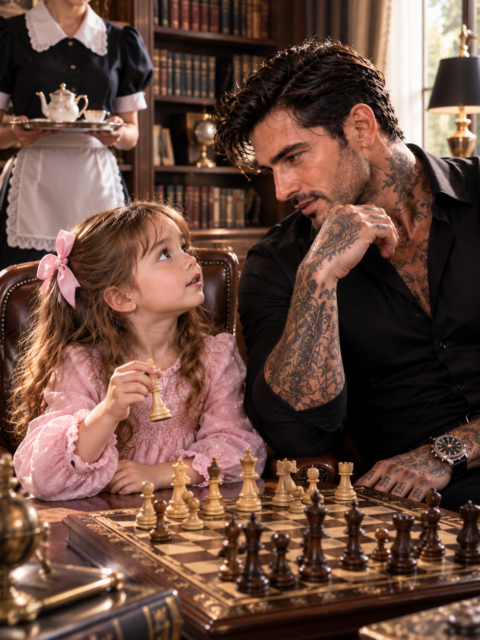
“She painted,” Dante said, old fondness entering his voice for the first time Rosa had witnessed since beginning her employment here. “Watercolors, mostly. Gardens, mainly ones she imagined rather than ones that actually existed anywhere.”
Sophia considered this with grave seriousness. “Can I see?”
Dante’s hand tightened slightly around hers, old hesitation visible despite the extraordinary openness he’d already shown. “Not today,” he said gently. “But perhaps, someday, if your mother doesn’t mind you continuing to visit this house.” He looked up at Rosa, something like genuine hope entering his expression. “I find I’d like that, actually. More than I expected to, before this particular afternoon.”
A New Kind of Walk
The weeks following that extraordinary afternoon brought gradual, genuine transformation to Dante’s daily ritual. Sophia, now openly welcomed rather than secretly tolerated, walked beside him most afternoons, her small hand in his, their pace considerably less rigid than his solitary eighteen months had established.
“You don’t walk with your hands behind your back anymore,” Sophia observed one afternoon, several weeks into their new routine.
“No,” Dante agreed. “I suppose I don’t need to anymore.”
“Why did you before?”
Dante considered the question carefully, the kind of question only a child would think to ask so directly. “I think,” he said slowly, “it felt like something to hold onto, when everything else felt like it had already slipped away. Hands behind my back, shoulders squared, the same careful steps every single day. It gave the grief somewhere specific to live, rather than letting it follow me everywhere unpredictably.”
“And now?” Sophia asked. Dante looked down at her small hand in his, considerably warmer company than his own careful solitude had ever provided. “Now I think I’ve found a better place for it to live,” he said. “Somewhere considerably less lonely than a locked hallway, walked alone, every single afternoon.”
The Locked Room
On the first anniversary of Sophia’s initial fourteen days of silent companionship, nearly two months after that extraordinary afternoon in the marble hallway, Dante finally unlocked Carmela’s sitting room, inviting both Rosa and Sophia inside for the first time.
The room had remained exactly as Carmela left it, half-finished watercolors still resting on her easel, brushes still arranged with the particular care of someone who’d fully intended to return to them the following morning.
“It’s beautiful,” Rosa said quietly, taking in the gentle, imagined gardens Carmela had spent her final months painting.
Sophia wandered the room with careful, reverent attention, finally stopping before an unfinished painting of a garden path lined with sunflowers. “Can I finish this one?” she asked. “I think I know what colors she wanted.”
Dante’s breath caught, old grief and unexpected tenderness tangling together as he watched this remarkable child consider completing his late wife’s final, unfinished work. “I think,” he said slowly, genuine emotion thick in his voice, “Carmela would have liked that very much.”
Sophia picked up a brush with careful, serious concentration, and Dante found himself, for the first time in over eighteen months, genuinely looking forward to whatever came next in this room he’d kept sealed against his own grief for far too long.
Rosa
The months that followed brought careful, gradual warmth between Dante and Rosa as well, their shared care for Sophia’s remarkable, unexpected role in his healing drawing them into easy, comfortable conversation that neither had initially anticipated.
“I never properly thanked you,” Dante told Rosa one evening, watching Sophia nap contentedly on the sitting room’s small sofa, worn out from an afternoon of careful painting. “For not stopping her, those first fourteen days. For trusting whatever instinct told you this was something worth allowing to continue.”
“I think,” Rosa said honestly, “I recognized something in her that I understood myself. Sophia lost her father two years ago. I believe some part of her recognized your grief as something familiar, even if she couldn’t properly explain that recognition at three years old.”
Dante absorbed this with quiet, genuine surprise. “I didn’t know that,” he said. “I’m sorry, Rosa. Truly.”
“We’ve both found our way through difficult grief this past year,” Rosa said gently. “I think, perhaps, that’s exactly why Sophia felt so naturally drawn to walking beside you. She understood, in whatever way children understand these things, that you needed exactly the kind of quiet companionship she already knew how to offer.” Dante reached for Rosa’s hand, something tentative and genuinely hopeful passing between them for the first time. “I’d like to properly get to know both of you,” he said quietly, “beyond simply gratitude for what Sophia’s fearless kindness accomplished.”
There
The year following that extraordinary fourteenth afternoon brought genuine, complete transformation to Dante’s entire household — Carmela’s sitting room reopened permanently, her unfinished garden painting now complete through Sophia’s careful, devoted additions, and Dante’s relationship with Rosa deepening slowly, deliberately, into something neither had rushed toward but both had genuinely welcomed.
“Do you still walk at four o’clock?” Rosa asked him one evening, nearly a year after Sophia had first begun her careful, secret imitation of his grieving ritual.
“Every day,” Dante confirmed. “Though it looks considerably different now.”
As if summoned by the conversation itself, Sophia appeared in the doorway, hands clasped behind her back in unconscious imitation of the ritual that had first drawn her into Dante’s careful, guarded grief. “Walk time,” she announced solemnly.
Dante rose immediately, extending his hand toward her with the same easy warmth that had defined their entire year together. Rosa joined them, and the three of them walked the marble hallway together, past Carmela’s now-open door, no longer a monument to solitary grief but simply one more room in a house that had finally, genuinely learned to hold both memory and new happiness at once.
“There,” Sophia announced, exactly as she had that very first, extraordinary afternoon, watching Dante’s genuine, easy smile with evident satisfaction.
“There,” Dante agreed, squeezing her small hand gently, finally, completely understanding exactly what she’d meant by that single word all along.