“Daddy! I Knew You’d Come!” Five Years After Abandoning My Pregnant Girlfriend, I Walked Into an Orphanage With a $3 Million Donation — Then the Staff Handed Me a Letter Claire Left Behind
The Three-Million-Dollar Check
My name is Michael Rivers, and at thirty-two, I was the exact breed of man Wall Street loved to celebrate. I owned a penthouse overlooking the East River, drove Italian cars worth more than suburban houses, and commanded an investment syndicate occupying twelve polished floors of a Midtown tower. In the financial papers, they called me calculating, fearless, and surgically precise.
They didn’t know that every dollar I possessed tasted like cold iron. Every single milestone of my career was weighed down by a five-year-old memory I could neither bury nor outrun. I had built a fortress of wealth, but inside its soundproof walls, I remained the coward who bolted down the stairs of a rainy Chicago walk-up on an October night in 2021.
I still saw Claire Bennett standing by our dented radiator, clutching a plastic pregnancy stick with white-knuckled fingers. Her eyelashes were wet, her voice barely louder than the hum of our broken refrigerator. “Michael, we’re having a baby.”
A decent man would have pulled her into his arms. A real partner would have sworn on his life that they would conquer the world together. Instead, suffocated by the terror of poverty and the sudden weight of a future I hadn’t mapped out, I dropped my gaze to the linoleum and muttered four cowardly words: “I can’t do this.”
Claire grabbed the sleeve of my leather jacket as I dragged my suitcase across the threshold. “Please, Michael. I’m terrified too, but our baby needs you. We can figure it out.”
I yanked my arm away. I didn’t look back. Within six months, I was in Manhattan, working eighty-hour weeks, turning leveraged buyouts into tens of millions, and convincing myself with every glass of expensive bourbon that Claire was resilient, that she would call if things fell apart, that perhaps a father who ran from his own blood was better off staying gone.
Five years passed without a single ring on my phone. Not one text. Not one demand for child support.
Then my public relations director arranged a three-million-dollar philanthropic endowment to Sunrise Children’s Home on Chicago’s West Side. It was supposed to be a flawless photo opportunity—tax deductible, front-page material, and a calculated gesture to soften my predatory reputation before our fund’s autumn acquisition spree. I arrived at ten o’clock on a brisk Tuesday morning in a bespoke charcoal three-piece suit, escorted by private security and greeted by a dozen local news crews.
Microphones were shoved beneath my chin on the sunlit steps. Cameras clicked in rapid, rhythmic volleys. I smiled my practiced corporate smile, preparing to deliver a rehearsed remark about investing in the future of underserved youth.
Then a high-pitched cry shattered the reporters’ questions like a rock through glass.
“DADDY!”
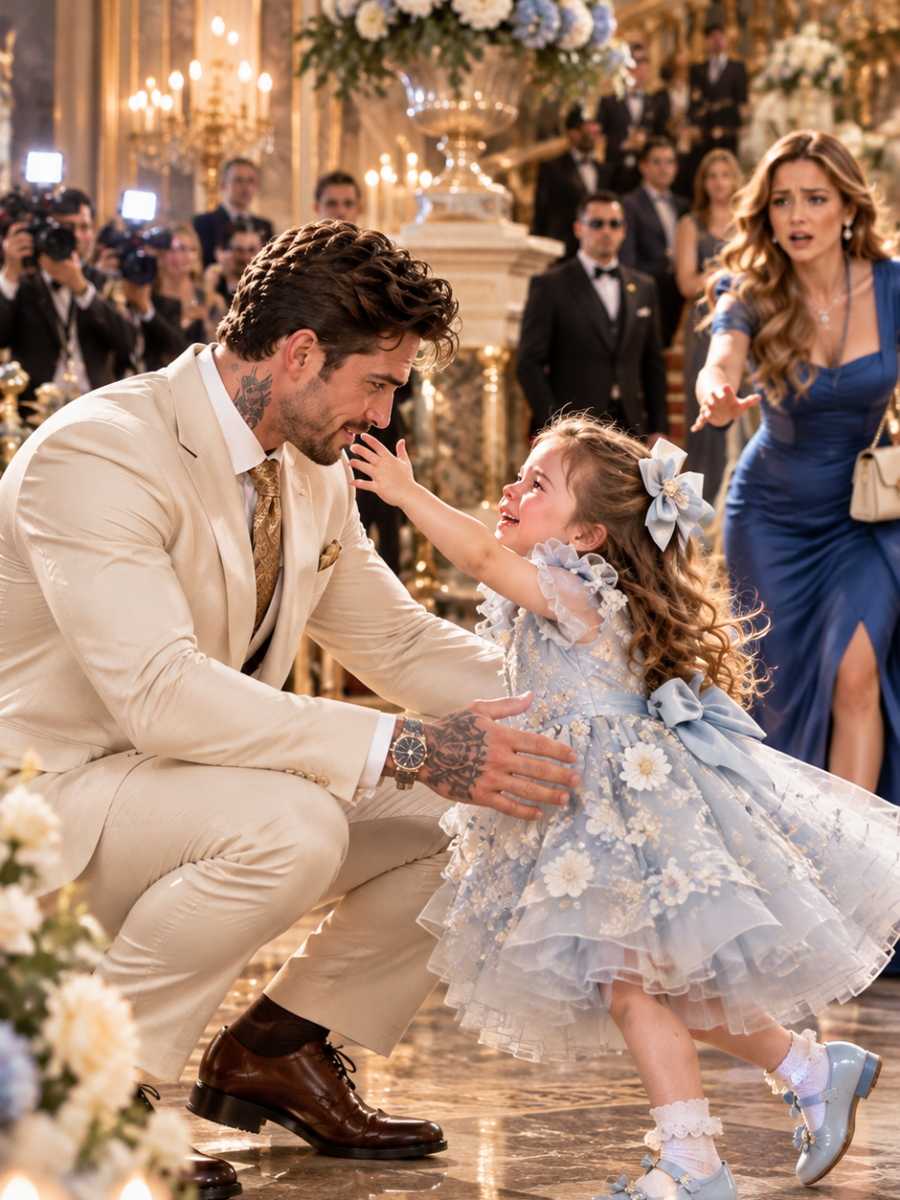
Before my bodyguard could react, a small blur in a faded navy pinafore and a mint-green satin ribbon burst right through the cordon. She hit my knees at full tilt, her small arms throwing themselves around my thighs with a fierce, desperate strength that nearly knocked me off balance. The cardboard check slipped from my hands and tumbled onto the concrete.
Her dark curls brushed against my trousers. Her entire body shook as she buried her face against my jacket, sobbing into the cashmere. “I knew you’d come! I told them you’d come!”
The press went dead silent. Shutters stopped clacking. Forty grown adults froze on the sidewalk.
I dropped to both knees on the pavement, completely unmindful of the five-thousand-dollar wool grinding against the grit. I reached out, my fingers trembling violently as I touched her small shoulders. When she lifted her face, my heart slammed against my ribs with sickening force.
She had Claire’s almond eyes—deep, expressive amber, framed by long lashes. But the stubborn line of her jaw and the slight crook of her brow belonged entirely to me.
“Sweetheart,” I managed, my throat closing up like a dry pipe. “What’s your name?”
Her bright, tear-streaked smile collapsed into immediate bewilderment. Her tiny fingers tightened on my lapel. “You don’t know me, Daddy?”
Before I could answer, a flustered woman in her mid-fifties wearing an administrator’s badge hurried through the glass double doors, out of breath and pale as linen. “Mr. Rivers, I am so sorry! Emma saw your face on the morning news broadcast thirty minutes ago and slipped past the playground monitor—”
The woman abruptly cut herself off. She looked at Emma clinging to my coat, then up at my face. The color drained from her cheeks until she looked like a ghost.
“Is her mother’s name Claire Bennett?” I demanded. My voice wasn’t that of a hedge fund executive; it was the raw croak of a man falling through thin ice.
The woman’s lips parted, trembling. “Mr. Rivers… perhaps we should take this into my private office.”
“Where is Claire?” I shouted, rising to my feet and scooping Emma into my arms purely on instinct. The little girl wrapped her arms around my neck and buried her nose into my collarbone, smelling faintly of baby shampoo and cinnamon. “Is she here? Is she alive?”
The director looked down at the concrete, her eyes brimming with a terrible, heavy sorrow. She didn’t speak. She touched my arm, her hand cold through my sleeve, and gestured toward the quiet brick building behind her.
“Mr. Rivers,” she whispered softly. “Claire left something for you. She made us swear on our lives that we would only release it if you walked through these doors looking for your daughter.”
And when she finally opened the office door and spoke, the first four words shattered everything I thought I knew about the world.
↑ Back to Chapter 1
“She Never Stopped Waiting”
The director’s office was quiet, smelling of lemon polish and worn paper. Outside, my head of security was dispersing the press and locking down the perimeter, but inside those four walls, the noise of the city ceased to exist. Emma refused to let go of my hand. She sat on the edge of a corduroy sofa, her tiny sneakers swinging an inch above the carpet, watching me with an intensity that made it difficult for me to stand upright.
The director closed the heavy oak door, turned the brass lock, and stood behind her desk. Her nameplate read Martha Finch, Executive Director.
“Sit down, Mr. Rivers,” Martha said softly, her voice carrying none of the deference usually afforded to men of my net worth. “Please.”
I didn’t sit. I pulled a wooden chair close to Emma, sinking into it so our knees touched. “Where is she, Martha? If Claire is sick, I don’t care what it costs. Johns Hopkins, Mayo Clinic, Zurich—I’ll have a medical jet on the tarmac in two hours.”
Martha took off her wire-rimmed glasses, her hands unsteady as she set them on a leather blotter. She looked at me not with anger, but with an overwhelming, suffocating pity. That pity hurt worse than any fist.
“Claire passed away seven months ago, Michael,” Martha said.
The room seemed to tilt. The blood rushed from my head with the roar of a subterranean train. I gripped the edges of the wooden chair, my knuckles turning stark white. “No. No, that’s impossible. She was twenty-seven. She was healthy. She rode her bike across the lakefront every Sunday—”
“Postpartum cardiomyopathy,” Martha interrupted quietly. “Her heart was weakened during delivery, but she never complained. She refused to stop working. She kept two bookkeeping jobs while raising Emma in a third-floor apartment on Lincoln Avenue. By the time she collapsed last winter, the damage was irreversible. She fought for four weeks in the ICU before she succumbed.”
I felt a sickening tightness in my chest, as if an invisible band of wire were constricting around my lungs. The money in my accounts, the four properties, the investment funds—every cent was worthless trash. I had been dining in three-star Michelin restaurants in Manhattan while the woman who loved me was drowning in her own lungs, working twelve-hour shifts to afford baby formula.
“Why didn’t she call me?” I choked out, a hot tear finally breaking free and tracking down my cheek. “She knew where my firm was. I was in the papers every month! All she had to do was dial the switchboard!”
“Because Claire knew you, Michael,” Martha replied, her voice firm yet achingly gentle. “She said if you gave her money out of guilt, it would poison Emma’s spirit. She said a father’s duty wasn’t a transaction. She told me: ‘If Michael ever remembers us, he has to come back because his soul hurts, not because I handed him a bill.’”
Beside me, Emma reached out. Her small palm pressed against my wet cheek. She didn’t look frightened; she looked concerned for me, a five-year-old child comforting a grown billionaire who was disintegrating before her eyes.
“Don’t cry, Daddy,” she whispered. “Mommy said you were doing big things. She said you’d have to find your way through the tall buildings before you came home.”
I bowed my head against her tiny shoulder and broke. I had not cried since I was eleven years old, but right there, in that cramped charity office, five years of calculated arrogance washed away in racking, silent sobs. Emma patted my hair with her little hand, exactly the way Claire used to do when I lost a contract in our early days.
After several minutes, Martha unlocked the lower drawer of her metal filing cabinet. She pulled out a heavy manila envelope, sealed with a circle of blue wax, and a small, tarnished silver key on a faded red ribbon.
“Claire spent her final three days writing this,” Martha said, placing the envelope and the key on the table between us. “She paid for a safety deposit box at Chicago First Heritage Bank with her last seventy dollars. She told me: ‘If Michael comes, give him this. If he never comes… burn it when Emma turns eighteen.’”
My fingers hovered over the blue wax, and as I broke the seal, Claire’s familiar handwriting hit my chest like a physical blow.
↑ Back to Chapter 2
The Letter in the Blue Envelope
Claire’s handwriting was neat, slanted slightly to the right, written in the dark blue fountain pen ink she had always favored. The paper smelled faintly of lavender and hospital disinfectant—a heartbreaking collision of the girl I left and the mother who died alone.
Emma sat quietly on the sofa now, coloring with a box of crayons Martha had fetched, humming a little nursery rhyme under her breath. Her presence was both my salvation and my punishment. I unfolded the three pages, my hands shaking so violently that the paper rustled in the quiet room.
“Michael,” the letter began.
“If you are reading these pages, it means you finally stopped running. It means you walked into Sunrise, looked at the world beyond your balance sheets, and found our girl. Or maybe you just came to write a check and fate decided to drag you by the collar. Either way, you are here. And Emma is looking at you.”
I had to squeeze my eyes shut against the stinging tears before I could read the next paragraph.
“I am not writing this to curse you. When you walked out of our apartment that night, I spent six months hating you with every fiber of my being. I cursed your name when the morning sickness made me sick on the train. I cursed you when the hospital bills piled up on the counter. But the night Emma was born—at 4:17 on a rainy Thursday morning—the nurse placed her on my chest. She opened her eyes, Michael. And she looked right through me with your exact dark eyes.”
“In that second, all the hatred evaporated. I realized that if I held onto bitterness, Emma would drink that poison every day of her life. So I made a decision. I told her the truth, but I told it with grace. I told her that her daddy was a brilliant, driven man who was fighting dragons in the city of glass. I told her you were building something enormous, and that one day, when your work was finished, you would walk through the door and scoop her up into the clouds.”
A tear fell from my chin, soaking into the fiber of the page, blurring the blue ink over the word dragons. I hadn’t been fighting dragons. I had been hoarding money like a coward, hiding behind lawyers and quarterly reports.
“The doctor says my heart cannot sustain another winter. I am not afraid of dying, Michael, but I am terrified of leaving Emma alone in this world. My uncle Richard has already sniffed around, asking about life insurance and state survivor benefits. If he gets his hands on her, he will milk her for every social check and neglect her in an empty room. Don’t let him take her.”
“The silver key belongs to Box 412 at Chicago First Heritage on LaSalle Street. It holds her birth certificate, my mother’s wedding band, and five years of letters I wrote for every birthday Emma has yet to celebrate—up to her eighteenth. Take them. Read them to her on her birthdays. Teach her how to ride a bicycle. Make sure she eats her broccoli before her dessert.”
“I forgive you, Michael. Not for your sake, but for hers. Don’t waste your remaining years drowning in regret. Be the man I thought you were when we were twenty-two and believed we could change the world. Love her. That is all the restitution I will ever ask of you.”
The letter ended simply:
“Always your Claire.”
I folded the paper with reverent care and pressed it against my chest, right over my own racing heart. I looked over at Emma. She was drawing a house with a green roof, two stick figures holding hands, and a giant sun with yellow rays. Beneath the figures, in clumsy kindergarten print, she had written: DADY AND ME.
I walked over to the couch, knelt down on the rug, and gently took her small crayon from her fingers. “Emma?”
She looked up at me, her amber eyes wide and expectant.
“Your mommy was the bravest person who ever lived,” I whispered, my voice thick with emotion. “And I’m never leaving you again. Do you understand me? Never.”
Emma didn’t hesitate. She threw her arms around my neck and buried her nose into my ear. “I knew it,” she whispered triumphantly. “Mommy said you just needed time.”
A sudden pounding on the glass outer door shattered our moment, followed by the angry raised voice of a man demanding to enter.
↑ Back to Chapter 3
The Keepsake Chest and the Broken Watch
Martha hurried to the window, peering through the blinds toward the foyer. Her expression hardened instantly. “It’s Richard Bennett. Claire’s uncle. He brought a local TV crew with him.”
Emma shrank back against the sofa cushions, her small shoulders curling inward. The joyful spark in her eyes vanished, replaced by an instinctive, learned terror. “Daddy… Uncle Richard is mean. He shouted at Mommy when she was in the bed with the beeping machines. He said she was lazy.”
Something cold and volcanic ignited in the pit of my stomach. The guilt that had crippled me for five years didn’t vanish—it weaponized itself into an unyielding wall of protective fury. I stood up, adjusting my cuffs.
“Martha,” I said, my voice completely steady now, dropping into the icy register that corporate boards had learned to fear. “Does he have legal custody?”
“No,” Martha said, locking her hands together. “When Claire passed, she named Sunrise as temporary guardian while the state processed foster placement. Richard filed a petition claiming kinship custody three weeks ago. The court hearing is scheduled for next Monday. But he found out about your donation this morning—it was all over the news ticker.”
“He wants the money,” I said.
“He wants three million dollars,” Martha corrected grimly. “He told me last Friday that if the orphanage received an endowment, he expected an ‘administrative settlement’ to take the burden of Emma off the state’s hands.”
I picked up the silver key on the desk. “Where is the keepsake box Claire left here?”
Martha nodded quickly. “In the vault downstairs. Follow me.”
I lifted Emma into my arms, resting her against my hip. She clutched my shoulder, her fingers digging through my jacket. We walked down a narrow flight of concrete stairs into the secure storage room beneath the administration wing. Martha unlocked a green steel locker and pulled out a small, cedar-wood box with brass hinges.
I placed the box on a wooden workbench and inserted the tarnished silver key. The lock clicked open with a soft, clean snap.
Inside lay twelve thick envelopes, each labeled with a year: For Emma’s 6th Birthday, For Emma’s 7th Birthday, all the way to For Emma’s 18th Birthday. Beneath them sat an infant’s silver rattle, a lock of dark baby hair tied with red thread, and an object wrapped in a faded blue cotton handkerchief.
I peeled back the handkerchief. My breath caught.
It was a scratched Seiko stainless steel watch. The crystal was cracked across the three-o’clock marker. The leather strap was worn raw at the buckle.
It was the watch my grandfather gave me for my high school graduation. Five years ago, on the night I packed my bags in our Chicago apartment, I took it off and threw it onto our kitchen table in anger because Claire had begged me to look at the time, to see that we still had a whole life ahead of us.
She hadn’t thrown it away. She hadn’t sold it for scrap metal when she couldn’t afford groceries. She had kept it wrapped in her handkerchief for five long years.
Emma reached out and touched the glass with one tiny fingertip. “Mommy kept that in her drawer. Every night she would wind it.”
“She did?” I whispered, my vision swimming.
“She told me: ‘When this watch ticks again, Daddy is finally home.’”
I held the crown between my thumb and forefinger. I turned it slowly. One click. Two clicks. Three clicks.
The second hand gave a shuddering twitch, jumped forward across the cracked glass, and began to tick with a steady, unbreakable rhythm.
↑ Back to Chapter 4
The Ambush at Sunrise
When we ascended the stairs back to the main foyer, the scene was chaotic. Two Chicago police officers, summoned by my security detail, stood between the outer glass doors and an aggressive man in an ill-fitting brown sports coat. Behind him stood a slick-haired attorney holding a manila briefcase and a cameraman from a local tabloid channel with a shoulder-mounted lens aimed through the glass.
That was Richard Bennett. He was fifty-two, red-faced, with yellowed teeth and the desperate swagger of a career gambler down to his last fifty dollars.
“Let me in!” Richard was roaring at my security guard. “That’s my niece’s child! I’m her legal flesh and blood! You got a billionaire in there trying to smuggle an orphan out the back door without court authorization!”
Emma whimpered and buried her face against my neck. “Daddy, don’t let him take Sweepy.”
“Sweepy?” I asked gently, stroking her back.
“Her stuffed rabbit,” Martha whispered beside me. “Richard threw it across the hospital room when Claire was dying because he claimed it was contaminated with germs.”
That was all I needed to hear. The last trace of hesitation vanished from my heart. I handed Emma gently to Martha Finch. “Take her into the library, Martha. Close the inner doors. Give her some apple juice.”
“Michael, be careful,” Martha murmured. “He has an active petition with Child Protective Services.”
“He has a death wish,” I replied flatly.
I turned, squared my shoulders, and strode toward the glass foyer doors. The security guards parted immediately. I pushed the door open and stepped out onto the wide stone terrace. The cold October wind whipped against my tie, but I didn’t feel it.
Richard Bennett froze when he saw me. His eyes flicked from my tailored suit to my polished oxfords, then to my face. A greasy smile spread across his lips.
“Rivers,” Richard barked, stepping forward with his hand outstretched. “Well, well. The runaway prince returns. I see you finally found out about little Emma. Sad business with Claire, wasn’t it? Very tragic.”
I ignored his hand completely. I kept mine in my pockets. “You have thirty seconds to get off this property before I have you arrested for criminal trespass.”
Richard’s lawyer, a skinny man named Higgins with a predator’s grin, stepped forward, tapping his leather folder. “Mr. Rivers, I’d advise against threats. My client is Emma Bennett’s sole living adult relative of record. You abandoned the mother five years ago. Legally, you are a complete stranger to that child. You are not on the birth certificate. You have zero paternal standing under Illinois law.”
“Is that right?” I asked softly.
“That is a legal fact,” Higgins said smoothly. “Now, my client understands that you are a very busy, very wealthy man. You don’t want a circus in the Chicago Tribune. You don’t want headlines about billionaire deadbeat dads abandoning pregnant women to die in public wards. We are prepared to sign a complete waiver of custody and parental surrender… for an endowment settlement of two million dollars.”
Richard chuckled, leaning against the stone balustrade. “Two million is pocket change for you, Rivers. Pay the fee, and you take the kid. Refuse, and I drag Emma through family court until she’s twelve years old, and I’ll make sure every news station in North America broadcasts your face every single day.”
I looked at Richard Bennett. I looked at the cameraman whose red recording light was blinking.
I pulled my phone from my pocket, dialed my chief legal counsel in New York, and said four words into the speaker: “Execute the contingency wall.”
↑ Back to Chapter 5
The Lion’s Wall
Men like Richard Bennett operate under the delusion that wealth makes a man vulnerable to extortion. They believe that fear of bad publicity will cause any wealthy target to write a check just to make the nuisance disappear. They forget that the men who build financial empires do not do so by yielding to scavengers.
“Thirty minutes, Richard,” I said, putting my phone away. “Stand right there. Don’t leave.”
“You think you’re scaring me with a New York lawyer?” Richard laughed, but his eyes darted nervously toward his attorney. “This is Cook County, pal. I was born here.”
Twenty-two minutes later, two black Cadillac Escalades pulled smoothly up to the curb, tires hissing against the wet asphalt. Four men in dark charcoal suits stepped out. Leading them was Eleanor Vance, the most ruthless family law and criminal litigation attorney in the Midwest, whom my firm kept on a permanent half-million-dollar annual retainer.
Behind her walked two uniformed officers from the Cook County Sheriff’s Financial Crimes Unit.
Eleanor didn’t even look at Higgins. She walked straight up the stone stairs, unbuttoning her wool overcoat, and opened a blue leather dossier. “Richard Bennett?”
Richard blinked, backing up half a step. “Yeah? What of it?”
“I am Eleanor Vance, representing Mr. Michael Rivers,” she said in a clear, ringing soprano that silenced the entire courtyard. “At 10:45 AM today, an emergency expedited paternity filing was submitted electronically to Judge Harrison in Cook County Family Court, accompanied by an affidavit of voluntary acknowledgment and an emergency DNA buccal swab authorization from Mr. Rivers. The judge signed an emergency temporary protective custody order fifteen minutes ago.”
She handed a stamped court document directly to the two Chicago police officers standing by the door. The officers reviewed the gold seal and nodded.
“That’s garbage!” Higgins sputtered, waving his hands. “He can’t just bypass the custody queue—”
“He didn’t bypass it, counselor,” Eleanor continued, her eyes drilling into Higgins like diamond drill bits. “Furthermore, Sheriff’s Deputies Miller and Kowalski are here on a separate warrant. Mr. Bennett, on March 14th of this year, three days following Claire Bennett’s funeral, you attempted to forge her signature on a forged change-of-beneficiary document for a fifty-thousand-dollar term life policy through Mutual Benefit Illinois.”
The color vanished from Richard’s face so fast he looked as though he had been struck with a club. His mouth fell open. “That’s… that’s a lie. She wanted me to have that—”
“We have the forensic handwriting analysis,” Eleanor said, pulling out a second sheaf of documents. “And we have the recorded phone call you placed to the claims adjuster threatening him if he didn’t expedite payment to your personal offshore account. That is attempted wire fraud, grand larceny, and felony forgery. The State’s Attorney signed the indictment twenty minutes ago.”
Deputy Miller stepped forward, pulling a pair of steel handcuffs from his belt. “Turn around, Richard. Hands behind your back.”
The cameraman lowered his lens, clearly realizing he had just recorded his own client’s arrest for felony fraud.
Richard struggled as the cold steel ratcheted around his wrists. He looked at me, his eyes bloodshot with rage and terror. “Rivers! You bastard! You left her! You’re no better than me!”
I walked down the steps until I was standing six inches from his face. I didn’t raise my voice. I didn’t yell. My words were as cold and sharp as surgical steel.
“I was a coward five years ago, Richard,” I whispered. “I ran from the woman I loved because I was terrified of responsibility. But I am not running now. And I will spend every single dollar I possess, every hour of my life, making sure you spend the next ten years in a state penitentiary where you will never lay eyes on my daughter again.”
As the police cruiser pulled away with sirens flashing, the courtyard fell silent, leaving only the sound of small footsteps approaching the glass door.
↑ Back to Chapter 6
White Lilies on the Hillside
By three o’clock that afternoon, the legal paperwork had been expedited through the highest levels of the Cook County court system. With paternity acknowledged and certified by immediate blood sample, and with Claire’s notarized testament naming me as Emma’s sole guardian in the event of my return, the custody transfer was completed without impediment. Sunrise Children’s Home was granted the full three-million-dollar endowment—not as a publicity stunt, but as a permanent, debt-free trust to ensure no child beneath its roof would ever go without shelter or care.
Before taking Emma back to New York, there was one place we had to go.
The limousine carried us through the quiet suburbs to Oakridge Cemetery, a rolling expanse of green hills and ancient willow trees west of Chicago. The autumn air was crisp, carrying the scent of damp earth and fallen leaves. I held Emma’s small hand as we walked up the gentle slope of Section 14.
In my other hand, I carried a bouquet of fresh white lilies—the flowers Claire had loved to buy from the corner bodega on Friday evenings when we only had twenty dollars left for groceries.
We stopped before a simple granite marker set flush into the grass. The stone was modest, purchased with the small savings Claire had managed to preserve:
CLAIRE BENNETT
1998 – 2026
“A mother’s love outlives the stars.”
My knees gave way. I dropped onto the damp earth beside the stone, pressing my forehead against the cold granite. The stone was smooth, chilled by the October wind.
“Claire,” I whispered. The word tore from my throat like broken glass. “I’m so sorry. I was blind. I was small. I threw away the greatest treasure God ever put in my path.”
I wept openly, letting my tears soak into the grass beside her name. Five years of late nights, five years of board meetings, five years of empty penthouses and hollow victories—all of it felt like a ghost story compared to the reality of the woman who had died alone on a hospital bed, protecting our daughter with her final breaths.
“I promise you,” I choked out, my fingers tracing the carved letters of her name. “On my life. On my soul. Emma will never know fear again. She will never doubt that she is loved. I will spend every day making sure she becomes the woman you wanted her to be.”
Emma stood beside me, watching with quiet, solemn reverence. Then, without a word, she reached up to her dark hair. Her tiny fingers worked at the mint-green satin ribbon she had worn all day.
She pulled it free. Her dark curls tumbled down around her shoulders.
She knelt beside me on the grass, smoothed the ribbon with both hands, and laid it gently across the top of the granite headstone. She placed the white lilies right beside it.
“Mommy,” Emma whispered, leaning forward to kiss the stone. “Daddy found us. You can sleep now. He has the watch, and it’s ticking.”
A sudden gust of wind swept across the hillside, rustling the willow branches like a gentle sigh, and for the first time in five years, the crushing weight in my chest released.
↑ Back to Chapter 7
The Penthouse by the Park
Six months later, the twenty-eighth floor of my Manhattan residence was completely unrecognizable.
The cold, minimalist glass-and-steel showroom that interior designers had once praised in architectural magazines had disappeared. In its place was a warm, vibrant home. The marble foyer now had a small wooden coat rack with tiny pink boots and a miniature raincoat. The soundproof glass walls overlooking Central Park were decorated with colorful finger paintings, handprint turkeys, and a giant poster of the solar system.
On the grand piano in the living room sat three framed photographs. The first was Claire at twenty-one, laughing in a Chicago coffee shop with foam on her nose. The second was Claire holding baby Emma wrapped in a yellow blanket. The third was a photo taken just last week: Emma sitting on my shoulders beneath the blooming cherry blossoms in Central Park, holding an ice cream cone and grinning from ear to ear.
Every night at 7:30 PM, regardless of market volatility or pending mergers, my phone went onto silent mode. I didn’t care if Tokyo was crashing or London was rallying. At 7:30 PM, I was in Emma’s bedroom, sitting beside her canopy bed, reading from one of the letters Claire had left in Box 412.
That evening, Emma was propped up against her pillows, wearing rabbit pajamas and hugging Sweepy—whom my security team had personally retrieved and professionally sanitized until the stuffed toy looked brand new.
“Daddy?” she asked, her amber eyes reflecting the soft glow of her bedside lamp.
“Yes, sweetheart?”
“Are you going to work tomorrow?”
“Only until lunch,” I smiled, pulling the quilt up to her chin. “Because tomorrow is Saturday. And tomorrow we are going to the American Museum of Natural History to see the blue whale, just like Mommy’s letter said.”
Emma clapped her hands in delight, then looked at my left wrist. The scratched Seiko watch was on my arm, ticking faithfully against my pulse. I had never replaced the cracked crystal. I never would. That scratch was a reminder of the night I broke my life, and the ticking was a reminder of the grace that repaired it.
“Daddy?” she whispered, her voice growing soft as sleep began to claim her.
“What is it, Emma?”
“I’m glad you found your way through the tall buildings.”
I leaned down, kissed her forehead, and felt a profound, unshakeable peace that all the billions on Wall Street could never buy.
“Me too, baby,” I whispered in the dark. “Me too.”
I closed her bedroom door, looked out over the glittering lights of Manhattan, and knew that for the first time in thirty-two years, I was finally a wealthy man.
↑ Back to Chapter 8