“Hug?” The Most Feared Man in New York Held a Stranger’s Toddler in Central Park — Then Her Mother Said, “It’s About Who Lily Really Is to You.”
I’m Alessandro Moretti, and for fifteen years, men twice my size have trembled when I walked into a room. The morning before my wedding, a folded DNA report in my coat destroyed the future I thought was mine. Then, in Central Park, a two-year-old in a golden princess dress lifted both arms and said one word that nearly brought me to my knees. Her mother came running down the path. I knew her face. She was the woman who had saved my life eight years ago. Read every chapter to find out what she had been hiding.
Hug?
“Don’t be afraid of me, little one.”
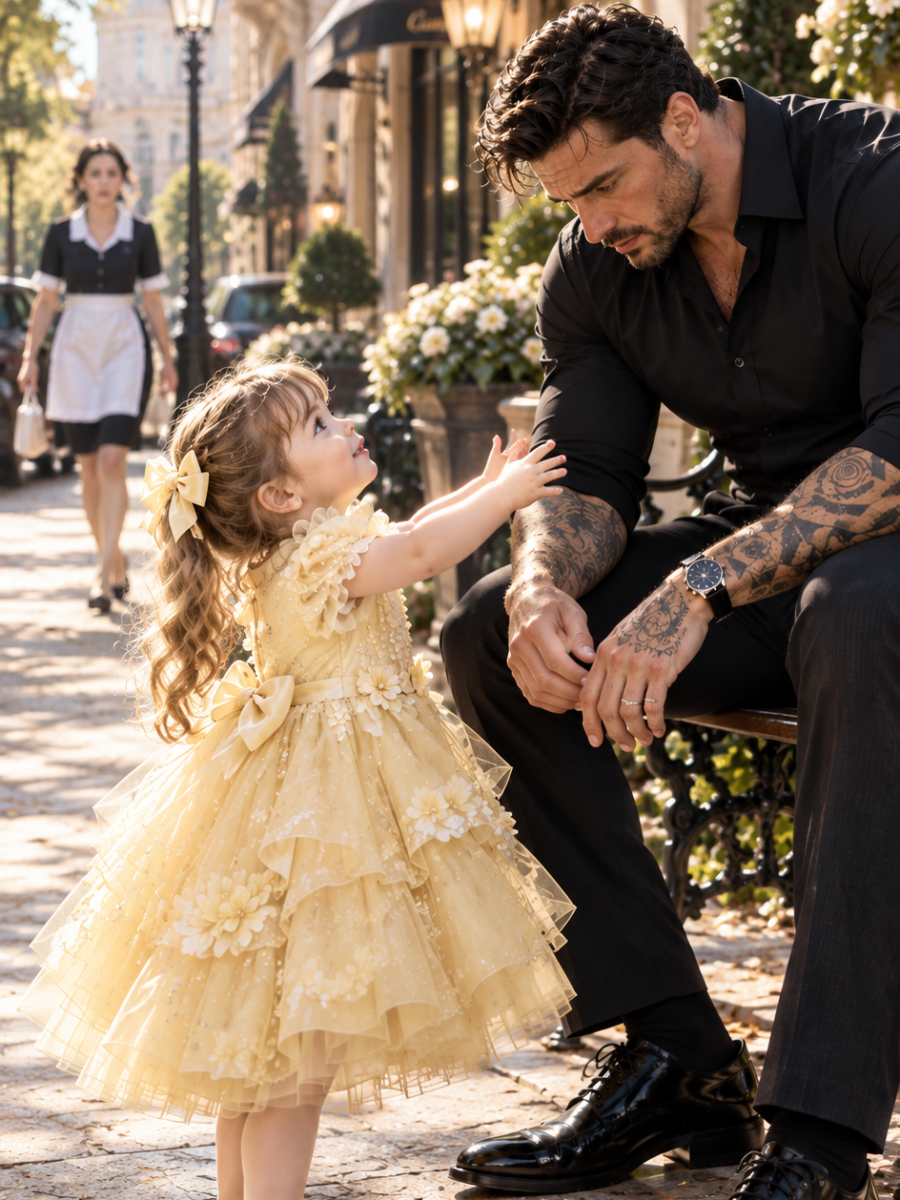
The tiny girl stared up at me with enormous dark-brown eyes. Then, instead of running, she lifted both arms.
“Hug?”
I froze. Men twice my size had trembled when I entered a room. Yet somehow, that one word nearly brought me to my knees.
My name is Alessandro Moretti, and for fifteen years I had been one of the most feared men in New York. But that morning, none of it mattered. Not the money, not the influence, not the people who answered when I called. Inside my coat was a folded DNA report containing four words that had destroyed the future I thought belonged to me.
Probability of paternity: 0%.
Tomorrow was supposed to be my wedding day. For months I had been preparing to become a father. There was already a nursery inside my mansion, a handcrafted crib under the window, stuffed animals lined neatly along the shelves. I had even bought three pairs of tiny shoes because I didn’t know what size a newborn needed. Then Sofia, my fiancée, finally confessed. The baby she carried wasn’t mine.
So I left the mansion and walked, without a driver and without my men, until my feet carried me into Central Park. That was where she found me.
The little girl couldn’t have been more than two. She had fair skin, round rosy cheeks, and long, slightly wavy dark-brown hair beneath two oversized bright-yellow bows. Her sparkling golden-yellow princess dress looked impossibly cheerful against the gray morning. In both hands she held a pink heart-shaped mirror, which she studied for a moment, comparing the face in it with mine.
“Sad,” she announced.
I almost laughed. “You’re very observant.”
She held the mirror up toward me. “Look.” I glanced at my reflection, and she was right. I looked like a man who had lost something, because I had. I had already loved a child who had never been mine.
“Where’s your mother?” I asked, and she pointed down a nearby path. “Mama.” “Then you should stay close to her.” She shuffled closer instead, and one of the yellow bows began to slip sideways. “Name?” she asked, tilting her head. “Alessandro.” She tried it out loud, her small mouth working. “San-dro.” For the first time all day, I smiled. “That’ll do.”
She noticed my hand clenched around the report in my pocket, and her little fingers touched mine. “Boo-boo?”
“Something like that.”
Her face turned solemn. She lifted her arms again, and I knew I should have called for her mother. Instead, I slowly opened mine. She climbed against me without a moment of hesitation, wrapped her arms around my neck, and smelled faintly of strawberries and baby shampoo. The man who was feared across New York sat on a park bench, holding a stranger’s toddler, with tears burning behind his eyes.
“Thank you,” I whispered into her yellow bow.
She patted my shoulder. “Okay, Sandro.”
Then I heard someone running.
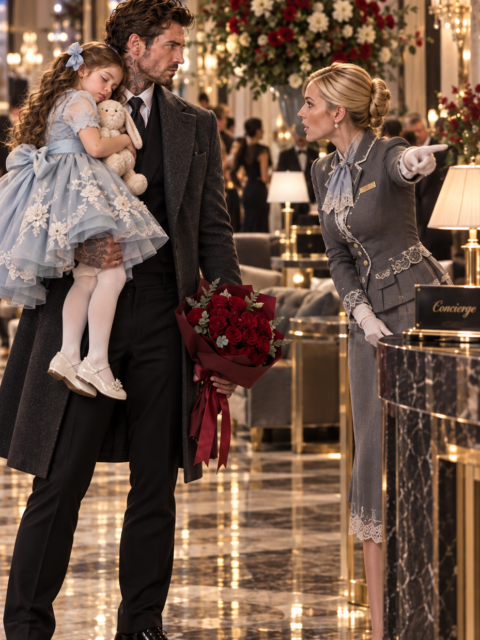
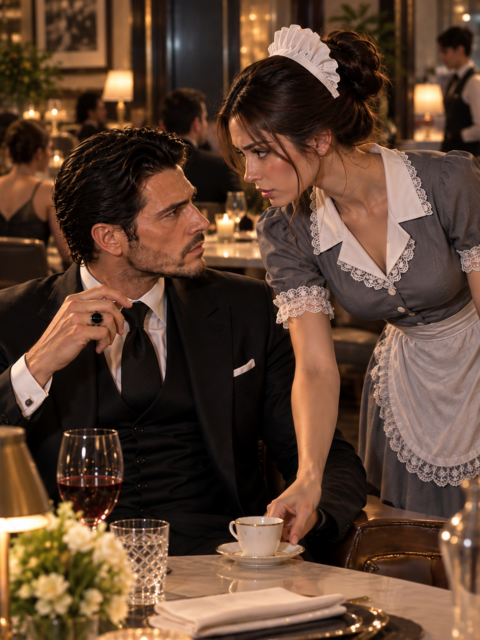
“Lily!” A woman in a gray maid’s uniform hurried up the path, and when I lifted my head and saw her face, eight years disappeared in an instant.
Back to top ↑
The Girl From the Alley
I remembered rain. I remembered a dark alley behind a Brooklyn clinic and the sound of tires on wet asphalt, and the way blood feels when it soaks through a good shirt faster than a man believes possible. Eight years earlier, my convoy had been ambushed on Atlantic Avenue. I had gone down on one knee, then onto the pavement, and the last thing I saw before the dark came up was a young woman in blue scrubs kneeling in the puddles beside me, pressing both trembling hands against my side.
She had hidden me in the back room of that clinic. She had stitched my wounds with a hand so unsteady that she wept the whole time, and she had kept me alive until the morning. When I woke up, she was gone, and there was only a folded note on the pillow in a small, neat hand. Don’t look for me. You aren’t safe, and neither am I.
I had looked anyway. I had looked for eight years. I had paid investigators in four states and promised a stranger’s face a debt that I could not name, because a man like me does not forget the person who hands him his life back.
Now she stood ten feet away on a gray November path in a maid’s uniform, with her chestnut hair coming loose from its pins and a look on her face I could not read.
“Isabella?” I whispered.
The color drained out of her face. In my arms, Lily looked from her mother to me and clutched her pink mirror to her chest. “Mama know Sandro?”
Isabella slowly crossed the last few steps and took her daughter’s hand. “Yes, sweetheart,” she said softly. “I know him.” Then her eyes came up to mine, and there was fear in them. There was something else too, something that made my heartbeat change in a way I had not felt since I was a boy.
“Alessandro,” she said quietly, “I never expected you to meet Lily like this.”
“What does that mean?”
Isabella looked down at her daughter, and then back at me. The wind pulled at the hem of the yellow dress. A jogger passed on the path behind us with headphones in, and a pigeon hopped across the frozen grass, and the whole city went on as if nothing in the world had shifted.
“There’s something I should have told you years ago,” she said.
I stood, still holding the child, because I could not bring myself to put her down. “What?”
She hesitated. I watched her fight the thing she had been carrying, I think for as long as that child had been alive, and when she finally spoke, her voice was barely more than breath.
“It’s about who Lily really is to you. She isn’t a stranger, Alessandro. She’s Dante’s daughter.”
Back to top ↑
What Dante Left Behind
My brother Dante had walked away from our family when he was twenty-two, the winter our father died. He had refused the money and the men, and the name above our door. He had wanted to be a doctor, and I had called him a fool at the funeral, and it was the last real conversation we ever had. Three years ago a state trooper had called me at four in the morning to say that a gray sedan had gone off the Taconic Parkway in the rain. I had buried my brother in a cemetery in Queens, and I had believed for three years that the road had simply killed him.
Isabella told me the rest on a bench by the Bethesda Fountain, with Lily asleep against my shoulder, and she told it the way a person tells a story she has rehearsed alone at night until it stopped sounding like language.
“Dante was the volunteer medic at the clinic,” she said. “That night in the alley. I found you, and I couldn’t lift you, so I ran inside for help, and he came out in his scrubs, and he looked at your face and went white. He said, ‘That’s my brother.’” She was crying without sound. “He carried you inside. He sewed you up himself. He told me not to let you see him, and not to tell you who we were. He said if you knew he was there, you’d never let him leave again, and he couldn’t go back. He would have been dragged under, and he’d have died in that world, like our father did.”
“So you disappeared.”
“We both did.” She wiped her cheek with the back of her wrist. “We fell in love in that clinic, Alessandro, over a year of night shifts. He told me everything about you. How you taught him to ride a bike. How you used to cut the crusts off his sandwiches.” She tried to smile. “He talked about you every day. He was so proud of you and so afraid of what you’d become.”
I looked down at the child asleep against my collar. My brother’s dark hair. My brother’s dark-brown eyes, the ones that had looked at me so steadily over a mirror in the cold. I had been sitting on a park bench, holding a toddler, and some part of me had known since the moment she lifted her arms.
“What happened on the Taconic?” I asked.
Isabella’s voice dropped. “Dante found out who set up the ambush eight years ago. It wasn’t a rival, Alessandro. It was someone inside your own circle. He’d been gathering evidence for two years, quietly, on his own. He was going to bring it to you. He was driving to Manhattan the night he died.” She swallowed. “He had called me from the car. He said he’d finally proved it, and that he was going to put the whole thing in front of you in the morning.”
“Who?” I asked. My voice did not sound like mine.
“Carmine Vitale,” Isabella whispered. “The man whose daughter you’re supposed to marry tomorrow.”
Back to top ↑
The Nursery
I did not go back to the mansion at once. I walked Isabella and Lily to the Upper East Side apartment where she worked as a live-in maid for a family that knew nothing about her past, and I asked her to pack a bag. She asked me why. I told her that the man who killed my brother had a daughter who slept in my house, and that I would not leave my brother’s child anywhere he could reach her. I think I said it badly. She packed.
It was after dark when I walked into the mansion by myself and found Sofia in the nursery.
She sat in the white rocking chair beside the crib I had carved with my own hands, one palm resting on her belly, and she did not look up when I came in. She had been crying. For eleven months I had believed I knew every face she owned, and I realized, standing in the doorway, that I had never once seen this one.
“You know,” she said. “About Dante.”
“How do you know what I know?”
“Because I saw your face at the door.” She finally lifted her eyes. “Papa told me the day you proposed. He said, ‘This is the end of it, Sofia. Marry him, and we’ll own the whole city by spring.’ I didn’t know about your brother. I swear to you on the baby, Alessandro, I didn’t know until three weeks ago, when I found a file in his study.” Her voice cracked. “I was going to tell you. I told you about the baby first, because I thought if I told you the rest you would…”
“Whose child is it, Sofia?”
She looked at her hands. “Marco Bellini’s. One of Papa’s men. I met him at a charity gala before I met you. I’d been lonely, and I was stupid, and then Papa arranged your introduction.” She laughed bitterly. “He wanted a Moretti grandson. He didn’t care whose blood it was, as long as it carried your name.”
I stood in the dark with the crib between us and felt nothing at all, and that scared me more than anger would have. I had spent three months imagining a boy who looked like me, a boy I would teach to ride a bike. I had never loved Sofia. I had loved the idea of the future. And a man who has been alone for fifteen years will build a house for whatever walks toward him.
“Where is he now?” I asked. “Your father.”
“At the club. He’s been drinking since the afternoon.” She took a ragged breath. “He had a man follow you to the park today, Alessandro.” She stood, and her hand tightened on her stomach. “He saw you with the child and the woman. I heard him on the phone. He said, ‘That maid is Dante’s whore.’ He said, ‘Take care of it before the wedding.’”
I was across the nursery before she finished the sentence, my phone already at my ear. “Enzo,” I said. “Where is Isabella Reyes right now?”
Back to top ↑
Three Pairs of Shoes
Enzo, my oldest lieutenant, had put two men at the building on East Seventy-Eighth Street after I left. They were the only reason that what happened next was not a funeral. A black Escalade pulled up to the curb at 9:41 that night, and four of Vitale’s men got out. My men were waiting. Nobody fired a shot. They sent the Escalade back the way it had come, with one man in the back seat who would never again be able to hold a pistol, and a message for Carmine Vitale that I had dictated myself.
By ten, Isabella and Lily were in the east wing of my mansion, under six guards and a locked gate, with a doctor on call. By eleven, Isabella was sitting on the edge of the guest bed with her coat still on, staring at the wall, as though if she moved she would wake up and find herself in a cold apartment with the lights off.
Lily had refused to sleep anywhere but the nursery. I had not planned that. The room was the one that was ready, and I stood in the doorway at midnight and watched my brother’s daughter climb into the crib I had carved for a baby who did not exist.
“Sandro,” she said sleepily, through the slats. “Bed.”
I crouched beside the crib. The yellow bows had finally come out of her hair and lay on the pillow beside her. She held the pink mirror under her chin like a teddy bear. I tucked a blanket around her, and my hands, which I have trusted with weapons and ledgers for fifteen years, shook.
My eyes fell on the shelf by the window. Three pairs of tiny shoes sat in a neat row where I had placed them months ago. White leather, cream wool, a pair of red satin slippers I had bought on a whim because they reminded me of something I couldn’t name. I picked up the smallest pair, the red ones, and I held one next to her sleeping foot.
It fit exactly.
I put a hand over my mouth. For three months I had prepared for a child who was never going to arrive, and the entire time, five miles uptown, a little girl who needed all of it had been sleeping in a rented room with a mother who cried in the dark. I thought of Dante, who had been twenty-two when he walked out of our father’s house, and who had died believing that he would never again be able to tell me the truth. I sat down on the floor of the nursery, with my back against the crib, and I wept the way I had not wept since the day I buried him.
Lily’s small hand reached through the slats. Her fingers touched my hair. “Okay, Sandro,” she mumbled, already half asleep, and patted me twice.
At 1:12 in the morning my phone buzzed. It was a text from an unknown number, and it contained a single photograph: Isabella’s old apartment, with every window dark, and Carmine Vitale’s signature cigar smoke curling in the foreground. Below it were six words. Bring the girl to the wedding.
Back to top ↑
The Rehearsal Dinner
I did not call off the wedding. That was what shocked everyone, including Enzo, who stood in my study at three in the morning and asked me whether I had lost my mind. I explained, slowly, that a man like Carmine Vitale expects people to react. He had built his empire on knowing how his enemies would flinch. If I canceled, he would run, and a man like that, once he runs, takes years to find.
“So we give him exactly what he wants,” I said. “The wedding goes ahead. The church, the guests, every flower. He comes to give away his daughter, because he has waited ten years for this day, and he will not miss it.” I opened the safe behind my desk and took out the folder that Isabella had carried for three years, wrapped in a plastic bag, at the bottom of a baby bag. Dante’s evidence. Eight years of bank records, wire transfers, and recorded phone calls. “And we invite one more guest.”
Special Agent Rachel Kim of the FBI’s organized crime unit listened to my proposal in my kitchen at six a.m., without touching her coffee. I had been a name on her whiteboard for nine years. When I put Dante’s folder on the table, she did not speak for a full minute.
“You’re offering me Vitale,” she said finally.
“I’m offering you Vitale and the three men who work for him. In exchange, I want my brother’s name cleared in the accident report, and I want Isabella and her daughter in a federal witness security program, if they choose it.” I paused. “And I want one thing more. I want to be the one who says it to his face.”
The rehearsal dinner was held that evening at Vitale’s private club on Mulberry Street, and I walked in with a smile and an arm around Sofia’s shoulders. Carmine Vitale rose from the head of the table, a broad man in his sixties with a silver mustache and a gold ring on every finger. He embraced me, kissed me on both cheeks, and held me at arm’s length with an affection so convincing that for one second I almost believed in it.
“My son,” he said warmly. “Tomorrow you’ll be my family at last.”
“I’m honored, Carmine.”
“A man who will have his own child at the altar.” He patted my cheek. “I’m told the little maid and her daughter found shelter in your house last night. A terrible business. Such a pity. It’s so easy for children to get lost.”
It took everything I had to keep my face still. Across the room, I saw Enzo at the bar, and beyond him, in an alcove by the coat check, a woman in a waiter’s jacket whose hand rested on her earpiece.
I smiled at Carmine Vitale, reached into my coat, and unfolded the DNA report on the white tablecloth between us. “Carmine,” I said. “You and I need to discuss what your daughter has been carrying.”
Back to top ↑
What I Decided
Vitale read the page. His face did not change, and I will give him that, he was a man who had spent forty years not letting his face change. Then he looked at his daughter, and I watched him do the arithmetic that I had done in the park. Marco Bellini, a charity gala, a plan that had been one man’s idea too many. “Sofia,” he said, very quietly, in Italian.
“I’m sorry, Papa,” she whispered. “I couldn’t do it anymore.”
“You foolish girl,” he said. And then, without raising his voice, he looked at me. “You think you’ve won something.”
“I think I’ve finished something.” I took Dante’s folder out of my coat and set it on the table beside the report. “Eight years ago you ordered the ambush on Atlantic Avenue to weaken my family. Three years ago you had my brother driven off the Taconic Parkway because he found out. And last night, you sent four men to a woman’s door with a two-year-old child asleep in the next room.”
Vitale’s hand went inside his jacket. He was fast. Forty years of practice makes a man fast. But Rachel Kim’s agents were already moving, and the pistol never cleared its holster. By the time the room stopped shouting, Carmine Vitale was on the floor of his own club with an FBI agent’s knee in his back and his silver mustache pressed against the carpet, and the rest of his table was being quietly escorted out through the kitchen.
I stood over him. Everything in me, every year of my life, every lesson my father had ever taught me, told me what came next. There was a gun in the ankle holster beneath my trouser leg. Enzo’s eyes found mine across the room, and he gave me the smallest shake of his head.
I thought of a toddler in a golden dress holding up a pink mirror. Look.
“Read him his rights,” I told Agent Kim, and stepped back.
Carmine twisted his head up to stare at me, his face purple. “You’re a coward, Moretti. You’ll never be a real man. You let the law do your work.”
“No,” I said. “For fifteen years, I let blood do it. My brother would have wanted me to choose something better.”
Sofia stood against the wall with both hands over her mouth. When the agents led her father past her, he did not look at her, and she did not look at him. She turned instead and met my eyes. She said, “Thank you,” without a sound, and then she sat down on the floor in her wedding rehearsal dress and put her face in her hands.
By midnight, Carmine Vitale’s name was on every news broadcast in the city. By two in the morning, I was standing outside the east wing of my own mansion with my hand on a doorknob I was afraid to turn.
Back to top ↑
The Pink Mirror
Isabella was awake. She sat at the window of the guest room in the lamplight, with her shoes off and her knees drawn up, watching the first gray light creep over the garden. She did not turn when I came in. She said, “Is it over?”
“It’s over.” I sat down on the floor beside her chair, which is not a place I have ever sat in front of anyone. “He’s in federal custody. He won’t see daylight again.”
Her shoulders began to shake, and then she was crying, the way I think she had wanted to cry for three years, with her hand pressed against her mouth so that the sound would not wake the child. I did not touch her. I waited until she had finished.
“I should have found you sooner,” she whispered at last. “I should have walked up to your door the day after the funeral. I was so afraid of what they would do to her.”
“You kept her alive,” I said. “You and Dante both. I owe you two debts now, Isabella, and I don’t know how to pay either of them.”
“You don’t owe me anything.”
“Then let me owe her.” I looked at the door of the nursery, which stood ajar at the end of the hall, with a night light glowing inside. “I lost a brother, and I didn’t know I had a niece. I have a house with too many rooms in it, and I’d like to see them filled.” I stopped, because my voice had begun to fail me. “I’m not asking you to forgive me for what my family did to yours. I’m only asking whether you’ll stay.”
Isabella looked at me for a long time. Then, very slowly, she smiled, the first smile I had seen on her face since the alley, tired and crooked and entirely real. “Dante always said you’d be a good uncle,” she said. “He said you just needed someone small enough to tell you.”
The months that followed were not simple, and I will not pretend they were. There was a trial, which lasted six weeks and ended in three life sentences. There was a long and difficult conversation with Sofia, who testified for the government and was placed in a program in another state, with her child, a boy born on a snowy night in February, who looked nothing like me and had everything of his own. There was a quiet funeral at which Dante’s name was finally carved on a stone in my family’s plot, next to our father’s, with a line at the bottom I chose myself: He chose a better road.
And there was a morning in April, a very ordinary Tuesday, when I came downstairs and found Lily sitting on the third step of the staircase in a yellow dress, with both bows crooked in her hair and the pink mirror held up in front of her face, studying her reflection with grave attention.
“Sandro,” she said, without turning. “Look.”
I crouched in front of her. In the little heart-shaped glass, I saw a man with dark eyes and a face I had not recognized in years. He was smiling.
“Happy,” Lily announced, delighted with her discovery. Then she set the mirror down on the step, lifted both arms, and looked at me, with my brother’s eyes and his gravity and his absolute trust.
“Hug?”
I did not freeze this time. I opened my arms, and she climbed into them as though she had been doing it all her life, and I held my brother’s daughter against my heart in the quiet hallway of a house that had finally, after fifteen years, begun to feel like a home.
More Trending Stories You Can’t Put Down