“Sir, When You’re Gone, She Does Strange Things.” He Faked a Business Trip to Catch His Nanny — Then His Sons Called Her “Mama” and Pointed Down the Hall
Ethan Caldwell faked a trip to Geneva to catch his nanny Lena doing something terrible to his one-year-old twins. Instead he found her on the floor in yellow rubber gloves, his sons laughing harder than he’d heard in years. Then Nico pointed down the hallway toward his grandmother’s office and said two words: Bad Nana. Read every chapter to find out what Margaret had actually been doing, and why Lena was too afraid to say it first.
Bad Nana
“Sir, when you’re gone, she does strange things.” Those were the words that followed Ethan Caldwell all the way back to Washington.
So he faked a trip to Geneva. He told everyone he was thousands of miles away. But he never left. He came home silently, expecting to catch Lena Morales doing something terrible to his one-year-old twin sons.
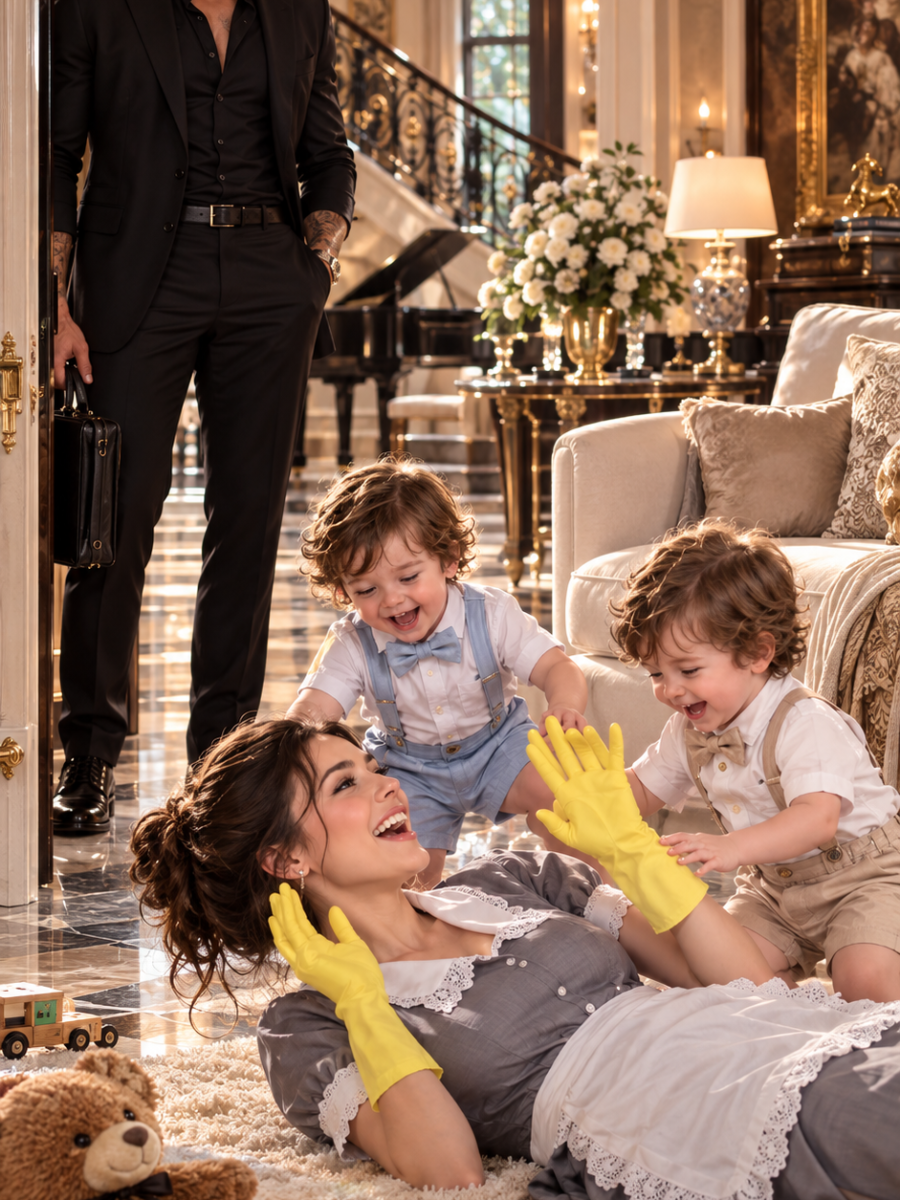
Instead, he found something he never expected. His living room was destroyed. Blankets everywhere. Toys scattered across the floor. And Lena, the nanny Margaret had warned him about, was lying on her back wearing ridiculous yellow rubber gloves while his sons climbed all over her.
Then Ethan heard it. Laughter. Real laughter. The kind he hadn’t heard from his boys in years. And then Nico looked up. Pointed at him. And said his first clear word: “Daddy.”
Ethan froze. But what happened next was even more shocking. Both boys reached for Lena. And whispered: “Mama.”
Ethan’s blood ran cold. “What have they been calling you?” Lena’s eyes filled with tears. “They started doing it a few weeks ago.” “Then why didn’t you tell me?” “I was afraid.” “Afraid of what?” Lena didn’t look at him. She looked toward Margaret’s office.
Then Nico suddenly grabbed Ethan’s leg and pointed down the hallway. “Bad Nana.”
Ethan’s entire world shifted. The woman who had warned him about Lena. The woman who had controlled his household for years. The woman who claimed Lena was hurting his children.
Might have been the one they needed protection from.
Why Lena Didn’t Tell Him
Ethan carried both boys into the kitchen, away from the hallway, and set them in their high chairs with hands that weren’t entirely steady. Lena followed, pulling off the yellow gloves with visible, trembling reluctance.
“Explain,” he said. “Everything. Starting with why my sons just called their grandmother bad to my face.”
“Margaret interviewed me herself,” Lena said. “Eight months ago, before you’d even met me. She told me, privately, that if I ever discussed her methods with you, she’d ensure I never worked in this city again. I believed her, Mr. Caldwell. She’s spent decades in rooms with people who could make that true.”
“What methods?”
Lena’s hands twisted together. “She has rules for the boys. No crying past thirty seconds, or she locks the nursery door and lets them cry it out alone, sometimes for an hour. No messy play, ever, which is why she doesn’t know about this,” she gestured at the wrecked living room. “If they reach for her and she’s occupied, she swats their hands away. Hard enough to leave marks sometimes.”
Ethan’s stomach turned. “Why didn’t you tell me the moment you saw this?”
“I tried once,” Lena said quietly, “my first week. I mentioned the crying rule gently, hoping you’d simply overrule it as the father. Margaret found out I’d spoken to you before I even finished the conversation. The next day she told you I’d been letting the boys eat food off the floor. You believed her immediately.” She looked at him directly. “I stopped trying to tell you anything after that. I started simply trying to protect them quietly instead.”
The Camera in the Playroom
Ethan sat with this for a long moment, old memory reorganizing itself with sickening clarity. He remembered the food-off-the-floor accusation now, remembered believing it instantly, remembered the cold, clipped way he’d spoken to Lena that evening without ever asking her side.
“I need proof,” he said finally. “Not because I don’t believe you, Lena. Because whatever happens next, with Margaret, with custody arrangements, with anything, I need something beyond a one-year-old’s two words and your account against hers.”
“There’s a camera in the playroom,” Lena said. “Installed when the boys were born, for safety monitoring. Margaret had the main feed routed to her own tablet, officially so she could check on them during the day. I don’t believe she realized the system also saves to a cloud archive she doesn’t have access to delete.”
“How do you know that?”
“Because I checked,” Lena admitted. “Three weeks ago, the day after she left a mark on Theo’s wrist. I didn’t know what I’d do with the footage. I only knew I needed it to exist somewhere she couldn’t simply erase.”
Ethan’s hands curled into fists. “Show me,” he said. “I want to see exactly what my mother has been doing to my sons in my own house, Lena, and then I want to understand how we protect them permanently, starting today.”
What the Footage Showed
The archive, accessed through a service technician Ethan called directly rather than trusting to his own household staff, contained six weeks of continuous recording. Lena had flagged specific timestamps, and Ethan made himself watch every one.
Margaret standing over the crib while Theo cried, her expression carrying cold, controlled irritation rather than comfort, the door closing deliberately on his continued sobbing. Nico reaching for her during a meal, her hand striking his away sharply enough that he recoiled, crying, for several minutes afterward. A pattern, repeated across weeks, of affection withheld and distress ignored unless cameras weren’t the only witness and appearances required managing.
“She’s never once held them when they’re upset,” Ethan said slowly, watching clip after clip with mounting, nauseated horror. “In six weeks of footage, Lena, I don’t see a single moment of actual comfort.”
“She believes comfort creates weak children,” Lena said quietly. “She told me that directly, during my first week. She said your own childhood followed the same principles, and that you turned out successful because of them, not despite them.”
Ethan thought of his own childhood, memories he’d filed away as simply how things were done, reorganizing themselves now into something considerably darker. “I don’t want my sons successful at that cost,” he said. “I want them loved. Properly. Visibly. Every single day.”
He closed the laptop slowly. “I want Margaret out of this house today,” he said. “Not eventually. Not after a careful conversation. Today, Lena, before she has another opportunity to be alone with either of them.”
Margaret’s Reasons
Margaret met him in her office with the composed, unhurried confidence of a woman who had run this household for eleven years and genuinely believed nothing could shake that position.
“I’ve seen the playroom footage,” Ethan said, setting his laptop on her desk without preamble. “Six weeks of it. I’d like you to explain yourself before I decide exactly how to proceed.”
For the first time in Ethan’s memory, Margaret’s composure faltered. “Whatever you believe you’ve seen,” she said carefully, “I’ve only ever done what I believed necessary to raise them properly. Your father raised you with exactly these same principles, Ethan, and you’ve built an empire most men only dream of.”
“My father wasn’t warm,” Ethan said slowly, “and I spent considerable years in therapy learning why that cost me more than it ever gave me. I won’t repeat that inheritance with my own sons.”
“Softness creates weakness,” Margaret said, her voice hardening. “I warned you about Lena specifically because I watched her coddling them, letting them cry into her shoulder instead of teaching them self-sufficiency. I was trying to protect their futures.”
“You were trying to protect your own control over this house,” Ethan said quietly, “and you were willing to let my sons believe affection was dangerous to maintain it. I want you to understand something clearly, Mother. Whatever relationship we have going forward depends entirely on your willingness to accept that this ends today, completely, without negotiation.”
Catherine
The deeper conversation, held carefully over the following days with a family therapist Ethan retained specifically for this purpose, revealed context that didn’t excuse Margaret’s behavior but helped explain its origin.
“Your wife’s death changed something in her,” the therapist, Dr. Patel, explained, after separate sessions with both Ethan and Margaret. “Catherine’s passing, eighteen months ago, left Margaret believing she was the only remaining adult capable of ensuring these boys grew up properly. She’s described, in our sessions, a genuine terror that losing control of their upbringing would somehow mean losing Catherine’s memory as well.”
“That doesn’t excuse hurting them,” Ethan said.
“No,” Dr. Patel agreed. “It doesn’t. Grief explaining behavior is different from grief excusing it. I simply want you to understand the full picture as you decide how to move forward, both for your own clarity and potentially for your sons’ understanding, years from now, of why their grandmother behaved this way.”
Ethan sat with this difficult context, old anger tempering slightly without fully dissolving. “What does genuine change look like,” he asked, “if that’s even possible at this point?”
“Considerable time,” Dr. Patel said honestly. “Supervised visitation only, if any visitation occurs at all initially. Her own continued therapy, addressing both the grief and whatever in her own upbringing taught her that love and control were the same thing. I can’t promise genuine change is possible, Ethan. I can only tell you it’s not impossible, given sufficient time and her own willingness to actually do the difficult work.”
A House Without Margaret in It
Margaret moved to a separate property Ethan owned across town, her access to the boys restricted to supervised visits contingent on continued, verified therapy and considerable demonstrated change. It was not the complete severing some might have expected, but it was considerably more protection than his sons had possessed a month earlier.
“I want you to stay,” Ethan told Lena, during a quiet evening once the household had finally settled into its new, considerably gentler rhythm. “Not simply as their nanny, though I’d understand if that’s genuinely all you want this to remain.”
“What are you asking, Ethan?” Lena asked carefully.
“I’m asking whether you’d consider something more permanent,” he said. “I’ve watched you love my sons more completely in eight months than anyone else in this house managed in their entire lives. I’d like to understand whether that capacity extends toward me as well, given time.”
Lena considered this with the same careful thoughtfulness she brought to everything concerning the twins. “I’d like to find out,” she said finally. “Slowly, Ethan, without rushing past whatever pace actually serves all four of us best.”
“Slowly,” Ethan agreed, genuine warmth entering his voice for the first time in longer than he cared to admit. “I find I’m finally willing to be patient with something that actually matters.”
Their First Clear Word
The year following that extraordinary afternoon brought genuine, steady transformation to the Caldwell household — Nico and Theo’s vocabulary expanding rapidly in a home finally organized around comfort rather than careful control, Margaret’s slow, genuine progress through therapy earning her gradually increasing, still carefully supervised time with her grandsons, and Ethan’s own relationship with Lena deepening into something neither had rushed nor taken for granted.
“Mama,” Theo announced one morning, reaching for Lena with the same easy confidence his brother had first shown months earlier, no longer a secret whispered in fear but simply, openly true.
“He says it so easily now,” Ethan observed, watching Lena lift Theo with practiced, genuine warmth. “I remember how frightened you both were, that first afternoon, when I asked what they’d been calling you.”
“I was terrified you’d see it as some kind of betrayal,” Lena admitted. “Instead of simply two little boys recognizing who actually showed up for them, every single day, with real comfort rather than careful control.”
Margaret, visiting under Dr. Patel’s continued careful guidance, watched this warm domestic scene from the doorway with an expression that had grown, slowly, into something resembling genuine humility rather than her old, practiced composure. “They’re thriving,” she said quietly, to no one in particular. “Despite everything I nearly cost them.”
“They’re thriving,” Ethan agreed, watching his sons’ easy, uncomplicated joy fill a house that finally, completely belonged to all of them. “Because somebody finally taught this family that love was never actually the weakness you believed it to be.”