He Hired a Norwegian Widow for One Montana Winter — Then Someone Poisoned His Creek and Started Shooting at His Ranch
Elias Ward hired Ingrid Larson for one hard Montana winter, expecting cooking and mending from a quiet widow willing to work for room and twenty dollars a month. Instead she pulled him back from ruin one small catch at a time — a rotten hay bale, a sagging fence, a cracking water line — until a land baron who’d spent years patiently waiting for ranchers like Elias to break decided a failing debt wasn’t going to cost him fast enough. Read every chapter to find out how far Caleb Mercer was willing to go to take the Ward ranch, and what it cost him to underestimate the widow standing in his way.
The Broken Rope
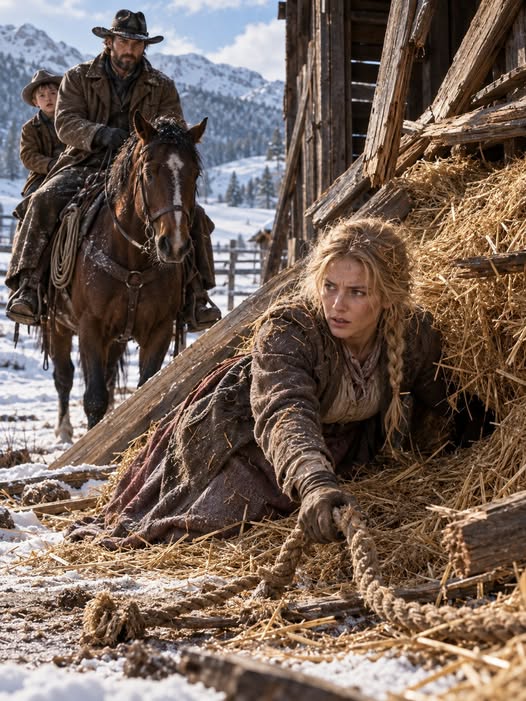
The rope snapped with a sound like a pistol crack, and Ingrid Larson vanished beneath half a wagonload of hay. Elias Ward was off his horse before the last armful settled. “Ingrid!”
For one terrible heartbeat, nothing moved. Then two gloved hands punched through the golden pile. Elias stopped. The woman who had arrived at his ranch three weeks earlier with one worn suitcase and a contract for winter wages clawed her own way free, coughing straw, her long blonde braid nearly undone. She came up on her knees, drew one hard breath, and reached for the broken rope.
Behind Elias, eleven-year-old Samuel whispered, “Pa, is she fixing to do it again?” Apparently she was.
Elias strode forward and caught the rope before Ingrid could. “That load nearly buried you.” She wiped hay from her cheek. “Then the tying was poor.” “The rope broke.” “Yes.” “You could have been killed.” Ingrid looked at the scattered hay, then at the dark clouds gathering over the Montana mountains. “And the cattle could go hungry if we leave this lying in snow.”
That answer irritated him because it was true. It also unsettled him because she did not say it like someone trying to prove herself. She said it like a ranch hand stating the next necessary thing.
Elias had hired her because he was running out of choices. Six years earlier, fever had taken his wife and left him with a young son, a ranch too large for one exhausted man, and a silence inside the house that had hardened year by year. Now the cattle were thin, the barn roof leaked in two places, winter stores were low, and a bank letter in his coat gave him until spring to clear the remaining debt.
Ingrid Larson had appeared in town asking for work. A Norwegian widow, someone said. Strong worker, said another. Elias had offered a small room, meals, and twenty dollars a month through winter. He had expected cooking, mending, perhaps help with lighter chores. The first evening had corrected him.
“I can cook,” Ingrid had said. “Can you handle cattle?” “Yes.” “Fence repair?” “Yes.” “Snow?” Her pale eyes had met his without challenge or apology. “I have lived through worse than snow.” He had not asked what she meant. He still had not.
Now she rose beside the haystack and held out her hand. “The rope, Mr. Ward.” “No.” Her brows lifted. “You’re done hauling today.” “That is not what you hired me for.” “I hired you to work, not get crushed.” “And I agreed to work, not be kept indoors because one rope failed.”
Samuel covered a grin with his glove. Elias noticed and gave his son a look. Samuel immediately became fascinated with his boot.
Ingrid walked around Elias, found another length of rope on the wagon, and tested it twice before looping it around the remaining hay. There it was again — that carefulness. She was stubborn, certainly. But not reckless. Elias had begun seeing the distinction.
Two days earlier, she had stopped him before he forked hay into the cattle rack. “Not that bale.” He had almost told her to mind her own task. Then she split it open. The center smelled sour with damp and rot. He had stared at it longer than he cared to admit. Another week of feeding from that stack and he might have lost cattle he could not afford to lose.
Before that, Ingrid had found a sagging section of fence behind the north pasture. Before that, a crack beginning near the water line. Small things. The kind a tired man overlooked while trying to save everything at once.
Now she tightened the fresh rope, planted her boots, and looked at him. “Are you helping?” Elias almost laughed. He had nearly forgotten what laughter felt like. Instead, he bent and took the other end. They worked until the hay was restacked beneath cover.
At supper that evening, Samuel tried teaching Ingrid how to whistle through two fingers. Ingrid failed so spectacularly that the sound came out like an injured bird. Samuel laughed until milk nearly came through his nose. Elias sat at the far end of the table, spoon motionless in his hand. The boy had not laughed that freely in years.
Ingrid caught Elias watching. Her own smile faded — not from guilt, but caution. She understood, he realized, that joy could hurt a grieving man almost as sharply as loss. So she looked away and asked Samuel for another lesson. Elias said nothing.
The next afternoon, three riders came through the front gate. Caleb Mercer rode in the center. His coat was finer than anything Elias owned. His horse was better fed than most of the Ward cattle. Mercer had been buying land through the valley for years, patient as frost, waiting for smaller ranchers to break.
His gaze moved over the patched barn, the cattle, and finally Ingrid. “So this is the woman keeping Ward’s dying ranch alive.” Elias stepped off the porch. “Get off my property.” Mercer smiled. “You’ll lose it soon enough.”
Ingrid stood near the woodpile with an axe in one hand. She did not hide behind Elias. Neither did she advance. Mercer looked toward her. “When the bank takes this place, ma’am, you’ll need another position.” “She has one,” Elias said. “For the winter.” Mercer’s smile widened. “Winter ends.” He turned his horse. The three men rode away.
That evening, Ingrid did not mention Mercer. Instead, near dusk, she walked the creek line with a lantern. Elias found her crouched beside the water. “What are you doing?” She dipped two fingers near the edge, smelled them, and immediately wiped them on dead grass. “Come here.” Something in her voice made him obey. He crouched. “Smell.” Elias leaned toward the water. Kerosene. Every muscle in his body tightened. The ranch depended on that water.
Before he could rise, a gunshot cracked from the darkness. The lantern exploded beside them. Samuel screamed from near the barn. Elias drew his revolver and ran. A second shot struck the barn wall.
Through the cattle pens, a dark rider broke for the far fence. Elias raised his weapon, but Ingrid was already moving the other way. Not toward shelter. Toward Samuel. She seized the boy by the shoulders, pulled him behind the hay wagon, and dropped beside him as another shot tore splinters from the barn. “Stay down.” Samuel clutched her coat.
Elias fired once toward the fleeing rider. The horse vanished into darkness. Then silence came back over the ranch.
Elias turned toward the wagon. Ingrid had one arm around Samuel. The other hand was braced against the wheel, ready to move him again if another shot came.
And Elias ran toward them.
Kerosene
“Is anyone hit?” Elias’s voice came out rougher than he intended, dropping to his knees beside the wagon and running his hands over his son’s small shoulders with a frantic thoroughness that made Samuel squirm despite the fear still evident on his face.
“I’m all right, Pa,” Samuel said, though his voice shook considerably more than his words admitted. “Ingrid pulled me down before I even heard the first shot proper.”
Ingrid herself remained crouched, scanning the darkness beyond the fence line with the particular alert stillness of someone who had done exactly this kind of assessment before, in circumstances Elias still knew nothing about. “He’s gone,” she said finally. “One rider, moving fast toward the eastern ridge. I don’t believe he intended to hit anyone directly — the shots came too wide, too spaced out for a man actually trying to kill.”
“Then what was he trying to do?” Elias asked, though even as he said it, the answer settled over him with cold clarity.
“Frighten you,” Ingrid said. “Same as the kerosene in your creek. A man who wants your land badly enough to poison your water isn’t necessarily ready to commit murder outright, not yet. But he wants you frightened enough to consider selling before matters escalate further.”
They spent the remainder of that night securing the ranch as thoroughly as three people and limited resources allowed — moving the cattle to the pasture farthest from the road, boarding the most exposed windows, and taking turns keeping watch while the others attempted, with limited success, to actually sleep.
By morning, the full scope of the kerosene’s damage to the creek had become clear enough to demand immediate action. “We can’t water the cattle from this line until it clears,” Ingrid said, examining the contaminated stretch in the pale morning light. “Kerosene this concentrated will take considerable time to fully dissipate, and even diluted, it risks making the animals sick.”
“There’s a secondary spring on the property’s western edge,” Elias said, “farther from the house, harder to reach in deep snow, but clean. I’ll need to dig a temporary channel to bring water closer to the herd.”
“I’ll help,” Ingrid said immediately, already moving toward the tool shed, and Elias found himself, despite the previous night’s terror, grateful in a way he hadn’t expected for a woman who met catastrophe not with panic but with the same steady, practical resolve she brought to a rotten hay bale or a sagging fence post — though even as he watched her work, a colder question settled into his chest that he couldn’t shake: how had a Norwegian widow with no prior connection to Montana ranching learned to identify kerosene in creek water, assess a gunman’s intent from the spacing of his shots, and move a frightened child to safety with the calm, practiced efficiency of someone who had clearly survived violence before, considerably worse than anything Caleb Mercer had yet attempted against them.
What Ingrid Had Survived
Elias asked her directly that evening, once Samuel had finally, exhaustedly fallen asleep and the two of them sat alone by the kitchen fire, the day’s crisis finally allowing a moment of quiet neither of them had earned easily.
“You knew exactly what to do last night,” he said. “Not just brave — practiced. I need to understand where that comes from, Ingrid, if we’re going to face whatever Mercer intends to try next.”
Ingrid was quiet for a long moment, her pale eyes fixed on the fire with an expression Elias recognized, uncomfortably, as the same careful management of old grief he practiced himself most days. “My husband and I did not come directly from Norway to Montana,” she said finally. “We stopped first in Minnesota, on a homestead claim considerably less peaceful than anything you’ve built here. There was a man there too — not so wealthy as Mercer, but violent in ways Mercer has not yet shown himself to be. He wanted our land for the timber rights beneath it.”
“What happened?”
“He burned our barn first,” Ingrid said, her voice carefully controlled despite the visible effort it cost her. “Then our house, eventually, with my husband still inside it, trying to save what he could of our winter stores. I was in town that day, fetching supplies. I came home to find everything I’d built gone, and everyone I loved gone with it.”
Elias sat with the weight of that revelation, understanding suddenly, with painful clarity, exactly why she had moved toward Samuel rather than toward shelter the previous night, exactly why she recognized kerosene’s smell so immediately, exactly why her calm under fire carried the particular steadiness of someone who had already survived the worst version of exactly this kind of escalating threat.
“I’m sorry,” he said quietly. “I had no idea.”
“I don’t share it often,” Ingrid said. “Grief becomes its own kind of currency in small towns, Elias. People either pity you or use it to explain away anything unusual about your behavior, and I have never wanted either response badly enough to volunteer the story freely.”
“Why share it now?”
Ingrid met his eyes directly. “Because I recognize exactly what Mercer is doing, having watched a man do the same thing to my own family with a considerably worse ending. Intimidation first. Property damage next. And when that fails to move you, Elias, violence considerably more direct than a few shots fired into darkness. I need you to understand the shape of what’s coming, so that neither of us makes the mistake of underestimating how far a man like that will actually go once he decides patience has run its course.”
“Then we don’t wait for him to escalate further,” Elias said, something resolute settling into his voice that hadn’t been present there in the six years since his wife’s death. “Tomorrow, I want to speak with Sheriff Dawes directly, and I want to understand exactly how many other ranchers in this valley have faced something similar before Mercer finally succeeded in taking their land — because if this is a pattern, Ingrid, I intend to make sure it’s documented properly before he adds the Ward ranch to whatever list he’s already built.”
Caleb Mercer’s Valley
Sheriff Dawes received Elias’s account the following morning with a careful, guarded expression that told Elias immediately he was not the first rancher to bring exactly this kind of complaint through the sheriff’s office door.
“Kerosene in the creek, shots fired in the dark, no rider anyone can positively identify,” Dawes said, reviewing his notes with visible frustration. “That’s roughly the same story I heard from Otis Graham eighteen months back, and from the Hendricks family before that, both of them selling to Mercer’s company within a season of similar troubles beginning.”
“Then why hasn’t anyone brought formal charges?” Elias demanded.
“Because in every case, exactly like yours, there’s no witness willing to swear positively to Mercer’s direct involvement,” Dawes said. “A masked rider in darkness, kerosene that could theoretically have entered the water through a dozen innocent explanations, threats delivered vaguely enough to avoid any clear legal violation. Mercer’s careful, Mr. Ward. Careful enough that I’ve never once managed to build a case that would actually hold up before a judge.”
“So he simply continues,” Elias said, “buying failing ranches at whatever discount his intimidation manages to produce, while the law stands by unable to act.”
“I don’t stand by easily,” Dawes said, some genuine frustration finally cracking through his careful, procedural tone. “But I need evidence, Mr. Ward. Something concrete enough to actually prosecute, rather than another account of vague threats and unidentified riders in darkness.”
Ingrid, who had accompanied Elias to town and remained quietly present through the conversation, finally spoke. “What if we could provide that evidence directly? Not simply another account of a single incident, but a documented pattern connecting Mercer’s business dealings to the timing of these attacks across multiple ranches.”
Dawes studied her with renewed interest. “That would require considerably more resources than my office currently has available to properly investigate.”
“Then perhaps,” Ingrid said, “those of us who’ve already been targeted should compare our experiences directly, rather than each suffering through this in isolation, assuming we’re each simply an unfortunate, unconnected victim of bad luck.”
Sheriff Dawes considered this for a long moment before finally nodding slowly. “Otis Graham still lives two counties over, on a smaller property he managed to keep after selling most of his original land to Mercer at a considerable loss. If you’re willing to make the ride, Mr. Ward, I believe he’d have considerably more to tell you than he was ever willing to share with my office directly — men in his position often trust a fellow rancher’s questions more readily than a lawman’s, especially when admitting how frightened they’d been feels like its own kind of humiliation.”
Sheriff Dawes
Elias and Ingrid made the ride to Otis Graham’s smaller property three days later, leaving Samuel in the careful watch of a trusted neighboring family for the day given the ongoing danger surrounding their own ranch.
Graham, a weathered man whose careful, guarded manner immediately suggested exactly the kind of lingering fear Sheriff Dawes had predicted, received them cautiously at first, his suspicion only easing once Elias explained, in careful detail, the kerosene, the gunshots, and Mercer’s own visit to the Ward ranch days earlier.
“Same pattern,” Graham said finally, some of his guardedness giving way to a bitter, exhausted recognition. “Poisoned my well first, then my hay stores caught fire — accidentally, according to the official account, though I never believed that for one moment. Then shots at my barn, close enough to frighten but never close enough to hit anyone directly. By the time Mercer’s man made his final offer, I’d have sold my own mother’s grave marker just to make the fear stop.”
“Did you ever identify who actually carried out the attacks?” Ingrid asked.
“Never with certainty,” Graham admitted. “But I always suspected a man named Dutch Coleman, who rides for Mercer’s outfit and has a reputation in three counties for exactly this kind of quiet, deniable intimidation work. I never had proof enough to bring to Dawes directly, and by the time I might have gathered it, I’d already lost the will to fight rather than simply survive what remained of my own dignity.”
“Would you be willing to provide a formal statement now,” Elias asked, “if it might help stop Mercer before he does to my family what he did to yours?”
Graham considered this for a long moment, old fear visibly warring with a fresh, cautious hope that someone else’s fight might finally accomplish what his own exhausted resignation hadn’t managed. “I’ll tell you everything I remember,” he said finally. “Dates, details, everything Dutch Coleman’s crew did to drive me off my own land. If it helps put a stop to this pattern before it claims another family, I’d consider that worth whatever risk speaking up might still carry for me personally.”
Graham’s detailed account, combined with careful notes Ingrid took throughout the conversation, provided considerably more specific evidence than Sheriff Dawes had previously managed to gather — including, most significantly, Graham’s memory of overhearing Dutch Coleman mention, during a drunken evening at the county saloon eighteen months earlier, a standing arrangement with Mercer that paid a bonus for every ranch “encouraged” to sell within a full season of the initial trouble beginning, a detail specific enough, Ingrid pointed out on their ride home, to potentially connect Mercer directly to a documented financial motive rather than simply a pattern of unfortunate coincidence.
Otis Graham’s Story
Sheriff Dawes, presented with Graham’s detailed statement and the specific detail about Dutch Coleman’s bonus arrangement, agreed to formally open an investigation into Coleman’s activities, though he cautioned both Elias and Ingrid that building a case solid enough to actually prosecute Mercer himself, rather than simply his hired intimidator, would likely require considerably more evidence still.
“I want Dutch Coleman’s bank records,” Dawes said, “cross-referenced against the timing of every documented incident across every ranch Mercer’s company has acquired over the past three years. If that bonus arrangement Graham overheard is real, it should show as a pattern of payments timed suspiciously close to each sale’s completion.”
Securing those records required a formal request to the regional bank, a process that would take considerable time even with Dawes’s official backing, time that Elias understood, with growing unease, Mercer might use to escalate his own tactics well before any paperwork could actually conclude.
That unease proved justified within the week. Returning from a supply run to town, Elias and Ingrid found Samuel waiting anxiously at the ranch gate, considerably more distressed than the errand should have warranted.
“Pa, there were men here,” Samuel said, practically vibrating with barely contained fear. “While you were gone. They didn’t come to the house, but I saw them out past the north fence, just standing there watching, for almost an hour before they finally rode off.”
“Did you recognize any of them?” Elias asked, kneeling to his son’s level with the particular urgent calm he’d learned to project even when his own chest was tight with fear.
“One of them had a real mean-looking scar down the side of his face,” Samuel said. “I hid in the loft and watched through the gap in the boards, just like you taught me.”
Ingrid’s expression sharpened considerably at the description. “Dutch Coleman,” she said grimly. “Graham described exactly that scar when he spoke of him. If Coleman’s men are watching the ranch openly now, rather than simply striking under cover of darkness, that suggests Mercer’s grown considerably more confident that no consequences are actually coming for his previous tactics.”
“Or,” Elias said slowly, a colder possibility settling over him, “it means Mercer’s somehow learned about our visit to Graham, and about Sheriff Dawes’s new investigation, and he’s decided open intimidation is worth the risk now that subtler tactics have failed to move us — which means whatever Coleman tries next is likely to be considerably more direct than kerosene in a creek or shots fired wide enough to miss on purpose.”
The Bank Letter
The following days brought a tense, watchful quiet to the ranch, Elias and Ingrid taking turns keeping careful watch through the nights while Sheriff Dawes’s investigation into Coleman’s bank records proceeded with what felt, given the mounting danger, like agonizing slowness.
The bank’s original debt deadline, meanwhile, continued approaching regardless of the danger surrounding them, the letter in Elias’s coat pocket a constant, additional pressure layered atop the more immediate threat of Coleman’s men.
“Even if we survive whatever Mercer intends next,” Elias admitted to Ingrid one evening, reviewing his increasingly desperate finances at the kitchen table, “I still owe the bank considerably more than this ranch can produce before spring. Proving Mercer’s tactics were criminal doesn’t erase the actual debt underneath all of it.”
“No,” Ingrid agreed. “But it might buy you time the bank would otherwise refuse, if Sheriff Dawes’s investigation demonstrates that your financial hardship was itself partly manufactured through Mercer’s deliberate sabotage rather than simple mismanagement or bad luck.”
It was, in fact, precisely this argument that Sheriff Dawes carried to the regional bank himself, once Coleman’s financial records — finally secured through the bank’s cooperation, given Dawes’s now-formal investigation — confirmed exactly the pattern Graham had described: four separate bonus payments to Dutch Coleman over the preceding three years, each one timed within weeks of a targeted rancher finally agreeing to sell to Mercer’s company.
“This is enough to bring formal charges against both Coleman and Mercer,” Dawes told Elias and Ingrid, once the investigation’s findings were fully compiled. “Conspiracy, property destruction, and reckless endangerment at minimum, possibly attempted murder depending on how the courts interpret the shots fired at your ranch. I’ll need both of your formal testimony, along with Graham’s, to move forward with an arrest.”
“What about my debt?” Elias asked. “The bank’s deadline is barely six weeks away now.”
“I’ve already spoken with the bank’s regional manager,” Dawes said. “Given the evidence that your financial hardship was substantially worsened by documented criminal sabotage, he’s agreed to extend your deadline by a full season, pending the outcome of the case against Mercer. It’s not a permanent solution, Mr. Ward, but it should buy you considerably more breathing room than you had this morning.”
The relief of that reprieve lasted less than a full day. That same evening, as Elias and Ingrid finished the last of the evening chores, Samuel’s frightened shout carried across the yard from the direction of the barn — and turning toward the sound, Elias saw, with a horror that stopped his heart entirely, flames already climbing the barn’s western wall, considerably faster than any accidental fire had any right to spread.
The Barn
“Samuel!” Elias’s voice tore from his throat as he sprinted toward the burning structure, terror for his son overriding every other consideration entirely.
“Here, Pa!” Samuel’s voice came from a safe distance, considerably to Elias’s relief, the boy having apparently fled the barn the moment he’d noticed the flames rather than attempting to fight them alone. “I got the horses out first, like you always said!”
Ingrid was already organizing a bucket line from the well, her calm, practiced efficiency cutting through the chaos with the same steady clarity she’d brought to every crisis since her arrival. “The fire’s moving too fast for water alone,” she called. “We need to cut it off before it reaches the hay stores — Elias, the western wall, now!”
Together with Samuel and two neighboring ranch hands who arrived within the hour, alerted by the visible glow against the night sky, they fought the fire for nearly three hours, ultimately saving the barn’s main structure though losing the western storage section entirely, along with a considerable portion of their already-thin winter feed supply.
In the exhausted, smoke-stained aftermath, Sheriff Dawes arrived to examine the scene personally, his expression grim as he studied the fire’s clear point of origin. “This wasn’t accidental,” he said, examining a scorched patch near the wall’s base. “Someone used an accelerant here, deliberately, and the timing — the same evening I informed you both that formal charges were finally moving forward — tells me Mercer’s grown considerably more desperate now that his usual careful deniability is failing him.”
“Desperate men do desperate things,” Ingrid said grimly. “In Minnesota, my husband’s death came at exactly this point in a similar campaign — once legal consequences finally began closing in, the man responsible escalated to violence he’d previously avoided specifically because he had, by that point, nothing left to lose by trying it.”
The warning settled a fresh, urgent fear over all of them, Sheriff Dawes agreeing immediately to station a deputy at the Ward ranch around the clock until Mercer and Coleman could be safely taken into custody.
The arrest, when it finally came two days later, unfolded with less resistance than any of them had feared — Mercer, confronted with the full weight of Coleman’s financial records, Graham’s testimony, and the fresh evidence from the barn fire, chose surrender over the kind of violent last stand his own hired intimidation had always relied on someone else to carry out on his behalf. As deputies led him away in restraints, Mercer turned back toward Elias with an expression carrying more calculation than remorse. “You’ll find,” he said, “that ranches like yours fail eventually regardless of my involvement. I simply intended to hurry along what the land itself was already deciding.”
Spring
Mercer’s trial, held in the county seat over the following two months, resulted in convictions on charges of conspiracy, arson, and reckless endangerment for both Mercer and Dutch Coleman, sentences severe enough to end Mercer’s decade-long pattern of patient, predatory land acquisition throughout the valley entirely.
Otis Graham, along with two other ranchers who came forward once Mercer’s arrest made speaking up considerably less frightening, ultimately received modest financial restitution through the court’s judgment, though nothing could fully undo years of accumulated fear and loss any of them had already suffered.
The Ward ranch’s extended debt deadline, combined with a genuinely strong spring calving season and the sale of surplus hay to neighboring ranches grateful for Elias’s help during the crisis, allowed him to clear the remaining bank debt entirely by early summer — considerably ahead of even the extended timeline Sheriff Dawes had negotiated on his behalf.
Ingrid’s contract, originally written for a single Montana winter, quietly extended itself without either of them ever formally renegotiating its terms, the arrangement gradually, naturally becoming something neither wages nor a written agreement could properly describe.
“I never intended to stay past March,” Ingrid admitted one warm June evening, sitting together on the porch while Samuel chased fireflies across the yard with an unrestrained joy that had become, over the preceding months, entirely ordinary rather than remarkable. “I told myself one winter, enough money to consider my next move, and then somewhere new entirely.”
“What changed?” Elias asked, though he suspected he already knew the answer.
“I stopped believing that surviving meant staying constantly ready to leave,” Ingrid said. “Minnesota taught me that everything could be taken in a single terrible night, and I built years of careful distance around that lesson, refusing to let myself want permanence anywhere, with anyone. This ranch, and this family, taught me something different. That surviving well sometimes means choosing to stay and fight for something worth keeping, rather than simply preparing yourself to lose it eventually anyway.”
Elias reached for her hand, the gesture considerably more natural now than it would have seemed even a few months earlier. “Then stay,” he said simply. “Not as hired help anymore, Ingrid. As my wife, if you’ll have me, and as the mother Samuel has already decided you are in every way that actually matters to him.”
Ingrid’s answering smile carried none of the earlier caution he remembered from that first supper, when joy itself had seemed like something she needed to carefully manage around his grief. “I already stopped packing my suitcase months ago,” she said. “I believe some part of me knew the answer long before you found the courage to properly ask the question.”
Behind them, Samuel’s delighted shout rang out across the summer evening as he finally caught his firefly, the ranch around them healed and thriving in ways that had seemed, one terrible winter earlier, entirely beyond saving.