For three years, Luke Carter rode six miles into Red Creek every Thursday morning, then told Hannah Brooks she was too beautiful for a man like him and rode away again. When a sincere, respectful suitor finally offered her a future, Hannah realized she could no longer wait for Luke to say what his eyes had said for three years running. She walked six miles through the dust to tell him the truth before giving her answer — and what he finally admitted, hands trembling as he reached for her face, explained exactly why he’d spent three years pushing away the one thing he wanted most. Read every chapter to find out what happened next.
Six Miles
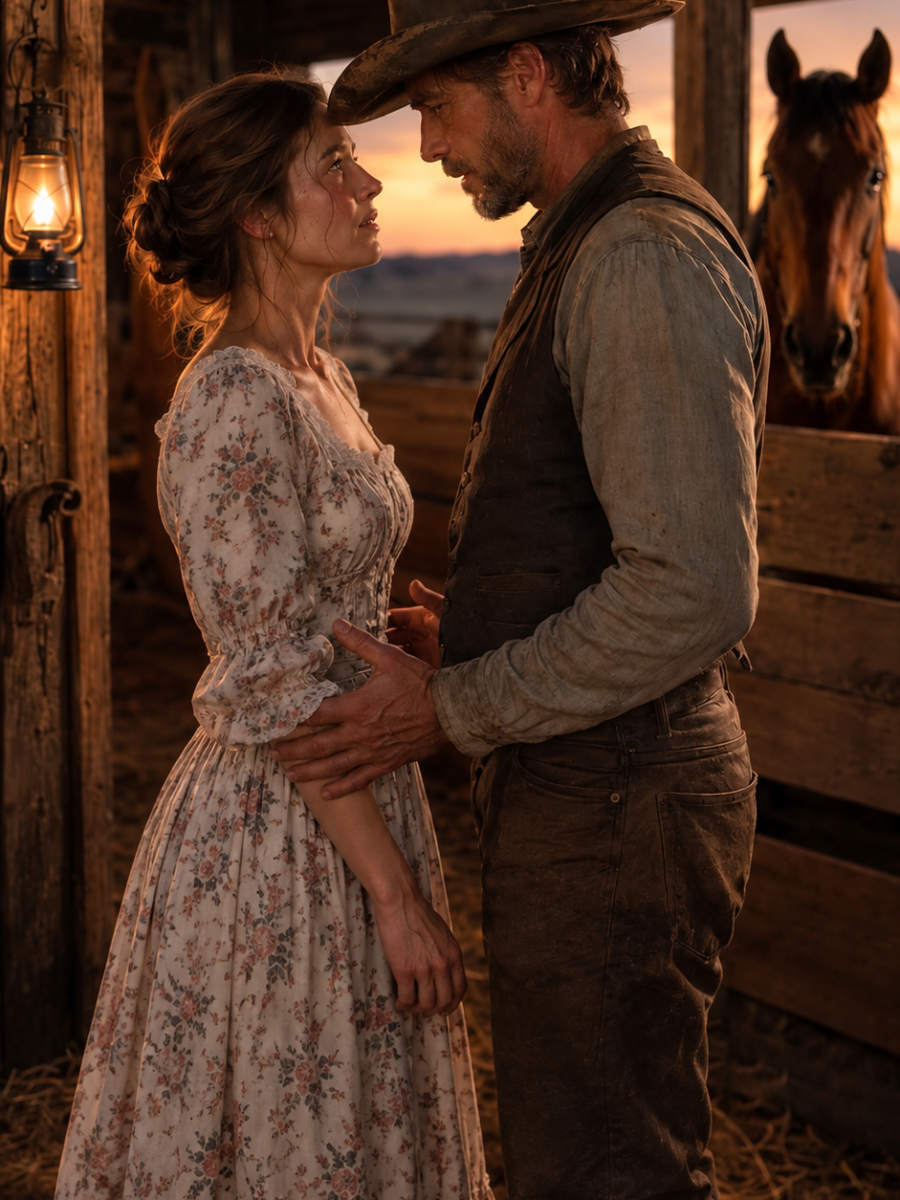
Hannah Brooks stepped into Luke Carter’s barn at dusk with six miles of road dust on her hem and an answer due by morning.
Luke stopped brushing the bay mare. The surprise on his face came before he could hide it. “Hannah?” “I need to talk to you.” Her voice sounded steadier than she felt.
Nathan Whitmore was waiting at the Red Creek hotel. By breakfast, Hannah had promised to tell him whether she would accept the future he had offered her. Nathan was handsome, successful, respectful, and painfully sincere. He had never treated her like a joke. That alone mattered more than most people in Red Creek understood.
For twenty-seven years, Hannah had lived inside other people’s measurements of her body. Too heavy. Too broad. Pretty face, shame about the rest. Men had said such things loudly enough for her to hear and quietly enough to pretend they had not meant her to. Women had sometimes been worse, offering sympathy disguised as kindness. Hannah had learned not to let anyone see the words land.
She rose before sunrise, lit the bakery oven that had once belonged to her mother, rolled dough, balanced accounts, negotiated flour prices, and made bread people rode from two counties away to buy. Red Creek trusted Hannah Brooks whenever it needed feeding. It simply had trouble believing she might also be wanted.
Luke Carter had been the one exception. For three years he had ridden six miles from his modest horse ranch every Thursday morning. At first he claimed he came for sourdough. Then the visits stretched. A cup of coffee. A complaint about a stubborn gelding. A dry joke delivered so seriously Hannah sometimes needed several seconds to realize he was teasing her. He listened when she spoke. He remembered things. He never examined her body with that quick calculation she had learned to recognize before a man even opened his mouth.
And because he never asked anything from her, Hannah had made the dangerous mistake of loving him. She had loved him quietly.
Then, one July morning, Luke had sat on her bakery porch drinking lemonade and said the words that had followed her for weeks. “You’re far too beautiful for a man like me.” He had smiled when he said it. Then he had talked about his secondhand saddle, his modest ranch, and the smell of horses that followed him most days. Hannah had laughed. She had gone back inside after he rode away and wondered whether three years of Thursdays had meant something only to her.
Then Nathan Whitmore came to town. Unlike Luke, Nathan did not hide his interest. He asked Hannah to the church picnic. He walked her home. He brought books. He asked about her mother and remembered the answers. When he finally asked whether Hannah would consider building a future with him, she could no longer pretend she had endless time to wait for another man to say what he wanted.
So she asked Nathan for one night. And now she stood in Luke Carter’s barn.
Luke set the horse brush on a ledge. “What happened?” “Nothing happened.” He waited. That made it harder.
Hannah had crossed the whole distance determined not to rehearse because she knew herself too well. If she built a speech, she would hide inside it. She folded her hands to stop them shaking. “Nathan Whitmore asked me to consider a future with him.”
Something shifted behind Luke’s eyes. It vanished almost immediately. “I see.” “He wants my answer tomorrow morning.” Luke nodded once. Hannah nearly hated him for how calm he looked. “I wanted you to know before I gave it.” “You don’t owe me that.” “No.” Her heart hammered. “I don’t.” That finally changed his expression.
Hannah drew one breath. “Which is why you need to understand that I did not walk six miles because I owed you anything.” Luke said nothing. “I came because I am tired.” His brow tightened. “Tired of Nathan?” “No. Nathan has done nothing wrong.” She stepped farther into the barn. “I am tired of Thursdays.”
Luke went completely still. “I have spent three years telling myself that one week I would stop waiting to hear your boots on my bakery step. I would stop setting aside your bread before anyone else could buy it. I would stop watching you ride away and wondering whether you ever looked back.” “Hannah—” “No. Let me finish.” He closed his mouth. That, more than anything, kept her going. She had spent too much of her life being spoken over. Luke Carter had never done that.
“I am not asking you to rescue me from answering Nathan. I am not asking you to make a promise because you’re afraid somebody else might have me. If you do not want what I want, I will go back to town tonight, and I will still decide my own future tomorrow.” Luke’s jaw tightened. “But I will not decide it while carrying a lie.” “What lie?” “That you are only the man who buys my bread.”
The mare shifted behind him. Leather creaked. Hannah heard her own breathing. Then she said the words she had feared for three years. “I love you, Luke.”
Nothing moved. Not Luke. Not Hannah. Even the barn seemed to hold still.
She forced herself to continue. “I have loved you for three years. I did not tell you because I have watched too many people look at me as if kindness is the most I should expect from them. I could bear that from strangers.” Her voice thinned despite her efforts. “I did not know if I could bear it from you.”
Luke’s face changed. Hannah could not read how. “That is all I came to say.” He remained silent.
The old voices began immediately. Too much. Too foolish. You imagined it. A few loaves of bread and some porch conversations, and you built a whole life where none existed.
Hannah straightened. She would not beg. She would not apologize for loving him. And she would not make Luke responsible for repairing the shame other people had spent years teaching her.
“I should go.” She turned. Behind her came the hard scrape of Luke’s boot against the barn floor. “Hannah.” She stopped. When she faced him again, whatever careful distance had lived in Luke Carter for three years was gone.
He crossed the three steps between them and lifted both trembling hands toward her face.
What Luke Never Said
His palms were rough with years of rope and leather, and they shook against her cheeks with a tenderness that undid her considerably more thoroughly than any confident, practiced touch could have managed.
“I have rehearsed this moment more times than I’ll ever admit to you,” Luke said, his voice unsteady in a way she had never once heard from him in three years of Thursday mornings. “And every single time, I told myself the kindest thing I could do was let you believe I simply wasn’t interested, rather than let you find out the actual reason.”
“What reason?” Hannah asked, barely above a whisper.
“That I have loved you since the second Thursday I ever rode into town,” Luke said. “Not the sourdough, Hannah. Never the sourdough. I told myself that story so many times I nearly believed it myself, right up until the moment you stood in this barn tonight and told me the truth I’d been too much of a coward to say first.”
“Then why,” Hannah said, old hurt rising even as his hands remained gentle against her face, “did you tell me I was too beautiful for a man like you? Why did you smile when you said it, Luke, as though it were a joke rather than a door closing?”
Luke’s jaw tightened, old pain visible beneath the words he finally allowed himself to speak. “Because I have spent my whole adult life believing that a woman as remarkable as you deserved considerably more than a secondhand saddle and a ranch that barely survives most winters. I told myself that sentence as a joke because saying it plainly, as the truth I actually believed, would have meant admitting how much it terrified me to want something I was certain I couldn’t properly provide.”
“I never asked you to provide anything beyond honesty,” Hannah said. “I built my own bakery with my own hands, Luke. I have never once needed a man to rescue me from my own life.”
“I know that now,” Luke said. “I think some part of me has always known it, actually. But knowing a thing and believing yourself worthy of it are two considerably different accomplishments, Hannah, and I’ve spent three years failing at the second one despite understanding the first perfectly well.”
“Then stop failing at it,” Hannah said, her voice steadier now, old fear finally giving way to something considerably more certain. “Right now, Luke Carter, because I have exactly one night to give Nathan Whitmore an honest answer, and I refuse to spend what’s left of it standing in a barn while you explain three years of careful cowardice instead of simply telling me plainly whether you want the same future I do.”
The Ranch His Father Lost
Luke’s hands finally stilled against her face, some final, careful wall visibly coming down as he looked at her with an openness three years of Thursday mornings had never once permitted.
“I want the same future,” he said. “I have wanted it since long before I had any right to believe you might want it too. But Hannah, before you decide anything permanent, I think you deserve to understand exactly where three years of careful cowardice actually came from, because it isn’t only about believing myself unworthy of you specifically. It goes back considerably further than that.”
He led her to a bench near the barn’s entrance, the bay mare settling behind them, and told her a story he had apparently never shared with anyone in Red Creek during his considerable years living among them.
“My father built this ranch from almost nothing,” Luke said. “Good years, mostly, until a drought took two consecutive seasons when I was fourteen. He borrowed against everything he owned trying to hold on, and when the bank finally called the debt, we lost half our original acreage in a single terrible autumn. My mother left the following spring — not entirely because of the ranch, I’ve come to understand as an adult, but the timing was close enough that I spent years believing our poverty had cost my father the person he loved most.”
“Luke,” Hannah said softly, “that wasn’t your fault, or even entirely your father’s.”
“I know that now, mostly,” Luke said. “But I was fourteen, watching my father’s hands shake exactly the way mine did a moment ago, watching him fail to hold onto something he’d built with genuine love and effort, and somewhere in that terrible year, I decided that loving someone deeply enough meant eventually watching them leave once you couldn’t provide what they actually deserved. I built my entire adult understanding of love around that single, painful conclusion, and I never fully examined whether it was actually true.”
“So when you fell in love with me,” Hannah said slowly, “you assumed the same story would eventually repeat itself. That I would leave, the way your mother left, because a modest rancher couldn’t provide whatever you believed I actually deserved.”
“Yes,” Luke admitted. “It’s not a rational fear, laid out plainly like this. I understand that. But fear rarely announces itself rationally, Hannah. It simply sits quietly in the back of every decision until something — or someone — finally forces you to examine it directly.”
“Then let’s examine it directly right now,” Hannah said, taking his still-trembling hands in both of hers. “Luke Carter, I did not walk six miles through the dust to accept a future with a man who might leave me the way your mother left your father. I walked six miles because I have never once, in three years, believed you were the kind of man who measures love by the size of a bank account or the number of acres attached to a ranch. Tell me plainly, without a joke to hide behind this time — do you want to build a life with me?”
Telling Nathan
“Yes,” Luke said, without a moment’s hesitation this time, the single word carrying more certainty than three years of careful deflection ever had. “Completely, and for as long as you’ll have me, Hannah Brooks.”
What followed was not a grand, sweeping kiss of the kind Hannah had sometimes allowed herself to imagine during quiet Thursday mornings, but something gentler and considerably more real — Luke’s forehead pressed against hers, both of them simply breathing together in the quiet barn, three years of careful distance finally, completely dissolved.
“I need to go back to town tonight,” Hannah said eventually, practical concerns reasserting themselves even through the warm haze of the evening’s revelations. “I promised Nathan an answer by morning, and he deserves to hear it directly from me, in person, rather than learn secondhand that I’ve already made my choice.”
“I’ll ride with you,” Luke said immediately. “Not into the room when you tell him — that conversation should be yours alone to have with dignity. But I’m not letting you walk six miles back through the dark by yourself, not tonight, not after everything we’ve just said to each other.”
The ride back to Red Creek passed in a comfortable, unhurried quiet, Luke’s horse carrying them both while Hannah rested against his chest, three years of unspoken longing finally settling into something considerably more solid than either of them had dared hope for that morning.
At the edge of town, Luke reined in the horse and helped her down carefully. “I’ll wait here,” he said. “However long you need.”
Hannah found Nathan Whitmore on the hotel’s porch, exactly where she’d expected him, his expression carrying the particular hopeful patience of a man who had spent the evening genuinely uncertain which answer he’d receive.
“Hannah,” he said, standing as she approached. “You look like you’ve walked considerably farther than across town.”
“I have,” she admitted. “Nathan, I owe you an honest answer, and I owe you the respect of delivering it plainly rather than dressing it up in gentler words than it deserves.”
Nathan’s expression shifted, old hope visibly giving way to something he was clearly working hard to receive gracefully. “You’ve chosen someone else.”
“I have,” Hannah said. “I’m sorry, Nathan, because you have genuinely never once given me reason to doubt your sincerity, and you deserve considerably better than learning this after asking me to consider a future together.” Nathan was quiet for a long moment, and when he finally spoke, his voice carried a rueful, self-aware honesty that told Hannah exactly why she’d respected him even while her heart had belonged elsewhere. “The rancher,” he said. “Carter. I suspected as much, honestly, from the way you spoke of him without ever quite meaning to. I hope you’ll allow me to say one thing before you go, Hannah, not to change your answer, but because I think it’s true regardless of who you choose: any man lucky enough to actually see you clearly is fortunate beyond whatever ranch or fortune he happens to bring alongside that sight.”
Red Creek Talks
News of Hannah’s decision moved through Red Creek with the particular efficient speed small towns reserve for exactly this kind of romantic development, and by the following Sunday, opinions had formed themselves into camps considerably more divided than Hannah had anticipated.
“A modest horse rancher,” she overheard Mrs. Pemberton say to another woman outside the church, not quite quietly enough to avoid Hannah’s hearing entirely, “when she could have had Nathan Whitmore’s considerable prospects instead. I do wonder what that girl is thinking.”
Hannah had expected this reaction, in some form, though hearing it delivered so plainly still stung more than she’d braced for. Three years of learning to disregard exactly this kind of casual, careless judgment about her own worth had prepared her considerably better than it might have a decade earlier, but old wounds, she was learning, didn’t disappear simply because a new happiness had arrived to compete with them.
“They’ll talk themselves out eventually,” Luke said, finding her after the service, his expression carrying a protective steadiness that helped considerably more than she expected. “Red Creek always does. Give them a new scandal by autumn, and they’ll forget entirely that you once chose a rancher over a more prosperous man.”
“It’s not simply the choice they’re questioning,” Hannah admitted. “It’s the same old measurement, Luke. As though my worth is only properly calculated by whichever man’s prosperity I attach myself to, rather than anything I’ve actually built with my own two hands.”
“Then let them keep measuring wrongly,” Luke said. “I’ve spent considerable time learning, this past week especially, that other people’s measurements only matter as much power as we hand them ourselves. I intend to hand mine considerably less power going forward, and I’d like to build that same habit alongside you, if you’re willing to keep working at it together.”
Not everyone in Red Creek shared Mrs. Pemberton’s skepticism. Several of Hannah’s longtime bakery customers, women who had watched Luke’s faithful Thursday visits for three years without ever fully believing either party would act on the obvious affection between them, offered warm, genuine congratulations that helped balance the sharper judgments considerably.
“About time,” old Mrs. Abernathy told her plainly, purchasing her usual Thursday loaf. “I’ve watched that man ride six miles every week for three years just to sit on your porch and pretend he came for bread. Anyone with working eyes could see exactly what he actually came for.”
Three weeks into their new understanding, however, a considerably more serious complication arrived — a letter from the regional bank, delivered to Luke’s ranch, informing him that a payment on his father’s old, long-standing debt — a debt Luke had been faithfully servicing for years, believing it nearly resolved — had come due in full considerably sooner than he’d been led to expect, the result, the letter explained, of a change in the bank’s ownership and a corresponding review of all outstanding regional loans.
The Dry Season
“How much do they want, and how soon?” Hannah asked, reviewing the letter Luke had brought to her bakery with visible, carefully controlled worry.
“Four hundred dollars, within sixty days,” Luke said. “Considerably more than I can raise from this season’s herd sales alone, especially given how dry this summer has already run. If I can’t pay it, the bank has the right to call the entire remaining debt and take the ranch’s remaining acreage as settlement.”
Old fear flickered across his face, the exact same fear, Hannah understood immediately, that had shaped his entire adult approach to love and worthiness fifteen years earlier. “This is exactly what happened to my father,” he said quietly. “Almost precisely. A debt called sooner than expected, a dry season making it impossible to raise the difference in time.”
“It is not exactly the same,” Hannah said firmly, taking his hands the way he’d once taken her face in his barn. “Your father faced this alone, Luke, with a wife who was already halfway gone before the debt ever came due. You are not facing this alone, and I am not going anywhere regardless of how this resolves.”
Together, they worked through the ranch’s finances with a thoroughness Luke admitted he’d never previously applied so rigorously to his own books, Hannah’s careful bakery accounting skills proving considerably more useful to the crisis than either of them had initially anticipated when she’d first offered to help.
“Your herd’s actually worth more than you’ve been assuming,” Hannah said, after two evenings spent reviewing his records at her kitchen table. “You’ve been selling to the same buyer in Red Creek for years, out of habit rather than because he’s actually offering fair prices. I know for a fact that Colonel Ashford’s ranch two counties over has been paying considerably better rates for exactly this quality of horse.”
The Colonel’s better prices, combined with a small but meaningful loan Hannah offered from her own bakery savings — an offer Luke initially resisted out of old pride before finally, carefully accepting once Hannah pointed out, with gentle firmness, that partnership meant sharing burdens as readily as joys — brought the total considerably closer to what the bank demanded, though still short by a worrying margin as the sixty-day deadline approached.
It was, unexpectedly, Nathan Whitmore who provided the final piece, arriving at the bakery three weeks before the deadline with an offer that surprised both Hannah and Luke considerably. “I’ve reviewed the bank’s new ownership,” Nathan said, “and I recognize the name attached to it. I have some influence there, through business dealings unrelated to Red Creek entirely, and I’d like to offer to intervene on Mr. Carter’s behalf — not as any kind of romantic gesture, Hannah, but because I meant what I said on my porch. I’d like to see you happy, and I’ve come to understand that happiness, for you, means seeing this ranch survive.”
Thursdays, Every Day
Luke’s pride, tested considerably over the preceding weeks, faced its most difficult challenge yet in accepting help from the very man whose romantic prospects he had, in some sense, ultimately triumphed over.
“I don’t need to like accepting his help to recognize it’s the right choice,” Luke told Hannah, after several days of visible internal struggle. “Pride cost my father his ranch once already. I’m not interested in watching it repeat itself simply because accepting Nathan Whitmore’s assistance feels uncomfortable to my own sense of dignity.”
Nathan’s intervention, delivered through channels neither Hannah nor Luke fully understood but which proved genuinely effective, resulted in the bank agreeing to restructure the debt over a considerably more manageable timeline, the immediate crisis resolving with a speed that left both Luke and Hannah profoundly grateful, however complicated that gratitude felt given its unlikely source.
“I don’t fully understand why you’re helping us,” Luke told Nathan directly, the two men meeting for a somewhat awkward but genuinely civil conversation at the hotel’s restaurant. “Most men in your position would have simply let the ranch fail and let time prove Hannah’s choice a mistake.”
“Most men, perhaps,” Nathan said. “But I’ve found, in my considerable experience with business and with people, that the men who resort to that kind of quiet cruelty rarely actually deserved the thing they lost in the first place. I’d rather be the kind of man who helps build something good, even when it isn’t the something I originally hoped to build for myself.”
The ranch survived its dry season, considerably strengthened by Hannah’s careful attention to its finances and by a partnership with Colonel Ashford that continued proving more profitable than Luke’s old habits ever had. By the following spring, Luke Carter and Hannah Brooks married in a ceremony at the same bakery where three years of Thursday mornings had first, quietly, begun building toward this exact outcome.
Mrs. Pemberton attended, considerably more gracious in person than her earlier gossip had suggested she might be, and even Nathan Whitmore sent his genuine congratulations from the neighboring county where his own business interests had since carried him.
On their first Thursday morning as a married couple, Luke rode the familiar six miles into town out of old habit, though he no longer needed any excuse of sourdough or coffee to justify the visit.
“You know,” Hannah said, handing him his usual loaf across the bakery counter with a smile she no longer had to guard carefully against her own old fears, “you could simply live here now, instead of riding six miles back and forth every single day.”
“I could,” Luke agreed, leaning across the counter to kiss her properly, entirely unbothered by the two customers waiting behind him. “But I find I rather like the ride, now that I finally understand exactly what — and who — I’m actually riding toward.”