A Mafia Boss’s Baby Rejected Everyone Who Tried to Hold Him — Until He Saw a Waitress Who Looked Exactly Like His Dead Wife
Mara Ferro was three tables behind on a brutal Friday shift when the most feared man in the city walked into Ristorante Bellagio with an infant son who had never once let anyone hold him besides his own mother. The baby reached for Mara instantly. Then Damiano Conti looked up from his son’s calm, contented face, toward a photograph hanging above the bar, and whispered four words that changed everything: his wife had died two years ago, and she had Mara’s exact face. Read every chapter to find out who Mara Ferro really was, and what actually happened to Elena Conti.
Table Seven
The mafia boss’s baby had rejected everyone who tried to hold him — until the moment he saw me. Then he reached for me like he’d been waiting his whole life. I thought that was the strangest thing that would happen that night. I was wrong. Because minutes later, the most dangerous man in the city would stare at my face, then at a photograph hanging behind the bar, and whisper words that turned my blood cold. “She died two years ago.”
It was Friday night at Ristorante Bellagio, and before that moment, my biggest concern had been surviving another brutal shift. The dining room overflowed with wealthy guests, expensive wine, and laughter. I moved between tables balancing plates while mentally calculating how many unpaid bills were waiting at home.
Then the restaurant fell silent. Two men in black suits entered first, scanning every corner. More followed. Finally, he walked in.
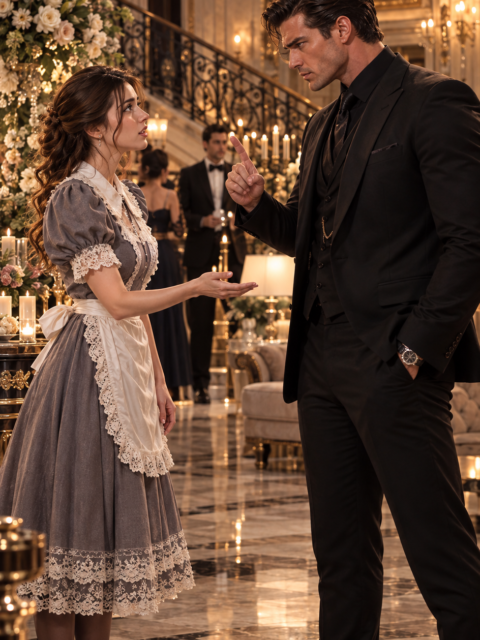
Broad shoulders. Tailored black suit. A scar cutting down one cheek. Dark ink covered his hands, including a black dragon curling across his knuckles. My mother’s warning flashed through my mind. “If you ever see men with dragons on their skin, Mara, walk the other way.” But I couldn’t walk away. Because my manager appeared beside me and whispered, “Table seven is yours.”
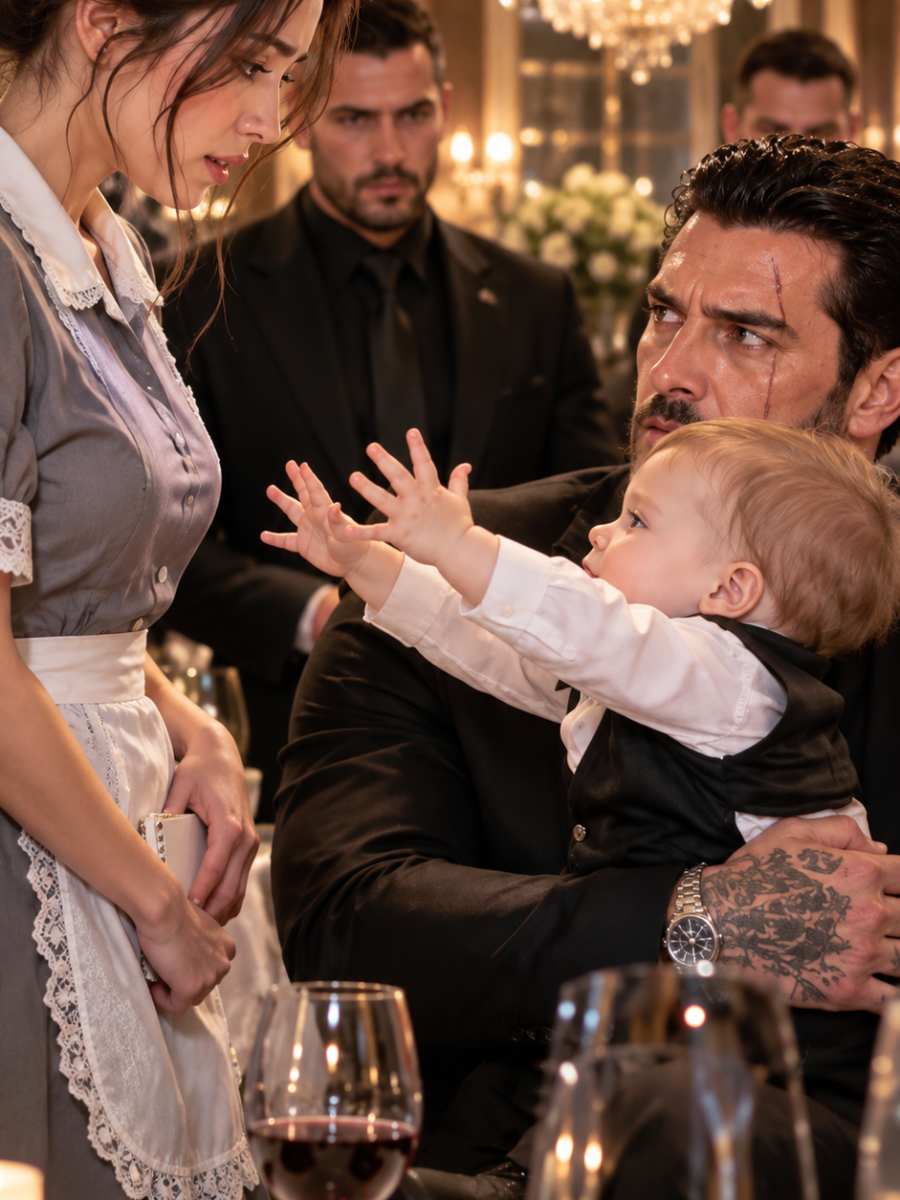
The man sat surrounded by bodyguards, but what stunned me was the baby resting against his chest. Maybe eight months old. Fair hair. Serious eyes. Tiny black vest over a white shirt.
I approached with my notepad trembling slightly. “Good evening. Can I get you something to drink?” The boss studied my name tag. “Mara,” he murmured. “Amarone. Water for the table. Milk for him.” “Yes, sir.” I turned to leave.
The baby suddenly reached for me. Both tiny arms stretched outward as he stared directly into my eyes. One bodyguard frowned. “That’s strange. He doesn’t like people.” His father pulled him closer. The baby cried. I leaned toward him instinctively. “Hey, it’s okay.” Instantly, he stopped. His whole face brightened. Then he lunged forward and grabbed my apron.
Everyone at the table froze. “He never does that,” another man whispered. The boss carefully loosened his son’s fingers, but the child immediately caught my thumb instead and refused to release it.
I should have been terrified. Instead, something about that tiny hand wrapped around mine made my chest ache.
“Hold him,” the boss ordered. I stared at him. “Excuse me?” “Hold my son.” There wasn’t exactly room for negotiation. “Okay. Just for a moment.”
I carefully took the baby. The instant his little body settled against my chest, he sighed deeply and rested his hand against my neck. Perfectly calm.
The mafia boss stared at us as though he were witnessing something impossible. “He doesn’t let anyone hold him,” he said quietly. “Not my men. Not his nannies. Not even my sister.” His expression changed. “Only…” I swallowed. “Only who?” “His mother.”
A chill ran through me. He leaned closer. “Tell me, Mara. Why is my son looking at you like that?” “I—I don’t know.”
Then my eyes drifted toward the mirror behind him. And I saw the photograph. A woman in a black dress hung framed above the wine bottles. Dark eyes. Same hair. Same nose. Even the tiny dimple beside her mouth was identical to mine. My breath stopped. She had my face.
The baby shifted against me while my fingers went numb. The boss noticed where I was staring. “You recognize her?” “No,” I whispered. “I’m just dizzy.”
His gaze moved slowly from me, to the photograph, then back again. For the first time, genuine shock cracked through his terrifying composure. He rose from his chair and stared at me as though a ghost had just walked into his restaurant.
“She died two years ago,” he whispered. Then his eyes dropped to the baby clinging peacefully to my chest.
When he looked back at me, his expression had changed completely. “Who are you?”
The Photograph
“I’m Mara Ferro,” I said, my voice unsteady despite every effort to keep it professional. “I’ve worked here for two years. I don’t know who that woman is, Mr.—”
“Conti,” he said, still staring at me with an intensity that made the baby in my arms feel like the only safe thing in the entire room. “Damiano Conti. That woman in the photograph was my wife. Elena.”
The name landed with no recognition at all, and yet something about the shape of it, the particular cadence, unsettled me in a way I couldn’t fully explain. “I’m sorry for your loss,” I said carefully, “but I promise you, I’ve never seen her before in my life.”
“Look at the photograph again,” Damiano said, his voice carrying a controlled urgency that made refusing feel considerably more dangerous than complying. I turned, forcing myself to study the framed image properly this time rather than glancing away from the uncanny resemblance.
Elena Conti smiled out from the frame with an expression I recognized, uncomfortably, as one I’d caught in mirrors my entire life — the particular way my own mouth tilted slightly higher on the left side, the exact placement of a small dimple I’d always considered simply mine.
“This is impossible,” I said quietly. “I don’t understand how a stranger could look this much like me.”
“Neither do I,” Damiano said, “which is exactly why I need you to answer some questions honestly, Mara, before either of us decides this is simply an extraordinary coincidence.” He gestured toward an empty chair at his table, an invitation that carried, given his reputation and the armed men surrounding him, considerably more weight than an ordinary dinner guest’s request. “Please. Sit.”
My manager appeared at the edge of my vision, clearly uncertain whether to intervene, and Damiano’s brief, dismissive glance sent him retreating without a word.
“Where were you born?” Damiano asked, once I’d settled into the chair, the baby — I would learn shortly his name was Leo — still contentedly nestled against my chest as though he had no intention of ever being returned to anyone else.
“I don’t know,” I admitted. “I was adopted as an infant. My parents, the people who raised me, never had much information about my birth family beyond a closed adoption processed through an agency in Naples.”
Damiano’s expression, already tense, tightened further. “Elena was also from Naples,” he said slowly. “Raised by a wealthy family, though she always spoke of her childhood with a certain careful distance I never fully understood until now.”
“What do you mean?” I asked, an uneasy premonition building in my chest. Damiano studied me for a long moment before answering, his voice carrying a weight that suggested he was working through the implications even as he spoke them aloud. “Elena mentioned once, only once, in the early days of our marriage, that her mother had been pregnant with twins. She said only one child survived the delivery, according to the story she’d always been told. Mara, I need you to understand — if that story wasn’t true, if there was in fact a second child who simply never came home with the family Elena grew up in, I think we may both be looking at exactly the explanation for why my son cannot stop reaching for your face.
No Known Family
The possibility settled over me with a dizzying, vertiginous weight — not simply an uncanny resemblance to a stranger, but the suggestion that I might be looking, for the first time in my life, at an actual, biological connection to someone who had shared my mother’s womb.
“I need to see my adoption records,” I said slowly, “properly, for the first time. I looked into it once, years ago, when I was eighteen and curious, but the agency told me the records were sealed and my birth mother had specifically requested no contact. I let it go after that. It seemed cruel to keep pushing against someone’s clear wishes.”
“I have resources considerably more capable of unsealing records than an ordinary request through official channels,” Damiano said, something in his controlled composure finally cracking into a rawer, more urgent hope than his earlier shock had shown. “If you’re willing, Mara, I would like to pursue this immediately. Not simply for my own curiosity — though I won’t pretend that isn’t part of it — but because if you are genuinely connected to Elena’s family, you may be the only living link my son has left to understanding where half of his own history actually comes from.”
I looked down at Leo, still settled peacefully against me, his small hand now curled loosely around a strand of my hair with the same contented ease he might have once shown his own mother. “I don’t know what to say,” I admitted. “Two hours ago, I was simply trying to survive a difficult shift and pay rent this month. Now you’re suggesting I might be connected to your entire family.”
“I understand this is overwhelming,” Damiano said. “I’m not asking you to accept anything immediately. I’m asking permission to investigate properly, so that neither of us is left wondering for the rest of our lives what an extraordinary coincidence might have actually meant.”
I considered the offer carefully, my own quiet, ordinary life suddenly poised on the edge of something I’d never once expected to encounter. “All right,” I said finally. “I want to know too. I’ve spent my whole life without answers about where I actually came from. If there’s finally a chance to understand that, I don’t think I could walk away from it now even if I wanted to.”
Damiano’s investigator, a careful, discreet woman named Renata who specialized, according to Damiano’s brief explanation, in matters requiring both legal precision and considerable delicacy, began work that same evening, and within three days, produced a preliminary finding that transformed uncertain speculation into devastating, confirmed fact: hospital records from Naples, dated to within days of both Elena’s and my own recorded birthdates, documented a set of twin girls born to a woman named Costanza Salerno — one child kept by the Salerno family, raised eventually as Elena Salerno before her marriage to Damiano, and one child, born second and smaller, given up for adoption within forty-eight hours under circumstances the hospital’s aging records described only briefly as “family arrangement, mother’s request.”
The Adoption Records
“Mother’s request,” I repeated slowly, sitting across from Damiano in his study as Renata laid out the documentation she’d carefully assembled. “Not financial hardship, not medical necessity. My birth mother chose to give me away specifically, while keeping my sister.”
“I want to be careful about drawing conclusions from incomplete records,” Renata said gently. “But given the specific wording, and given that the Salerno family was, by all historical accounts, quite wealthy at the time of your birth, financial hardship seems an unlikely explanation for separating twin daughters.”
“Then why,” I asked, old grief for a childhood spent wondering resurfacing with fresh, complicated pain, “would a wealthy family keep one twin and give away the other?”
Renata hesitated, clearly reluctant to voice a theory she hadn’t yet fully confirmed. “I have one more lead to pursue,” she said carefully. “Costanza Salerno passed away eleven years ago, but her sister, your and Elena’s aunt, is still alive, living in a care facility outside Naples. If anyone remaining might know the actual reason behind the separation, it would be her.”
The journey to Naples, undertaken within the week with Damiano insisting on accompanying me personally despite the considerable demands of his own business affairs, carried a tension neither of us fully acknowledged aloud — the possibility that whatever answers waited might prove considerably more painful than the uncertainty we’d lived with until now.
Elena and Costanza’s aunt, a frail but sharp-minded woman named Teresa, received us with a startled, emotional recognition the moment she saw my face, her hands trembling as she reached toward me across the small visiting room table.
“Costanza told everyone the second baby died,” Teresa said, once she’d recovered enough composure to speak clearly, tears already falling freely down her lined face. “I never believed it, not fully — I saw how carefully she avoided the subject, how she flinched whenever anyone mentioned it. I always suspected there was more to the story than a simple infant death, but I never had proof enough to challenge her directly, and family loyalty kept me silent for considerably longer than I’m now ashamed to admit.”
“Why would she lie about it?” I asked. “Why give one daughter away and claim she’d died, rather than simply telling the truth?”
Teresa’s expression carried a difficult, decades-old grief as she finally answered. “Because your grandfather, my own father, believed firmly that a family’s inheritance should never be divided between multiple heirs if it could possibly be avoided,” she said quietly. “Costanza was pregnant with twins at a time when our family’s shipping business was already being carefully positioned to pass to a single female heir upon her eventual marriage. Two daughters complicated that plan considerably — two potential husbands, two potential claims, two family lines to eventually manage. My father insisted, in a decision I have never forgiven him for, that only one child could remain in the family, and that the story told publicly would be considerably simpler if everyone believed the other twin had simply died at birth rather than been deliberately given away.
Why They Were Separated
The revelation landed with a particular, cold cruelty — not a tragic accident of circumstance, but a calculated decision, made by people I would never meet, treating my own existence as an inconvenient complication to be quietly erased from a family’s carefully managed inheritance plans.
“Did Elena ever learn the truth?” I asked, working to keep my voice steady despite the old, complicated grief the revelation had stirred.
“Not that I’m aware of,” Teresa said. “Costanza maintained the story of her daughter’s death until her own passing eleven years ago. I don’t believe Elena ever knew she had a twin sister living, somewhere, entirely unaware of the family she’d been separated from.”
Damiano, quiet through most of the difficult conversation, finally spoke, his voice carrying a controlled fury directed at people long since beyond any consequence he might have once delivered. “Elena spent her entire life believing herself an only child,” he said slowly, “raised inside a family built on a lie designed specifically to protect an inheritance neither she nor her sister ever had any say in dividing.”
“I’m so sorry,” Teresa said, reaching for my hand across the table with a tenderness that felt, despite decades of separation and silence, genuinely maternal in a way I’d never once experienced from anyone actually related to me. “I should have found you decades ago. I told myself the search would only cause pain, disrupting whatever life you’d built without the complications of a family that had already rejected you once. I understand now how wrong that reasoning actually was.”
The return journey to Milan passed in a heavy, contemplative silence, Damiano and I both processing a revelation that had answered one painful mystery only to reveal a considerably more devastating truth beneath it — Elena had died, two years earlier, never knowing she had a twin sister who might have offered her family, connection, and understanding she’d apparently spent her entire life without.
“I want to ask you something,” Damiano said, finally breaking the silence somewhere over the Tuscan countryside, “and I need you to consider it carefully, without any obligation to answer immediately. Given everything we now know — that you’re Elena’s biological twin, that Leo has responded to you the way he might have responded to his own mother — would you consider being part of his life going forward? Not replacing Elena. I would never ask that of you, or expect it. But as family, in whatever capacity actually feels right to both of us.”
Before I could answer, my phone buzzed with an alert from Renata, still working in Naples on remaining loose threads from the investigation, her message carrying an urgency that pulled my attention immediately away from Damiano’s question. “I found something in the hospital’s original delivery records,” her message read, “that I think changes our understanding of Elena’s death considerably. The same physician who delivered you and Elena twenty-eight years ago also happened to be the attending doctor who signed Elena’s death certificate two years ago — and reviewing his notes from that final examination, Mara, I don’t believe her death was as straightforward as the official cause has always suggested.
How Elena Died
Damiano’s expression, reading the message over my shoulder, hardened into something considerably more focused than the emotional weight of our earlier conversation had suggested. “What was the official cause of death?” he asked, though his tone suggested he already suspected the answer felt increasingly incomplete.
“Cardiac arrest,” he said slowly, answering his own question from memory rather than waiting for Renata’s report. “Sudden, unexpected, ruled natural given her family’s history of heart conditions. I accepted that explanation at the time because I had no reason to question it, and because grief left little room for scrutinizing details I assumed medical professionals had already handled properly.”
Renata’s full report, transmitted within the hour once she’d finished reviewing the physician’s original examination notes, revealed troubling inconsistencies the original investigation had apparently either missed or chosen not to pursue — elevated levels of a specific compound in Elena’s final bloodwork that the examining physician had noted as “unusual” but ultimately attributed to medication interactions rather than pursuing as a potential indicator of poisoning.
“I want this properly investigated,” Damiano said, his voice carrying the particular controlled fury I imagined had once made him genuinely feared throughout the city, now redirected entirely toward understanding a wife’s death he’d never once thought to question. “If Elena was murdered, two years after the fact or not, I want to know exactly who did it and exactly why.”
The forensic reexamination, conducted with resources considerably more thorough than the original investigation had apparently applied, confirmed within days that the compound identified in Elena’s bloodwork was consistent with a slow-acting cardiac toxin, administered over an extended period rather than in a single acute dose — a method specifically designed, the toxicologist explained, to produce exactly the kind of gradual, seemingly natural cardiac decline that had led the original examination to rule her death accidental.
“Someone poisoned her slowly,” I said, absorbing the full horror of what had actually happened to the sister I’d never had the chance to meet. “Deliberately, over time, specifically to avoid the kind of scrutiny a sudden, acute poisoning would have triggered.”
“I need to understand who had access to her regularly enough to administer a slow-acting toxin over an extended period,” Damiano said, already moving through the calculation with the same focused intensity he’d applied throughout the entire investigation. “That narrows the list considerably — household staff, close family, or someone within my own organization with regular, trusted access to our home.”
Renata’s continued investigation, tracing the toxin’s specific chemical signature against known suppliers and cross-referencing household staffing records from the period surrounding Elena’s death, produced a name within three days that made Damiano go completely, dangerously still. “Bruno Farelli,” she reported. “Your longtime financial advisor, Mr. Conti. Records show he purchased a compound matching this toxin’s chemical profile through a shell pharmaceutical distributor, six months before Elena’s death, using funds routed through an account he controlled personally rather than through your organization’s usual channels.
Bruno’s Ledger
Damiano’s shock at Bruno’s name gave way rapidly to a cold, methodical fury, the particular controlled stillness I’d come to recognize as considerably more dangerous than any visible outburst. “Bruno has managed my family’s finances for fifteen years,” he said. “He was present at our wedding. He held Leo the week he was born, before Leo apparently decided he would never again permit anyone but Elena, and now you, to hold him so easily.”
“Why would he want Elena dead?” I asked.
The answer, uncovered through a careful forensic audit of Bruno’s financial management over the preceding decade, revealed a motive considerably more mundane and considerably more damning than any dramatic betrayal — years of quiet embezzlement from accounts Elena, unlike Damiano, had apparently begun reviewing personally in the months before her death, her background in finance from her own upbringing giving her the specific expertise to notice discrepancies that had escaped Damiano’s attention entirely.
“She found it,” Damiano said slowly, reviewing the audit’s findings with a grief considerably sharper now that it carried the full weight of preventable betrayal rather than random tragedy. “She must have confronted him, or at minimum, gathered enough evidence that Bruno recognized his embezzlement was about to be exposed.”
Bruno Farelli, confronted directly once the evidence had been fully compiled, offered no meaningful defense once the forensic audit and toxicology findings were laid before him, his composure collapsing into a desperate, resigned confession that confirmed every detail Renata’s investigation had already uncovered.
“I never intended for it to go that far,” he said, his voice carrying none of the confident financial authority I imagined had characterized fifteen years of trusted service. “I told myself a slow decline would simply look like an unfortunate, natural tragedy. I never imagined the investigation would eventually reach far enough to expose exactly how it happened.”
“You murdered my wife,” Damiano said, his voice carrying a controlled finality that left no room for any response Bruno might have offered in his own defense, “to protect embezzlement you’d been committing for years, and you let me grieve her death as a random, natural tragedy while you continued managing my family’s finances as though nothing had happened.”
The resolution that followed unfolded through channels Damiano chose deliberately to keep considerably more legitimate than his organization’s usual methods of handling betrayal — full cooperation with law enforcement, comprehensive documentation of both the embezzlement and the murder, a decision Damiano explained to me quietly as owed directly to Elena’s own memory.
“She would have wanted this handled properly,” he said, “not through the kind of quiet, violent resolution my world usually demands. She spent her whole life inside a family that solved inconvenient problems by simply erasing them from the official record — you, most devastatingly of all. I’m not willing to solve her murder the same way her own family solved the inconvenience of having two daughters instead of one.”
Leo’s Family
Bruno Farelli’s arrest and subsequent conviction, reached through a legitimate trial that provided Damiano with a form of justice he’d never fully expected to seek so directly, closed the two-year mystery of Elena’s death with a clarity that, while devastating in its details, finally allowed genuine grieving to begin in place of unresolved, unexamined loss.
My own relationship with Damiano and Leo, meanwhile, grew steadily over the following months from an extraordinary coincidence into something considerably more permanent, my presence in their household evolving gradually from occasional visits into a role neither of us had fully planned but both, increasingly, found ourselves grateful for.
“He still won’t let anyone else put him to sleep,” Damiano told me one evening, watching Leo settle contentedly in my arms with the same easy trust he’d shown from our very first meeting at Ristorante Bellagio. “Not his nannies, not my sister, not even me most nights. Only you.”
“Maybe he simply recognizes something familiar,” I said, “even if neither of us can fully explain what that actually means, biologically or otherwise.”
“I think,” Damiano said carefully, “he recognizes exactly what the rest of us have been slowly, carefully discovering these past months. That family isn’t only the people history and biology hand us, or the people wealthy grandfathers decide to keep and discard according to inheritance convenience. Sometimes it’s simply the people who show up, consistently, and choose to stay.”
I thought of Teresa, finally reunited with the niece she’d spent decades wondering about, now a regular, warm presence in visits that had healed considerably more than either of us initially expected. I thought of Elena, a sister I’d never had the chance to meet, whose death had ultimately led me toward exactly the family connection her own life had been denied.
“I’d like to stay,” I told Damiano, watching Leo’s peaceful, sleeping face with a tenderness I hadn’t expected to feel this completely, this quickly, for a family I’d known only a handful of months. “Not simply as a resemblance to someone you lost, Damiano. As myself, building something new alongside both of you, for as long as that continues feeling like exactly where I belong.”
Damiano’s answering smile carried none of the terrifying composure that had once made an entire restaurant fall silent at his arrival — simply the quiet, grateful warmth of a man who had spent two years grieving an incomplete story, finally allowed to build something whole in its place.
“Then stay,” he said simply, reaching for my hand with the same gentle certainty his son had once shown reaching for my face across a crowded restaurant table. “Elena’s family tried to erase half of what she actually was, believing one daughter was simpler than two. I intend to spend considerably more care than that making sure Leo grows up understanding exactly how much richer his family actually became, the night his mother’s sister finally, impossibly, walked into our lives.”