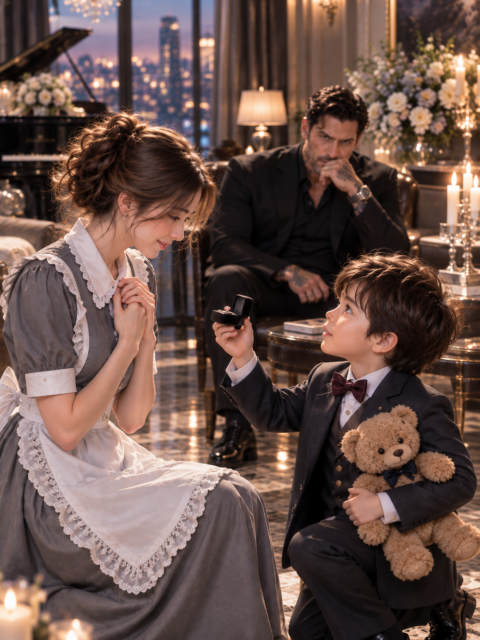
The Maid’s Little Girl Sent the Mafia Boss to Time-Out… Then the Whole Room Burst Out Laughing
I’m Roman Belucchi. Grown men change direction in hallways to avoid me. At 7:26 on a Wednesday morning, a three-year-old in a yellow sweater pointed one sticky finger at me and said, “Time out.” I sat down. Everyone laughed, except one man at my table, who had very good reasons not to. Read every chapter to see what a little girl noticed that my entire security team missed.
Three Minutes
“Time out.”
At 7:26 on a Wednesday morning, a three-year-old girl in a yellow sweater pointed one sticky finger at me, and the breakfast room at Belucchi House went so quiet I could hear the old clock ticking in the west hallway.
My name is Roman Belucchi. For eleven years I have run the family my father built on fear. I stood at the head of my own walnut table that morning in a black shirt with my sleeves rolled to the forearm, my cousin Daario across from me, two senior men from our legitimate businesses at his side, and a pot of coffee that had stopped steaming twenty minutes earlier. I hadn’t raised my voice. I never need to. My anger lives in the stillness of my face, and everyone in that room knew exactly what it looked like.
The girl copied it perfectly. She pulled her small eyebrows together, pressed her mouth into a line, folded her arms over her sweater, and tilted her chin the way I had been tilting mine for the last five minutes. One of the senior men suddenly found his coffee fascinating.
“You’re making the mean face,” she informed me.
In the doorway, a housekeeper named Elena Morales, holding a stack of linen that was never going to reach the second floor, went the color of the tablecloth. “Lucy,” she whispered. The child didn’t turn around.
“Mommy says people who make the mean face because they’re not using their words need a timeout,” Lucy explained, to the room.
Daario stared at her as though she’d walked in holding a live grenade. My security chief, Evan Hale, standing at the window with his hands folded, failed to hide the movement at the corner of his mouth. And I did something I would not have predicted an hour earlier. I took her seriously.
“Time out,” I repeated. My face gave away nothing. “How long does the sentence last?”
She considered this with the gravity of a judge. “Three minutes.”
“Is that because you’re three?”
“No.” Lucy shook her head with tremendous dignity. “Because you’re big.”
Evan coughed into his fist. I looked across the room at a small upholstered chair by the fireplace, put there years ago for an elderly aunt, absurdly delicate beside the rest of my furniture. Then, in front of my cousin, two managers, my head of security and a horrified housekeeper who was clearly calculating how long unemployment benefits take to process, I walked over and sat down in it.
Lucy nodded in approval. “Hands in your lap.”
I put my hands in my lap. That was when Evan laughed. The sound escaped before he could dress it as a cough, and within seconds one of the senior men followed, then the other, and even Daario’s expression cracked at the edges. Elena covered her mouth with both hands.
I looked around the room until the noise died. I saw Elena’s face in that silence. She was certain she was about to watch eleven months of careful work end in a single morning.
Then the corner of my mouth lifted, and Lucy pointed at it immediately. “There are no scary faces in timeout.”
The room broke all over again. For about ten seconds, the breakfast room at Belucchi House sounded like an ordinary place full of ordinary people laughing at something ridiculous. I couldn’t remember the last time it had.
I served my full sentence, ninety more seconds in a chair built for an old woman. But only one person at that table never laughed at all, and I’d remember that later.
Back to top ↑
The Incomplete Rule
That morning’s meeting was about a grocer named Levenson.
When Lucy declared my sentence served, I returned to the head of the table and picked up the document I’d been holding when she interrupted. Two of Daario’s men had visited Levenson’s market on Monday. Over a lease, Daario said, in a tone that suggested I should find this boring. A neighborhood relationship.
“Unnecessary pressure,” I said. I felt my jaw begin to tighten, and then across the room I heard Lucy draw a slow, audible breath. I looked at her. She was holding a bread roll the size of her face, and she was watching me with an expression of pure supervision. I let the tension out of my jaw on purpose, the way another man might loosen a tie.
“If the lease is bad, use a lawyer,” I said evenly. “If the owner doesn’t want to sell, you leave him alone. No visits to his house. No messages through his brother. No men waiting outside his business.”
Daario leaned back. “Roman, with respect, this family’s position in the city was built on pressure.”
“It was my father’s method. Not mine.”
“You enjoy the benefits while pretending to despise what created them.”
“Two years ago I told you collections, intimidation and private visits were finished.” I did not raise my voice. “If you can’t negotiate without frightening people, you have no business negotiating for me.”
The room went quiet again, but this time Lucy did not need to intervene. She had found the butter.
Elena stepped forward from the doorway. I noticed her hands first, still tight around the linen, and then her face, which was composed in the particular way of a woman who has rehearsed an apology in the elevator. “Mr. Belucchi, I’m very sorry. Her preschool closed unexpectedly. I had no backup, and I should have called Mrs. Keen before bringing her.”
I looked at her. She had been in my house eleven months. She ran the East Wing staff so quietly that I had to be told how well. “How many employees in this house have children?”
She blinked. “I don’t know.”
“Mrs. Keen would know.” I turned to Evan. “Have her put together numbers on emergency child care for household staff.”
Daario made an impatient sound. I ignored it. Elena stared at me.
“Sir, I’m not asking you to create a policy because I broke one.”
“You broke a rule because the policy assumes our employees don’t have emergencies,” I said. “That makes the rule incomplete.” And when she reminded me that this still didn’t make her choice appropriate, I agreed, and said it wasn’t the same thing.
“Can I have butter?” Lucy asked, holding up half a roll.
I pointed at the sideboard. “Apparently the court is still in session.”
Elena smiled before she could stop herself. I saw it, and something unfamiliar moved in me. It was not warmth, exactly. It was interest.
“Take the morning,” I told her. “Work from the family sitting room near the kitchen. Keep her with you.”
“I can still finish the East Wing.”
“I know.” I hadn’t treated her like a fragile thing. I had simply changed the conditions so she could do the work, and I watched her understand the difference.
As she led Lucy out, Daario murmured at my shoulder, too quietly for anyone else. “Cute child. Where does the mother’s family live, again?”
Back to top ↑
The Family Sitting Room
I told myself the question meant nothing. Daario asked questions about everyone. It was one of the reasons I had kept him close for so many years.
But I went down to the family sitting room at noon anyway, ostensibly to see whether Mrs. Keen’s assignments had been adjusted. I found Elena on the floor with a laptop balanced on an ottoman and Lucy sitting across from her at a low table, feeding a stuffed rabbit a piece of toast with enormous seriousness. Elena looked up and began to stand.
“Please don’t,” I said.
She stayed on the floor. Lucy offered me a crayon.
“What is this?” I asked, accepting it.
“A rule paper.” Lucy slid a sheet across the table. It showed a large scribble with a smaller scribble beside it and a purple blob between them. “That’s you, and that’s Daddy Evan, and that’s the grumpy man’s face.”
“Which grumpy man?”
“The one at breakfast. He says bad words in the garage.”
Elena inhaled sharply. “Lucy, honey, that’s not—”
“It’s all right.” I kept my voice casual and crouched, which put me on eye level with her, which put me in the carpet’s line of fire. “When did you hear him?”
“When I was lost,” Lucy said. “I went with the crayons. He was on the phone. He said the grocery man was too stubborn and that someone would have to be, um.” She searched for the word. “Persuaded.”
Elena put her hand over her mouth.
I said nothing for a moment, because the man everyone in this city fears had just been given a piece of evidence by a girl with butter on her chin. I didn’t want to frighten her by what my face might do. I thought of the chair by the fireplace and the three minutes I’d served.
“Thank you, Lucy,” I said. “That was a very helpful rule paper.”
Elena stood after all. She put a hand lightly on my arm, the first time any employee had touched me in years, and stopped. She seemed to realize it a moment too late. “Mr. Belucchi,” she said very quietly. “I haven’t been telling you everything.”
“I know,” I said.
“How?”
“Because you tried to hide your phone when I walked in, and you haven’t taken your eyes off the door since. Someone has been pressuring you.” I held her gaze. “And you haven’t reported it, because you were afraid it would cost you the job.”
She said nothing. That was an answer.
“Tonight,” I said. “After Lucy’s asleep. We talk.”
I found Evan in the hall and told him to pull everything on my cousin’s phone records for the past ninety days. He looked at me, and for once didn’t ask why. “It’s already on your desk,” he said. “I was going to wait until after your meeting.”
Back to top ↑
What Lucy Heard in the Garage
Evan’s folder was eleven pages thick, and every page had my cousin’s fingerprints on it.
Daario had been negotiating privately with a developer named Pike for fourteen months. His plan was simple: buy the old market district block by block, force the holdouts out by pressure, and sell the land to Pike at triple price. Levenson was the last holdout on the corner. Daario’s men had been making visits to Levenson’s home, leaving notes with his brother, and parking outside his shop in the evening, every one of them against a rule I had given in person and in writing.
It was worse than disobedience. The phone log made it plain that Daario hadn’t merely disobeyed me. He had been waiting for me to look weak. A boss who sat in a child’s chair on camera, so the story would go, was a boss who could be replaced. Pike’s money was already earmarked for a coup.
That evening I took the folder to the sitting room, where Elena had put Lucy to sleep on a pile of cushions under a coat. I sat across from her in the amber light and put it between us. “Tell me,” I said, “what you haven’t been telling me.”
She took a breath. “Daario’s driver stopped me at the service entrance three weeks ago. He said Mr. Daario had noticed how hard I work. He said I should keep my eyes open and let him know when you’re in the house, and who you meet with, and what you say. He said it would be worth a bonus. A big one.”
“And?”
“I said no.” She laced her fingers. “He came back last Friday. He said my brother Marco works at the Harbor Street warehouse, which Daario’s company supervises. He said it would be a shame if Marco lost his shift. He said the same about my apartment, which is rented through a building you own.”
“Why didn’t you come to me?”
“Because you’re the one man in the city who could have fired me for speaking up, and I have a daughter.” Her voice shook for the first time. “And because I didn’t know who I could trust. Everyone in this house reports to someone. I thought if I said no and stayed quiet, it would stop.”
“It didn’t,” I said.
“No.”
I looked at the sleeping child, at the small hand curled under the coat, at the mother who had refused a fortune and said nothing so that her family would stay safe. I thought of how many men in my organization would have taken the money. I thought of how many had.
“You said no twice,” I said. “To a man who could ruin your brother, and with no one to tell. I’d like to be worthy of that.”
Elena looked down at her hands. “You are,” she said. “I think. A little more every day.”
I had barely stood to leave when Evan’s voice came over the radio, flat and fast. “Roman. Daario’s car just left the estate. Two men with him. They’re heading toward the east side. They’re heading toward Lucy’s preschool.”
Back to top ↑
The Offer Elena Never Mentioned
The school wasn’t open, and Daario knew it. That was the point.
I realized it in the car, with Elena’s hand locked around mine so hard I felt the bones. Daario had no intention of taking a child. He wanted leverage, a way to prove he could reach what I had begun to protect, and an excuse to tell the other families I’d gone soft over a maid and her daughter. The preschool was only the place where he would stage the message. If he couldn’t find Lucy, he would find her mother’s brother instead.
“Marco,” Elena said. She was already dialing. “Marco, where are you?” She listened, and her face fell. “Don’t go to the warehouse tonight. Stay with your coworkers. Don’t open the door for anyone. I’ll explain.”
“What did he say?” I asked when she hung up.
“Two men came to the dock at nine and told him there was an issue with his paperwork. He’s locked himself in the office.” She stared out of the window, steadier than anyone had a right to be. “I should have taken the money, Roman. I’m sorry. I should have said yes and quietly told you everything. If I had, nobody would be in danger.”
“You did the one thing that was right,” I said. “You didn’t become what he wanted.”
She turned from the window. For the first time, I saw something other than fear in her face. I saw trust. It was heavier than any weapon I had ever carried.
I left Lucy in the back seat, asleep in her mother’s coat, with Evan’s second-best driver and a guard I would have trusted with my own life. Then I turned to Elena and did something I’d never done in front of an employee. I asked her to help me.
“Call Daario’s driver,” I said. “Tell him you’ve changed your mind.”
She understood at once. It was a gamble, using her as bait in front of the man who had threatened her family, and I would have refused it from anyone else. But when I told her what I needed, she held out her hand for the phone before I finished the sentence.
“Tell him,” I said, “that I’m in the east sitting room at midnight, alone, with the ledger.”
There was no ledger. There was only a trap, and the one man in my family who wanted my chair badly enough to walk into it.
The call connected. Elena’s voice was smooth and low, a performance so perfect I forgot for a second that it was one. And at the other end of the line, the driver said, “Mr. Daario will be there himself.”
Back to top ↑
The Man Outside the Preschool
I have waited for enemies in a dozen rooms. I’d never waited in one with a crayon drawing taped to the mantel.
It was Lucy’s. She had given it to me before she fell asleep, with great ceremony, and I hadn’t had the heart to put it in a drawer. Under the lamp, the rule paper looked less like a child’s scribble and more like a map: three figures standing in a row, a grumpy face, and a big purple blob in the middle that I decided to believe was a heart.
Midnight arrived. Daario came alone, as I’d asked. Behind him, at the end of the hall, his two men waited by the door with their hands in their jackets. He stepped into the sitting room in a gray suit, smiling the smile of a man who believed he’d already won.
“Roman,” he said. “It’s late for ledgers.”
“It’s late for a lot of things.” I gestured to the chair across from me. “Sit.”
He didn’t. He glanced around the room. “Where’s the maid?”
“Gone home. She was frightened. I understand someone offered her a bribe.”
“Roman, whatever she told you—”
“She told me you wanted to know when I’m in the house, and who I meet, and what I say. She told me you threatened her brother’s job and her apartment.” I leaned back. “She told me you asked where her family lives.”
His smile thinned. “She’s a servant with an imagination. You’re taking her word over mine?”
“I’m taking a three-year-old’s word over yours,” I said. “She heard you in the garage on the phone with Pike.”
The air changed. For the first time since he’d come into the room, my cousin looked afraid, not of the child, but of what a child can see. People like Daario do not hide things from children because they respect them. They hide things from adults because adults are afraid. A little girl had simply walked into a garage and heard what the rest of us were too frightened to notice.
“You’re sentimental,” Daario said, and the mask dropped. “You always were. Your father would have been ashamed of you, sitting in a child’s chair while the whole city laughed.”
“They weren’t laughing at me,” I said. “They were laughing with me. It was the first honest thing that room has heard in years. You wouldn’t recognize it.”
He nodded to his men. They stepped forward, hands out of their jackets, and I did not move.
“Before you do that,” I said, “you should look behind you.”
Evan Hale was standing in the doorway with thirty armed men. And at the top of the stairs, holding Elena’s hand in her yellow sweater, with a stuffed rabbit under one arm, a very small voice said, “Roman, is the grumpy man in trouble?”
Back to top ↑
Using Your Words
Daario’s men put their hands up. They’d been loyal to my cousin for money, and they were not eager to be loyal to him at gunpoint.
I took the phone from my pocket and set it on the table. A recording was playing: Daario’s voice, two hours earlier, to Pike’s lawyer. It was all there. The block purchases, the threats, the plan to remove me from power. Evan had recovered his call logs, his bank transfers, and the notes his driver had made about Elena. I had spent the evening not on a trap, but on a file.
“What are you going to do?” Daario asked. His voice had gone rough. “Shoot me in front of the child?”
It was the question my father would have answered with a pistol. I felt the old weight of it settle on my shoulders, the family tradition that said a man’s crimes must be answered in kind. I thought of my chair by the fireplace. I thought of three minutes.
“No,” I said. “I’m going to use my words.”
It took six hours. At dawn I called every head of the Belucchi family businesses into the east room and laid out the file in front of them. I told them what Daario had done, and what I intended to do about it. The men who had followed my father listened without moving. When I finished, the old consigliere, a man in his seventies named Adriano, put down his cup and said, very softly, “We’ve waited a long time for you to say that.”
Daario was removed from every position. His shares were sold to cover damages to the families he had threatened, beginning with Levenson. His men were handed to the state police along with my cooperation in a case against Pike and the developer’s network, which resulted in eleven indictments by the following spring. My cousin stood trial and received nine years. He never spoke to me again.
Levenson kept his corner. I visited his market myself, alone, in a plain coat, and bought a bag of apples. “Sir,” he said, hands trembling, “I didn’t think it would end.”
“It ended because a three-year-old noticed,” I said. “Next time, call me. I mean it.”
Elena’s brother kept his shift, and then got a better one. Her apartment lease was quietly rewritten so it could never be taken from her. When she tried to thank me, I told her there was nothing to thank. She had refused a bribe twice while terrified. In a family like mine, that is rarer than courage.
I thought the story had ended there. Then, one month later, a small envelope arrived on my desk, written in careful crayon: an official summons from the court of Lucy Morales.
Back to top ↑
The Smallest Chair in the House
The summons was real. It required the defendant’s presence in the family sitting room at 7:26 on a Wednesday morning, to answer for the crime of “scary face.”
I arrived on time. I was in a black shirt, sleeves rolled, and I stood in front of Lucy’s table while she held a wooden spoon like a gavel. Elena stood behind her, one hand over her mouth, shaking with laughter she was trying and failing to hide. My security chief stood at the window. He had made a point of being there.
“Mr. Roman,” Lucy said, “you made the scary face at the grumpy man’s lawyer yesterday.”
“I did,” I admitted. “It was a very bad lawyer.”
“Time out.”
I sat in the small chair. I put my hands in my lap. Evan, from the window, did not even bother with a cough.
The new household policy had been signed three weeks earlier. Mrs. Keen put it together with surprising enthusiasm: an on-site child care room on the first floor for the children of staff, run by two licensed teachers and furnished by a committee of employees who had very strong feelings about carpet. It opened on a Monday. The first child through the door was Lucy, in the same yellow sweater. She walked straight to the smallest chair in the room, patted it, and announced that it was reserved.
The employees named it The Lucy Room before I could object. I did not try very hard.
Elena was promoted that spring. She was running the household staff by summer, and she was running it better than anyone had before her. She stopped calling me “sir” around the same time. I stopped needing her to. We began having coffee after meetings, then breakfast on Sundays with Lucy in the middle, and then one evening in the garden, when she laughed at something I said and I realized I was not thinking about my father at all.
“You know she’s going to give you a hundred of these,” Elena said, nodding at the chair.
“I’ve counted.”
“And?”
“I’d sit in all of them.”
She looked at me for a long moment. Then she took my hand, in front of the whole sunlit garden, the first time either of us had done it in daylight.
“Sentence served,” Lucy called from the swing set, without looking up.
“Of course,” I said. And I sat there for a little longer anyway, in the smallest chair in the house, listening to the laughter in my home, and I understood at last what my father never had. The room had never been afraid of me. It had been waiting for a reason to laugh.
Read Next